A DTC brand scaling past $15M on Shopify rarely struggles to find Shopify marketing tools. The Shopify App Store hosts over 18,000 apps, and a serious operation typically runs eight to twelve simultaneously: email, SMS, loyalty, reviews, pop-ups, SEO, attribution, paid ads.
The problem surfaces when the CFO wants to know which channels drive profitable revenue after fulfillment costs, returns, and COGS, and not one of those twelve tools can produce that answer.
This guide covers 15 tools across six categories, each with pricing, honest limitations, and a clear best-use-case. The brands pulling ahead have connected their execution tools to a data foundation where every marketing dollar traces to contribution margin, turning a pile of point solutions into a single system of record for growth decisions.
Is your data actually Decision-Grade?
9 questions. 3 minutes. Score your Profitability Visibility and Readiness for AI-driven growth.
Start Free Diagnostic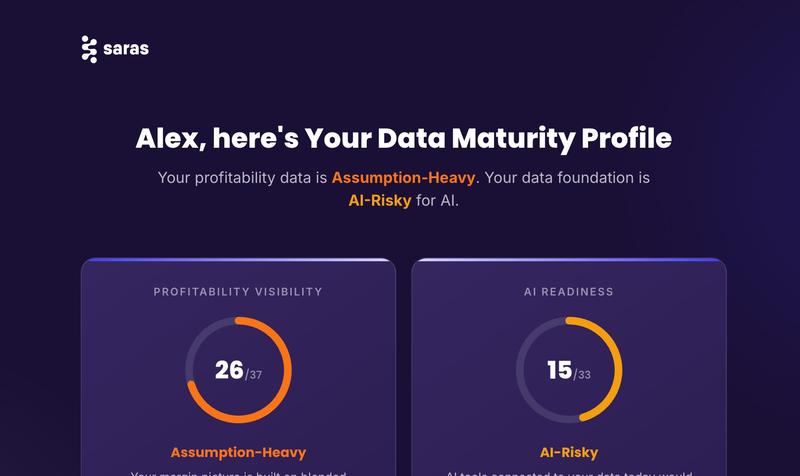
How to Use This Guide: A Note on Stack Architecture
Organize your Shopify marketing stack in three layers:
- Execution tools (email, SMS, paid ads, SEO, social) to drive traffic and conversions.
- Retention tools (loyalty programs, reviews, referrals, CRO) to extend customer lifetime value.
- An intelligence layer (analytics, attribution, contribution margin visibility) that connects everything and tells you which execution and retention tools are generating profitable outcomes.
.svg)
The sections below cover Shopify marketing tools across all three layers, starting with intelligence. That ordering is deliberate. The measurement layer shapes how you evaluate every tool that follows.
Shopify Marketing Tools for Analytics and Data Intelligence
Your marketing tools are only as valuable as your ability to measure what they produce. Shopify Analytics plus GA4 tells you sessions and revenue. However, neither can connect ad spend to contribution margin, identify which acquisition cohorts retain at 90 days, or show you why ROAS looks strong while profit margin is shrinking. The tools in this section close that gap.
Saras iQ: Best for Unified Marketing Intelligence and Profitability Analytics
Saras iQ sits above the execution stack as the data foundation that answers one of the most important questions in eCommerce marketing: which channels drive contribution margin, not just revenue. While attribution tools can show where revenue originates, they often struggle to provide visibility into contribution margin by channel after accounting for COGS, fulfillment costs, returns, and other variable expenses.
Consider a brand spending $40K/month on Meta. Triple Whale shows 4x ROAS. But when you layer in COGS, fulfillment costs to the West Coast, a 22% return rate on the hero SKU, and affiliate commissions that sit outside the ad platform, the profitability picture changes significantly. That gap between reported ROAS and actual margin is where $10M or $15M+ brands discover they've been over-investing in channels that look strong on the dashboard but erode profit after variable costs.
Saras iQ covers multi-touch attribution with first-party focus, tracking podcasts, TV, affiliates, and influencers alongside paid digital channels with custom channel weighting that matches your actual business model. Cohort-level LTV by acquisition channel identifies which sources bring customers who come back, not just customers who convert once.
Saras iQ adds a conversational AI layer that answers marketing questions in plain English, with every answer traceable to certified data. Underneath, Saras Daton connects over 200 data sources, including Shopify, Amazon, paid media, 3PL, and ERP systems, so the analytics layer never works from incomplete information.
Best for: Shopify brands at $15M+ running multiple channels that need unified analytics connecting marketing execution to actual profitability.
Weezie, a DTC towel and sleepwear brand, used Saras to achieve a 20% lift in paid search performance and 1.7x improvement in social attribution accuracy by replacing platform-reported metrics with unified first-party measurement. Read the full case study →
Triple Whale: Best for Shopify-Native Marketing Attribution
Triple Whale is the most widely adopted independent attribution tool for Shopify DTC brands, with over 50,000 stores running its first-party Triple Pixel to track customer journeys independent of platform-reported numbers. It delivers blended ROAS, CAC, and creative performance across Meta, Google, TikTok, and email in a single dashboard. The Moby AI assistant handles natural-language queries for daily performance checks.
Triple Whale is Shopify-only, the attribution methodology is proprietary with limited transparency into how it weights touchpoints, and financial depth (margin, COGS, fulfillment) is limited. For brands spending under $50K/month on ads that need fast, accessible attribution without enterprise complexity, it is the right starting point.
Pricing: From $219/month. Free version available.
Polar Analytics: Best for Custom Unified Dashboards
Polar Analytics combines multi-touch attribution with fully customizable reporting dashboards, letting teams design the exact views they need rather than working within pre-built reports. It pulls from ad platforms, email tools, GA4, and Shopify, normalizing everything into consistent metrics.
It is better suited to data-driven teams that want to build their own analytical views than operators who need ready-made answers. The customization is a strength if you have an analyst on staff and a limitation if you don't.
Pricing: Custom pricing based on GMV and selected products.
| Tool | Ideal Revenue Stage | Requires Analyst? | Free Tier |
|---|---|---|---|
| Saras iQ | $15M+ (critical at $20M+) | No (managed data service included) | No |
| Triple Whale | $1M–$50M | No | No |
| Polar Analytics | $5M+ | Yes (to maximize value) | No |
Shopify Marketing Tools for Email and SMS
Email marketing delivers an average return of $36 for every $1 spent (Litmus, State of Email), making email and SMS the highest-ROI channels in any DTC stack. The category choice comes down to three things: automation depth, segmentation sophistication, and whether SMS is included or costs extra.
Klaviyo: Best for Sophisticated Email and SMS Automation
Klaviyo is the standard choice for DTC brands past $5M on Shopify. Real-time Shopify data sync with millisecond latency, predictive analytics including expected next order date, churn risk score, and predicted LTV, plus an AI-powered Marketing Agent for campaign and flow creation. Advanced segmentation combines behavioral, demographic, and predictive filters across 350+ integrations. SMS is available as a paid add-on.
The trade-off is cost. Pricing scales quickly with list size, SMS adds a separate fee beyond 150 free credits, and the platform's depth can overwhelm smaller teams without a dedicated email operator. Klaviyo earns its place when you have the team bandwidth to use the segmentation, not just pay for it.
Pricing: Free up to 250 contacts; paid plans scale with list size.
Omnisend: Best for Combined Email and SMS at Lower Cost
Omnisend is the most direct Klaviyo alternative. It offers integrated SMS capabilities, with pricing depending on plan type and messaging volume. The workflow builder is more intuitive than Klaviyo's for many operators, and the pricing trajectory is significantly flatter as your list grows.
Where it falls short: segmentation depth and predictive analytics at the top tiers do not match Klaviyo. For brands under $5M that want strong multi-channel automation without Klaviyo's pricing curve, or for any brand where SMS is a primary channel rather than an add-on, Omnisend delivers better economics.
Pricing: Free up to 250 contacts; paid starts from $20/month.
Shopify Email: Best Free Starting Point
Shopify's native email tool gives you 10,000 free emails per month with drag-and-drop editing and native data sync. Rated 4.7/5 on the App Store with 3,000+ reviews, it covers the basics of email marketing for stores under $500K without a third-party subscription.
The ceiling is low: no A/B testing, limited segmentation, weak deliverability at scale, and basic analytics. Think of Shopify Email as the validation tool. Use it to confirm email drives revenue for your brand, then graduate to Klaviyo or Omnisend when your list and operational complexity justify the investment.
Pricing: Free for the first 10,000 emails/month; $1 per 1,000 after.
| Tool | SMS Included? | Predictive Analytics | Ideal List Size | Learning Curve |
|---|---|---|---|---|
| Klaviyo | Add-on (paid) | Yes (LTV, churn risk, next order date) | 5,000+ | Steep (dedicated operator recommended) |
| Omnisend | Yes (in paid plans) | Basic | 1,000–50,000 | Moderate |
| Shopify Email | Basic SMS via Shopify Messaging | No | Under 5,000 | Low |
Shopify Marketing Tools for Social Proof, Reviews, and Loyalty
Customer acquisition costs across eCommerce have climbed over 60% in the past five years, driven by iOS privacy changes, ad auction inflation, and more brands bidding on the same keywords. That makes the retention layer of Shopify marketing tools — reviews, loyalty, and referrals — a direct margin lever rather than a nice-to-have line item.
Yotpo: Best All-in-One Reviews, Loyalty, and Referral Platform
Yotpo consolidates reviews, loyalty programs, and referrals into one platform instead of requiring three separate apps with three separate data silos. AI-driven review collection generates up to 6x more reviews than manual requests, and those reviews can be syndicated to retail partners like Target and to Google Shopping.
The loyalty module supports tiered VIP structures and gamified rewards. Photo and video reviews function as shoppable social proof through the built-in UGC engine. For brands where trust signals and repeat purchase programs are central to the growth strategy, Yotpo reduces tool fragmentation while keeping review, loyalty, and referral data in one place.
Pricing: Free to install; paid from $85/month (Starter plan), scaling with order volume.
Smile.io: Best for Straightforward Loyalty Programs
Smile.io is the most widely used loyalty app in the Shopify ecosystem: simple setup, reliable points-for-purchase mechanics, and referral programs that work without heavy configuration. It does not match Yotpo's tier structure or analytics depth, but it launches faster and requires less ongoing management.
If your team has the bandwidth for Yotpo's full suite, that is the more complete option. If you need loyalty live this quarter with minimal overhead, Smile.io gets you there.
Pricing: Free tier available; paid from $79/month.
Foursixty: Best for Shoppable UGC from Instagram and TikTok
Foursixty turns Instagram and TikTok content into shoppable galleries embedded on product pages and across the storefront, connecting organic social proof directly to conversion. Where Yotpo's strength is text reviews and loyalty mechanics, Foursixty is purpose-built for brands where visual social content is the primary trust mechanism.
Many visually-led brands run both Yotpo for reviews and loyalty, and Foursixty for shoppable UGC. The overlap is minimal because they serve different parts of the conversion path.
Pricing: From $90/month.
| Tool | Reviews | Loyalty | UGC/Social | Referrals | Best Pairing |
|---|---|---|---|---|---|
| Yotpo | Yes (AI-collected, syndicatable) | Yes (tiered VIP) | Yes (photo/video) | Yes | Standalone or + Foursixty for social UGC |
| Smile.io | No | Yes (points + referrals) | No | Yes | + Yotpo or Okendo for reviews |
| Foursixty | No | No | Yes (Instagram/TikTok galleries) | No | + Yotpo or Smile.io for loyalty |
Shopify Marketing Tools for Paid Ads and Creative Intelligence
Paid media remains the primary acquisition channel for DTC brands on Shopify, but platform-reported numbers have grown less reliable with each iOS privacy update. For DTC brands where paid media drives 40-60% of new customer acquisition, the right tools for ads management can meaningfully shift CAC economics.
Madgicx: Best for Meta Ad Automation and Creative Intelligence
Madgicx combines AI-powered ad buying with creative analytics, surfacing which creatives are fatiguing, which audiences are underserved, and where budget should shift. Its Creative Insights module shows performance across all Meta placements, making it particularly strong for brands running 20+ active creatives simultaneously.
The limitation is scope. Madgicx focuses almost entirely on Meta. Cross-channel visibility across Google, TikTok, and programmatic is limited, so brands running significant spend across multiple platforms will still need a separate attribution or analytics layer to see the complete picture.
Best for: Meta-heavy brands running $20K+/month in ad spend with large creative libraries. Pricing: From $45/month (Starter plan).
UpPromote: Best for Affiliate and Influencer Marketing Programs
UpPromote is the top-rated affiliate marketing app on the Shopify App Store (4.9/5, 3,383 reviews), letting brands build commission-based affiliate and influencer networks directly within the platform. It handles creator recruitment, referral tracking, and automated payouts without custom development.
For brands where word-of-mouth, creator partnerships, or influencer-driven traffic represent a meaningful acquisition channel, UpPromote turns that channel into a measurable, scalable program rather than a collection of manual arrangements and one-off payments.
Best for: Brands scaling affiliate and influencer programs without custom dev work. Pricing: Free to install; paid from $29.99/month.
| Tool | Channel Focus | AI/Automation | Recommended Minimum Spend | Best Integration Pairing |
|---|---|---|---|---|
| Madgicx | Meta (primary) | Yes (bid optimization, creative fatigue detection) | ~$20K/month on Meta | Triple Whale or Saras iQ for cross-channel view |
| UpPromote | Affiliate/Influencer | Yes (payout automation, tracking) | No minimum | Klaviyo for nurture sequences to affiliate-acquired customers |
Shopify Marketing Tools for SEO and Organic Traffic
SEO compounds in ways paid channels cannot. Every optimized page and every fixed technical issue continue generating traffic without incremental spend. In 2026, Shopify SEO increasingly includes optimizing for AI search surfaces like ChatGPT, Perplexity, and Google AI Overviews, where product discovery is shifting. Brands that invest in structured, authoritative content now will own awareness that paid-only strategies cannot replicate.
Plug In SEO: Best for Automated On-Site SEO Monitoring
Plug In SEO is the most widely used Shopify SEO app, automatically auditing meta tag gaps, broken links, and structured data errors with fix-it guidance that does not require developer involvement. For stores that want organic traffic improvement without hiring an SEO agency, it covers the technical hygiene layer.
The ceiling is surface-level SEO. Plug In SEO handles on-page issues well but does not address site architecture, Core Web Vitals in depth, content strategy, or the generative engine optimization (GEO) work required to appear in AI search results. It's the floor of SEO, not the ceiling.
Pricing: Free tier available; paid from $29.99/month.
Modash: Best for Influencer Discovery and UGC at Scale
Modash is an influencer intelligence platform with a database of 250M+ creator profiles and audience analytics, enabling Shopify brands to find, vet, and manage micro to macro influencer campaigns without manual outreach overhead.
Where Modash connects to organic growth: influencer content generates backlinks, PR coverage, and referral traffic that improve domain authority over time. For brands where influencer partnerships serve both acquisition and organic authority, Modash turns creator management into a system rather than a spreadsheet of DMs and PayPal transfers.
Best for: Brands where influencer content drives both social proof and organic authority. Pricing: From $199/month.
| Tool | SEO Type | Addresses AI/GEO Search? | Requires Developer? | Time to Impact |
|---|---|---|---|---|
| Plug In SEO | Technical and on-page auditing | No | No | 2–4 weeks for quick fixes |
| Modash | Off-page (authority via influencer content) | Indirect (builds domain authority) | No | 3–6 months (compounding) |
Shopify Marketing Tools for Conversion Rate Optimization
CRO improves the return on every other Shopify marketing tool in your stack. A 10% improvement in conversion rate means 10% more revenue from the same traffic and the same ad spend. These two tools target different moments in the buyer journey: one captures visitors before they leave, the other extracts additional value after they buy.
Wisepops: Best for Pop-ups, Banners, and Email List Building
Wisepops powers on-site pop-ups, announcement bars, and gamified email capture. Deep Shopify integration enables targeting by cart value, purchase history, or browsing behavior, so pop-ups fire based on actual shopping signals rather than generic page views.
The best use case is list-building: capturing email and SMS subscribers from traffic you are already paying for. Every visitor who leaves without subscribing is acquisition spend that generated a single touchpoint instead of an ongoing relationship.
Pricing: From $99/month.
ReConvert: Best for Post-Purchase Upsells and AOV Lift
ReConvert optimizes the Shopify thank-you page, turning a dead-end confirmation screen into a revenue opportunity through product recommendations, upsell offers, and subscription prompts. Users report an average AOV lift of 15%, which is incremental revenue from traffic that has already converted.
For brands with natural cross-sell opportunities (skincare routines, subscription upgrades, complementary accessories), ReConvert captures value that would otherwise require a separate email touchpoint days later.
Pricing: Free for the first $500 in upsell revenue; paid from $4.99/month.
| Tool | Conversion Mechanism | When It Fires | Revenue Type | Setup Complexity |
|---|---|---|---|---|
| Wisepops | Pop-ups, banners, gamified capture | Pre-purchase (on-site browsing) | List growth leading to future revenue | Low to moderate |
| ReConvert | Thank-you page upsells and recommendations | Post-purchase (confirmation page) | Immediate AOV lift | Low |
How to Build a Shopify Marketing Stack That Compounds
Stack decisions follow a simple test: at your current revenue stage, which layer has the highest return on the next dollar invested?
Consider a $15M apparel brand running seven Shopify marketing tools simultaneously: Klaviyo, Triple Whale, Yotpo, Smile.io, Wisepops, Madgicx, and Plug In SEO. Monthly subscriptions total around $2,500. The expensive part is the marketing decisions being made without knowing which of those seven tools is driving profitable acquisition versus generating activity that looks productive on a dashboard but erodes margin after variable costs.
Watch for this signal: If your marketing team reports ROAS above 3x but your finance team cannot confirm those same channels are profitable after fulfillment and returns, the gap you need to investigate is your data architecture. That is the inflection point where an intelligence layer stops being optional.
| Revenue Stage | Recommended Stack | Primary Focus | Why This Stack Works |
|---|---|---|---|
| Under $500K | Shopify Email, Plug In SEO, Smile.io | Email, Organic Traffic, Retention | A low-cost foundation that covers the highest-ROI channels while validating product-market fit and building an initial customer base. |
| $500K–$5M | Klaviyo or Omnisend, Triple Whale, Yotpo, Wisepops, UpPromote | Email/SMS, Attribution, Reviews & Loyalty, List Building, Affiliate Marketing | Provides the core growth infrastructure needed to scale acquisition, retention, and measurement without excessive complexity. |
| $5M–$20M | Everything above, plus Madgicx, Polar Analytics, and Saras iQ | Paid Media Optimization, Custom Analytics, Profitability Intelligence | At this stage, the cost of poor measurement often exceeds software costs. Saras iQ adds contribution margin visibility, cohort LTV analysis, and SKU-level profitability to guide investment decisions. |
| $20M+ (Omnichannel) | Saras iQ, Saras Daton, Saras iQ, plus existing execution tools | Enterprise Data Intelligence & Unified Reporting | Creates a centralized data foundation across Shopify, Amazon, wholesale, paid media, ERP, and 3PL systems. Replaces fragmented reporting with a single source of truth for attribution, profitability, and operational performance. |
True Classic consolidated over 40 disconnected tools into a single data ecosystem with Saras, saving more than 1,000 hours annually. Read the full case study →
.png)
Conclusion
The best Shopify marketing tools in 2026 share a common trait: they are matched to your stage, configured for your specific business, and connected to a measurement layer that answers one question clearly: what is actually producing profitable revenue?
For brands early in the journey, start with the free stack: Shopify Email, Plug In SEO, Smile.io. For brands past $5M, the individual tools matter less than the intelligence layer connecting them. Knowing which channel drives profitable revenue, which cohorts are worth acquiring, and where margin is leaking is worth more than any individual execution app.
Saras iQ connects your Shopify marketing stack to profitability: contribution margin by channel, LTV by acquisition cohort, and a conversational analytics layer powered by Saras iQ that answers marketing questions in plain English. Talk to the Saras data consultants to see what unified marketing intelligence looks like for your specific stack.
.svg)
.webp)
%201%20(1).svg)











.jpg)



%20Statistics%20in%202026.jpg)

%20Software%20for%20DTC%20Brands%20in%202026.png)

%20Setup%20Guide%20for%20Ecommerce%20Finance%20Team.png)












.webp)

.webp)
.webp)
.webp)
.webp)