In today’s ecommerce landscape, customers rarely convert after a single touchpoint. In fact, 73% of shoppers use multiple channels before making a purchase, engaging with brands through ads, emails, social platforms, and even offline interactions. This fragmented journey makes it harder than ever for marketers to understand which campaigns truly influence conversions.
The cost of getting attribution wrong is steep—studies show that nearly 30% of marketing budgets are misallocated when businesses rely on incomplete tracking models. Ineffective channels continue to absorb spend while high-performing touchpoints remain underfunded, eroding ROI over time.
That’s why advanced attribution models have become non-negotiable for growth-focused ecommerce brands. Companies adopting data-driven, multi-touch attribution have reported up to 40% improvement in ROI and significant reductions in acquisition costs.
In this article, we’ll explore what ecommerce marketing attribution is, why it matters, the models available, key challenges, and how brands can leverage it to maximize ROI.
What is Ecommerce Marketing Attribution?
Ecommerce marketing attribution is the process of identifying and assigning credit to the various marketing touchpoints that influence a customer’s path to purchase. Instead of assuming a single channel—like the last ad clicked—deserves all the credit, attribution helps uncover the true contribution of every interaction across the customer journey.
For example, a shopper may first discover a brand through a TikTok ad, later engage with an Instagram retargeting campaign, receive a promotional email, and finally complete the purchase on desktop. Attribution ensures that each of these interactions is recognized for its role in driving the conversion.
At its core, attribution answers a fundamental question for ecommerce marketers: Which channels and campaigns are driving measurable impact, and how should budgets be allocated accordingly? By moving beyond surface-level metrics, it provides a data-driven framework for smarter decision-making, higher ROI, and more efficient customer acquisition.
.avif)
Benefits of Ecommerce Marketing Attribution
1. Eliminate Wasteful Ad Spend
Attribution gives marketers visibility into which campaigns and channels are truly effective and which ones drain budgets without meaningful results. Instead of relying on vanity metrics like impressions or clicks, attribution reveals whether those engagements actually lead to conversions. By cutting out high-cost, low-performing placements, brands can reinvest in areas that produce measurable returns.
Example: A retailer might notice that display banner ads generate plenty of views but very few purchases, while retargeting emails consistently convert. Attribution insights allow the retailer to reduce spend on banners and increase investment in email campaigns, driving higher sales without additional cost.
2. Optimize Marketing ROI
Maximizing return on investment requires a clear picture of how different channels contribute to conversions. Attribution connects top-of-funnel awareness campaigns with bottom-of-funnel purchase decisions, preventing brands from undervaluing touchpoints that play an indirect but crucial role. This ensures that budget cuts don’t accidentally weaken high-performing customer journeys.
Example: If awareness-driven Instagram ads are cut because they don’t directly convert, branded search traffic may also decline. Attribution shows the link between the two, proving that upper-funnel ads fuel lower-funnel conversions and safeguarding overall ROI.
3. Understand and Improve Customer Journeys
Customers rarely follow a straight line to purchase—they discover, research, and return across multiple channels and devices. Attribution helps marketers map this journey, showing how different touchpoints influence behavior along the funnel. With this visibility, businesses can design more seamless experiences and anticipate customer needs.
Example: A shopper may see a TikTok ad, later search for the brand on Google, and finally respond to an email offer before purchasing. Attribution connects these dots, helping marketers refine strategies that replicate and scale successful journeys.
4. Data-Driven Decisions
Attribution turns marketing from guesswork into strategy. Instead of relying on assumptions or outdated reports, businesses gain a clear, data-backed view of channel effectiveness. This allows teams to prioritize campaigns with measurable impact and avoid decisions based on intuition alone.
Example: A company might assume influencer campaigns are their best driver of sales because of strong engagement metrics. Attribution could reveal that organic search actually brings in more final purchases, helping the brand shift focus toward SEO for long-term growth.
5. Campaign Testing and Optimization
Attribution enables marketers to test campaigns more effectively by evaluating how variations influence the final conversion—not just clicks or engagement. It highlights which strategies resonate most with target audiences and allows brands to continuously optimize performance.
Example: A brand could test two email campaigns—one promoting discounts and another highlighting new arrivals. Attribution reveals not just which email gets opened more often, but which one ultimately drives more completed purchases, providing actionable insight for future campaigns.
6. Better Budget Allocation
Without accurate attribution, marketing budgets often get spread too thin across underperforming channels. Attribution ensures resources are directed to campaigns with the greatest return, helping businesses scale high-impact strategies while reducing wasted spend. This alignment improves efficiency and long-term profitability. Example: A fashion brand might discover that Google Shopping ads consistently outperform display ads in attracting high-value customers. Attribution makes this insight visible, allowing the brand to shift budget toward Shopping ads and maximize customer acquisition.
Types of Ecommerce Attribution Models
eCommerce Marketing attribution models' worth may be measured in various ways, such as by a percentage, a cash amount, or even a yes/no answer. First, let's look at eCommerce brands' common marketing attribution models today.
| eCommerce Marketing Attribution Models | Overview |
|---|---|
| First-click Attribution Model | Credits 100% value to the customer’s first touchpoint. |
| Last-click Attribution Model | Credits 100% value to the customer’s last touchpoint. |
| Multi-touch Attribution Model | Credits different values to different touchpoints. |
| Linear Attribution Model | Credits equal value to all customer touchpoints. |
| Position Based Attribution or U-Shaped Attribution Model | Credits 40% value to the customer’s first touch, 40% value to the customer’s last touch, and spreads the remaining 20% value equally to the rest of the touchpoints. |
| Time Decay Attribution Model | Mainly credits value to the last touchpoint but allows some credit to touchpoints leading up to conversion. |
| Last Non-Direct Click Attribution | Credits 100% value to the most recent non-direct customer touchpoint. |
1. First-Click Attribution
The first-click attribution model gives 100% credit to the very first touchpoint that introduced a customer to the brand. It’s often used to identify which channels are most effective at driving awareness.
Example:
A shopper clicks a Facebook ad, later engages with a Google ad and a podcast, and finally purchases directly on your site. Under this model, the Facebook ad receives full credit.
Strength & Limitation:
It’s simple to measure and shows how customers first discover your brand. However, it ignores all subsequent touchpoints that helped move the buyer toward conversion.
2. Last-Click Attribution
Last-click attribution assigns all credit to the final touchpoint before purchase, ignoring everything else in the journey. It is still one of the most widely used models because of its simplicity.
Example:
If a customer interacts with a Facebook ad, Google ad, and email, then completes a purchase after clicking the email, the email receives 100% credit.
Strength & Limitation:
It highlights the final trigger for conversion, which is valuable for understanding purchase intent. But it undervalues awareness and mid-funnel channels that set up the sale.
3. Multi-Touch Attribution (MTA)
Multi-touch attribution spreads credit across all touchpoints that contributed to a conversion, offering a fuller picture of the buyer’s journey.
Example:
If a customer engages with a Facebook ad, later clicks a Google ad, and then converts via your website, each touchpoint receives partial credit.
Strength & Limitation:
This model gives balanced visibility into the entire funnel, showing how channels work together. However, it can be complex to implement and requires advanced analytics tools.
4. Linear Attribution
Linear attribution assigns equal weight to every interaction along the customer’s path. Every channel that influenced the purchase is treated the same.
Example:
A journey involving a Facebook ad, Google ad, podcast, and final purchase would assign 25% credit to each.
Strength & Limitation:
It’s fair and easy to interpret, recognizing all touchpoints equally. But it doesn’t account for the fact that some channels (like a retargeting ad) may play a bigger role than others.
5. Time-Decay Attribution
Time-decay attribution gives more credit to touchpoints closer to conversion, while earlier ones receive less. It assumes that recent interactions carry more influence on the purchase decision.
Example:
In a journey where a shopper first saw a Facebook ad, later clicked a Google ad, listened to a podcast, and then purchased on the website, the podcast and website would receive the most credit, while Facebook gets the least.
Strength & Limitation:
This model highlights which recent efforts helped push the buyer to purchase, making it useful for optimizing last-mile campaigns. However, it undervalues early awareness channels.
6. Position-Based (U-Shaped) Attribution
The position-based model, often called U-shaped attribution, gives 40% credit each to the first and last touchpoints, with the remaining 20% split among the middle interactions.
Example:
In a journey that includes a Facebook ad, Google ad, podcast, and final purchase, the Facebook ad and website each get 40% credit, while the Google ad and podcast share the remaining 20%.
Strength & Limitation:
This approach balances the importance of initial discovery and final conversion while still acknowledging the middle touchpoints. However, it assumes equal value for all middle interactions, which may not always reflect reality.
7. Last Non-Direct Click Attribution
The last non-direct click attribution model ignores direct traffic and assigns 100% credit to the last marketing channel a customer interacted with before converting. This makes it different from last-click attribution, which may count direct visits as the final source.
Example:
A shopper clicks a Facebook ad, later engages with a Google ad, listens to your podcast, and finally makes a purchase by directly visiting your website. Under this model, the podcast gets full credit because it was the last non-direct interaction before the conversion.
Strength & Limitation:
This model helps marketers better evaluate the impact of campaigns by removing the noise of direct traffic, which often doesn’t reveal much about marketing influence. However, it still oversimplifies the customer journey by ignoring all other touchpoints and the possible influence of direct visits.
Which eCommerce Marketing Attribution Model is best for your Business?
When choosing the suitable eCommerce marketing attribution model, you have to consider every aspect of your brand. The right marketing attribution model for your brand will vary according to your specific circumstances and long-term objectives.
- Who is your target audience?
- What are your different sales channels?
- What marketing stage (traffic growth, lead generation, etc.) are you at?
If you answer these questions, it will help you zero in on one or two marketing attribution models. And using Google Analytics, you can quickly switch between views to compare the outputs of various models.
For instance, the first interaction model might help identify the entry points via which customers first became aware of your brand. However, the time decay or last interaction model may be more appropriate if your brand wants to discover which efforts are most successful at generating conversions.
In addition, a linear attribution model is helpful if you want to examine the steps your clients made from initial exposure to final purchase. After selecting a model, you can then focus on collecting and analyzing attribution insights and revise your marketing strategy to yield desired business results.
Challenges in Ecommerce Marketing Attribution
While marketing attribution promises clarity, ecommerce businesses often run into practical roadblocks that make accurate measurement difficult. In fact, 76% of marketers admit ongoing struggles to accurately credit conversions to appropriate channels. From fragmented customer journeys to data silos and rising privacy restrictions, these challenges can distort insights and limit decision-making.
1. Multi-Touch and Fragmented Journeys
Today’s customers rarely buy after a single interaction. They might first see an Instagram ad, read a blog post, get an email reminder, and finally purchase after clicking a Google ad. Tracking these fragmented journeys across multiple platforms is one of the biggest attribution challenges. Without connecting the dots, businesses risk undervaluing key touchpoints.
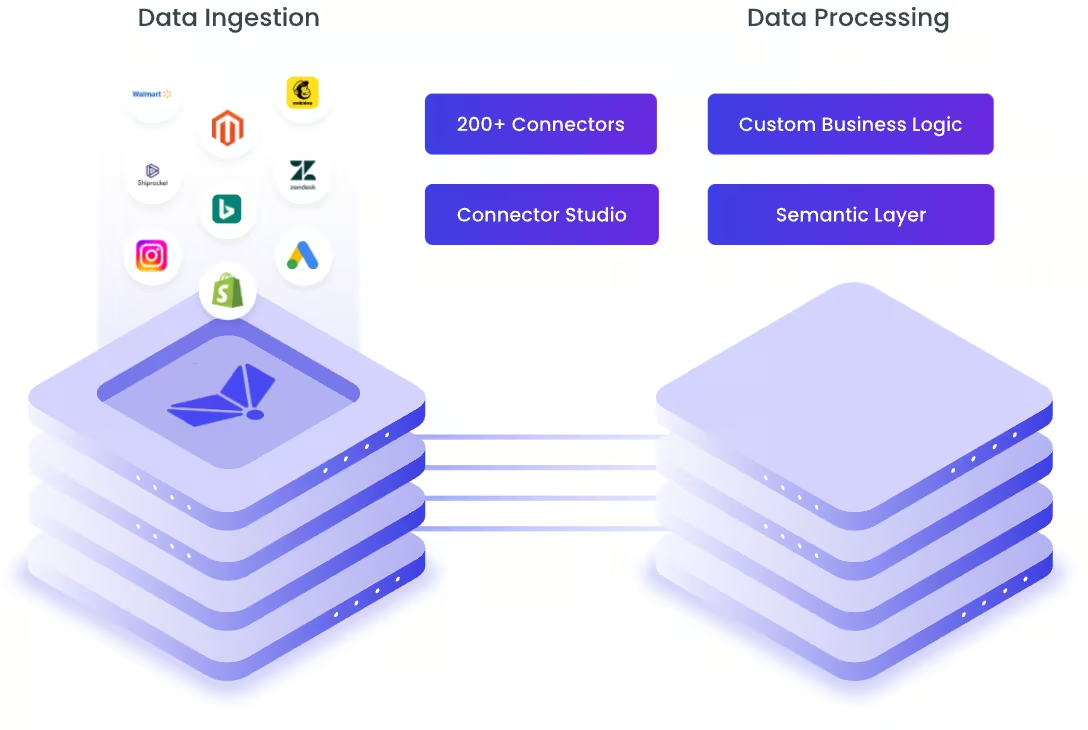
How Saras helps: With Daton, businesses can consolidate customer data from all marketing and sales platforms into a single warehouse, while Saras iQ provides dashboards that visualize these multi-touch journeys. This enables a complete, connected view of how different channels work together to drive conversions.

2. Data Fragmentation and Overload
Ecommerce teams often deal with data scattered across platforms—Google Ads, Meta, Shopify, email tools, and more. When this data stays siloed, attribution reports become inaccurate or incomplete. On the other hand, when all the raw data is pulled together, it can feel overwhelming without structure. This combination of fragmentation and overload makes deriving insights difficult.
How Saras helps: Daton automates data extraction and centralization, ensuring all marketing and sales data lives in one place. Saras iQ then organizes this data into clean, easy-to-read dashboards, cutting through the noise and highlighting the metrics that actually matter for attribution.
3. Privacy, Cookie, and Tracking Hurdles
With new privacy regulations (like GDPR and CCPA) and browsers phasing out third-party cookies, it’s becoming harder to track users reliably across devices and channels. For ecommerce businesses, this means attribution models may miss touchpoints or under-report performance. Essentially, what used to be “visible” in a customer journey is now often hidden.
How Saras helps: By relying on first-party data integration through Daton, Saras Analytics reduces dependence on cookies and external trackers. Meanwhile, Saras iQ uses this clean, consent-compliant data to provide more reliable attribution insights without breaching privacy norms.
4. Limitations of Attribution Models
Every attribution model has trade-offs. For example, last-click may overvalue the final channel, while first-click may give too much credit to initial awareness. Even multi-touch models rely on assumptions that may not reflect real-world behavior. This means businesses can’t expect one model to tell the full story.
5. Potential for Bias and Misinterpretation
Attribution results are only as unbiased as the data and model behind them. If one channel is tracked more accurately than another, or if marketers choose a model that favors their channel, the results can be misleading. For instance, a team might push for last-click attribution because it makes their campaigns look better—leading to biased budget decisions.
6. Marketing Attribution Doesn’t Predict the Future
Attribution shows what worked in the past, but it can’t predict how new campaigns or market shifts will perform. Consumer behavior changes quickly, and relying solely on past attribution insights can lead to missed opportunities. For example, just because Facebook ads worked last quarter doesn’t guarantee the same ROI in the next one.
7. It’s Easy to Manipulate
Because attribution can be influenced by how data is collected and what model is chosen, marketers sometimes “game the system.” For example, they may time campaigns to align with last-click conversions or exclude certain channels from reports to highlight their own impact. This manipulation creates an illusion of performance rather than the reality.
8. It Often Captures Incomplete Customer Journeys
Offline interactions, word-of-mouth recommendations, or dark social shares (like links sent via WhatsApp) often go untracked in attribution models. As a result, reports may show only a partial journey, missing key influences on purchasing decisions.
How Saras helps: With Daton, businesses can integrate more offline and CRM data sources into their analytics setup. Saras iQ then blends this with online performance metrics, giving a more holistic view of the customer journey—even when parts of it happen outside traditional digital channels.
9. Attribution Tools Can Be Expensive and/or Complex
Many advanced attribution tools come with high licensing fees, require skilled analysts, or demand complex implementation. For growing ecommerce brands, this makes enterprise-grade attribution feel out of reach. The result is either overspending on tools or relying on basic, inaccurate reports.
How Saras helps: Saras Analytics offers a cost-effective alternative. Daton provides affordable ETL pipelines that reduce dependency on large IT teams, while Saras iQ delivers pre-built, ready-to-use dashboards that eliminate the complexity of setting up attribution models from scratch.
How to Implement Ecommerce Marketing Attribution
Implementing ecommerce marketing attribution isn’t just about plugging in tools — it’s a structured process that ensures marketing decisions are rooted in data, not guesswork. Each step builds the foundation for more accurate measurement, smarter budget allocation, and stronger ROI. Here’s how brands can do it.
1. Define Business Goals and KPIs
Attribution should begin with a clear understanding of what the business is trying to achieve. Whether the focus is reducing customer acquisition costs (CAC), maximizing customer lifetime value (CLV), or improving return on ad spend (ROAS), goals shape how attribution models are designed and interpreted. Without this clarity, marketing teams risk chasing vanity metrics instead of outcomes that drive revenue growth.
2. Map the Customer Journey
Customers rarely convert after a single interaction. They move through a fragmented path of ads, emails, social touchpoints, and site visits. Mapping this journey helps identify which touchpoints are influencing awareness, nurturing intent, and driving conversions. A clear journey map prevents over-crediting “last click” channels and ensures hidden but influential touchpoints are accounted for.
How Saras Helps: Daton unifies data from ads, CRM, website analytics, and email into a single warehouse. Saras iQ then stitches this data into a holistic customer journey view, showing marketers how each channel contributes to conversions.
3. Choose the Right Attribution Model
Not all attribution models tell the same story. First-click attribution highlights acquisition channels, last-click favors closing channels, and multi-touch models spread credit across the journey. Advanced, data-driven models can adjust credit dynamically based on real performance. Selecting the right model ensures decisions reflect reality instead of skewed or oversimplified views.
How Saras Helps: Saras iQ lets teams compare different attribution models side by side, empowering marketers to select the one that aligns with their business objectives and test how outcomes vary under each model.
4. Ensure Data Accuracy and Quality
Attribution is only as reliable as the data feeding into it. Inconsistent tagging, duplicate records, or platform discrepancies can lead to false insights and wasted budgets. Maintaining high-quality, standardized data ensures the models deliver actionable insights instead of misleading results. Brands that overlook this often face significant blind spots in their decision-making.
How Saras Helps: Daton automates data extraction, cleaning, and standardization across all sources, while Saras iQ reconciles discrepancies to deliver a single source of truth for attribution reporting.
5. Apply Privacy-Compliant Tracking
The decline of third-party cookies, along with stricter regulations like GDPR and CCPA, has changed the way marketers can collect and use data. Relying on outdated tracking puts businesses at risk of compliance issues and incomplete attribution data. Brands must pivot toward first-party data strategies and privacy-friendly tracking methods to maintain reliable attribution.
How Saras Helps: Saras iQ integrates with privacy-compliant tracking solutions, leveraging first-party and server-side data to ensure brands can continue to attribute effectively while staying within regulatory boundaries.
6. Monitor, Test, and Optimize
Attribution isn’t a one-time setup — it needs constant monitoring. Consumer behavior shifts, platforms change algorithms, and new channels emerge. By regularly testing and refining campaigns, marketers can adapt attribution strategies to current realities and avoid stale insights. This ongoing optimization ensures marketing spend is always aligned with performance.
How Saras Helps: Saras iQ offers real-time dashboards and supports controlled testing, helping marketers continuously refine campaigns based on actual performance insights.
7. Share Insights Across Teams
Attribution insights have value beyond the marketing team. Finance needs them for budget planning, sales relies on them for pipeline visibility, and leadership uses them for strategic growth decisions. When attribution remains siloed, organizations miss opportunities for better alignment and resource optimization. Making attribution insights accessible across teams creates a unified decision-making framework.
Ecommerce Marketing Attribution Tools
To implement attribution effectively, businesses need the right tools that can unify data, analyze touchpoints, and generate actionable insights. The market has several platforms, each with its strengths, limitations, and focus areas. Below is a comparison of leading ecommerce marketing attribution tools:
1. Saras Analytics
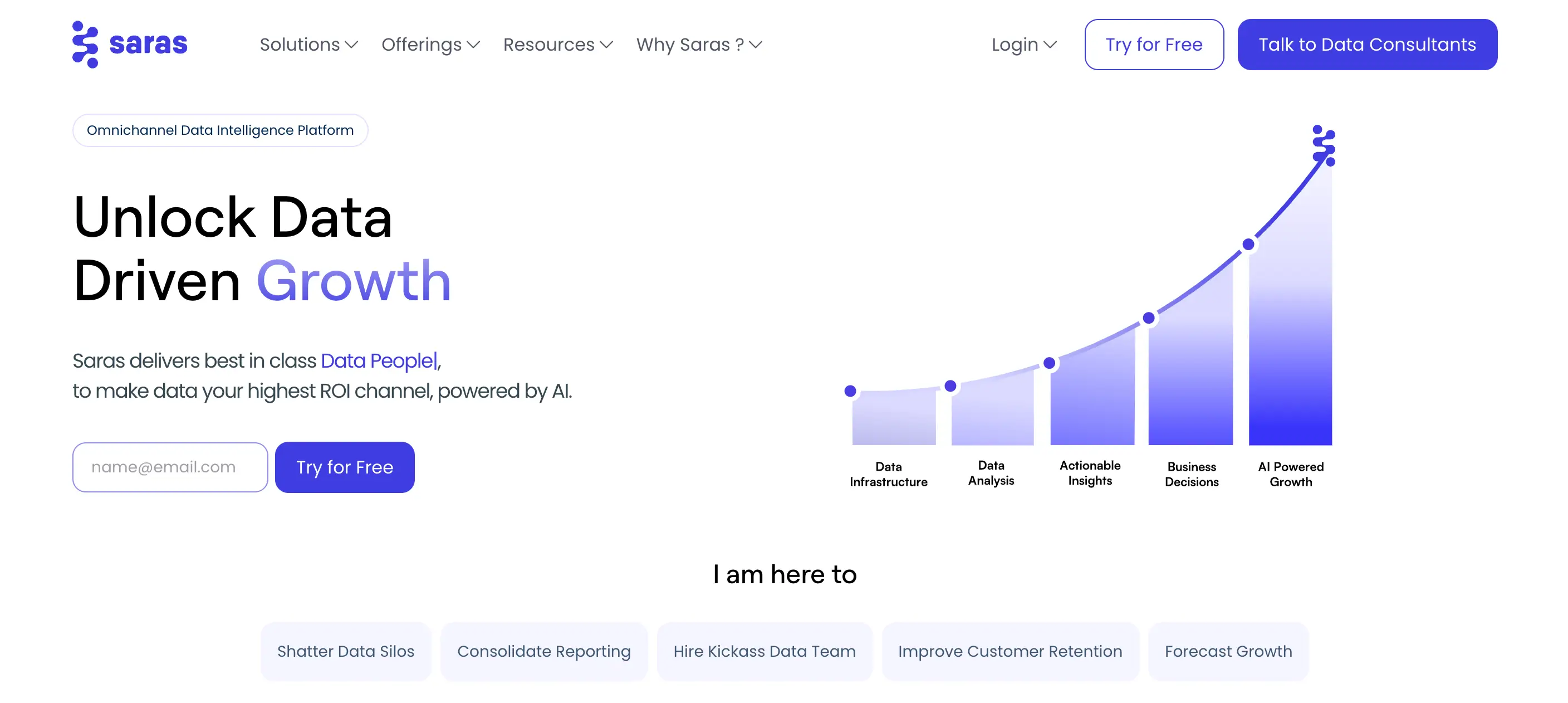
Saras Analytics delivers a comprehensive attribution solution through its two products — Daton (a no-code ETL platform for data integration) and Saras iQ (a customer journey and attribution insights platform). Together, they allow ecommerce brands to centralize fragmented marketing data and turn it into actionable attribution reporting that directly ties campaigns to revenue and customer lifetime value (CLV). Unlike many competitors, Saras bridges both the data engineering and business analytics sides of attribution, offering end-to-end visibility.
Key Features
- Daton (ETL Platform): Seamlessly integrates data from 150+ sources including ad networks, CRMs, ecommerce platforms, and analytics tools into a centralized warehouse.
- Saras iQ (Attribution & Insights): Provides multi-touch attribution, cohort analysis, revenue forecasting, and customer lifetime value tracking.
- Customizable Models: Supports rule-based, time-decay, and algorithmic attribution models tailored to a brand’s goals.
- Scalable Architecture: Built for both mid-market and enterprise ecommerce brands, with automation reducing manual reporting overhead.
- Business-Friendly Dashboards: Prebuilt dashboards with ROAS, CAC, CLV, and revenue metrics designed for marketing and finance teams.
Pros
- Offers a complete solution (data integration + attribution insights) rather than a siloed analytics layer.
- Highly customizable and adaptable for ecommerce businesses with complex channel mixes.
- Reduces dependency on ad-platform-reported metrics, ensuring unbiased, accurate attribution.
- Designed to align marketing metrics with business outcomes like revenue, margins, and CLV.
- Scales well for brands at different stages — from growth-stage DTC companies to large enterprises.
Cons
- May require initial setup and alignment with data teams compared to lightweight plug-and-play attribution tools.
- Pricing is more enterprise-oriented, which might be higher for smaller ecommerce startups.
- Requires businesses to have (or adopt) a data warehouse to get the full benefit of Daton + Saras iQ.
- Advanced features like predictive modeling may have a learning curve for non-technical marketers.
Pricing
Saras Analytics offers customized pricing based on data volume, number of connectors, and specific business needs. Unlike tools with flat monthly fees, pricing is typically tailored for mid-market and enterprise ecommerce brands. While this makes it less accessible for very small businesses, it ensures that larger brands only pay for the scale and capabilities they actually need.
.avif)
2. TripleWhale
TripleWhale is popular among DTC and ecommerce brands for its simplified dashboards and mobile-first reporting. It consolidates marketing performance metrics from ad platforms like Meta, Google, and TikTok, making it easier for marketers to track ROAS and customer acquisition costs in real time. While it is lightweight and user-friendly, it may lack the deeper flexibility and scalability needed by larger enterprises. However, for fast-growing ecommerce brands, it provides a quick and accessible way to visualize attribution data.
3. Northbeam
Northbeam positions itself as an advanced attribution and forecasting platform for ecommerce companies. It emphasizes media mix modeling, predictive analytics, and real-time reporting, helping brands allocate spend more intelligently across channels. Its strength lies in handling high-volume, multi-channel campaigns with precision. However, it often requires more technical onboarding compared to simpler tools, making it better suited for scaling brands that need advanced control over their data.
4. Rockerbox
Rockerbox focuses on unifying marketing data from fragmented sources to build a centralized view of campaign performance. It offers strong multi-touch attribution modeling and supports granular breakdowns by channel, campaign, or even creative. Rockerbox is often chosen by marketers who want more transparency and control than standard ad platform reporting allows. The trade-off is that it can demand more data literacy from teams, as its flexibility requires thoughtful configuration.
5. Segment (by Twilio)
While Segment is not exclusively an attribution tool, it plays a critical role in enabling attribution by serving as a customer data platform (CDP). It captures and unifies customer interactions across devices and channels, then pipes that clean, structured data into analytics and attribution tools. Ecommerce companies often pair Segment with platforms like Saras or Northbeam to ensure their attribution models are powered by high-quality, standardized data. Its strength is in data accuracy and flexibility, though it typically requires integration with additional analytics platforms to deliver complete attribution reporting.
Future of Ecommerce Marketing Attribution
The next era of ecommerce marketing attribution will be defined by intelligence, privacy, and holistic measurement. As customer journeys span multiple touchpoints and regulatory landscapes shift, attribution models must evolve to stay relevant. Below are the key trends shaping the future:
1. AI-Driven Attribution
Artificial intelligence and machine learning are transforming attribution by processing massive, complex datasets and uncovering hidden patterns in customer behavior. Predictive models will forecast conversion likelihood and dynamically optimize campaigns across all touchpoints in real time. Leading retailers like ASOS already use AI agents to automatically adjust spend, improving channel efficiency and lowering customer acquisition costs by over 30%. This shift ensures attribution becomes smarter, faster, and more profit-focused.
2. Privacy and Cookieless Tracking
As third-party cookies phase out, marketers can no longer rely on traditional tracking methods. The future lies in first-party data, server-side tracking, and consent-based interactions such as gated content, loyalty programs, and subscription models. Platforms must prioritize compliance with regulations like GDPR and CCPA while still providing accurate insights. This balance of privacy and precision will define how brands earn customer trust while sustaining marketing performance.
3. Cross-Channel & Device Integration
Tomorrow’s attribution will not stop at online ads—it will integrate voice assistants, smart devices, social commerce, retail media, and in-store experiences for a true 360° customer view. Multi-touch attribution will map journeys across email, search, influencers, paid media, and emerging channels, giving brands a holistic understanding of what drives conversions. This cross-device and cross-channel integration will allow marketers to allocate budgets with far greater accuracy.
4. Advanced Attribution Models
Attribution frameworks will evolve beyond last-click or simple linear models. Sophisticated multi-touch models—such as time-decay, U-shaped, and W-shaped—will become mainstream, offering deeper clarity into each channel’s influence. Additionally, attribution will increasingly prioritize customer lifetime value (LTV) and retention, shifting the focus from just the initial purchase to long-term profitability. Businesses that adopt these advanced models will gain stronger insights into sustainable growth drivers.
Key Takeaways for Ecommerce Leaders
The future of attribution will bring 30–40% improvements in ROI as advanced, AI-powered models become standard. Attribution will no longer be static but dynamic and personalized, adapting to seasonality, product category, and even individual customer journeys. To remain competitive, businesses must invest in robust data infrastructure, flexible attribution frameworks, and privacy-first practices. Ultimately, ecommerce attribution is heading toward being smarter, omni-channel, and continuously optimized—delivering actionable insights that drive both revenue and stronger customer relationships.
Conclusion: Turning Attribution Challenges into Growth with Saras Analytics
Ecommerce marketing attribution is no longer just about tracking clicks—it’s about uncovering the true drivers of revenue, retention, and customer lifetime value. With AI-driven insights, privacy-first tracking, and multi-touch modeling, businesses can finally move past guesswork and build strategies that consistently deliver ROI.
Saras Analytics empowers ecommerce brands to harness their data, eliminate silos, and apply advanced attribution models that reveal what truly fuels growth. By aligning spend with proven revenue drivers, businesses not only maximize efficiency but also unlock sustainable, long-term profitability. In today’s competitive market, smarter attribution isn’t optional—it’s the key to staying ahead.
Talk to our data consultants today to see how Daton and Saras iQ can help you transform your marketing ROI with smarter attribution.

.svg)
.webp)
%201%20(1).svg)















.jpg)



%20Statistics%20in%202026.jpg)



%20Software%20for%20DTC%20Brands%20in%202026.png)













%20Setup%20Guide%20for%20Ecommerce%20Finance%20Team.png)



























.webp)

.webp)
.webp)
.webp)
.webp)