A COO at a subscription DTC brand recently spent an hour connecting Claude to his analytics tools. He got it working. He asked questions, got answers, and felt the potential. Two days later, the connection broke down. He reconnected, but a different query returned a different number than before. Within a week, he gave up on the live connection entirely and started screenshotting his dashboards, dropping the images into Claude, and asking questions that way. Faster, more reliable, and completely defeating the purpose of having a data connection at all.
That gap between a working MCP connection and a trustworthy one is where most eCommerce data teams are right now. Shopify, Stripe, and PayPal have all shipped official MCP servers. Connecting Claude to your warehouse takes hours. But for eCommerce brands building toward an AI-ready data foundation, the MCP server launch guide eCommerce teams actually need covers what happens after the connection works: the security, the validation, and the data architecture underneath.
Is your data actually Decision-Grade?
9 questions. 3 minutes. Score your Profitability Visibility and Readiness for AI-driven growth.
Start Free Diagnostic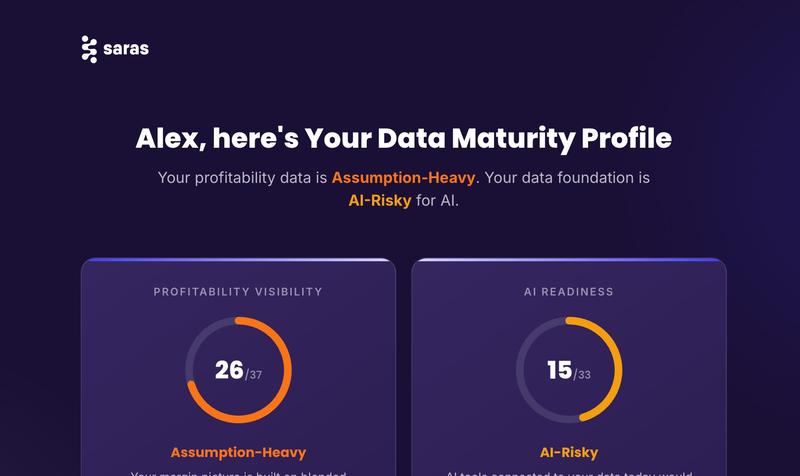
What a Production-Grade eCommerce MCP Server Actually Requires
A production eCommerce MCP server sits at the top of a five-layer stack. The server itself is one layer. The four layers beneath it determine whether the AI's answers are trustworthy or just fast. If you have already read our explainer on what an MCP server is and how it works, this section is the diagnostic version: for each layer, here is what breaks in your business if it is missing.
Layer 1: Clean Ingestion. Every data source needs to flow into the warehouse reliably and with correct schema mapping. If a source is missing, the AI has no way to account for it. It calculates contribution margin without fulfillment costs because 3PL data never made it in, and the answer looks precise enough that nobody questions it. An eCommerce data pipeline covers the long-tail connectors generic ELT tools miss.
Layer 2: Data Models. Raw source tables need transformation into clean, joined, business-logic-applied models. Returns get joined to originating orders. COGS is applied date-effectively. Bundles are unbundled into component-level SKUs. Without this layer, the AI reasons over raw data with ambiguous column names and broken joins. A pre-modelled eCommerce data warehouse provides the transformation logic generic dbt templates do not cover.
Layer 3: Semantic Layer. Metric definitions, join rules, and business logic are formalized on top of the modeled tables. "Net revenue" is defined exactly. "Contribution margin" has a locked calculation. "ROAS" specifies which attribution window and which revenue definition. The AI queries this layer instead of the raw tables beneath it, and that routing is what makes the eCommerce AI data server configuration produce trustworthy answers.
Layer 4: MCP Server. Exposes the semantic layer to any MCP-compatible AI tool. Handles authentication, query routing, access controls, and result formatting.
Layer 5: AI Client. Claude, ChatGPT, or whichever tool the team uses. The AI asks questions; the MCP server routes them through the semantic layer; trusted answers come back.
Three Failure Modes That Turn a Working Connection into a Liability
The MCP server for eCommerce data is the fastest layer in the stack to stand up, and the least likely to be the source of a wrong answer. The layers beneath it take 10 to 20 times longer to build and are responsible for nearly all output quality issues. Yet most launch conversations focus on the server configuration — the one part that rarely breaks.
Here are the three ways teams get burned after the connection is live.
1. Raw Table Access
The MCP server connects Claude directly to raw Shopify and Amazon tables. Claude generates SQL against them, picks the wrong revenue column, misses the returns join, and returns a number that looks right.
Consider a $40M DTC brand. Their data team asks Claude for Q4 contribution margin by channel. The answer comes back clean: $2.8M. Finance catches the problem three weeks later. The AI had calculated margin without 3PL fulfillment costs from a secondary warehouse because that data was never ingested. The real number was $1.9M — a 32% gap.
2. No Semantic Layer
The data is modeled and clean, but there are no locked metric definitions. Claude chooses between three columns that could plausibly represent revenue. Different phrasings of the same question return different numbers. An operations lead asks "what was revenue last month" and gets $4.2M. The CFO asks "total net sales for April" and gets $3.8M. Both are technically correct compared to different columns. The team loses trust in the tool within a week and reverts to spreadsheets.
3. Incomplete Ingestion
The MCP connection works. The semantic layer is in place. But two data sources are missing from the warehouse. The AI answers questions about contribution margin but cannot account for affiliate commissions or returns processing fees because those feeds were never configured. The answers are internally consistent but structurally incomplete. This is the hardest failure to catch because the numbers always look reasonable.
Saras iQ MCP is a purpose-built MCP server for eCommerce that connects Claude specifically to the semantically modeled data layer, not raw tables. The distinction matters because the server enforces that every query routes through certified metric definitions before generating a result.
The Security Gap 53% of MCP Servers Have Right Now
Astrix Security analyzed over 5,200 open-source MCP server implementations in 2025 and found that 53% rely on static API keys or Personal Access Tokens as their authentication mechanism. Only 8.5% use OAuth 2.1, the standard the MCP specification actually requires for HTTP-based transports. For eCommerce brands, where warehouse data includes customer PII, order history, and financial metrics, this is a production-grade risk your data team should be auditing before launch.
Here are four MCP server security requirements eCommerce teams should verify before going live.
1. OAuth 2.1 Over Static API Keys
Static API keys are long-lived, rarely rotated, and if leaked, give persistent access to your warehouse data. OAuth 2.1 provides short-lived tokens, proper scope enforcement, and revocation capabilities. The June 2025 MCP spec revision made this the required standard for enterprise deployments.
2. Per-Tool Scope Enforcement
Do not give AI agents blanket access to every tool the MCP server exposes. Define scopes at the tool level. Read access to analytics tools does not imply write access to order management tools. In July 2025, an AI coding agent at a SaaS company deleted a production database because it had write permissions it did not need for the task it was performing. For eCommerce MCP servers, this means marketing should query contribution margin dashboards but should not be able to modify warehouse configurations.
3. HTTPS Everywhere
MCP traffic over HTTP exposes authentication tokens to interception. In 2025, researchers found hundreds of MCP servers bound to 0.0.0.0 by default, exposed to any device on the same network. Every production MCP endpoint must use HTTPS with valid certificates.
4. Query Logging and Audit Trails
Log every tool invocation: which AI client made the request, which tool was called, which data was accessed, and what result was returned. When a question arises about an AI-generated number in a board deck, the audit trail traces the answer back to its source.
Ask your data team: Before launching your eCommerce MCP server setup, confirm with your data team: Are we using OAuth 2.1 or static API keys? Do AI agents have write access to anything they shouldn't? Is every MCP endpoint on HTTPS? Can we trace any AI-generated answer back to the exact query and metric definition that produced it?

The Pre-Launch Validation Checklist Your Data Team Should Run
The most dangerous failure mode for an eCommerce MCP launch is a plausible wrong answer. Run these checks against known-correct numbers before any team member uses the system for real decisions.
1. Revenue Sanity Check. Ask the AI for total net revenue for a completed month. Compare against your accounting system's figure for the same period. A discrepancy larger than 1–2% indicates a data model issue: wrong column, missing return attribution, or a source not fully ingested. Do not proceed to launch until this passes.
2. Contribution Margin Accuracy. Ask for contribution margin by channel for the same period. Compare against a manually calculated figure your finance team has already verified. This tests COGS application, ad spend joins, and fulfillment cost attribution simultaneously. If the AI's number diverges from the finance team's number by more than a few percentage points, there is a data model gap or a semantic definition mismatch.
3. Metric Consistency Test. Ask the same metric question using five different phrasings. "Revenue last month." "Total sales in April." "Net revenue for the last 30 days." "How much did we make in April?" "DTC plus Amazon net sales, April." If the answers differ, the semantic layer has definition gaps or the MCP server is not consistently routing queries through it.
4. Schema Drift Test. Rename a column in a non-production copy of the warehouse and verify the MCP server surfaces a clear error rather than guessing or returning null. This confirms dynamic schema retrieval is working rather than relying on a cached snapshot that will silently break when the warehouse evolves.
5. Access Control Test. Log in as a user with restricted permissions and attempt a query outside their authorized scope. Confirm the MCP server returns a permission denial rather than silently returning restricted data.
Important: When a validation test fails, trace the SQL the AI generated. Identify whether the issue is a data model gap, a semantic definition mismatch, or a missing source. Fix the root cause in the data model or semantic layer. Do not fix wrong answers through prompt engineering.
Build vs. Managed: What the Project Actually Costs in Weeks and Headcount
The DIY Path
A data engineering team can build the full five-layer stack in-house. Realistic timeline for a mid-market eCommerce brand with 8 to 15 data sources:
| Phase | Timeline | Notes |
|---|---|---|
| Warehouse setup | 1–2 weeks | BigQuery or Snowflake provisioning and configuration |
| Ingestion configuration | 2–4 weeks | Longer if sources include Amazon DSP, niche 3PL systems, or custom ERP connectors |
| Data modeling | 4–8 weeks | eCommerce-specific logic for kit unbundling, return attribution, and date-effective COGS is not in generic dbt templates |
| Semantic layer definition | 2–4 weeks | Locking every metric definition with your finance team |
| MCP server configuration and security | 1 week | Transport, auth, tool definitions, access controls |
| Validation and QA | 2 weeks | Running the five checks above against known-correct numbers |
| Total | 12–21 weeks | Plus at least one dedicated analytics engineer ongoing |
Even connecting to a different database type than the one your MCP infrastructure was originally built for — say Snowflake when the codebase was built for BigQuery — can add one to two weeks of backend changes, whitelisting, and testing. The eCommerce data warehouse MCP configuration is not plug-and-play when the destination changes.
The Managed Path
Managed solutions compress layers 1 through 4 into a pre-built stack. Saras Daton handles ingestion with 200+ eCommerce connectors. Saras iQ provides pre-built data models and a semantic layer with certified metric definitions. Saras iQ MCP connects Claude or any AI to the semantic layer with OAuth, query logging, and access controls configured. Even on the managed path, the data foundation has to meet a minimum health standard before the MCP connection is activated. That gate protects the experience.
The Honest Tradeoff
Build gives full control, maximum customization, and is right for brands with strong in-house data engineering. Managed gives faster launch and pre-solved eCommerce logic with lower ongoing maintenance — right for most brands between $10M and $200M. The most common architecture for mid-market DTC brands is hybrid: managed foundation, customized semantic layer for brand-specific business rules on top.
What a Properly Launched MCP Stack Looks Like in Operation
Any team member asks a question in plain English and gets a trusted answer within seconds. No SQL. No waiting for an analyst.
The AI asks clarifying questions when a query is ambiguous. It prevents metric misunderstandings before they reach a board deck. Every answer shows the SQL it was generated from, and the metric definition applied. The CFO can see exactly how contribution margin was calculated and confirm it matches the P&L definition.
Results are consistent regardless of which tool queries the semantic layer: Claude via MCP, a Looker dashboard, a Google Sheets export. Same definition, same answer. The security audit trail is complete. Every query is logged.
Josh Holley, COO and CFO at BPN, described what this kind of system enables: "Saras built a tracking system for us to identify recently churned high-value customers."
That tracking works because the data underneath is modeled, semantically defined, and queryable by both humans and AI through the same certified definitions. The AI eCommerce analyst layer sits on top of that foundation.
Conclusion
An MCP server for eCommerce data is a five-layer architecture problem. The server itself is a day's work. The layers underneath are weeks of work and the part most teams underestimate. Get the foundation right and you have AI analytics your team can trust. Skip it and you have a fast connection to plausible wrong answers.
Saras iQ MCP connects Claude and any AI directly to an eCommerce-specific semantic layer, with ingestion, modeling, security, and validation already done. Talk to the data consultants at Saras Analytics today.

.webp)
.svg)
%201%20(1).svg)


%20Setup%20Guide%20for%20Ecommerce%20Finance%20Team.png)












.webp)
.webp)
.webp)
.webp)
.webp)





.webp)


.webp)




.webp)




.png)