By now, every eCommerce team has felt the squeeze: rising CPMs, shrinking attribution windows, unpredictable CAC swings, and “AI-optimized” ad platforms that somehow make acquisition easier and more expensive. The real issue is that most brands still chase cheaper clicks instead of understanding the customer behind the click.
eCommerce customer acquisition in today’s business landscape requires data maturity, not bigger budgets. The brands that win in 2026 will be the ones who connect CAC with LTV, fix leakage in their funnels, and deploy customer intelligence instead of praying for algorithmic luck.
This guide breaks down how acquisition works today, why CAC volatility is the new norm, and the strategies that help brands acquire customers profitably.
What is eCommerce Customer Acquisition?
eCommerce customer acquisition is the process of turning a stranger into a first-time buyer through any combination of paid, organic, owned, or partnership channels. But “acquisition” is broader than most teams treat it. It requires moving a customer through five steps:
Traffic → Engagement → Conversion → Activation → Repeat purchase
A more accurate definition looks like this:
- Paid inputs (Meta, Google, TikTok, retail media)
- Organic discovery (SEO, content, social, communities)
- Owned channels (email, SMS, loyalty, referrals)
- Retention loops that improve CAC by accelerating payback
A mature acquisition strategy treats all of this as one system.
Acquisition Efficiency Formula
A clean way to measure whether acquisition is sustainable:
Why eCommerce Customer Acquisition Matters
Acquisition still matters; but not for the textbook reasons everyone repeats. What matters now is whether you can acquire profitably in spite of volatility. CAC isn’t stabilizing. Platform automation is flattening the tactical edge. The only way to scale in 2026 is by understanding customer value with precision and feeding that intelligence back into acquisition
eCommerce Customer Acquisition Cost (CAC): Full Breakdown
This is where most brands quietly mess up. They think their CAC is “whatever Meta shows.” That’s how budgets spiral, ROAS lies, and teams scale campaigns that should’ve been killed months ago.
A proper eCommerce customer acquisition cost model needs three layers:
Layer #1: The Core CAC Formula
This is how you calculate CAC:
Layer #2: Blended CAC vs Channel CAC vs Cohort CAC
Most teams only look at one of these and then act surprised when payback windows don’t match reality.
- Blended CAC → spend across all channels / all new customers
- Channel CAC → spend per channel / new customers from that channel
- Cohort CAC → the real CAC once you factor in LTV, repeat rates, discounts, returns
If you don’t evaluate CAC through all three lenses, you will not be able to take the right decisions.
Layer #3: Why CAC Is Often Miscalculated
D2C brands often mess up CAC math because of these reasons:
1. Misattribution
Meta takes credit. Google takes credit. Shopify claims the sale. But none of them reconcile to actual customer value. As a result, your CAC looks healthier than reality.
2. Counting Only Front-End Ad Spend
Teams forget to include:
- agency fees
- creative costs
- influencer payments
- affiliate commissions
- sampling
- promotions
Once these enter the equation, CAC often doubles.
3. Ignoring Overhead Inputs
Acquisition requires ops, team bandwidth, retention follow-up, customer support, and logistics readiness. Ignoring these skews CAC downward.
4. Mistaking ROAS for CAC
ROAS is a surface-level metric, whereas CAC is the ultimate financial truth. And if attribution is fragmented (it is), CAC becomes fiction unless you unify your data first.
So, the point is: when information like customer, spend, and attribution data lives in silos, you don’t get the accurate picture. This is where Saras iQ helps by unifying data through automated pipelines that pull Shopify, ad platforms, email, and subscription data into a single modeled layer, resolving identities and standardizing metrics across channels for accurate CAC and LTV visibility.
What is a Good CAC for eCommerce?
Shopify’s own analysis found that returning customers are 50% more likely to convert than first-time visitors, which means CAC alone is meaningless unless paired with LTV.
“Good CAC” is irrelevant without context. The only metrics that matter are contribution-margin payback and cohort value. If payback takes more than 60 days or cohorts don’t reorder, CAC isn’t scalable; regardless of what the ad platform reports.
Types of eCommerce Customer Acquisition Channels
Mature D2C eCommerce brands treat channels as a portfolio, each with different intent, costs, and LTV impact. Below is a clear, tactical breakdown.
1. Paid Channels
Meta Ads: Great for creative-led demand generation, retargeting, and broad acquisition. But CPMs swing wildly, making cost control difficult without strong creative testing and LTV visibility.
Google Ads (Search + Shopping): High-intent users mean stable CAC; but expensive categories can destroy margins quickly. This works best when you have strong product market clarity.
TikTok Ads: This one offers cheap reach, but with volatile conversion. Great for top-of-funnel awareness and creative experimentation. Requires constant testing to avoid fatigue.
Influencer & Paid UGC: Still one of the most efficient levers when done correctly, influencer and paid user-generated content works well when you use creators for both reach and ad creative production.
Retail Media (Amazon, Walmart, Instacart): Intent-heavy, but high competition inflates bids. Requires SKU-level margin understanding to avoid unscalable CAC.
2. Organic Channels
SEO: One of the most reliable long-term acquisition engines. Slow to ramp, but CAC improves as your content ecosystem compounds.
Content Marketing: Guides, product education, and problem-solution pages are some examples of it. Useful for lowering CAC over time by warming up traffic before they ever see an ad.
Organic Social: It is best for community building and brand depth, not instant conversions.
Community-led Growth: This comprises niche groups, discord, Reddit, and creator communities. Also, it works when authenticity is high and brands solve a real problem.
Press / PR: Good for credibility; CAC impact is indirect but powerful.
3. Owned & Retention Channels
These channels don’t “acquire” customers, but they dramatically reduce CAC by improving payback windows.
Email & SMS: Still among the strongest ROI channels that offer high repeat conversion at extremely low marginal cost.
Loyalty Programs: Increase repeat behavior and stretch LTV, letting teams tolerate higher CAC.
Referrals: Low CAC when incentivized well; but only works if product/experience is strong.
4. Partnership & Affiliate Channels
This one is underrated, under-utilized, and often the most stable CAC path.
Creators: Performance-based partnerships with creators who consistently convert.
Affiliates: Great for ranking pages you don’t want to compete on directly.
Wholesale & Retail Partnerships: Expand discovery without heavy ad spend. Useful for brands with strong margins.
Quick Guidance: When These Channels Work Best
- Paid → fastest scale, highest volatility
- Organic → slowest scale, best long-term CAC
- Owned → best for improving CAC payback
- Partnerships → stable CAC, predictable revenue, strong for emerging brands
Your acquisition strategy wins when these channels reinforce each other.
Common Mistakes Brands Make with eCommerce Customer Acquisition
When it comes to eCommerce customer acquisition, none of these mistakes look dramatic in the moment, but over time they bloat CAC and suffocate growth.
1. Optimizing for Low CAC Instead of High LTV
Cheap customers often stay cheap. Profit comes from the ones who stay, reorder, and grow, and not the ones who bought because of a heavy discount.
2. Treating Repeat ROAS as First-Time ROAS
A campaign might look profitable only because returning customers are hiding the true CAC. This is the biggest silent killer of budgets.
3. Not Using Dynamic Audiences
If your targeting never updates, your CAC rises even if your creative assets are good.
4. Poor Attribution Setup
When Meta, Google, and Shopify don’t match, teams make decisions based on whichever number feels comforting. That leads to terrible scaling choices.
5. Over-dependence on Meta/Google
One algorithm tweak and your CAC doubles. Therefore, diversification is absolutely required to keep inaccurate data at bay.
6. Ignoring On-Site Conversion
Slow load times, weak PDPs, unclear value propositions — all of them inflate CAC before a single dollar hits ads.
7. No Pre-Purchase Education or Offer Sequencing
Most brands try to sell too fast. High-ticket or emerging categories require education before conversion.
9 Data-Backed Strategies to Reduce eCommerce Customer Acquisition Cost in 2026
CAC feels expensive because teams optimize against incomplete data, misattributed conversions, and audiences that decay too fast. The strategies below cut through that noise and focus on the levers that move CAC:
1. Optimize the CAC:LTV Ratio, Not CAC Alone
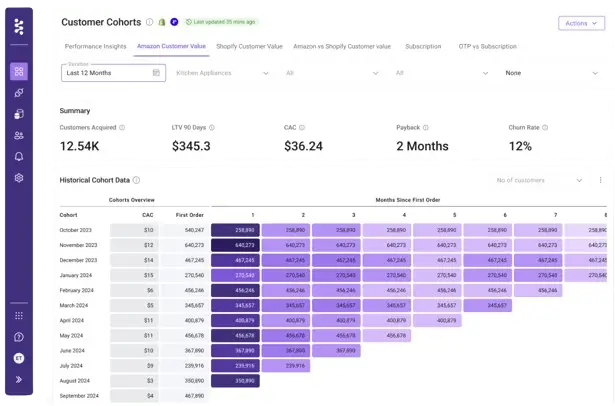
Instead of chasing cheap customers, you need to start focusing on profitable customers. The brands scaling in 2026 have one thing in common: they kill campaigns that bring low-LTV buyers and double down on channels that attract cohorts who reorder quickly.
Saras iQ helps by showing LTV by channel, product path, and cohort, so teams adjust budgets based on value, not just metrics.
2. Fix Top-of-Funnel Conversion Before Scaling Spend
Scaling ads into a broken funnel is financially reckless. Before increasing budget, you should do the following:
- improve page load speed,
- rewrite PDPs for clarity,
- fix funnel leaks using heatmaps and session recordings,
- test value propositions above the fold.
Every improvement you make here drops CAC without touching ad spend.
3. Use Predicted LTV & Cohort Insights to Allocate Budget Smarter
Instead of allocating the budget based on yesterday’s ROAS, you should focus on future value. Using LTV predictions, SKU-level cohorts, and payback windows lets you redirect spend toward the audiences and channels that compound, not just convert.
This is where Saras iQ’s predictive LTV removes guesswork from budget allocation. Saras iQ models expected revenue by cohort, ties it back to the original acquisition channel, and shows which audiences pay back fastest.
4. Build High-Intent Audiences with Zero- & First-Party Data
Third-party data is unreliable now. Zero-party inputs (quizzes, surveys, preference selections) combined with first-party behavior (sessions, product views, add-to-cart, purchase history, email/SMS engagement) give you audience signals that Meta and Google simply cannot infer on their own.
Saras iQ takes these signals, stitches them into unified profiles, and builds segments based on real buying intent. You can sync these segments directly into Meta, Google, and Klaviyo, allowing you to target:
- shoppers who showed intent but didn’t convert,
- high-LTV lookalikes trained on your best cohorts,
- customers nearing replenishment windows,
- discount-sensitive vs non-discount buyers.
The result is simple: higher intent, lower CAC, and far less wasted spend because you’re feeding platforms cleaner and more meaningful data than their default algorithms can ever produce.
5. Leverage Creators + UGC to Lower Creative Fatigue
Creative fatigue drives up CAC faster than platform changes do. Creator-led content works because it resets fatigue cycles and builds trust instantly. Modern D2C eCommerce brands use creators for ad creative, besides just reach.
6. Improve Product Pages Using Behavioral Analytics
Removing friction is one of the easiest CAC levers because most brands don’t lose customers at the ad; rather, they lose them on the product page.
- Use heatmaps to spot “dead zones” where users stop engaging, and scroll-depth tracking to pinpoint exactly where attention collapses.
- Add AI-powered product recommendations to surface the right SKU at the right moment.
- Rewrite copy so it leads with benefits, not generic features.
- And make essentials like pricing, shipping timelines, and returns impossible to miss.
A better PDP means fewer wasted clicks, which translates to lower CAC.
7. Strengthen Post-Purchase Flows to Improve Payback Period
If a customer buys again within 30–45 days, your allowable CAC jumps because cash returns faster and payback risk drops. That second purchase is the economic unlock. Here are a few things you can do:
- Strengthen replenishment flows with timing based on actual consumption patterns, not generic “30-day” defaults.
- Use upsell sequences that match what customers bought the first time, instead of random add-ons.
- Add subscription nudges only when the data shows a product is truly repeatable.
- And reinforce all of it with education content that reduces hesitation and teaches customers how to get the most from the product.
8. Build Email/SMS Pre-Launch Lists to Reduce CAC Spikes
List-building ahead of launches, sales, or seasonal peaks gives you a pool of zero-CAC, high-intent buyers you can convert before touching paid ads. These early conversions act as algorithm “warm-up signals.” It helps improve your ad relevance score and lower CPMs when you eventually scale spend.
Pre-launch lists also help you test messaging, validate demand, and segment buyers by interest before you spend a dollar on acquisition. It’s one of the most reliable ways to reduce dependency on paid traffic and smooth out CAC volatility during big pushes.
9. Use Offer Testing (Bundles, Trials, Guarantees, Financing)
Remember, your offer matters more than your ads. Bundling high-margin items, adding trial sizes, clarifying guarantees, or offering financing can reduce CAC by removing psychological friction from the buying journey. Great offers outperform great creatives.
Challenges Ecommerce Brands Face in Customer Acquisition
CAC problems usually start with data blind spots, fragmented systems, and decisions made on half-truths. Below are the real acquisition challenges operators face, and these are the ones you only discover after burning budget.
Improve eCommerce Customer Acquisition with Saras iQ
CAC can often be unstable, and that part is uncontrollable. What is controllable is how precisely you understand customer value and how fast you react to changes in acquisition quality.
Saras iQ gives eCommerce teams the three capabilities that modern acquisition requires:
1. LTV Prediction and Cohort Insights for Smarter Budget Allocation
Besides telling you what converted yesterday, Saras iQ also shows which customers stick, spend more, and come back without heavy discounts. When you can compare cohorts by channel, product path, and payback window, budget decisions become painfully obvious: scale the sources that create profitable customers, pull back on the ones that look good on ROAS but collapse after the first order.
Instead of debating attribution, teams finally allocate spend based on unit economics that hold up in real life.
2. Unified CAC Model Across Shopify, Ads, Email & Subscription Tools
Saras iQ puts all your acquisition data in one place instead of letting Shopify, Meta, Google, Klaviyo, and Recharge each run their own version of the truth. Once everything is stitched together, CAC stops bouncing around like a broken speedometer. You’re no longer dealing with double-counted revenue, mismatched NTB numbers, or three platforms fighting for credit.
3. Segmentation That Improves Targeting and Lowers CAC
With Saras iQ you get the advantage of predictive segments:
- high-LTV lookalikes
- at-risk churners
- discount-dependent buyers
- SKU-affinity audiences
- high-repeat cohorts
These can be synced to ad platforms, giving you audiences that outperform standard algorithmic targeting.
4. Faster Payback Windows Through Retention Intelligence
Saras iQ shows when customers typically reorder, which SKUs quietly drive the strongest repeat cycles, and which cohorts respond to your post-purchase flows. Once you see that timing clearly, you realize how much CAC headroom you were leaving on the table.
Shorter payback means higher allowable CAC, and this is usually where growth teams claw back 20–40% more scalable spend without touching their creative or budgets.
5. Marketing + Finance Alignment (The Hardest Part in eCommerce)
When finance gets accurate CAC and contribution margin, and marketing gets cohort LTV and channel value, they both speak the same language. This enables faster decisions, tighter forecasting, and unified growth priorities.
Key Takeaways
CAC isn’t just a media metric anymore; it’s an output of your data maturity. Brands that rely on siloed numbers, UI dashboards, and intuition will keep overspending. Teams that unify data, track LTV by channel, and allocate budgets using cohorts win sustainably. Saras iQ gives ecommerce operators the intelligence layer they need to scale: predicted LTV, accurate CAC, high-intent segments, and real acquisition clarity. If you want to spend smarter instead of harder, a unified acquisition model is no longer optional. Talk to our Data Consultants today.
.webp)
.svg)
%201%20(1).svg)







.jpg)
%20Statistics%20in%202026.jpg)



%20Software%20for%20DTC%20Brands%20in%202026.png)

%20Setup%20Guide%20for%20Ecommerce%20Finance%20Team.png)










.webp)
.webp)
.webp)
.webp)
.webp)