Few things feel better to an eCommerce operator than watching a flash sale take off. However, a poorly designed eCommerce discounting strategy is a lot like pouring jet fuel into an engine with a cracked fuel line. The acceleration looks impressive, but underneath that burst of speed the system is quietly leaking the very resource it needs to keep running.
This is the uncomfortable reality behind most discounting strategy decisions. Promotions are designed to stimulate demand quickly, but they often hide a deeper issue: the discount comes directly out of your profit, while the underlying cost structure barely changes.
Understanding whether your promotions produce profitable discounts or simply create a temporary revenue illusion requires looking past sales volume and into unit economics. The question is: much profit remained after the discount was applied.
This blog explains why fixing discount performance starts with improving the accuracy and reliability of contribution margin calculations, and why treating data as highest ROI driver enables pricing strategy decisions that directly protect profitability instead of quietly eroding it.
Is your data actually Decision-Grade?
9 questions. 3 minutes. Score your Profitability Visibility and Readiness for AI-driven growth.
Start Free Diagnostic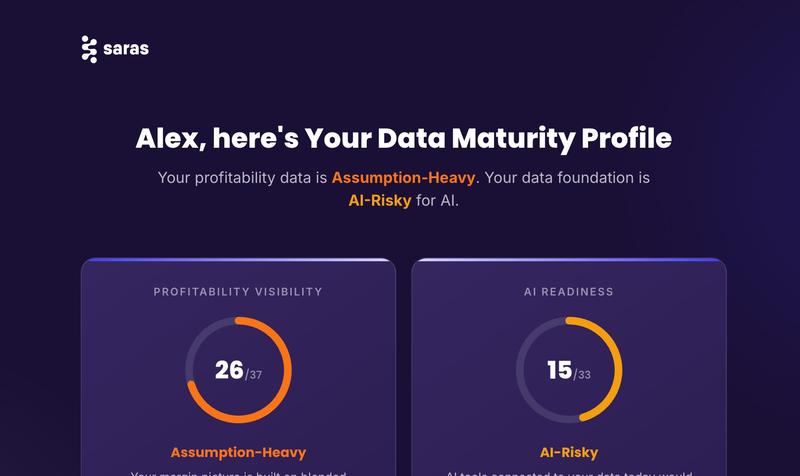
The Brutal Math Behind the Margin Hit
Discounting always feels smaller than it really is. When a brand runs a 20% promotion, the instinctive assumption is that profit simply shrinks by the same percentage. But the discount usually consumes a much larger portion of the margin.
Let’s consider a simple DTC example:
- Retail price: $100
- COGS: $50
- Gross profit: $50
At full price, the product carries a 50% gross margin.
Now apply a 20% discount.
New selling price: $80
The cost structure hasn’t changed:
COGS: $50
New gross profit: $30
Profit dropped from $50 to $30.
That means a 40% reduction in profit, even though the discount was only 20%.
The situation becomes worse when operational costs are included. Most eCommerce businesses also carry:
- pick-and-pack fees
- shipping subsidies
- payment processing charges
- marketing acquisition costs
If those costs add another $20 per order, the margin shrinks even further.
Full-price profit:
$100 – $50 – $20 = $30
Discounted profit:
$80 – $50 – $20 = $10
Now the same 20% discount destroyed two-thirds of the profit.
This is the core challenge behind any eCommerce discounting strategy. The revenue decline looks modest, but the discounting effect on profit margins is magnified because costs remain fixed.
The Volume Fallacy
The typical response to this margin loss is to sell more units. But the math often surprises operators. Using the example above:
- Profit before discount: $30 per order
- Profit after discount: $10 per order
To generate the same $3,000 in profit:
- Full-price scenario: 100 orders
- Discounted scenario: 300 orders
The promotion requires three times the volume just to break even.
That’s why understanding how discounts affect contribution margin in eCommerce is essential before launching any promotion. Volume alone cannot compensate for a broken margin structure.
Saras iQ: The AI Ecommerce Analyst for Shopify Brands Doing $20M+
Most Shopify brands at scale are making decisions from disconnected reports. Shopify, ad platforms, spreadsheets, all telling a different story. Saras iQ sits on top of a certified, AI-ready data foundation so your finance, marketing, and ops teams can ask business questions and get reliable answers instantly. No SQL. No hallucinations. No conflicting numbers.
What you can do with Saras iQ:
- Ask questions in plain English and get answers with visualisations, backed by SQL and business logic you can trace
- Get contribution margin, LTV, cohort analysis, and channel ROI on demand, without waiting for an analyst
- Flag issues and share insights to Slack, email, or Teams in one click
- Connect 200+ data sources including Shopify, Amazon, Meta, Google, and Klaviyo through a single AI-ready data layer
- Plug into Claude or any AI you already use via iQ MCP
Trusted by 200+ eCommerce brands doing $20M+.
How Discounts Destroy Your CAC and ROAS Thresholds
Discounts do more than shrink margins. They distort marketing metrics in ways that make campaigns appear far healthier than they are. The most obvious distortion happens in advertising dashboards.
The ROAS Trap
During a promotion, conversion rates often surge. Moderate discounts (10–25%) can increase eCommerce conversion rates by roughly 25–35%. Lower prices remove purchase hesitation, which makes paid campaigns look unusually efficient. ROAS climbs quickly because revenue per click increases. The problem is that revenue metrics ignore margin.
Suppose a brand normally sells a product for $100 with a $30 contribution margin and spends $20 on customer acquisition. The business still retains $10 per order after marketing.
During a 25% promotion, the selling price drops to $75. If the margin shrinks to $5, the campaign can no longer support the same acquisition cost.
Yet the ad platform reports strong performance because conversion rates increased. Marketing budgets expand even though the promotion quietly destroyed profitability.
This is the hidden impact of discounts on customer acquisition cost.
Distorted Customer Quality
Heavy promotions often attract a different customer segment entirely. Many shoppers drawn to steep discounts behave very differently from customers who buy at full price.
They tend to:
- purchase once during the sale
- avoid buying again until the next promotion
- show lower long-term retention
The immediate revenue spike hides the fact that these customers rarely become profitable over time.
Rising Operational Pressure
Discount promotions also create operational strain that quietly raises costs. Higher order volume increases packaging, shipping, and support workload. If those costs are not included in promotion analysis, teams underestimate the real margin impact.
Misleading Unit Economics
When promotions run frequently, the business begins optimizing around discounted economics rather than full-price performance. That gradually shifts the entire eCommerce discounting strategy toward dependency on promotions. Once that dependency forms, reversing it becomes extremely difficult.
💡 Real-World Profitability: Stop guessing on discounts. See how Bare Performance Nutrition (BPN) used unified data to stop margin leaks and drive an additional $900k in revenue.
The Cohort Degradation Effect (LTV Impact)
Discounts don’t only affect the economics of a single order. Over time, they shape customer behavior in ways that quietly eat the long-term value (LTV) of your audience.
A lot of DTC eCommerce businesses eventually notice the pattern: the more frequently promotions run, the harder it becomes to sell products at full price. Customers learn to wait.
Training Customers to Wait for the Next Sale: The Behavioral Effect of Discounting
Every promotion sends a signal to the market. When discounts appear predictably, such as holiday sales, weekend flash promotions, and clearance events, customers start to delay purchases until the next offer appears. What begins as a tactical promotion gradually becomes an expectation.
Over time, data shows this behavioral shift becomes widespread. Research found that 64% of online consumers say they prefer to wait for items to go on sale before making a purchase.
Consider a simple cohort comparison:
Cohort A – Full-price acquisition * Average first order value: $100
- Contribution margin per order: $30
- Repeat purchases in 6 months: 2
- Total 6-month revenue: $300
- Total contribution margin: $90
Cohort B – Discount acquisition * Average first order value: $80 (after discount)
- Contribution margin per order: $10
- Repeat purchases in 6 months: 1
- Total 6-month revenue: $160
- Total contribution margin: $20
Both cohorts initially appear healthy when measured only by first-order revenue. But when viewed through lifetime value, the difference becomes obvious. The discounted cohort generates less than one-quarter of the profit.
Cohort Analysis: Discount-acquired Customers vs Full-price Customers
To understand the real discounting effect on profit margins, eCommerce operators need to evaluate cohorts over time. The key question is simple: Did the promotion acquire customers who remain profitable once the discount disappears?
Tracking metrics such as repeat purchase rate, time to second order, and LTV-to-CAC ratio helps reveal whether a promotion created loyal customers or simply attracted bargain hunters.
If discounted cohorts consistently underperform full-price cohorts, the business may be funding revenue growth at the expense of long-term profitability.
Calculating Your Break-Even Discount Threshold
When it comes to deciding discounts, a much safer approach is to calculate the maximum discount a product can absorb before profitability disappears.
This number is called the break-even discount threshold. Once you know it, your eCommerce discounting strategy becomes far more disciplined.
Below is a step-by-step method to calculate it.
Step 1: Identify Your Contribution Margin Structure Start with the full-price economics of the product.
For example:
- Retail price: $120
- Variable costs:
- COGS: $60
- Shipping subsidy: $8
- Pick-pack and fulfillment: $5
- Payment processing: $3
- Total variable cost: $76
- Contribution margin: $120 – $76 = $44
- Contribution margin percentage: $44 / $120 = 36.7%
This margin represents the maximum economic buffer available before profit disappears.
Step 2: Calculate Your Break-Even Discount To determine the break-even discount, divide contribution margin by the retail price.
Using the example above:
- Break-even discount = 36.7%
That means any discount above 36.7% eliminates all contribution margin.
If the brand offers a 40% discount, the order becomes unprofitable before marketing costs are even considered. This calculation is essential when designing profitable discounts, because it reveals the limit beyond which promotions destroy unit economics.
Step 3: Adjust for Customer Acquisition Cost eCommerce orders also include marketing costs, and hence we need to factor them in.
Suppose the average acquisition cost is $20 per order.
- Updated contribution margin: $44 – $20 = $24
- Revised margin percentage: $24 / $120 = 20%
Now the break-even discount falls dramatically. Any discount above 20% eliminates profit entirely.
This illustrates why the discount impact on eCommerce unit economics can be so severe. Marketing costs shrink the margin buffer that promotions rely on.
Step 4: Simulate the Promotion Scenario Let’s test a real promotional scenario.
- Retail price: $120
- Discount: 25%
- New selling price: $120 × 0.75 = $90
- Variable costs remain unchanged:
- COGS: $60
- Shipping: $8
- Fulfillment: $5
- Payment processing: $3
- Total cost: $76
- New contribution margin: $90 – $76 = $14
- After marketing cost ($20 CAC): $14 – $20 = –$6
Each order now loses $6.
This is the type of analysis required when evaluating how to measure promotion profitability eCommerce environments accurately.
Step 5: Translate Margin Loss into Volume Requirements Finally, determine how much additional volume is required to offset the reduced profit per order.
- Full-price profit per order: $24
- Discounted profit per order: –$6
Because the promotion now produces a loss, increasing volume will not recover profitability. The campaign must either:
- reduce CAC
- increase price
- reduce discount depth
- or improve product margin
Understanding this threshold protects teams from running promotions that appear successful but quietly destroy margin.
This is the foundation of any disciplined eCommerce discounting strategy. Once operators know the break-even point for each SKU, they can design promotions that stimulate demand without sacrificing profitability.
Strategies to Run Profitable Promotions
A disciplined eCommerce discounting strategy treats promotions as controlled financial instruments rather than emotional reactions to slow sales or competitive pressure.
Below are several approaches operators use to design profitable discounts while protecting contribution margin.
1. Use Threshold Offers to Protect Margin Dollars
One of the simplest ways to reduce the damage of a promotion is to tie the discount to a minimum cart value.
For example: “Spend $100, get 20% off.”
At first glance, this looks like a typical promotion. But it changes the economics of the transaction. Instead of discounting a single product with limited margin, the promotion encourages customers to increase their basket size.
Consider the following example.
Average single product order:
- Retail price: $60
- Contribution margin: $20
- If a 20% discount is applied:
- Discounted price: $48
- New margin: $8
Now compare it with a threshold offer.
Customer adds two products to reach $120.
- Retail value: $120
- 20% discount: $24
- Discounted revenue: $96
- Total contribution margin before discount: $40
- After discount: $16
While margin still decreases, the promotion now covers operational costs and avoids collapsing unit economics. Threshold-based promotions are therefore a powerful tool in a sustainable ecommerce discounting strategy because they shift the focus from price reduction to basket expansion.
2. Use Product Bundling to Protect Blended Margin
Bundling works particularly well for catalogs with uneven margin distribution. Many eCommerce businesses carry a few high-margin items alongside slower-moving products that have lower profitability.
Instead of discounting a single SKU, bundling allows brands to combine products strategically.
For example:
Product A * Retail price: $80
- Contribution margin: $35
- Product B * Retail price: $40
- Contribution margin: $10
Individually discounted, Product B would barely survive a promotion. However, when bundled together:
- Bundle price: $100
- Total revenue: $100
- Total cost: $75
- Contribution margin: $25
The blended structure protects profitability while still offering perceived value to the customer. This approach is frequently used by brands trying to manage the discounting effect on profit margins without damaging the economics of their core products.
3. Apply Discounts Only to Margin-Resilient SKUs
A common mistake during promotional events is applying the same discount percentage across the entire catalog. However, not every product can absorb the same margin reduction. Some SKUs have enough built-in margin to withstand a discount. Others do not.
A simple screening framework helps identify eligible products:
- Calculate contribution margin per SKU
- Subtract average acquisition cost
- Determine the break-even discount threshold
- Exclude SKUs that cannot absorb the promotion
Without SKU-level filtering, the promotion would unintentionally turn profitable products into loss leaders.
4. Replace Sitewide Discounts with Tiered Promotions
Another way to protect margin is to avoid sitewide discounts entirely. Instead, use tiered promotions that reward larger purchases.
Example structure:
- Spend $75 → 10% off
- Spend $120 → 15% off
- Spend $180 → 20% off
This approach gradually increases the discount while ensuring that additional revenue covers variable costs. It also encourages customers to add incremental products to reach the next threshold.
5. Align Promotions with Inventory Strategy
Discounts should also serve operational goals. When used correctly, they help move inventory that is tying up capital without undermining the entire catalog’s margin structure.
Consider two scenarios.
Scenario one: A brand applies a 25% discount across the entire store.
Scenario two: The brand discounts only slow-moving SKUs that have been in storage for 120 days while keeping high-performing products at full price.
The second approach protects overall profitability while reducing holding costs and freeing warehouse space.
In other words, a disciplined eCommerce discounting strategy should treat promotions as an inventory management tool, not merely a revenue accelerator.
6. Set Promotion Guardrails Before the Campaign Launches
Perhaps the most important step in running profitable discounts is establishing financial guardrails before the promotion begins. Teams should answer several questions in advance:
- What is the maximum discount each SKU can absorb?
- What CAC threshold must marketing stay within during the promotion?
- What minimum contribution margin must each order generate?
- What sales volume justifies the promotion economically?
These constraints prevent promotions from drifting into unprofitable territory once the campaign begins.
Conclusion
A thoughtful eCommerce discounting strategy treats promotions as financial decisions rather than marketing tactics. Every discount should be evaluated against contribution margin, acquisition costs, and long-term customer value. When those numbers remain healthy, promotions can accelerate growth. When they do not, the revenue surge is little more than a temporary sugar rush.
Saras iQ gives eCommerce operators the visibility required to make those decisions confidently. By unifying marketing, finance, and operational data into a single profitability model, Saras iQ reveals the real economics behind every discounted order.
Stop relying on siloed spreadsheets. Get the contribution margin intelligence platform that reveals the true cost of your discounts. Talk to our data consultants today!

.webp)
.svg)
%201%20(1).svg)











.jpg)


%20Statistics%20in%202026.jpg)





%20Software%20for%20DTC%20Brands%20in%202026.png)







%20Setup%20Guide%20for%20Ecommerce%20Finance%20Team.png)

























.webp)

.webp)
.webp)
.webp)
.webp)