eCommerce leaders rarely question their daily profitability numbers when things look good. The assumption is simple: if margins looked healthy yesterday, the business must still be healthy today.
The problem is that the daily ecommerce contribution margin is usually built on operational data timing, rather than financial truth. What appears to be ‘precise profitability’ is often a partial view shaped by when systems update. In practice, this means many growth decisions rely on visibility that feels complete but is still evolving beneath the surface. This growing gap between perceived and real profitability is why many leadership teams now see data quality as the highest ROI lever in the business.
Brands operating on provisional margins that will later be revised (often called contribution margin restatements) face uncertainty across teams, which undermines confidence in decision-making. Leaders feel it as volatility, finance as reconciliation friction, and growth teams as unexpected performance swings.
This article unpacks why daily margins diverge from final numbers, where the structural gaps originate, and what organizations can do to achieve decision-grade contribution margin visibility that remains stable even after close.
Is your data actually Decision-Grade?
9 questions. 3 minutes. Score your Profitability Visibility and Readiness for AI-driven growth.
Start Free Diagnostic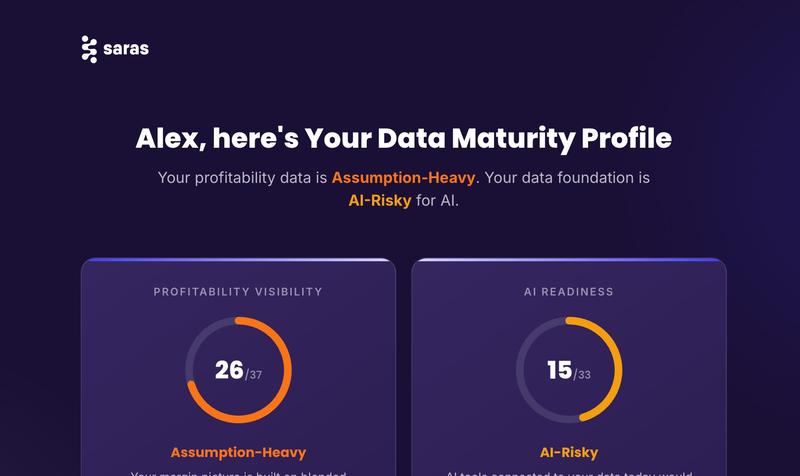
The Anatomy of a Month-End Break
A contribution margin shift during month-end close happens because different parts of the business recognize financial impact at different speeds.
While operations move fast, accounting moves when documentation is complete, and that is the gap where the break starts.
Why Daily Margin Looks Stable During the Month
During the month, most performance signals appear immediately. For example:
- Shopify records revenue the moment an order is placed.
- Marketing platforms show spend on a continuous basis.
- Fulfillment systems confirm shipments quickly, and inventory decrements in near real time.
If you are running a $20M DTC business, these systems together create a convincing narrative: revenue is known, marketing cost is known, units shipped are known, therefore margin must also be known.
But that assumption quietly ignores how cost recognition works in finance.
The largest cost components do not follow operational timelines.
Where the Timing Gaps Actually Come From
Several major cost categories arrive later than the activity they belong to:
- Carrier invoices post after delivery windows close
- 3PL billing cycles close weekly or monthly
- Inventory valuation updates only after supplier invoices reconcile
- Payment processor fees finalize after settlement adjustments
- Returns processing creates retroactive revenue and cost changes
- Finance posts accruals and corrections during close
By the time these costs land, the economics of transactions recorded earlier in the month have already shifted.
This is the core driver behind what operators often call the Shopify margin vs P&L difference. Both views reference the same orders, but they just reflect different cost states.
Example: How a Profitable Order Turns Negative During Close
Consider an eCommerce brand doing roughly $1.7M monthly revenue (~$20M annual run rate).
June 3 A customer places a $120 order.
Operational view on June 3:
- Revenue recorded: $120
- Product cost estimate: $42
- Paid media attribution: $28
- Estimated fulfillment + shipping: $18
Daily dashboard shows contribution margin ≈ $32.
Everything looks healthy.
June 8 Order ships. Carrier cost is still estimated using rate cards.
No financial change yet.
June 17 Carrier surcharges update due to zone adjustment and fuel index changes.
Actual shipping cost becomes $24 instead of $18.
No dashboard correction yet.
June 24 Customer initiates a return.
Operational systems may flag the return, but financial reversal is not finalized.
July 2 3PL invoice arrives covering late-June shipments with handling adjustments.
Pick/pack cost increases by $1.80 per order across the batch.
July 5 Payment processor settlement confirms blended fee higher due to international card mix.
Fees increase by ~1.2%.
July 7 — Month-End Close Finance posts:
- Updated shipping costs
- 3PL invoice allocation
- Processor fee adjustments
- Return revenue reversal
- Inventory revaluation impact
Final contribution margin for that June 3 order is now negative $6. At scale, thousands of transactions go through this same pattern every month.
💡 See It In Action: Wondering how scaling brands avoid these late-stage margin shocks? See how True Classic eliminated delayed reporting and automated their data stack to secure real-time profitability insights.
👉 Read the True Classic Case Study
Why Platform-First Data Creates a Revenue-First Illusion
Even without timing delays, many eCommerce dashboards start from the wrong foundation.
Commerce platforms like Shopify and Amazon are designed around transactions and revenue capture. Their data structures prioritize orders, payments, and customer events. Cost elements exist, but they are secondary objects; and these are often estimated, incomplete, or dependent on external systems.
This creates what finance teams informally call a “revenue-first” view of the business.
Revenue is precise, but costs are approximated.
For example:
- Product cost may come from static standard COGS instead of landed cost
- Shipping may rely on rate tables instead of carrier invoices
- Returns may be excluded until processed
- Marketing attribution may not reflect blended acquisition cost
- Fulfillment complexity surcharges may not exist in the model at all
From a finance perspective, this is dirty data, because the data is incomplete relative to financial truth.
The Two Forces Behind Month-End Margin Breaks
Most month-end contribution margin variance comes from two compounding effects:
- Timing distortion — costs arrive after activity
- Modeling distortion — some costs were never fully captured in the operational view
When both occur together, daily margin appears stable during the month and then shifts materially during close.
7 Reasons Your Daily Margin Truth Changes During Close
Understanding the structural causes behind the changes is critical if you want to avoid contribution margin restatements and margin volatility. Below are the seven mechanisms that most commonly shift margin after reconciliation.
1. Refunds, Returns, and Chargebacks Timing
Returns are one of the largest drivers of margin distortion because they almost never occur in the same accounting window as the original sale. Industry data shows that roughly 17% of retail sales are returned, meaning a significant portion of revenue is inherently subject to later reversal.
A product sold on June 28 may be returned on July 12. A chargeback may appear weeks later. Exchange processing may create additional shipping and handling costs that were not included in the original daily contribution margin report.
During month close, finance recognizes these events against prior revenue periods, which immediately changes profitability for earlier dates. This is why operators often see strong daily performance followed by unexpected margin compression later.
The returns impact on eCommerce profitability is especially severe in categories with high return rates such as apparel, supplements, or subscription replenishment models.
2. Shipping and Fulfillment Cost Finalization
Shipping is frequently estimated at the time of order. However, the true cost often arrives later. Carrier invoices typically include:
- zone adjustments
- dimensional weight corrections
- fuel surcharges
- address correction fees
- peak season surcharges
Third-party logistics providers may also finalize pick-and-pack charges after reconciliation cycles. These costs are rarely captured accurately in daily dashboards.
When invoices post during the eCommerce month end close, finance replaces estimated fulfillment costs with actuals, which changes SKU-level and order-level contribution margin.
This is one of the most common sources of margin variance during month-end close for scaling brands.
3. Inventory and Landed Cost Adjustments
We all know that COGS is not always stable. Inventory costs fluctuate because of multiple reasons, and some of them are:
- freight variability
- tariff changes
- supplier price shifts
- batch-level manufacturing differences
- currency movements
- duty and import adjustments
Many brands operate daily reports using static COGS assumptions. Finance, however, updates inventory valuations once final landed cost data becomes available.
When those adjustments hit the ledger, contribution margin shifts retroactively. The larger the inventory complexity, the greater the variance between daily eCommerce contribution margin and reconciled results.
COGS timing issues eCommerce finance teams deal with are rarely visible to marketing or growth leaders, which contributes to internal confusion.
4. Marketing and Customer Acquisition Cost Timing
Marketing spend does not always align perfectly with revenue timing.
Ad platforms post costs continuously, but attribution and allocation often settle later. Some costs appear after billing reconciliation. Others are distributed across cohorts or campaigns after performance analysis.
For example:
- agency fees may be booked monthly
- influencer payments may be delayed
- affiliate commissions may settle weeks later
- CAC allocations may be adjusted across channels
During close, finance applies finalized marketing costs to the correct periods, which can materially change contribution margin for earlier dates.
This explains why daily contribution margin reports that rely on estimated Customer Acquisition Cost (CAC) frequently diverge from final results.
5. Platform, Payment, and Marketplace Fee Reconciliation
Shopify, Amazon, payment gateways, and marketplaces provide estimated fee views during daily operations. The final settlement rarely matches those estimates exactly.
Fee adjustments can include:
- transaction fee corrections
- payment processing differences
- refund processing charges
- currency conversion costs
- platform incentive reversals
- dispute fees
Once final payouts reconcile, finance replaces provisional fee estimates with actual amounts, which affects profitability.
The Shopify margin vs P&L difference many operators observe often originates in this reconciliation step.
6. Accounting Accruals and Close Adjustments
Finance teams apply accrual logic that daily operational dashboards typically ignore. Accruals may include:
- prepaid marketing expenses
- subscription revenue deferrals
- inventory reserves
- chargeback reserves
- warehouse contract true-ups
- promotional liabilities
These adjustments ensure financial statements follow accounting standards, but they also change profitability views compared to daily operational metrics.
During eCommerce month end close, these entries can create noticeable shifts in contribution margin, especially for brands with subscriptions, promotions, or inventory financing structures.
7. Data and System Alignment Corrections
Even when numbers are technically correct, systems may not agree. eCommerce businesses operate across multiple platforms:
- Shopify or storefront systems
- ERP or accounting software
- fulfillment systems
- marketing platforms
- subscription tools
During reconciliation, teams often discover:
- missing orders
- duplicate transactions
- incorrect SKU mappings
- delayed integrations
- attribution mismatches
These alignment corrections adjust previously reported data and trigger contribution margin restatement events.
This category is less visible but extremely important. Without strong data governance and integration infrastructure, margin becomes unstable by definition.
The High Cost of “Restated” Profits
When daily eCommerce contribution margin later changes during the month end close, the business does not simply update a spreadsheet. Instead, it recalibrates decisions that were already made.
Marketing may have scaled campaigns based on margins that never actually existed.
Operations may have reordered inventory based on profitability assumptions that later disappear.
Finance must explain variance to leadership after the fact, which weakens confidence in reporting across departments.
This disconnect creates friction that extends far beyond accounting.
Budget waste is often the first visible symptom
If a SKU appears profitable in a daily contribution margin report, growth teams increase spend behind it. When reconciled costs arrive later and margins drop, the budget has already been deployed. Recovering that lost efficiency is difficult because marketing decisions compound quickly.
C-suite tension follows
Finance teams prioritize accuracy and reconciliation discipline, while growth teams prioritize speed and responsiveness. When numbers diverge, leadership discussions shift away from strategy toward debate over whose version of profitability is correct.
Decision lag becomes the most damaging consequence
Some brands delay performance adjustments until the eCommerce month end close finishes, effectively operating with a two-week blind spot. Others continue acting on provisional numbers, accepting the risk of later corrections. Neither approach supports scalable growth.
Avoiding month-end margin surprises requires more than faster reporting. It requires changing how margin is calculated and validated throughout the month.
💡 Real-World Impact: Fixing your data foundation directly impacts revenue. Learn how Saras Analytics helped BPN drive an additional $900k in revenue by unifying their reporting and decision-making data.
How to Achieve Decision-Grade Daily Margins
To solve margin variance, you have to start with data architecture. The goal is to ensure that daily eCommerce contribution margin reflects finance-approved logic continuously.
Here are four structural shifts that make it possible.
1. Automate Order-Level Auditability
Every cost component tied to an order must remain traceable throughout its lifecycle. This includes product cost, shipping expense, payment fees, returns, and promotional adjustments.
When costs connect directly to order records, margin calculations remain transparent even as new data arrives. Late adjustments update prior orders automatically rather than creating separate reconciliation layers. This reduces the likelihood of a contribution margin restatement because the system absorbs corrections in real time.
Order-level auditability also supports real-time contribution margin tracking across channels and fulfillment nodes without relying on estimated averages.
2. Unify the Data Foundation
Fragmentation remains the root cause of most reconciliation challenges. Shopify, ERPs, 3PL platforms, advertising systems, and accounting software each contain partial cost signals. When those systems do not synchronize continuously, teams must manually align data during the eCommerce month end close.
A unified foundation consolidates transactional, operational, and financial data into one model. Instead of exporting spreadsheets and performing manual joins, the system maintains consistency automatically.
This approach addresses one of the most persistent challenges organizations face: how to unify financial numbers across departments without relying on manual intervention.
Once systems operate from a single source of truth, financial reconciliation across multi-systems becomes a validation process rather than a reconstruction exercise.
3. Implement SKU-Level Micro-P&Ls
Aggregate margin reporting hides profitability volatility. Different SKUs carry different cost structures, shipping profiles, and acquisition economics. Without SKU-level profitability micro-P&Ls, daily eCommerce contribution margin becomes an average that obscures risk.
Micro-P&Ls allow teams to identify margin compression immediately when costs shift. If shipping costs rise for a specific product category or return rates increase for a promotional cohort, the impact becomes visible before the eCommerce month end close reveals it.
This level of granularity transforms margin analysis from retrospective reporting into operational intelligence.
4. Align Decision and Reporting Cadences
Most organizations operate with mismatched cadences. Marketing decisions happen daily. Finance validation happens monthly. Operations planning happens weekly. When financial truth arrives after decisions occur, alignment breaks down.
Aligning cadences means building systems where daily margins follow finance logic continuously. Finance does not lose control over accounting standards, and growth teams do not lose speed. Both operate from the same numbers.
This alignment eliminates the recurring Shopify margin vs P&L difference that creates confusion across teams. When daily numbers match financial reality, leaders can act without waiting for reconciliation cycles to finish.
Saras iQ: The End of Month-End Surprises
Most analytics tools attempt to improve visibility without fixing the underlying reconciliation problem. Saras iQ approaches margin accuracy differently. It focuses on creating a continuously reconciled financial model that stays aligned with accounting logic throughout the month.
The core objective is straightforward: daily eCommerce contribution margin should not change when the eCommerce month end close finishes. When numbers remain stable across reporting cycles, teams gain confidence to act earlier and more aggressively.
Saras iQ achieves this by unifying operational, marketing, and financial data into a single framework that applies finance-approved rules automatically.
Daily Contribution Margin Without Waiting for Close
Saras iQ connects storefront transactions, fulfillment data, advertising spend, payment fees, and accounting inputs into one environment with automated refreshes. Costs that typically arrive late, such as shipping adjustments or platform fees, attach directly to historical orders as soon as they become available.
This process reduces margin variance during month-end close because the system continuously absorbs new information rather than forcing large corrections at the end of the period.
A Single Reconciled Truth Across Teams
Fragmented tools often produce competing versions of profitability. Saras iQ establishes a single source of truth for financial data by applying consistent contribution margin logic across all functions. When growth teams analyze performance, they are working from the same cost structure finance uses for reporting.
This alignment removes recurring debates about whose numbers are correct and allows leadership to focus on decisions rather than reconciliation.
Custom Contribution Margin Logic That Matches Your Business
Every eCommerce company calculates margin differently. Some include fulfillment labor in contribution margin. Others treat it as overhead. Subscription businesses may allocate customer acquisition costs differently than one-time purchase brands.
Saras iQ accommodates these variations by allowing customized CM layers, including CM1, CM2, and CM3 definitions tailored to each business model. Instead of forcing teams into rigid templates, the platform mirrors the financial structure already used by finance leadership.
This flexibility ensures that daily eCommerce contribution margin remains consistent with internal accounting policies, eliminating surprises during the eCommerce month end close.
Preparing for Predictive Profitability
Accurate historical data creates the foundation for forward-looking decisions. When contribution margin calculations remain stable, organizations can begin modeling scenarios such as allowable CAC thresholds, pricing optimization, and inventory planning with greater confidence.
Clean, reconciled data also supports predictive analytics initiatives by reducing noise in the underlying inputs. Without reliable margin data, predictive models inherit inaccuracies that undermine their usefulness.
💡 Optimize Inventory with Clean Data: Discover how Greater Than improved their inventory management and operational reporting using a unified data layer.
👉 Read the Greater Than Case Study
Wrapping Up
Scaling a modern eCommerce business requires more than visibility. It requires confidence in the numbers guiding decisions. When daily eCommerce contribution margin behaves like an estimate rather than a reconciled metric, organizations slow down. Leaders hesitate to increase spend. Finance delays approvals. Growth teams rely on instinct instead of data.
It is possible to eliminate that uncertainty by aligning daily performance data with finance-grade accounting logic. Instead of waiting for the eCommerce month end close to validate profitability, teams can operate with decision-grade insights throughout the month.
When contribution margin becomes stable, predictable, and trusted across departments, companies gain a significant competitive advantage.

.webp)
%201%20(1).svg)
.svg)






%20Software%20for%20DTC%20Brands%20in%202026.png)














%20Setup%20Guide%20for%20Ecommerce%20Finance%20Team.png)




























.webp)


.webp)
.webp)
.webp)
.webp)












.webp)





.webp)










.webp)