
Polar Analytics is a strong analytics platform for Shopify-native DTC brands. Clean dashboards, solid multi-touch attribution, a well-rated support team, and fast setup make it a reliable fit for brands running primarily on Shopify. Most brands evaluating Polar Analytics alternatives have outgrown what Polar was designed for: marketing-focused analytics, reporting-first architecture, and a pricing model that climbs as GMV increases.
But the gap widens when the business needs unified data across multiple sales channels. In such situations, the real question is no longer which channel drove revenue, but which channel drove profitable revenue.
The answer depends on what you need your analytics platform to do. Some brands simply need better attribution and marketing reporting. Others need a unified view of marketing, operations, and finance to understand contribution margin and overall business performance.
This article covers the strongest Polar Analytics alternatives in 2026, organized by the specific reason you're considering a switch.
Is your data actually Decision-Grade?
9 questions. 3 minutes. Score your Profitability Visibility and Readiness for AI-driven growth.
Start Free Diagnostic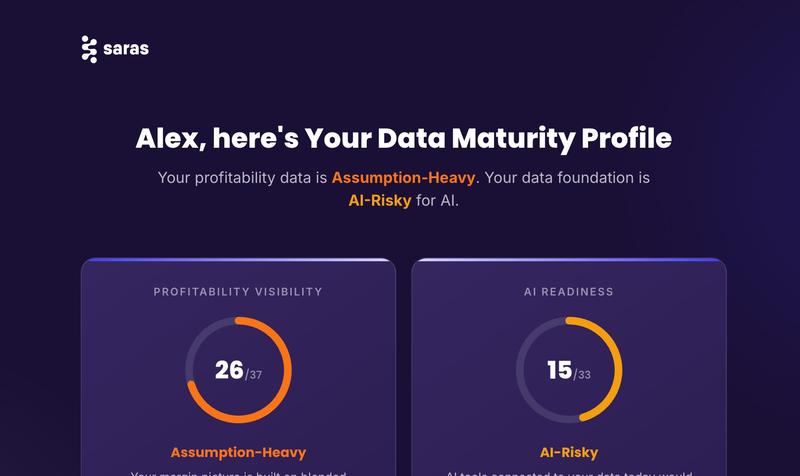
What Polar Analytics Does Well and Where It Falls Short
Polar Analytics is a Shopify-native analytics platform that centralizes marketing data, attribution, and cohort analysis into customizable dashboards. It performs well for Shopify-native brands whose primary analytics requirements revolve around attribution, campaign reporting, and eCommerce performance monitoring.
The limitations surface when brands scale past a certain threshold and need deeper integration across eCommerce, ERP, finance, wholesale, and operational systems, true profitability analytics, or greater control over their data warehouse.
Where Polar Analytics Delivers for Shopify Brands
Any credible list of Polar Analytics alternatives needs to start with what Polar does well, because the tool earns its reputation.
- Polar offers customizable dashboards that non-technical operators can configure without writing SQL.
- It offers multi-touch attribution powered by a first-party Polar Pixel and Conversion API Enhancer for post-iOS accuracy.
- You also get Shopify-native architecture that gets most brands operational within 48 to 72 hours.
- Customer support consistently scores among the highest in the ecommerce analytics category, rated 9.5 out of 10 on G2.
Five Limitations That Trigger the Search for Polar Alternatives
The brands searching for Polar Analytics competitors are typically hitting one or more of five limitations.
1. Analytics run in Polar's managed environment. As brands get more technically sophisticated, they often want analytics to run directly in their own cloud environment. Polar provisions a dedicated Snowflake instance for each customer with SQL access and data export capabilities, but teams that need to extend models, connect additional internal systems, or build AI applications often prefer a customer-managed data foundation that they control end to end.
2. Pricing scales with GMV. Polar Analytics uses GMV-based pricing that increases as revenue grows. While entry-level pricing starts around $750/month for smaller brands, costs rise with higher GMV tiers, making pricing an important consideration for larger eCommerce businesses. Independent estimates put the cost above $1,000 per month for brands at $6M+ in annual revenue.
3. Built for eCommerce reporting, not data infrastructure. Polar Analytics is purpose-built for eCommerce reporting and performs best when most decision-making happens inside marketing and Shopify data. As brands add ERP systems, custom profitability models, operational reporting, and AI use cases, they often need a more extensible analytics architecture than a reporting-first platform can provide.
4. Finance-grade profitability requires broader data integration. Polar calculates profitability metrics from marketing and eCommerce data, including ad spend, returns, fulfillment costs, and contribution margin. Where it differs from a finance-grade contribution margin model is in connecting that view to ERP-sourced COGS, channel-specific fee structures, and wholesale or B2B operational data outside the marketing layer.
5. Cross-functional customization has limits. Polar's strength is marketing analytics. When finance needs custom contribution margin definitions, when customer analytics needs segment-level profitability tied to cohort data, and when the executive team needs board-grade KPIs spanning marketing, operations, and finance simultaneously, the platform's flexibility starts to show its limits.
Key Insight: A recurring pattern among larger eCommerce brands is that the analytics conversation eventually shifts from reporting to ownership. Once teams start asking how to connect profitability, operations, and AI initiatives to the same data foundation, warehouse control and extensibility often become more important than dashboard features alone.
The Best Polar Analytics Alternatives in 2026
Every eCommerce analytics alternative to Polar fills a different gap. The right choice depends on whether you need cheaper attribution, deeper attribution, better retention analytics, or a different kind of data architecture that connects marketing spend to the full P&L.
Saras iQ: Best Overall Alternative for Profitability and Full P&L Analytics
Among Polar Analytics alternatives, Saras iQ occupies a different category. Polar Analytics, Triple Whale, and Northbeam are marketing analytics platforms designed to optimize attribution and marketing performance. Saras iQ extends that view by connecting marketing performance with ERP, finance, and operational data to measure profitability across the business. That distinction takes a different data architecture underneath.
Contribution margin by channel, SKU, cohort
Saras iQ connects marketing performance data to COGS, fulfillment costs, shipping, returns, and payment fees at the order level to produce contribution margin by channel, by SKU, and by customer cohort.
.png)
LTV tied to margin
Beyond profitability, Saras iQ delivers cohort analysis and LTV by acquisition channel tied to margin rather than just revenue. Customer segments linked directly to profitability data change how you evaluate retention campaigns, because a high-LTV cohort that costs more to serve than it returns in margin looks very different when you can see both sides. The platform covers Shopify, Amazon, 3PL, ERP, wholesale, and subscription data in one unified foundation.
Your own warehouse
Your analytics sit on your own BigQuery or Snowflake instance rather than a vendor-managed environment. Your data team owns the warehouse, the schema, and the business logic. They can extend models, connect additional internal systems, and build AI use cases directly on top of certified data without hitting a vendor's architectural boundary.
AI analyst layer
The platform's AI eCommerce analyst layer lets leadership ask cross-functional questions in plain language with every answer traceable to the governed data model. Metric definitions are enforced centrally through an AI-ready data foundation and semantic layer, so the CMO and CFO see the same number without reconciliation.
Ridge adopted Saras iQ as the foundation for a company-wide analytics layer spanning marketing, product, finance, and operations. By standardizing metric definitions and connecting teams to a shared data foundation, the company reduced analysis turnaround time from 10 days to 45 minutes and enabled AI-driven access to trusted business data. Read the full case study →
Best for: Brands at $15M+ revenue running across multiple channels where the question is no longer "what is our ROAS" but "which channel is actually profitable." Also the right fit for teams that want to own their data warehouse and build on top of it rather than renting a vendor's environment.
Pricing: Contact Saras Analytics for pricing.
Triple Whale: Best for Shopify Brands at Lower Cost
The most direct Polar Analytics vs Triple Whale comparison comes down to price and product direction. Both are Shopify-native attribution platforms with similar core feature sets: first-party pixel tracking, multi-touch attribution, customizable dashboards, and cohort analysis. Triple Whale undercuts Polar significantly with a free plan and paid tiers starting at roughly $219 per month on annual commitment, compared to Polar's $750 per month starting range.
G2 reviewers rate Triple Whale higher on product direction and generative AI capabilities, where its Moby AI assistant handles natural-language queries for daily reporting. Polar wins on customer support quality (9.5 versus 8.9 on G2) and slightly cleaner dashboard administration. Over 50,000 Shopify brands currently use Triple Whale, giving it the largest user base in the Shopify analytics category.
Best for: Shopify-only brands under $50K per month in ad spend that want accessible attribution without Polar's price tag.
Pricing: Free plan available; paid plans from $219 per month (annual commitment).
Northbeam: Best for Attribution Depth at High Ad Spend
The Polar Analytics vs Northbeam comparison is less about features and more about category. Where Polar and Triple Whale compete on similar capabilities at different price points, Northbeam operates at a different level of attribution rigor. Its ML-powered multi-touch attribution, deterministic view-through tracking (launched late 2025 in partnership with Meta and TikTok), and MMM+ triangulation produce more reliable independent signals than pixel-based approaches for brands running complex media mixes.
Northbeam requires meaningful ad spend volume to justify the investment and the onboarding timeline. The platform starts at $1,500 per month, needs 2 to 4 weeks of calibration before models produce reliable output, and works best when a dedicated media buyer is actively using the data for budget allocation decisions. Brands spending under $20K per month on ads won't generate enough conversion data for Northbeam's ML models to produce actionable results.
Best for: Brands spending $50K+ per month on paid media across Meta, Google, TikTok, and CTV that have outgrown Polar's attribution depth and need creative-level granularity with incrementality validation.
Pricing: From $1,500 per month (Starter); Professional plans for $250K+ monthly spend are custom-quoted.
Lifetimely: Best for LTV and Cohort Depth
Lifetimely is the specialist pick when the primary need is customer lifetime value and cohort analytics rather than campaign attribution. It combines a real-time P&L dashboard with predictive LTV modeling, cohort analysis segmented by CAC payback and retention curves, and channel-level analytics at a price point that makes every other tool on this list look expensive for its specific use case.
The tool holds a 4.8 out of 5 rating on the Shopify App Store with over 400 reviews. The limitation is scope: Amazon integration remains a frequently cited pain point in reviews, non-Shopify platform support is limited, and the tool is better suited for retention analytics than campaign attribution or full profitability reporting.
Best for: Shopify DTC brands under $10M that want LTV, cohort analysis, and retention analytics as their primary focus.
Pricing: Free plan available; paid plans from $79 per month.
ThoughtMetric: Best for Smaller Budgets Needing Accurate Attribution
For brands evaluating Polar Analytics alternatives on budget alone, ThoughtMetric covers the core attribution use case reliably. Server-side tracking, multi-touch attribution across Shopify, WooCommerce, BigCommerce, and Magento, five attribution models, post-purchase survey integration, and clean attribution reporting at $99 per month.
Dashboard customization is lighter than Polar's, and analytics depth does not extend into profitability, cohort, or LTV territory. ThoughtMetric is a focused attribution solution for a specific stage and budget, not a broad analytics platform.
Best for: Early-stage brands under $1M revenue that need independent, privacy-safe attribution without enterprise pricing. Also a viable option for agencies managing multiple smaller stores.
Pricing: From $99 per month; 14-day free trial available.
Platform Comparison
| Platform | Best For | Starting Price | Key Strength | Primary Limitation | Data Ownership |
|---|---|---|---|---|---|
| Polar Analytics | Shopify-native brands focused on attribution and reporting | ~$750/mo | Strong attribution, cohort analysis, customizable dashboards, excellent support | Limited profitability analytics and cross-functional reporting | Vendor-managed |
| Saras iQ | Brands needing contribution margin and full P&L visibility | Custom | Contribution margin by channel, omnichannel analytics, warehouse-first architecture, AI-ready data foundation | More infrastructure-oriented than lightweight reporting tools | Customer-owned |
| Triple Whale | Shopify brands seeking lower-cost attribution | From $219/mo | Affordable attribution, first-party tracking, large Shopify ecosystem | Limited beyond marketing analytics | Vendor-managed |
| Northbeam | Brands spending $50K+ monthly on advertising | From $1,500/mo | Advanced attribution, MMM, incrementality testing, creative-level analysis | Requires significant ad spend and onboarding effort | Vendor-managed |
| Lifetimely | Brands focused on LTV and retention analytics | From $79/mo | Predictive LTV, cohort analysis, retention reporting | Limited omnichannel coverage and attribution depth | Vendor-managed |
| ThoughtMetric | Early-stage brands needing affordable attribution | From $99/mo | Privacy-focused attribution, server-side tracking, low cost | Limited profitability, cohort, and financial analytics | Vendor-managed |
How to Choose Among Polar Analytics Alternatives
The best Polar Analytics alternative depends entirely on which ceiling you have hit. For teams evaluating Shopify analytics alternatives in 2026, this framework maps each switching trigger to the right tool.
| Reason for Switching | Best Alternative | Why |
|---|---|---|
| Pricing too high at current stage | Triple Whale or ThoughtMetric | Similar Shopify attribution at $99 to $219 per month vs. Polar's $750+ |
| Need deeper attribution for $50K+ monthly ad spend | Northbeam | ML-powered MTA, creative-level analytics, and incrementality testing |
| Need LTV and cohort analytics as primary focus | Lifetimely | Predictive LTV, cohort segmentation, and retention analytics from $79 per month |
| ROAS reporting can't tell you whether you are profitable | Saras iQ | Contribution margin by channel, SKU, and cohort connecting marketing to the full P&L |
| Need Amazon, 3PL, and ERP data alongside Shopify | Saras iQ | Omnichannel coverage across Shopify, Amazon, 3PL, ERP, wholesale, and subscription data |
| Need to own your data warehouse and build on top of it | Saras iQ | Analytics delivered on your own BigQuery or Snowflake, not a vendor-managed instance |
Watch for this signal: If your CFO and CMO consistently arrive at different numbers for the same metric in the same meeting, the problem is architectural. Switching between Polar Analytics alternatives in the marketing dashboard category won't close that gap. A platform like Saras iQ that enforces metric definitions across the entire organization fills it because the consistency lives in the data layer, not the reporting layer.
Conclusion
Polar Analytics is a good tool for the right brand at the right stage. The brands evaluating Polar Analytics alternatives have typically outgrown what it was designed for, and the right move depends on which ceiling triggered the search.
For brands where ROAS stopped being the right question, where the business now needs contribution margin by channel, LTV tied to profitability, and full P&L visibility across every sales channel, Saras iQ was built for exactly that transition. It connects marketing performance to the financial outcomes that every marketing-only tool leaves incomplete.
Talk to the Saras Analytics data consultants to build an analytics foundation for profitable growth.

.svg)
.webp)
%201%20(1).svg)















.jpg)




%20Statistics%20in%202026.jpg)



%20Software%20for%20DTC%20Brands%20in%202026.png)






%20Setup%20Guide%20for%20Ecommerce%20Finance%20Team.png)

























.webp)

.webp)
.webp)
.webp)
.webp)