In the eCommerce domain, marketers spend millions across ads, influencers, email, and partnerships. However, many still struggle to answer the most burning question: which campaigns actually drive revenue?
With U.S. ad spend projected to reach $422 billion in 2025 and eCommerce brands allocating 10–20% of revenue to marketing, the stakes are higher than ever.
Fortunately, marketing campaign analytics can provide you with the answers you need. The analytics can help you transform campaign performance analysis from vanity metrics like clicks and impressions into revenue- focused insights.
What is Marketing Campaign Analytics
Marketing campaign analytics is the discipline of tracking, analyzing, and optimizing campaign performance across multiple channels with a revenue-first perspective. Unlike surface-level reporting, which stops at engagement, true analytics ties every dollar of spend to outcomes such as customer acquisition, retention, and lifetime value.
Campaign analytics depends on three elements:
- Data sources: ad platforms, CRM, ecommerce, subscription systems, and customer support.
- Metrics: performance KPIs aligned to campaign goals such as CAC, CLV, churn, and incremental revenue.
- Attribution models: rules to assign credit for conversions, ranging from simple last-click to advanced multi-touch and AI-driven models.
The most effective eCommerce teams build unified dashboards where leadership, finance, and marketing can view outcomes in real time. This is where Customer 360 platforms add value. By consolidating data across touchpoints, they allow marketers to see not only who clicked on an ad but whether that customer went on to purchase, how much they spent, and if they returned.
%20(1).avif)
Why Marketing Campaign Analytics Matters
Campaign analytics matters because it links marketing activity to measurable business outcomes. Here are some key benefits you cannot overlook:
| Benefit | What It Means | Why It Matters |
|---|---|---|
| Strategic Alignment | Connects campaign spend to pipeline and revenue. | Leadership gains confidence that marketing budgets fuel business outcomes. |
| Smarter Optimization | Moves beyond vanity metrics to measure profitability and retention. | Teams avoid scaling campaigns that bring low-CLV customers. |
| Customer Understanding | Reveals which creatives, messages, and channels resonate with each segment. | Enables better targeting and personalization. |
| Budget Efficiency | Highlights campaigns with highest ROI and lowest wasted spend. | Reduces CAC and improves marketing’s contribution to margin. |
| Competitive Advantage | Real-time insights empower faster pivots than competitors. | Brands adapt campaigns mid-flight to capture more value. |
| Data-Driven Decision Making | Replaces guesswork with analytics-based clarity. | Ensures budget reallocation is based on outcomes, not opinions. |
| Organizational Alignment | Creates a single version of truth across teams. | Marketing, finance, and leadership work from the same data. |
| Agility & Real-Time Control | Live dashboards reveal campaign anomalies as they happen. | Marketers can pause or scale campaigns instantly, protecting ROI. |
Different personas within an organization interpret campaign analytics in unique but complementary ways:
- Growth Marketer: Responsible for acquisition, this role focuses on efficiency and scale. Features like Shopify Customer Value allow growth marketers to evaluate revenue and margin by SKU, uncovering which products attract the highest-value customers.
- Retention Marketer: Charged with keeping customers engaged, this persona depends on cohort-level Performance Insights. By tracking repurchase behavior across months, retention teams can identify drop-off points and design lifecycle campaigns to intervene.
- CFO: Finance leaders prioritize metrics that connect marketing to the P&L. Features such as Amazon Customer Value provide clarity into LTV and margin from marketplace customers, highlighting costs from returns, ads, and fees that often go unnoticed.
- CEO/Founder: Founders view analytics as a compass for strategic growth. They seek competitive advantage and scalability. When campaign analytics highlight that subscription-based cohorts yield a CLV three times higher than one-time purchase cohorts, it informs executive-level decisions on where to allocate budget and how to scale sustainably.
According to a 2024 Supermetrics report, companies using advanced campaign analytics frameworks achieve 20–30% higher ROI compared to peers who rely only on platform-level reporting. This proves that the investment in campaign data analysis pays off significantly.
Key Metrics to Track for Marketing Campaign Analytics for eCommerce Brands
Tracking the right metrics is what transforms campaign analytics from generic reporting into strategic decision-making. To make this practical, it helps to look at metrics by campaign type.
1. Lead Generation Campaigns (Paid Ads, Webinars, Events)
The goal of lead generation campaigns is to maximize the number of qualified prospects who eventually convert into customers. Metrics should go beyond volume to reflect quality and velocity.
Key metrics to track:
- Cost per Lead (CPL): Total campaign spend divided by the number of leads generated.
- Lead-to-Customer Rate: Percentage of leads that turn into paying customers.
- Pipeline Velocity: Measures how quickly leads move through the funnel into revenue.
2. Customer Retention Campaigns (Email, Loyalty, Retargeting)
Retention campaigns protect and grow customer lifetime value. According to Reteno, even a 5% improvement in retention can lift profits by 25%–95%.
Key metrics to track:
- Churn Rate: Percentage of customers lost in a given period.
- Customer Lifetime Value (CLV): Revenue expected over a customer’s entire relationship with the brand.
- Net Revenue Retention (NRR): Revenue retained from existing customers after upsells, cross-sells, and churn.
3. Revenue-Scaling Campaigns (Cross-Channel: Paid + Organic + Partnerships)
Scaling requires balancing efficiency with long-term revenue impact. The goal is to grow revenue efficiently and sustainably across all channels.
Key metrics to track:
- Incremental Revenue: Additional revenue generated as a direct result of the campaign.
- CAC Payback Period: Time required for the profit from a customer to cover acquisition cost.
- CLV-to-CAC Ratio: Compares customer lifetime value to acquisition cost, showing sustainability.
4. Brand Awareness Campaigns (Social, Influencer, PR, Video Ads)
Awareness campaigns expand brand reach and influence purchase intent, but they must be tied back to revenue impact.
Key metrics to track:
- Share of Voice (SOV): Percentage of total industry mentions or visibility captured.
- Branded Search Lift: Increase in search volume for brand-specific queries.
- Social Mentions: Frequency of brand mentions across platforms.
5. Lifecycle Nurture Campaigns (Email Drips, Retargeting, In-App Messages)
Lifecycle campaigns aim to guide prospects and customers through repeated actions.
Key metrics to track:
- Engagement Score: Weighted measure of opens, clicks, and actions.
- NPS Shifts: Change in Net Promoter Score over time.
- Repeat Purchase Rate: Percentage of customers making more than one purchase.
By structuring metrics around campaign types, marketing teams avoid information overload and focus on the analytics that truly drive business growth.
The Blind Spots in Marketing Campaign Analytics
Even the most sophisticated teams fall into common blind spots that undermine campaign data analysis. These gaps are often about mindset rather than missing technology.
- Not connecting spend to LTV: Many campaigns are still evaluated on CTR or conversions without measuring if those customers stay. A campaign that drives 10,000 sign-ups with $25 CAC is not successful if 80% churn within the first month.
- Over-attributing to last-click: Relying on last-click attribution hides the influence of mid-funnel campaigns like email nurtures or retargeting. This skews budget decisions.
- Chasing vanity metrics: Reporting on impressions and clicks without ROI context creates a false sense of success.
- Neglecting cohort analysis: Without tools like Performance Insights or Amazon Customer Value, marketers can’t see differences between customer segments, leading to poor allocation.
Pro Tip: Saras iQ addresses these blind spots by combining multi-touch attribution with real-time LTV dashboards. A growth marketer can monitor marketing campaigns across channels and instantly see how each dollar of spend contributes to long-term revenue. Compared with traditional reports, this shifts conversations in the boardroom from “How many clicks did we get?” to “How profitable are these customers over time?”
5 Use Cases of Marketing Campaign Analytics (with real examples)
Campaign analytics becomes most powerful when applied to real business situations. These five use cases illustrate how brands are already transforming spend into measurable ROI, using both Saras case studies and cohort-driven insights.
1. Proving ROI of Paid Media Spend to Leadership
For CFOs and CEOs, ROI proof is critical to justify marketing budgets. Campaign analytics ties spend directly to incremental revenue.

For example, Faherty, an apparel brand used Saras iQ to unify ad data and cohort behavior. With a sharper attribution model, Faherty drove $1.1 million in incremental revenue, improved ROAS by 55%, and actually cut ad spend by 5% while achieving better results (Read more).
Takeaway: Leadership now sees marketing as a profit driver, not a cost center, because campaign performance analysis exposed the true revenue contribution of paid media.
2. Improving Cross-Channel Attribution
Growth marketers need clarity across platforms like Google Ads, Meta, and TikTok. Without proper attribution, high-value campaigns are underfunded.

For example, Weezie Towels, a luxury towel brand faced attribution gaps where Paid Search and Social campaigns were under-reporting performance. After fixing their data pipelines with Saras, they saw a 1.7× attribution lift and uncovered additional orders that had previously gone uncredited (Read more).
.webp)
Takeaway: With campaign analytics, mid-funnel channels like social retargeting or email nurture no longer get ignored. Budgets can be confidently shifted to the campaigns that actually close revenue.
3. Identifying Retention-Driving Campaigns
Retention campaigns are often overlooked, but analytics shows which ones preserve CLV. Subscription brands can use Subscription Value dashboards to track cohorts. Performance insights can help retention marketers to identify drop-off points by cohort.
4. Scaling Campaigns with Highest CLV Impact
Scaling means investing in campaigns that don’t just acquire customers but deliver profitable cohorts.
.webp)
Here is another example – Faherty SKU Analysis: Using Shopify Customer Value, Faherty discovered certain SKUs attracted repeat buyers with higher lifetime value. Campaign budgets were redirected toward those products, scaling profitably.
5. Personalizing Lifecycle Campaigns with CRM Insights
CRM and lifecycle teams often execute email drips or in-app messages without knowing their revenue impact. Analytics changes that.
Let’s take the example of Epallet. This wholesale ecommerce company struggled with GA4 misconfigurations that broke campaign-to-revenue reporting. After restoring accurate tracking, they were able to tie lifecycle campaigns back to conversions, giving the team confidence to personalize customer flows (Read more).
Takeaway: Campaign analytics ensures CRM and Email Ops leaders can scale personalization based on actual revenue uplift, not just engagement metrics.
How to Perform Marketing Campaign Analytics
To embed analytics into everyday operations, teams need a repeatable process. The following framework ensures campaigns are not just monitored but optimized for outcomes:
Step 1: Define campaign goals
Every campaign should start with a clear objective: lead generation, retention, awareness, or revenue scaling. Goals determine which KPIs matter.
Step 2: Select success metrics aligned to goals
For acquisition campaigns, focus on CAC, pipeline velocity, and conversion rates. For retention campaigns, prioritize churn, CLV, and NRR.
Step 3: Collect and integrate data across sources
Data should flow from ad platforms, CRMs, ecommerce systems, and subscriptions into a unified model. Without integration, campaign analysis remains fragmented.
Step 4: Apply attribution models
Use multi-touch or cohort-based attribution rather than last-click to reveal true influence. AI-driven models, now offered in tools like Saras iQ, Northbeam, and HockeyStack, allow more accurate distribution of credit.
Step 5: Visualize results in dashboards
Build dashboards that connect campaign spend to outcomes across channels. This ensures visibility for executives, marketers, and finance leaders alike.
Step 6: Interpret data and act on insights
Numbers only matter if they influence action. If CAC payback is too long, reallocate spend. If retention campaigns improve CLV, double down.
Step 7: Automate reporting for real-time decision-making
Manual spreadsheet reporting wastes time. Automation tools such as Saras Daton and Improvado streamline ETL, ensuring campaign reporting is accurate and up-to-date.
Challenges in Marketing Campaign Analytics
Despite the benefits, organizations encounter challenges when operationalizing analytics. Here are some of the challenges in marketing campaign analytics:
1. Data silos across ad platforms, CRMs, and ecommerce
Growth marketers and CRM teams often lack a unified view of customer journeys. Without consolidated data, campaign reporting is fragmented. Saras Daton can address this by centralizing data pipelines.
2. Attribution complexity with multiple touchpoints
CFOs and finance analysts struggle with campaigns that span multiple channels. Over-crediting one touchpoint skews ROI measurement. Saras iQ and Northbeam mitigate this with multi-touch attribution dashboards.
3. Privacy regulations and data changes
GA4 migration, cookie deprecation, and privacy-first analytics create blind spots in tracking. Teams need tools that can rely on first-party data integration.
4. Manual reporting eats resources
CRM and lifecycle teams often spend hours pulling campaign reports from separate platforms. Automated campaign analytics & reporting saves time and reduces errors.
5. Lack of data literacy among non-technical teams
Even when data is available, non-technical teams struggle to interpret it. Dashboards that translate metrics into outcomes (e.g., CAC payback, LTV impact) make analytics accessible across the organization.
Best Tools for Marketing Campaign Analytics in 2025
Choosing the right tools is critical to transform marketing campaign analysis into actionable strategy. The market is full of platforms, but a few stand out for their ability to unify data, deliver attribution clarity, and help teams monitor marketing campaigns with confidence. Below is a structured overview:
| Category | Tools Best Known For | The Reason Behind |
|---|---|---|
| Foundational Analytics | Google Analytics 4, Mixpanel | GA4 delivers event-based tracking and predictive metrics, while Mixpanel connects campaign actions to user engagement funnels. Both are essential for baseline visibility into marketing campaign performance. |
| Business Intelligence & Visualization | Tableau, Looker | These platforms transform marketing campaign data analysis into executive-ready dashboards. Finance leaders, in particular, benefit from custom reporting that links marketing spend to gross margin and CLV. |
| Data Integration & ETL | Saras Daton, Improvado | Integration tools eliminate silos by connecting ad platforms, CRMs, and ecommerce data. Saras Daton stands out for its 200+ connectors and no-code usability, enabling fast setup without engineering overhead. |
| Ad Attribution & Performance Tracking | Saras iQ, Northbeam | Saras iQ is built for eCommerce and subscription brands to track multi-touch attribution and daily-refreshed LTV dashboards. Northbeam adds cohort-based attribution for Shopify-first businesses. Both give growth marketers clarity on which campaigns actually pay back. |
| AI-Driven Marketing Analytics | Saras IQ, Pecan AI | Saras IQ delivers natural language insights with instant charts and narratives, democratizing analytics for all teams. Pecan AI uses predictive models to forecast campaign ROI and churn before spend. |
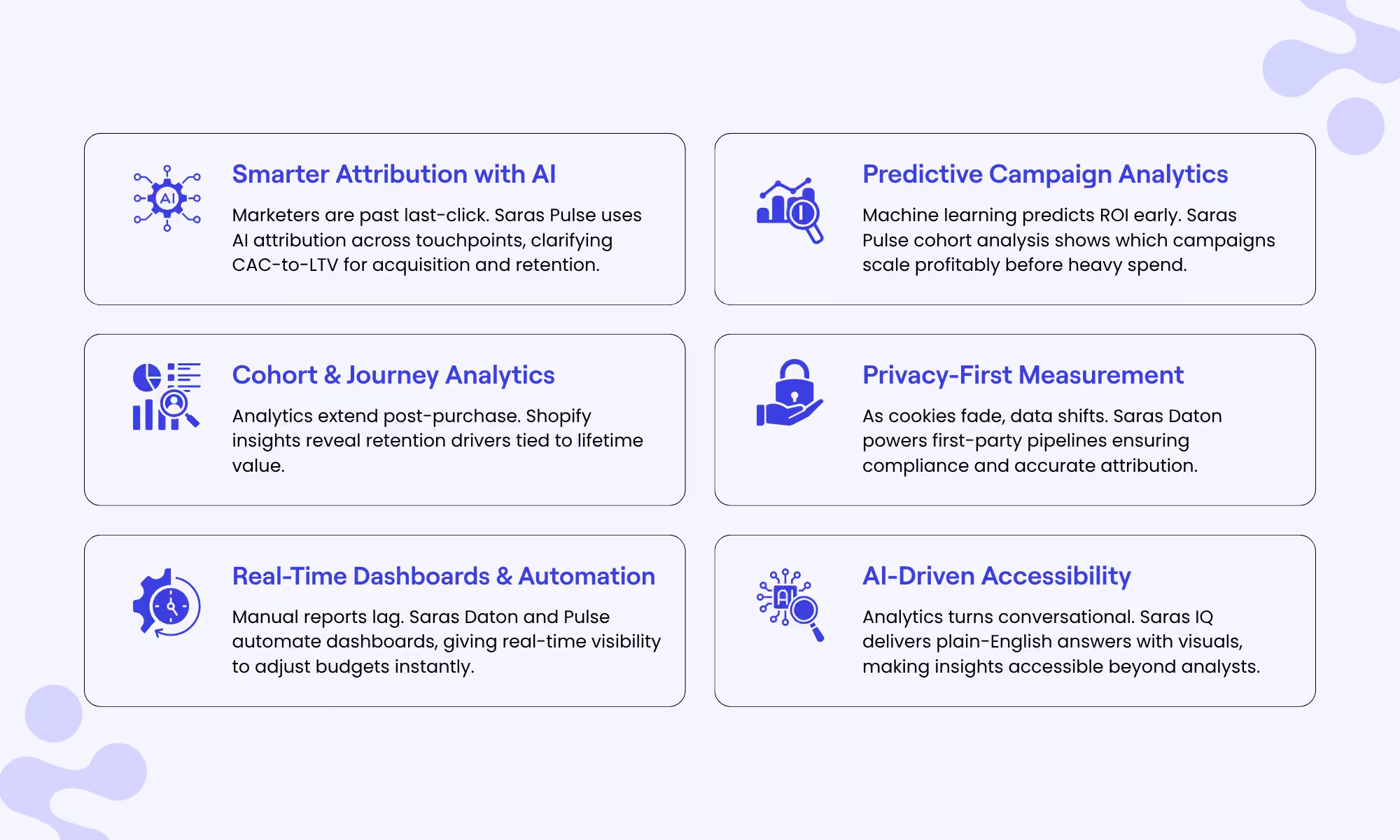
Marketing Campaign Analytics Trends to Watch in 2026
Turn Complex Marketing Campaign Analytics into Actionable Insights with Saras Analytics
Marketing campaign analytics is the operating system for growth. By connecting spend to ROI, it helps growth marketers identify profitable channels, enables retention marketers to protect revenue, gives CFOs clarity on CAC payback and margins, and provides founders with confidence in scaling strategies.
Yet the complexity of integrating multiple channels, applying attribution, and delivering insights often slows teams down. Saras Analytics was designed to solve this.
- Saras Daton simplifies data integration with 200+ connectors, ensuring campaign data flows seamlessly from ad platforms, ecommerce systems, and CRMs.
- Saras iQ provides daily-refreshed LTV and attribution dashboards, giving teams a unified view of marketing campaign performance. Its predictive analytics help brands identify campaigns that will drive ROI before scaling spend.
- No-code usability ensures marketers and finance leaders can access actionable dashboards without technical barriers.
Together, Daton and Saras iQ turn fragmented marketing campaign analysis into a single, unified picture. For ecommerce and subscription businesses, this means fewer wasted dollars, faster decision-making, and growth strategies built on profitability rather than assumptions. Talk to our Data Consultant Today
.webp)
.svg)
%201%20(1).svg)











.jpg)






%20Statistics%20in%202026.jpg)




%20Software%20for%20DTC%20Brands%20in%202026.png)








%20Setup%20Guide%20for%20Ecommerce%20Finance%20Team.png)
























.webp)

.webp)
.webp)
.webp)
.webp)