

eCommerce safety stock was supposed to protect revenue. For brands operating across multiple warehouses, it is increasingly doing the opposite — quietly consuming the working capital that should be funding growth. The buffer that felt responsible during supply chain disruptions has become, for many operators, a permanent cash drain disguised as operational prudence.
Meanwhile, the data needed to right-size those buffers sits fragmented across 3PL portals, ERP systems, and Shopify exports that nobody has time to reconcile daily. This article breaks down why safety stock spirals beyond what is necessary, what it actually costs, and how unified inventory data turns buffer management from a blunt instrument into one of the highest-ROI operational levers available to an eCommerce team.
Is your data actually Decision-Grade?
9 questions. 3 minutes. Score your Profitability Visibility and Readiness for AI-driven growth.
Start Free Diagnostic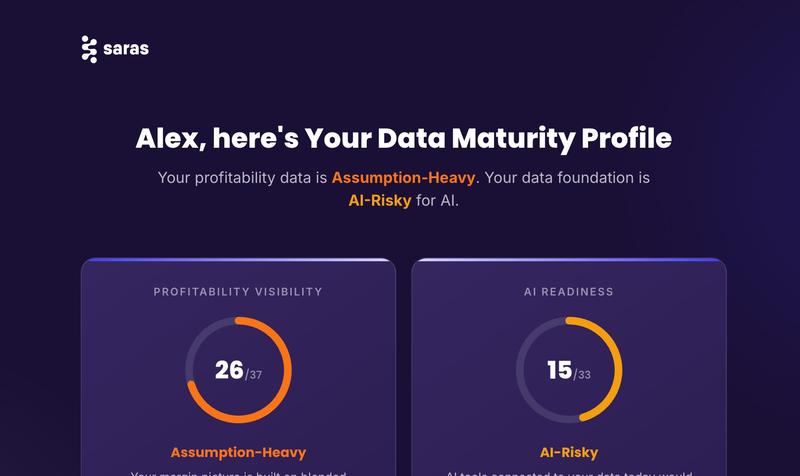
What eCommerce Safety Stock Costs Your Business
Safety stock is the inventory a brand holds above expected demand to absorb two types of risk: unexpected demand spikes and supplier lead time delays. In theory, it is a sensible hedge. But in practice, for eCommerce brands operating at scale, it functions as a capital trap that most finance teams underestimate because the cost is diffuse rather than visible on a single line item.
What Inventory Carrying Costs Include
Inventory carrying costs — the full annual cost of holding physical goods — typically run between 20% and 30% of total inventory value, according to the Chartered Institute of Procurement and Supply. That figure covers warehouse storage fees, insurance, depreciation on slow-moving goods, shrinkage, and the opportunity cost of capital tied up in physical product rather than deployed elsewhere. For a brand holding $500K in safety stock, that is $100K to $150K per year in carrying costs before a single unit of that buffer is ever needed.
Most operators track the storage fee line. Few track the full picture.
The more consequential cost is opportunity cost. Cash locked in warehouse shelves cannot fund a high-performing paid acquisition campaign, a new product launch, or a retention initiative that might generate 5 to 10x returns. Every dollar of excess safety stock has already made a choice on your behalf — and that choice was to sit still.
The Cash Conversion Cycle Signal
At scale, excess eCommerce safety stock extends your cash conversion cycle. You are paying suppliers for inventory weeks or months before that inventory sells and converts back to cash. The longer your CCC, the more working capital you need to fund ongoing operations, and the less flexibility you have to respond to market opportunities.
Watch for this signal: If the Days on Hand for any SKU exceeds 2x your supplier lead time, that buffer is almost certainly costing you more than the stockout risk it is protecting against. That is the threshold where carrying costs start outpacing the revenue protection value of the buffer.
One leading DTC fashion and apparel brand discovered this dynamic when reviewing warehouse performance data. Their third-party logistics partner was incurring roughly $150K annually in overtime charges, justified by claims of excess volume. When the operations team separated inbound from outbound throughput data, the picture shifted: outbound throughput consistently trailed committed capacity during standard operating windows, while inbound volume remained within planned ranges. Overtime was being incurred despite unused baseline outbound capacity. Visibility at the flow level, rather than the aggregate level, turned a recurring expense into a negotiable one.
.png)
The Multi-Warehouse Multiplier Effect
Two-day delivery expectations have pushed most mid-market eCommerce brands to split inventory across multiple fulfillment nodes: an East Coast 3PL, a West Coast 3PL, sometimes a Midwest hub, and often Amazon FBA running in parallel. The logic is sound. Proximity to the customer reduces transit time and shipping cost. The inventory consequence is something most operators do not model carefully enough before committing to the network.
Why Buffer Requirements Grow Faster Than Warehouse Count
When a brand operates a single warehouse, safety stock for a given SKU covers one demand forecast with one set of lead time variables. When that same brand splits the SKU across three warehouses, each location carries its own independent demand uncertainty. The East Coast node does not know what the West Coast node is selling. Each location needs its own buffer to protect against its own local demand spikes and its own replenishment timing.
The aggregate eCommerce safety stock required does not triple, but it grows substantially faster than most operators expect. A brand that needed 30 days of cover at a single node may find it needs 25 days at each of three nodes to achieve the same service level, because the statistical variance at each location is higher than the blended variance of the whole network combined. The result is more total inventory, more total capital deployed, and usually less visibility into any of it.
Node-level data changes what decisions are possible.
The same leading DTC fashion and apparel brand faced a peak season carrier decision with significant cost and customer experience implications. Rather than switching all shipments to a premium carrier across every state, their operations team ran a state-level analysis comparing economy versus premium carrier performance by geography at the 95th percentile of delivery times. The data showed that only a subset of states genuinely required the immediate switch. The remaining 30,000 shipments stayed on economy service, saving approximately $150K in two weeks without missing a single holiday delivery commitment.
For brands also running Amazon inventory analytics alongside 3PL nodes, these positioning decisions span two separate fulfillment ecosystems simultaneously, adding another layer to an already complex network.
When Nodes Go Out of Sync
When online demand velocity and in-store sell-through rates for specific SKUs diverge, inventory that should be moving gets locked as a safety buffer in one channel while another runs short. The business carries the cost of over-buffering on both sides, because without real-time cross-node visibility, there is no mechanism to identify the gap before it compounds. Identifying that divergence early enough to act on it is precisely the kind of decision that breaks down when inventory data is a day old.
Saras iQ: The AI Ecommerce Analyst for Shopify Brands Doing $20M+
Most Shopify brands at scale are making decisions from disconnected reports. Shopify, ad platforms, spreadsheets, all telling a different story. Saras iQ sits on top of a certified, AI-ready data foundation so your finance, marketing, and ops teams can ask business questions and get reliable answers instantly. No SQL. No hallucinations. No conflicting numbers.
What you can do with Saras iQ:
- Ask questions in plain English and get answers with visualisations, backed by SQL and business logic you can trace
- Get contribution margin, LTV, cohort analysis, and channel ROI on demand, without waiting for an analyst
- Flag issues and share insights to Slack, email, or Teams in one click
- Connect 200+ data sources including Shopify, Amazon, Meta, Google, and Klaviyo through a single AI-ready data layer
- Plug into Claude or any AI you already use via iQ MCP
Trusted by 200+ eCommerce brands doing $20M+.
Why Spreadsheets Fail at Multi-Warehouse Inventory Management
The standard response to inventory complexity is a more elaborate spreadsheet: more tabs, more VLOOKUP chains, more manual pulls from each 3PL portal stitched together into a weekly snapshot. This works well enough at $5M to $10M in revenue, where the SKU count is manageable and the warehouse network is simple. It breaks down at exactly the moment when the stakes get high enough to matter.
The Static Rule Problem
Many brands calculate eCommerce safety stock using a flat days-of-cover rule across their entire catalog: 30 days for everything, or 45 days during peak periods. The rule is easy to administer. It is also systematically wrong for most SKUs most of the time.
A hero SKU selling 500 units per day needs a meaningfully different buffer than a slow-moving variant selling 12 units per day. A product sourced domestically with a 10-day lead time needs a different buffer than one manufactured overseas with a 90-day lead time. A flat rule treats both identically, chronically over-buffering slow movers and occasionally under-buffering fast ones.
The Data Latency Problem
Inventory decisions require current data, and spreadsheet-based workflows cannot deliver it. Pulling daily inventory snapshots from three 3PL portals, reconciling them against Shopify sales velocity, adjusting for in-transit stock, and factoring in open purchase orders takes hours when done manually. By the time the process is complete, the underlying numbers have already moved.
For the leading DTC fashion and apparel brand referenced earlier, store-level inventory data spanned millions of rows and could not be practically analyzed in spreadsheets. Manual extraction from Shopify took up to 24 hours per pull. That lag made proactive inventory decisions — the kind that prevent over-stocking before it compounds — impossible to execute consistently. Panic-driven purchase orders are almost always a data latency problem in disguise. The buying team is not irrational. They are making decisions with the only information they have, which is already out of date.
3 Steps to Right-Sizing Your eCommerce Safety Stock
Right-sizing safety stock is not a one-time exercise. It is a continuous process that requires live inputs, SKU-level thinking, and node-level demand visibility. These three steps build on each other, and each produces better inputs for the next.
Step 1: Classify by Velocity and Margin (ABC Analysis)
Not all SKUs deserve the same safety stock treatment. ABC analysis segments your catalog into three tiers based on sales velocity and contribution to revenue:
| Tier | Characteristics | Safety Stock Approach |
|---|---|---|
| A items | High velocity, high margin; top 10 to 20% of SKUs driving 70 to 80% of revenue | Maintain a strong buffer; prioritize replenishment; monitor daily |
| B items | Mid-range velocity and margin; next 30% of SKUs | Moderate buffer; review weekly; adjust seasonally |
| C items | Low velocity, low margin; bottom 50% of SKUs | Near-zero buffer; replenish on actual demand signals; reduce carrying cost exposure |
Most brands discover, when they run this analysis for the first time, that C-items are consuming a disproportionate share of the safety stock budget. Shifting C-items to near-zero buffers and redeploying that capital toward A-item coverage — where a stockout costs meaningful revenue — is typically the fastest working capital win available in inventory and product planning.
Step 2: Track Dynamic Lead Times, Not Best-Case Estimates
The standard safety stock formula is:
(Maximum Daily Usage × Maximum Lead Time) − (Average Daily Usage × Average Lead Time)
Important: This formula is only as accurate as its inputs. If Maximum Lead Time comes from a supplier's quoted estimate rather than actual historical transit data — including delays, customs holds, and port backlogs — the buffer it produces will be consistently underestimated. Record actual receipt dates against expected receipt dates for every purchase order, by supplier and shipping route. Over time, that dataset tells you what your real lead time variance looks like: not what your supplier promises, but what you experience.
Step 3: Forecast at the Node Level, Not the Business Level
Demand forecasting for eCommerce inventory is most commonly done at the business level: total expected units sold across all channels. For a single-warehouse brand, that is sufficient. For a multi-warehouse brand, it is the wrong unit of analysis.
Each warehouse serves a distinct geographic demand pool. Seasonal patterns, shipping zone economics, and local demand spikes differ by location. Applying a business-wide forecast to individual node replenishment decisions means averaging out the variance that matters at each location. McKinsey research on inventory management consistently finds that companies investing in granular demand analytics reduce excess safety stock materially while maintaining or improving service levels.
The leading DTC fashion and apparel brand built a scenario-based forecasting model that delivered annual revenue forecast accuracy within 8 to 10% error, giving finance and operations teams enough confidence to reduce buffer assumptions without feeling exposed.
How Saras iQ Connects Inventory Data Across Your Warehouse Network
Executing the three steps above requires live inputs that most brands cannot produce from their current data infrastructure. ABC analysis needs accurate, current SKU-level sales velocity. Dynamic lead time tracking requires a maintained PO receipt history. Node-level demand forecasting for eCommerce needs daily inventory snapshots from every warehouse location, reconciled against live sales data, updated fast enough to act on.
Saras iQ centralizes daily inventory feeds from multiple 3PL systems — including Stord, OceanX, Mammoth, and ShipBob — alongside Shopify and Amazon sales velocity into a single certified data layer. SKU-level inventory tracking becomes a daily operation. Reorder points calculate against live demand signals. Overstock flags surface before carrying costs compound further.
Working capital optimization at the eCommerce safety stock level requires this kind of AI-ready data foundation connecting inventory positions, sales velocity, and demand forecasts in a single layer.
For the leading DTC fashion and apparel brand, Saras Analytics automated daily ingestion of store-level inventory data and built a recommendation engine that evaluated SKU velocity in-store versus online, historical sell-through patterns, and store-specific demand signals. Each week, the operations team received store-level, SKU-level recommendations indicating what quantity could be safely released and the expected revenue upside per decision. Approximately $375K in annual revenue opportunity was identified from safety stock that had been sitting as a static buffer, with $35K realized within the first four weeks. Read the full case study →
"Saras brought visibility and discipline to how we release store safety stock. What was previously manual and uncertain is now a repeatable, data-driven process." — Senior Director of Operations and Supply Chain
Conclusion
Safety stock should be a surgical buffer — sized precisely to actual demand variance and lead time risk, applied at the SKU level, and calibrated per warehouse node. When it becomes a blunt instrument applied uniformly across the catalog, it stops protecting revenue and starts consuming the working capital that funds growth.
Brands that right-size their buffers are not taking on more stockout risk. They are replacing fear-driven purchasing with data-driven purchasing. What they discover is that much of the inventory they release was idle capital assigned to a protective role it was not actually filling.
Talk to our data consultants to see what right-sized inventory intelligence looks like for your warehouse network. For brands that need hands-on support building this foundation, our data-led growth strategies practice can help accelerate the process.

.webp)
.svg)
%201%20(1).svg)





























.jpg)






%20Statistics%20in%202026.jpg)








%20Software%20for%20DTC%20Brands%20in%202026.png)














%20Setup%20Guide%20for%20Ecommerce%20Finance%20Team.png)




























.webp)


.webp)
.webp)
.webp)
.webp)