A practical framework for Shopify-first ecommerce brands trying to get one clean, trustworthy view of their numbers
Clients often ask whether Saras iQ can rely on a NetSuite integration alone — modelling all required datasets from it, and building dashboards on top without connecting Shopify, Amazon, or ad platforms.The honest answer is nuanced. NetSuite can support some financial and operational use cases well. But it cannot support the full set of marketing, customer, and growth analytics use cases that Saras iQ is designed for — without direct source integrations.
NetSuite remains the system of record for all finalized financial data. Shopify, Amazon, and ad platforms complement it with the operational, marketing, and customer detail that ERPs are structurally not built to capture.
Is your data actually Decision-Grade?
9 questions. 3 minutes. Score your Profitability Visibility and Readiness for AI-driven growth.
Start Free Diagnostic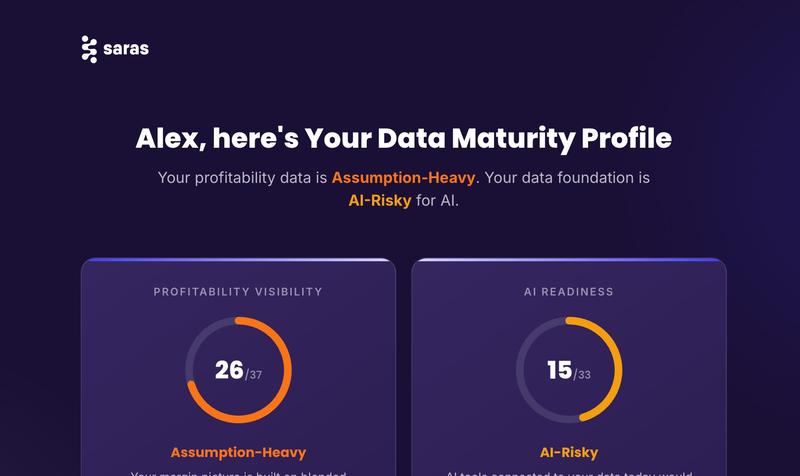
Start here: what question are you actually trying to answer?
The right integration stack depends entirely on the scope of questions your reporting needs to answer. There are two meaningfully different versions.
VERSION A "What were our revenues, costs, and margins this period?"This is a finance-grade question. NetSuite answers it. Period-end P&L, COGS, revenue recognition, inventory — your ERP was built for exactly this.
VERSION B "What drove those margins, which channels and campaigns performed, and how are customers behaving over time?"This is a marketing-aware and growth-oriented question. NetSuite captures the financial outcome but not the drivers, channel detail, or customer context behind it.
If you are only asking Version A, NetSuite alone may suffice. If Version B is in scope — even partially — source integrations are required.
Why NetSuite alone has structural limitations for analytics
NetSuite is highly configurable: field mappings, record structures, custom objects, and connector logic vary client to client. This means every NetSuite implementation requires custom discovery, custom modelling, and custom QA — and improvements cannot be standardized or scaled across clients.In contrast, Shopify and Amazon have consistent schemas. Saras iQ has invested in pre-built models, standard QA processes, and ongoing R&D to track platform changes — delivering accuracy, scale, and compatibility that a NetSuite-only approach cannot match.
Beyond configurability, each integration serves a structurally different purpose — and no amount of NetSuite configuration can substitute for the data that source platforms capture natively.
What each integration uniquely provides
NetSuite — financial record and system of record Authoritative for: finalized revenue, COGS, inventory, fulfilment, accounting dates, and GL-based P&L. This is where period-end numbers come from and where they should always be reconciled back to.
Shopify — order, customer, and marketing detail Shopify sends only a selected subset of attributes to NetSuite — enough to support ERP workflows like order approval, fulfilment, and returns. What does not flow through includes order tags, promo codes, customer journey metadata, and marketing attribution fields. Even when some fields are enabled, historical backfill is often unavailable.Direct Shopify integration gives Saras iQ access to the raw, unfiltered order object — enabling cohort analysis by promo code, LTV and retention modelling, subscription behavior, order-tag segmentation, and customer journey attribution.
Amazon Seller Central — fee detail and operational signals For Amazon, NetSuite typically receives only financial data from settlement reports — aggregated revenue, fees, refunds, and adjustments. Settlement data is delayed by approximately 15 days and does not include granular order or ASIN-level data.Direct Amazon integration provides: FBA, referral, storage, and adjustment fees at the order and ASIN level; booked revenue prior to settlement; daily performance without the settlement lag; and inventory health signals such as out-of-stock, listing suppression, and Buy Box eligibility.
Ad platforms — spend accuracy and campaign attribution Although ad spend can appear in NetSuite via invoices or credit card charges, it is recorded on invoice date — not daily spend date — and contains no campaign, ad group, keyword, impression, or click data. This means metrics like ROAS, MER, CPC, CPM, and CAC cannot be computed accurately from NetSuite data.Direct ad platform integrations provide event-level daily spend, campaign and ad group metadata, impression and click data, and the ability to map campaigns to products and SKUs — making product-level profitability inclusive of ad spend possible.
Full capability view: what each source enables
How reconciliation works across sources
Saras iQ follows a clear reconciliation philosophy: differences are preserved and explained rather than blended or overridden. All data is ingested with explicit source tagging and aligned at order ID, transaction ID, SKU/ASIN, and date levels.
| Common difference | How Saras iQ handles it |
|---|---|
| Timing gaps between order date and post date | Preserved and labelled by date type (order, ship, post) |
| Refunds initiated vs. refunds posted in NetSuite | Both states visible with timestamps and reason codes |
| Amazon daily sales vs. periodic settlement (~15-day lag) | Settlement logic mapped; daily view uses channel data |
| Accruals in NetSuite vs. actuals in channel data | Shown side by side — not blended or overridden |
| Invoice-based ad spend vs. daily spend actuals | Ad platforms provide event-level spend; NetSuite shows invoice totals |
NetSuite always wins for finalised financial reporting. Channel and ad platform data adds the timing, attribution, and operational context that explains why numbers look the way they do — and when they will converge.
Quick self-assessment: which integrations do you need?
| # | Question | Integration needed | Verdict |
|---|---|---|---|
| 1 | Do you need daily or intra-month contribution margin before close? | Shopify + Amazon | Integrations required |
| 2 | Do you run discounts, promo codes, or bundles? | Shopify | Integrations required |
| 3 | Do refunds or returns materially affect your margin? | Shopify + Amazon | Integrations required |
| 4 | Do you need SKU-level Amazon fee and margin clarity? | Amazon Seller Central | Integrations required |
| 5 | Do you track ROAS, CAC, or campaign-level ad performance? | Ad platforms | Integrations required |
| 6 | Do you need customer cohorts, LTV, or retention analysis? | Shopify | Integrations required |
| 7 | Do you have subscriptions? | Shopify + subscription platform | Integrations required |
| 8 | Do marketing and finance teams review the same dashboard? | Shopify + Amazon | Integrations required |
| 9 | Is your requirement limited to period-end P&L, COGS, and inventory only? | NetSuite only | NetSuite-only viable |
If you answered Yes to three or more questions, source integrations beyond NetSuite are required. The integrations do not replace or override NetSuite — they add structured, reconcilable layers above it that make the financial numbers explainable, actionable, and trusted across finance, marketing, and operations.
.webp)
.svg)
%201%20(1).svg)

%20Software%20for%20DTC%20Brands%20in%202026.png)




%20Setup%20Guide%20for%20Ecommerce%20Finance%20Team.png)


















.webp)
.webp)
.webp)
.webp)
.webp)






.webp)


.webp)








.webp)






.png)