
When three teams in an eCommerce brand report three different revenue numbers, it means the problem is with operational control (i.e., each team is pulling from a different system with different logic) and not analytics. What they lack is a single source of truth.
In such scenarios, finance adjusts revenue before every board deck, marketing questions about performance metrics, and operations struggles to plan inventory with precision. Instead of making decisions, leaders spend time reconciling reports.
As organizations grow, this misalignment quietly slows execution and increases risk. Unfortunately, this is the default state for many scaling DTC eCommerce brands. Shopify transactions live in one system, subscription data in another, marketing performance across multiple ad platforms, and COGS in spreadsheets. Each system reflects a valid slice of the business, but no single system provides a complete, consistent view.
Instead of layering more dashboards, the fix is rebuilding the reporting foundation itself. This post breaks down what that looks like and how growing DTC teams can create a version of the numbers everyone trusts. Also, you get a 6-step practical framework to unify reporting across Shopify, marketing, subscriptions, and finance.
Is your data actually Decision-Grade?
9 questions. 3 minutes. Score your Profitability Visibility and Readiness for AI-driven growth.
Start Free Diagnostic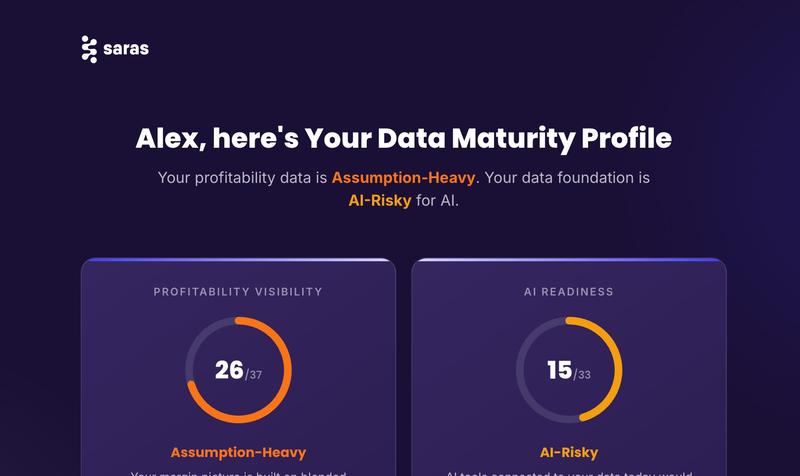
The Operational Symptoms of Fragmented eCommerce Reporting
In eCommerce businesses, fragmentation usually develops gradually. In the early stages, revenue increases, orders are steady, and individual dashboards appear sufficient. Hence, reporting feels manageable. But when new SKUs are added, more channels come online, subscription logic gets more nuanced, and fulfillment partners multiply, costs become harder to track consistently.
Each additional system introduces its own definitions and metrics. Over time, teams stop working from the same numbers and start maintaining their own versions of the truth.
At that point, reporting shifts from insight generation to reconciliation.
Real-World Results: Unifying the Data Stack
Wondering what happens when a scaling DTC brand fixes its data layer? We helped True Classic eliminate fragmented reporting and automate their analytics. By centralizing their data, they not only reduced manual reporting hours but also significantly cut their data pipeline costs.
👉 See how True Classic automated and unified their data stack
What Fragmented Ecommerce Data Looks Like in a Modern DTC Stack:
Instead of analyzing performance, teams spend time:
- Exporting CSVs
- Manually joining datasets
- Debating definitions
- Rebuilding reports every week
- Routing every question through finance
This leads to slower decisions, delayed visibility into issues, and increased dependence on spreadsheets.
What fragmentation looks like inside a modern D2C stack:
In most DTC eCommerce brands, their Shopify transactions, subscription lifecycle data, marketing performance, fulfillment attributes, and COGS tracking all live in separate tools with no shared structure. Every team generates reports differently, and that means the same SKU or revenue number could vary depending on who pulled it.
Why eCommerce Financial Reporting Breaks as You Scale
With inconsistent logic, each function calculates core metrics slightly differently, which leads to conflicting outputs even when everyone is working in good faith.
Over time, these inconsistencies turn routine reporting into recurring debates.
In growing DTC organizations, the same breakdowns appear repeatedly:
- Revenue defined differently across teams (gross vs. net vs. discount-adjusted)
- Margin calculations that treat COGS, shipping, and returns inconsistently
- SKU names or identifiers that don’t match across systems
- Cohorts calculated with different time windows
- Customer counts that vary by source
So, instead of asking “What should we change?”, teams often have to ask, “Which number is correct?”
The Real Cost: Slow Decisions, Manual Work, and Leadership Blind Spots
Broken ecommerce financial reporting rarely appears directly on the P&L, but its impact shows up daily in slower closes, delayed decisions, and manual reconciliation work.
The most visible symptom is time.
- Time spent compiling reports.
- Time spent reconciling differences.
- Time spent waiting for “final” numbers.
Where the drag shows up most:
Across functions, the effects tend to be consistent:
This lag creates blind spots. By the time issues are confirmed, the opportunity to act has often passed. Insights that should take minutes require days of exports, joins, and validation. Reporting cycles are also tied to manual effort rather than system refreshes.
What a Unified eCommerce Data Foundation Looks Like in Practice
Many reporting initiatives fail because they focus on visualization first. Teams try to solve messy outputs by adding more dashboards, assuming better charts will create clarity.
The teams that fix this don’t start with dashboards. They start with the data infrastructure that feeds those dashboards. Instead of producing more reports, they standardize the foundation, so every report pulls from the same governed source of truth.
The 3-Step System That eliminates fragmentation, and brings everything together:
The first step is centralizing the operational systems that directly drive revenue, cost, and customer metrics:
- Shopify storefront and line-item transactions
- Subscription lifecycle events
- Marketing channel performance and spend
- Fulfillment and operational attributes
- Cost inputs previously tracked in spreadsheets
All of these sources can be ingested automatically and refreshed on a consistent schedule. This distinction matters a lot, mainly because a dashboard summarizes information, whereas a foundation standardizes it.
Step 1: Standardize Metric Definitions
Before building pipelines or dashboards, successful teams align on definitions.
In many DTC brands, core terms such as revenue, margin, and customer carry slightly different meanings depending on the department. Finance may exclude returns, marketing may include them, and operations may calculate contribution differently. These variations create conflicting outputs even when the underlying data is correct.
Treating definitions as the first milestone, and not an afterthought, makes everything else easier.
Governance decisions to lock in early:
- A single, company-wide revenue definition
- Consistent margin and COGS logic
- Standardized SKU naming and identifiers
- Shared cohort rules
- Clear cost allocation methods
It’s also crucial to implement master SKU mapping and global identifiers across systems, so a product represents the same entity everywhere.
This step is often overlooked because it feels non-technical. In practice, it determines whether the rest of the architecture will work. Without shared definitions, no warehouse or dashboard can create trust.
👉 Learn more about aligning your Contribution Margin definitions here.
Step 2: Centralize eCommerce Data Integration into One Warehouse
Once governance is established, consolidation becomes the focus.
Operational sprawls are common in DTC stacks. Shopify tracks transactions, subscription platforms track lifecycle events, marketing tools track spend, fulfillment systems track logistics, and spreadsheets track costs.
These systems are then consolidated into a central warehouse that automatically ingests transactions from Shopify along with subscriptions, ad platforms, fulfillment data, and costs. This creates a durable reporting layer that doesn’t depend on exports or spreadsheets.
Practical improvements you typically see:
- Fewer spreadsheet dependencies
- No manual joins between systems
- Consistent time windows across reports
- Fewer “which report is correct” conversations
When every team queries the same base tables, the same question returns the same answer.
Want to see what this looks like in practice?
Here’s a detailed breakdown of how one DTC brand unified Shopify, subscriptions, and marketing data into a single warehouse, and what changed once every team worked from the same numbers.
→ Read how Saras helped BPN drive $900k in revenue
Step 3: Make Reporting Self-Serve for Finance and Marketing
A centralized warehouse alone does not solve the problem if only analysts can access it. That simply replaces one bottleneck with another. The unified data also has to be usable by non-technical stakeholders.
There should be role-specific dashboards that can pull from the same standardized definitions and refresh automatically.
So that the stakeholders can directly monitor:
- Revenue and growth trends
- Subscription vs. one-time purchase mix
- Customer behavior and cohorts
- Margin performance
- Operational metrics tied to financial outcomes
This way, teams no longer have to request ad hoc reports or wait for finance to compile numbers. Instead, they can check their performance themselves and act immediately.
When the Numbers Finally Line Up, Everything Moves Faster
Once this foundation is in place, the impact shows up immediately in day-to-day operations.
Instead of reporting being a weekly assembly process, it becomes a routine check-in. Teams no longer depended on finance or analysts to reconcile numbers before acting. The data was already aligned and current.
That reliability altered how decisions were made across functions. Instead of waiting for end-of-week summaries, teams evaluated performance continuously and adjusted in smaller, faster increments.
Where the shift showed up day to day:
Immediate operational gains:
- Daily automated refreshes instead of manual report compilation
- Fewer spreadsheet dependencies across finance and ops
- Reduced ad hoc reporting requests to analysts
- Faster access to margin and contribution metrics
- Consistent numbers across functions without reconciliation
The result was less time spent preparing numbers and more time interpreting them.
Most importantly, discussions shifted from “Which number is correct?” to “What should we change?”
Signs Your Brand Needs a Single Source of Truth for eCommerce Data
In every DTC eCommerce business, there is a point where fragmentation slowly starts looking more like a constraint than inconvenience.
At that stage, the cost shows up in decision speed and operational overhead.
If several of these situations are familiar, the foundation likely needs attention:
- Weekly or monthly reports take days to assemble
- Finance acts as the reporting gatekeeper
- Marketing and finance regularly disagree on revenue or margin
- Spreadsheets sit between core systems
- SKU or product identifiers don’t match across tools
- Leadership repeatedly asks for “one version of the truth”
- Teams hesitate to act because they don’t fully trust the numbers
These symptoms point to structural misalignment rather than an analytics skill gap.
A Practical Roadmap to Move from Fragmented Systems to Unified Reporting for Ecommerce
This transition does not require a multi-year rebuild. The sequence matters more than complexity. Teams that move successfully tend to follow a clear order of operations.
A 6-pointer checklist:
1. Audit your systems Inventory every source that contributes to revenue, cost, and customer metrics, including unofficial spreadsheets.
2. Align metric definitions Lock in revenue, margin, customer, and SKU logic before building pipelines.
3. Design a canonical data model Map every source into a consistent structure.
4. Implement automated ecommerce data integration and refreshes Replace manual exports with automated ecommerce data management across Shopify, Recharge, Meta, Google, and TikTok so reporting stays current without manual work.
5. Implement a governed metric layer Define calculations once and reuse them everywhere.
6. Enable self-serve access Create role-specific views that non-technical stakeholders can use without analysts.
How Saras Analytics Supports This Architecture
Building and maintaining this type of foundation internally is possible, but it typically requires ongoing data engineering effort, governance of ownership, and continuous maintenance as systems change.
Many mid-market DTC teams don’t have the bandwidth to support that infrastructure while also running the business. This is where Saras Analytics generally supports teams.
Rather than adding another reporting layer, the focus should be on fixing the underlying plumbing. Daton consolidates operational systems such as Shopify, subscription platforms, marketing channels, fulfillment tools, and cost sources into a governed warehouse. Saras iQ then exposes standardized metrics through role-specific reporting that non-technical stakeholders can use directly.
If fragmented reporting is slowing your team down, don’t add another dashboard, fix the foundation.
Start by seeing how a DTC brand implemented this architecture end-to-end.

.webp)
%201%20(1).svg)
.svg)









%20Setup%20Guide%20for%20Ecommerce%20Finance%20Team.png)




























.webp)

.webp)
.webp)
.webp)
.webp)











.webp)





.webp)









.webp)








.png)