
The phrase "AI agent" now shows up in the marketing copy of almost every eCommerce tool on the market. Some of those tools were called "AI assistants" six months ago and "automation workflows" before that. Operators evaluating AI agents for eCommerce are caught between genuine excitement and well-earned skepticism. The demos look impressive, but nobody is talking about what happens when an agent queries a warehouse where "revenue" means three different things depending on which system you ask.
Most agent failures trace back to the same root cause: the data foundation, not the model. This article maps what is production-ready, what is still early, and why the quality of the data layer underneath determines whether an agent becomes a strategic advantage or an expensive source of confident wrong answers.
Is your data actually Decision-Grade?
9 questions. 3 minutes. Score your Profitability Visibility and Readiness for AI-driven growth.
Start Free Diagnostic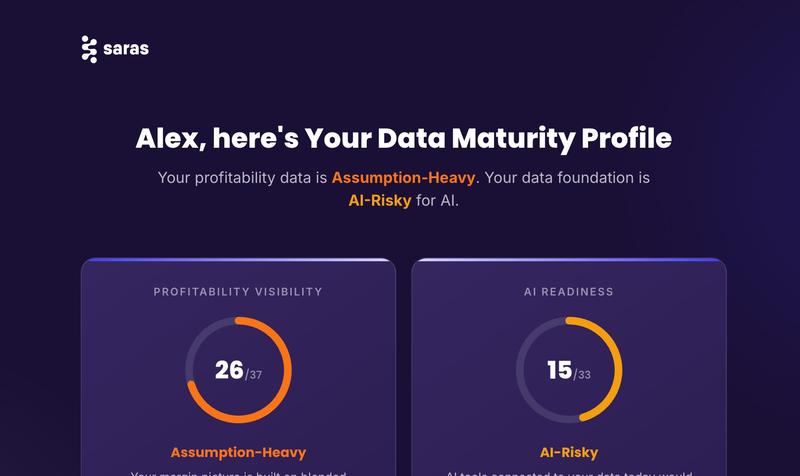
What an AI Agent Actually Is (and What It Is Being Called)
A real AI agent perceives its environment, reasons about a goal, and takes multi-step actions without requiring human intervention at each step. That three-part test separates genuine eCommerce AI agents from the growing category of eCommerce AI automation tools that have been relabeled overnight.
The distinction matters because the label is being stretched to cover everything.
- A chatbot that routes support tickets through a decision tree is not an agent.
- A content generator that writes product descriptions when prompted is not an agent.
Both are useful. Neither can monitor live inventory levels, compare them against demand forecasts, and trigger a replenishment order without someone walking it through each step.
| Category | Perceives Live Context | Takes Multi-Step Action | Adapts to New Situations |
|---|---|---|---|
| Automation | No (fixed triggers) | Yes (predetermined rules) | No |
| Chatbot | Limited (scripted paths) | Limited (routes or responds) | No |
| AI Tool | Yes (when prompted) | No (generates content) | Partially |
| AI Agent | Yes (continuously) | Yes (chains decisions) | Yes |
When operators compare AI agents vs chatbots eCommerce tools, the last column is the quickest filter. An agent adapts when the situation changes. Everything else follows a script, even a sophisticated one.
Where AI Agents for ECommerce Are Actually Working Right Now
The maturity of AI agents for eCommerce varies dramatically by use case. Some categories have been running at production scale for over a year. Others are still in prototype. Knowing which is which prevents both premature investment and missed opportunities.
Analytics and Business Intelligence Agents
This is the category where the gap between "looks like an agent" and "is actually useful" is widest. An analytics agent that answers "what was my ROAS last week" is straightforward to build and mostly redundant. An agent that answers "which channel drove profitable revenue last quarter after netting out COGS, returns, and fulfillment costs" requires a completely different data infrastructure underneath.
The question to ask of any analytics agent: what data is it running on? If the answer is raw tables or platform APIs without a semantic layer, the agent will produce confident wrong answers. If the answer is a certified, semantically modeled data foundation with your business definitions baked in, the agent becomes genuinely useful for real decisions.
One mid-market kitchenware brand is already running this workflow in production. Data is certified and updated by Sunday night. An analytics agent generates a structured Monday meeting brief via the Model Context Protocol (MCP), pulling from certified contribution margin and sales datasets. The CFO reviews the output in natural language, adjusts two sections, and walks into the leadership meeting with a pre-circulated summary no analyst assembled.
The business case for analytics agents becomes clearest when measured by what changes for the people making decisions, not by the feature list on the spec sheet.
| Decision Area | What a Governed Analytics Agent Changes |
|---|---|
| Margin Visibility | Daily contribution margin by channel, product, and customer type, refreshed before the Monday meeting rather than reconstructed after month-end close. |
| Acquisition Efficiency | Cohort-level CAC payback tracked continuously, so acquisition budgets shift toward the cohorts that generate margin, not just the ones with the lowest blended CAC. |
| Retention and Churn | Segment-level retention curves updated daily. Churn signals flagged early enough to act on, instead of surfacing as a trailing metric in a quarterly review. |
| Inventory Risk | SKU-level sell-through tracked against demand forecasts. Stockout risk flagged 14+ days out, with enough lead time to adjust purchase orders. |
| Executive Reporting | A certified weekly brief generated from governed data. The CFO reviews and edits in natural language rather than rebuilding from raw exports. |
Customer Support and WISMO Automation
This is perhaps the most mature AI agent category in eCommerce. Agents handling "where is my order," return status, and tier-1 support queries are running at scale today, automating the large majority of L1 ticket volume. The agent pulls live data from shipping carriers and order management systems, applies return policies, and responds with accurate answers without a human in the loop.
This is agentic in the real sense: the agent perceives the incoming query plus customer context, reasons about which policy applies, then acts by responding, initiating a return, or escalating when the situation exceeds its confidence threshold. For most mid-market brands, customer support is the lowest-risk entry point into AI agents.
Personalization and Product Discovery
AI-powered product recommendations have existed for years. Modern agents go further by reasoning about the customer's full session context, purchase history, intent signals, and live inventory simultaneously, then constructing a personalized discovery experience without a merchandiser configuring rules behind it.
Amazon's Rufus is the highest-profile example. Shoppers who engage with Rufus during a session are roughly 60% more likely to complete a purchase, and the assistant reached over 300 million users in 2025. The gap between "we have a recommendation widget" and "we have a real personalization agent" remains wide for most mid-market DTC brands, though. Personalization quality depends entirely on the customer data behind it. An agent recommending products without unified purchase history and behavioral signals across channels is guessing.
Inventory and Replenishment Agents
Agents that monitor stock levels against demand forecasts and automatically trigger replenishment orders are real and running at mid-market brands with the data infrastructure to support them. The basic version watches SKU inventory, compares it to a forecast, and creates a purchase order when stock drops below a threshold. More sophisticated versions coordinate replenishment with 3PL lead times and adjust for promotional calendar events.
Inventory replenishment is one of the clearest wins in AI for eCommerce operations. The logic is well-defined, the feedback loops are measurable, and the downside of a wrong decision is recoverable. The prerequisite is clean, unified inventory data from every channel and warehouse. An agent running on siloed inventory data will over-order in one channel while stocking out in another.
Dynamic Pricing Agents
Pricing agents that adjust prices in real time based on competitor availability, demand signals, and margin targets are in production at enterprise retailers and accelerating down-market. For DTC brands, the risk surface is higher (customer trust, brand positioning) and the tooling is less mature. Brands exploring this space should expect early-stage tools and significant configuration work.
An adjacent pressure worth tracking: AI search surfaces like ChatGPT and Perplexity are reshaping product discovery, which means agents also need to optimize product data for how AI systems find and recommend products.
Agentic Commerce: AI Shopping Agents
The consumer-facing side of agentic AI eCommerce, where an AI agent completes a shopping journey on behalf of a user from discovery through purchase, is the most discussed and least deployed category right now. Shopify made agentic storefronts available to millions of merchants in early 2026, letting products be discovered and purchased directly inside AI platforms. Perplexity's "Buy with Pro" and Amazon's "Buy for Me" are the clearest live examples of agentic commerce 2026 in action.
For mid-market DTC brands, the implication is practical: structure your product data so AI agents can discover and surface your products accurately. Clean, AI-readable product data is the new SEO.
The Data Problem Nobody Talks About
Every AI agent conversation focuses on the agent. Almost none focus on the data layer beneath it. That gap is where real deployments succeed or fail, and it is the reason AI agents for eCommerce produce wildly different results at different brands running similar technology.
The failure pattern repeats across companies. A brand deploys an analytics agent on top of their warehouse. The agent has access to Shopify and Meta. An executive asks which channel was most profitable last quarter. The agent answers confidently, and the answer is wrong: returns live in a separate system, COGS is a flat percentage instead of by SKU, and Amazon revenue was never connected.
As one CFO described in a recent conversation: "The accuracy and consistency of the reporting is being questioned on an ongoing basis. The most recent one was in our All Hands with investors present."
Every real deployment needs three layers working together:
| Layer | What It Does | What Happens Without It |
|---|---|---|
| Data ingestion | Connects all relevant sources: Shopify, Amazon, 3PL, ERP, ad platforms, subscription tools. 200+ eCommerce data connectors ensure nothing is missed. | The agent answers from whichever systems were easy to connect. Gaps stay invisible. |
| Semantic layer | Certifies business definitions: what "revenue" means, how CM1/CM2/CM3 are calculated, how attribution works. An AI-ready data foundation bakes definitions into every query. | The agent makes its own assumptions about every metric. Those assumptions are usually wrong. |
| Agent interface | Queries the semantic layer, not raw tables. Every answer traces back to a certified definition. | The agent queries raw tables and produces numbers that fall apart the moment you go granular. |
.png)
According to Deloitte's 2026 Global Retail Industry Outlook, 68% of retailers plan to adopt agentic AI in the next 12 to 24 months. The brands that will see actual results from that investment are the ones building the data foundation now, before deploying the agent.
Lauren Festante, SVP of Finance at Momentous, described the impact: "Saras helped strengthen this foundation by improving the consistency and visibility of our product and margin data." The result was near-real-time insights, built on a data infrastructure that was ready before any agent was deployed. Read the full case study →
Important: An analytics agent that only has access to your Shopify and Meta data will give you Shopify and Meta answers. If your business runs across Shopify, Amazon, 3PL, ERP, and wholesale, the agent needs all of it. Systematically incomplete data produces systematically incomplete answers.
How Saras iQ Answers P&L Questions Without the Guesswork
Saras iQ provides the data foundation: pre-built eCommerce data models covering contribution margin by channel, customer cohorts, marketing attribution, and inventory health. Saras iQ sits on top as a deployed AI eCommerce analyst that answers questions across the full P&L in plain English.
The kinds of questions it handles: what was contribution margin by channel last quarter? Which acquisition cohorts have the highest 90-day LTV? Which SKUs are at risk of stockout? Every response includes the SQL that was run and the business logic that was applied. And when iQ does not have the data to answer a question, it says so rather than filling the gap with a plausible-sounding number.
For teams working inside Claude, iQ MCP connects the same governed backend via the Model Context Protocol. The data stays governed. Claude handles the output: a dashboard, a document, or a multi-metric analysis from a single prompt.
As Jason Panzer, President of Hexclad, described it: "We go to Saras iQ and get our daily contribution margin reporting. We get all of our marketing metrics by channel, by category, even down to the SKU. Everything is pulled in automatically."
What to Look for Before Deploying Any AI Agent: A Checklist
Before evaluating AI agents for eCommerce, run every option through these seven questions. They apply to analytics agents, customer support tools, and inventory systems alike.
Conclusion
The brands getting real value from AI agents right now did the unglamorous work first: they unified their data, modeled their business logic, and certified their definitions. The agent was the last step. If your team is evaluating AI agents for eCommerce analytics, start with the data layer. Saras iQ provides the AI-ready datasets, dashboards, and semantic layer that make analytics agents trustworthy. Talk to the Saras data consultants to see what the foundation looks like for your stack.
.svg)
.webp)
%201%20(1).svg)




%20Setup%20Guide%20for%20Ecommerce%20Finance%20Team.png)
















.webp)
.webp)
.webp)
.webp)
.webp)





.webp)
.webp)




.webp)





.png)