

Lifetimely by AMP is one of the strongest LTV and cohort analytics tools built for Shopify. Predictive LTV modeling, best-in-class cohort analysis, and full feature access on every plan have earned that reputation. The brands searching for Lifetimely alternatives are not leaving a broken product. They are leaving because their business has outgrown what an LTV-focused, Shopify-only app can answer.
Three friction points drive most exits: order-based pricing that spikes during peak months, Shopify-only architecture that breaks when brands add Amazon or wholesale channels, and an LTV-first focus that stops short of contribution margin by channel and SKU.
For some brands, the right alternative is a better point solution that covers more ground at a better price. For others, it is a shift to a data foundation that connects customer value to the full P&L. This guide maps both paths.
Is your data actually Decision-Grade?
9 questions. 3 minutes. Score your Profitability Visibility and Readiness for AI-driven growth.
Start Free Diagnostic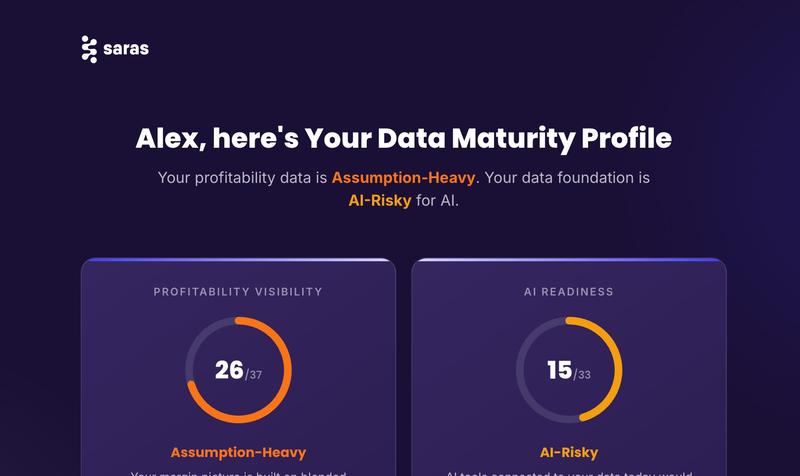
What Lifetimely Does Well and Where Brands Hit the Ceiling
Before evaluating alternatives, it's worth understanding why Lifetimely remains a popular choice among Shopify brands, and where its limitations begin to surface as businesses grow.
What Lifetimely Gets Right
Lifetimely earned its Shopify App Store reputation for good reason. Its biggest strengths include:
- The cohort analysis engine tracks customers by acquisition date, channel, and product, giving operators LTV visibility within minutes of connecting their store.
- The AI Cortex feature adds predictive LTV modeling, forecasting expected customer value and flagging churn risk before a cohort fully matures.
- The real-time P&L dashboard pulls COGS, ad spend, fulfillment costs, and revenue into a single view, making Lifetimely one of the few Shopify apps that attempts actual profit tracking rather than just revenue reporting.
- The LTV Drivers report shows which acquisition channels, products, and marketing activities produce the highest-LTV customers over time.
- Unlike many analytics tools that reserve their best features for premium tiers, Lifetimely includes full functionality on every plan. The difference between plans is order volume, not feature access. That is a genuine differentiator worth acknowledging.
Three Ceilings That Trigger the Switch
1. Lifetimely pricing scales with order volume. The pricing model ties monthly cost to order count. A store processing 1,500 orders per month pays one rate; a BFCM spike to 3,000 orders forces an automatic tier jump. According to current pricing tiers, the price starts at $79/month at 51-500 orders, jumping to $299/month at 3,000-7,000 orders. If the order range is between 15K and 25K, you will need to pay $749/month. The cost increase lands exactly when marketing budgets are already stretched, and there is no way to opt out of the upgrade for a single high-volume month. For agencies managing multiple Shopify stores, the per-store pricing model compounds this further.
2. Amazon integration. Amazon integration is a recurring concern mentioned in some customer reviews, particularly among brands that rely heavily on Amazon alongside Shopify. Some users report sync delays, data coverage limitations, and reliability concerns when using the Amazon integration. For brands where Amazon is a secondary experiment, this is tolerable. For brands where Amazon represents 20-40% of revenue, it makes multi-channel LTV analysis unreliable. And because Lifetimely's architecture is Shopify-native, there is no workaround for channels the connector does not fully support.
3. LTV reporting stops short of contribution margin. Lifetimely answers "which customers have the highest lifetime value." It does not answer which customers have the highest profitable lifetime value once COGS, fulfillment, returns, and acquisition costs are factored in. A high-LTV customer acquired through an expensive channel with a high-return product may be losing money on every reorder, and LTV-only reporting will never surface that.
Watch for this signal: When your finance team starts asking margin questions your LTV dashboard cannot answer, such as which products are profitable after fulfillment or which channels drive margin rather than just revenue, you have likely outgrown LTV-only analytics.
The Best Lifetimely Alternatives in 2026
The Lifetimely alternatives worth evaluating in 2026 split into two categories: tools that expand on Lifetimely's LTV focus with broader features like attribution or dashboard customization, and tools that connect LTV to the full P&L. The distinction matters because picking the wrong category means solving the wrong problem.
Saras iQ: Best for Contribution Margin Analytics and Omnichannel Coverage
Lifetimely tells you which customers have the highest lifetime value. Saras iQ answers a harder question: which customers have the highest profitable lifetime value, after COGS, fulfillment, returns, and acquisition costs are subtracted. In the Lifetimely vs Saras iQ comparison, that distinction is the dividing line.
The gap shows up in practice more often than most operators expect. A DTC brand running paid social aggressively on a hero SKU might see Lifetimely's cohort dashboard show that channel producing their best customers by LTV. But once fulfillment costs, a 22% return rate on that SKU, and the actual CAC are allocated at the order level, that "best" cohort might be losing money on every reorder.
What Saras iQ delivers beyond what Lifetimely covers:
- Daily, weekly, and monthly contribution margin views with COGS, fulfillment, and ad spend allocated at the SKU and channel level
- Cohort analysis and LTV by acquisition channel connected to margin data, so the question shifts from "which channels bring high-LTV customers" to "which channels bring high-LTV and high-margin customers"
- Omnichannel coverage through Saras Daton's 200+ connectors, covering Shopify, Amazon Seller Central, Amazon Ads, FBA, 3PL systems, and ERP data in a single data foundation
- Fixed pricing regardless of order volume, meaning a BFCM spike does not change the bill
- Saras iQ, an AI ecommerce analyst layer that answers questions across the full P&L in natural language, with every answer traceable to the underlying data
BPN used Saras to identify recently churned high-value subscribers and built targeted reactivation flows around them, generating $900K in incremental revenue. Read the full case study →
Best for: Brands at $15M+ revenue selling across Shopify and Amazon or other channels, where the question has shifted from customer LTV to profitable LTV across the full P&L. Also the right fit for brands hitting Lifetimely's per-store pricing ceiling with multiple storefronts.
Pricing: Starts from $300/month.
Triple Whale: Best for Shopify Brands Wanting Attribution Alongside LTV
Triple Whale is the most natural mid-market alternative for Shopify DTC brands that want LTV, cohort analytics, and marketing attribution in one platform. The Lifetimely vs Triple Whale comparison comes down to priority: Lifetimely goes deeper on LTV and cohort modeling, while Triple Whale covers more surface area by combining first-party attribution with profitability and LTV dashboards in a single interface.
The Triple Pixel is designed to provide first-party attribution insights across Meta, Google, and TikTok, separating actual performance from what the ad platforms self-report. The Moby AI assistant handles natural-language queries for daily performance checks, and with 60,000+ eCommerce brands on the platform, the onboarding path is well-tested.
Where Triple Whale wins over Lifetimely: flat monthly pricing that does not scale with order volume, independent marketing attribution, and a lower entry point with a free tier available. Where Lifetimely wins: deeper cohort analysis depth, more granular predictive LTV modeling, and stronger product-level profit tracking.
Best for: Shopify-only brands that want LTV and attribution in one tool without running separate platforms.
Pricing: Starts from $219/month.
Polar Analytics: Best for Dashboard Customization and Data Access
Polar Analytics targets a similar audience to Lifetimely but prioritizes dashboard flexibility and raw data access over LTV depth. The platform lets non-technical operators build custom metrics and tailored reporting views without writing SQL, and paid tiers include a dedicated Snowflake data warehouse for teams that want to query their own data directly.
The Klaviyo integration is worth calling out for brands investing heavily in email and SMS. Polar enriches customer profiles with purchase data to power more targeted retention flows, and incrementality testing is available as a separate add-on.
Where Polar wins over Lifetimely: dashboard customization, Snowflake data access, stronger attribution features, and a highly customizable interface. Where Lifetimely wins: lower price floor for smaller brands, deeper predictive LTV modeling, and more granular cohort analysis.
Best for: Data-savvy DTC brands at $2M+ revenue that want customizable dashboards and direct data warehouse access alongside Shopify LTV analytics.
Pricing: Customized pricing plans.
Peel Insights: Best for Automated Cohort and Retention Analytics
Peel Insights is the closest feature match to Lifetimely's core strength: automated cohort analysis, customer segmentation, and retention metrics for DTC brands. The platform surfaces LTV and churn visibility without requiring a data analyst to build the reports, and it automates segment tracking so operators see retention trends without manual configuration.
For brands whose primary frustration with Lifetimely is pricing or UX rather than analytical depth, Peel is the most natural swap. It answers the same category of questions Lifetimely answers, with a different pricing structure and interface. The analytical ceiling is similar, which makes it a like-for-like alternative rather than a category upgrade.
Best for: Shopify DTC brands that want cohort and retention analytics at Lifetimely's depth without the order-volume pricing model. A direct swap, not a category change.
Pricing: Starts at $449/month.
BeProfit: Best Budget Alternative for Basic Profit Tracking
BeProfit is the entry-level option for brands that need profit visibility without Lifetimely's analytical depth or price point. The interface is simpler, the monthly cost is lower, and it supports Shopify, WooCommerce, and Wix. COGS tracking, a basic P&L dashboard, and marketing channel performance cover the essentials.
BeProfit prioritizes simplicity and profit tracking over advanced features such as predictive LTV modeling and deep cohort analysis. It trades analytical capability for simplicity and affordability — the right trade-off for early-stage brands that need profit tracking before they need LTV depth.
Best for: Early-stage brands under $500K revenue that need basic profit tracking before investing in Lifetimely-grade analytics.
Pricing: Starts at $49/month.
Feature Comparison: Top Lifetimely Alternatives at a Glance
How to Choose the Right Lifetimely Alternative
The best Lifetimely alternative is the one that solves the specific problem pushing you to switch. The table below maps each common reason for leaving to the tool best positioned to address it.
Conclusion
Lifetimely is a strong LTV analytics tool for Shopify DTC brands, and the brands evaluating Lifetimely alternatives have not lost trust in it. They have hit a ceiling on what LTV-only, Shopify-only analytics can tell them about their business. Order-volume pricing surprises, Amazon integration gaps, and the distance between LTV and contribution margin are the three most common exit signals.
For brands where the question has evolved from "which customers have the highest LTV" to "which channels and products drive profitable LTV after all costs," Saras iQ is the platform that picks up where Lifetimely leaves off. Talk to the Saras data consultants to see what contribution margin analytics and omnichannel LTV look like for your specific channel mix.

.svg)
.webp)
%201%20(1).svg)























.jpg)





%20Statistics%20in%202026.jpg)



%20Software%20for%20DTC%20Brands%20in%202026.png)







%20Setup%20Guide%20for%20Ecommerce%20Finance%20Team.png)


























.webp)

.webp)
.webp)
.webp)
.webp)