
eCommerce scenario planning becomes essential when a revenue target exceeds what a fixed marketing budget can realistically support. The board sets the number. Finance caps ad spend. But the standard forecast, built on historical traffic, ROAS trends, and blended conversion rates, shows that hitting the target would require more budget than has been approved.
At that point, the problem is no longer about forecasting accuracy. It is that the planning tool cannot model the constraint it has been given. Under fixed spend, the highest-ROI use of your data infrastructure shifts from reporting what happened to modeling what different operational decisions could produce before resources are committed.
This article explains why linear forecasting fails in that environment, what dynamic scenario planning involves, and how brands with the right data foundation use it to reach targets that looked unrealistic on paper.
Is your data actually Decision-Grade?
9 questions. 3 minutes. Score your Profitability Visibility and Readiness for AI-driven growth.
Start Free Diagnostic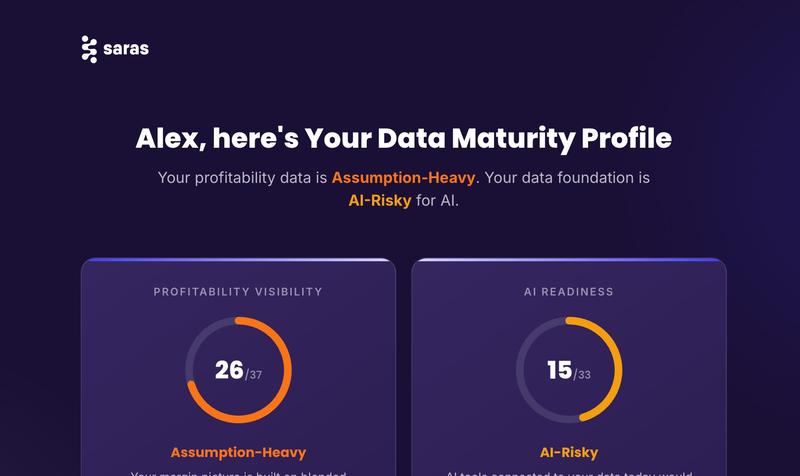
The Trap of Linear Forecasting on a Fixed Budget
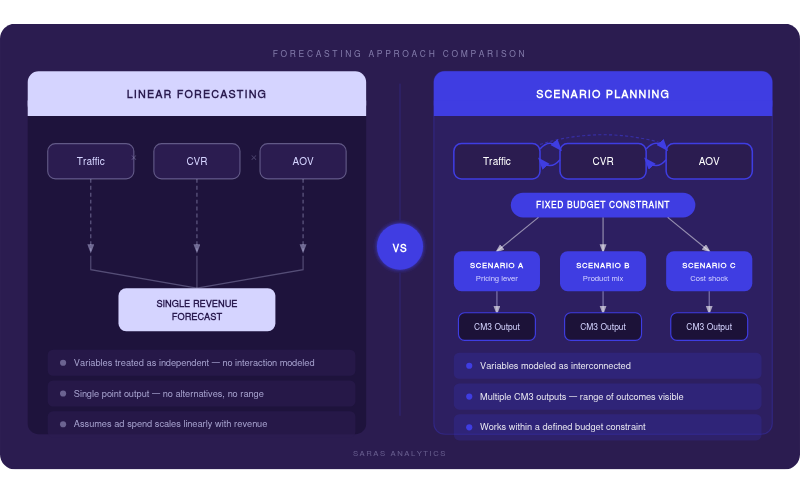
eCommerce forecasting built on a linear model assumes that the relationship between inputs and outputs stays constant. Traffic goes up, revenue follows. ROAS holds steady, CVR (conversion rate) holds steady. Spend less, get proportionally less. The model is intuitive and easy to build in a spreadsheet. It is also wrong in almost every situation where a constraint exists.
Why Traffic × CVR × AOV Breaks Under Constraints
The standard formula treats traffic, conversion rate, and average order value as three independent levers. In practice, they are not. Raising prices to improve AOV typically lowers CVR. Pushing heavier discounts to lift CVR eats AOV and, more consequentially, contribution margin per order.
Reallocating a fixed ad budget from high-volume lower-margin channels toward lower-volume higher-margin ones changes the traffic mix, which changes the baseline CVR the model assumed. Move one variable and the others shift with it. The linear model cannot show that, because it was not built to model interactions, only projections.
According to Gartner's research on scenario planning for finance teams, organizations that rely on single-point forecasts are significantly more likely to experience planning surprises than those using multi-scenario approaches, particularly during periods of resource constraint or market volatility.
Here’s an illustrative example: a brand enters its annual planning cycle with a board-set revenue target of $107-108M. The standard forecast model, projecting forward from last year's traffic growth and ROAS, requires, let’s say, a 15% increase in ad spend to hit that number. Finance has frozen the marketing budget. The linear model produces no workable answer. The planning cycle stalls because the tool has no mechanism for modeling which operational adjustments could close the gap within the approved budget. This is the planning problem that eCommerce scenario planning is designed to answer.
The Diminishing Returns Reality
Fixed ad spend runs into a ceiling that linear models consistently ignore. As a brand pushes the same audience harder with the same budget, incremental return per dollar typically declines. The next customer costs more than the last one did. Applying a flat ROAS assumption across the full budget cycle overstates the revenue that spend will actually generate, particularly past the point where the most efficient audience segments have already converted.
Watch for this signal: If your revenue forecast requires more ad spend than the approved budget, it may still be a valid projection, but it is no longer a usable operating plan. That is the point where eCommerce revenue forecasting needs to shift into scenario planning.
What Dynamic eCommerce Scenario Planning Involves
Standard forecasting answers one question: based on current trends, what will our revenue be? Scenario planning answers a different one: if we change this specific combination of operational variables, what happens to our net profit? The shift sounds subtle. The outputs are fundamentally different.
From Prediction to Prescription
A predictive forecast takes historical inputs, traffic trends, conversion rates, AOV, and projects them forward under the assumption that the business continues on its current trajectory. It is useful for capacity planning when conditions are stable and the budget is flexible.
A prescriptive model takes those same inputs and asks what happens when one or more of them changes deliberately.
- Raise the free shipping threshold by $25.
- Shift ad spend from a high-volume low-margin product toward a lower-volume high-margin one.
- Model the CM3 impact of a 12% increase in 3PL pick-and-pack fees across the top 20 SKUs.
Each of these is a specific question about a specific decision, and each requires a model that can hold multiple variables in motion simultaneously while the others adjust in response.
Why This Is Not Sensitivity Analysis
Operators often confuse scenario planning with sensitivity analysis, and the distinction matters in practice. Sensitivity analysis changes one variable at a time while holding everything else constant. It shows how revenue changes if CVR improves by 2%. It does not show what happens to CM3 when a price change lifts AOV, reduces CVR, and shifts the product mix enough to change fulfillment costs.
ECommerce scenario planning models those interactions together. That is what makes it the right tool for fixed marketing budget strategy decisions, where the whole point is that multiple variables are moving at once and the decision needs to account for all of them before any budget is committed.
3 Crucial eCommerce Scenario Planning Models Every Brand Must Run
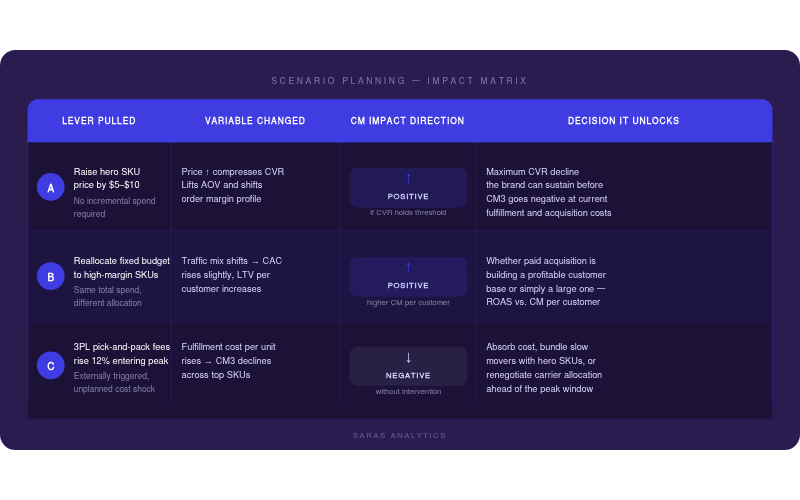
Knowing that eCommerce scenario planning outperforms linear forecasting under fixed budget constraints is one thing. Knowing which scenarios to model is another. Under fixed ad spend, three categories of operational decisions consistently produce the highest variance in CM outcomes, meaning they are exactly where modeling effort pays off most.
Important: Every scenario below must be evaluated at the contribution margin level, not the revenue level. A scenario that lifts AOV by 12% through product bundling can still destroy margin if fulfillment costs on that bundle exceed the revenue gain. ECommerce financial planning built around top-line revenue projections misses the decisions that move the business.
Scenario A: The Pricing and Conversion Trade-off
Raising prices is one of the most direct levers available under a fixed ad budget. It requires no incremental spend and, when modeled correctly, can improve both AOV and CM3 simultaneously. The question scenario planning answers is exactly how much CVR decline is acceptable before the margin improvement disappears entirely.
Here’s an illustrative example: a brand considers raising the price of its hero SKU by $8. A linear model cannot answer whether this is profitable because it cannot show the CVR impact, the AOV shift, and the variable cost structure simultaneously. A scenario model can. It calculates the exact conversion rate drop the brand can sustain before CM3 at current fulfillment and acquisition costs goes negative. ECommerce pricing strategy decisions made without this calculation are guesses dressed as plans, and guesses made under a fixed budget carry disproportionate consequences because there is no incremental spend available to recover from a miss.
What this looks like in practice is that the scenario output is not a revenue projection but a threshold, below which the price increase destroys more margin than it creates. That threshold is what the pricing conversation should be built around.
Scenario B: Shifting the Product Mix
Not all products deserve equal access to a fixed ad budget. High-volume, low-margin products can consume disproportionate acquisition spend relative to the CM they generate. High-margin, lower-volume products often look unattractive on a ROAS dashboard but produce significantly more CM per acquired customer over their lifetime (LTV).
Scenario B models the CM impact of reallocating a fixed budget from the high-volume low-margin product toward the high-margin alternative. The output is not just projected revenue. It is the CM3 delta, the CAC change, and the LTV trajectory of the different customer being acquired. This is the scenario that reveals whether your paid customer acquisition strategy is building a profitable customer base or simply a large one. Most brands running only ROAS-based optimization have never seen this comparison.
Scenario C: The Supply Chain Shock
Variable cost shocks, carrier surcharges increasing ahead of peak season, a primary 3PL raising pick-and-pack fees, landed COGS shifting because of supplier pricing changes, directly hit contribution margin forecasting accuracy and are almost never modeled in advance.
Scenario C asks: if pick-and-pack fees increase by 12% entering peak season, what is the CM3 impact across the top 20 SKUs, and which response protects margin most effectively: absorbing the cost, bundling slower-moving SKUs with hero products to offset per-unit fulfillment, or renegotiating carrier allocation ahead of the peak window? Brands that have modeled this before the cost hits make the decision in hours. Brands that have not spend weeks reconciling impact on data that should have been ready before the commitment was made.
Why Spreadsheets Break Under Multi-Variable Scenario Planning
Running the three scenarios above in a spreadsheet is possible for a single quarter with a small SKU catalog. As operational complexity grows, more SKUs, more channels, more variable cost categories, the spreadsheet-based approach fails in two predictable ways. The version control problem is also why eCommerce scenario planning rarely reaches its potential in organizations running multiple disconnected models simultaneously.
The Fragile Cell Problem
Multi-variable scenario models in Excel depend on hardcoded assumptions feeding into interconnected formula chains. Change the shipping cost assumption in one cell and it cascades through margin calculations, CAC thresholds, and LTV projections downstream, assuming all the references are correct. In practice, they frequently are not. A single broken reference silently produces wrong outputs across the entire model, and the error often goes undetected until the numbers fail to reconcile with actuals at month end.
The deeper problem is that accurate scenarios require accurate baselines. If your historical landed COGS figures are three months old, if your variable shipping costs are estimated rather than pulled from actual carrier invoices, and if your discount data is manually entered from a marketing spreadsheet, the scenario output is only as reliable as the weakest input feeding it. Errors compound across every variable the model touches, which means the further out the scenario projects, the less it resembles the business reality it is supposed to represent.
The Version Control Problem
Multi-variable scenario planning requires alignment across finance, marketing, and operations. In a spreadsheet environment, each team typically maintains its own version. Three models, three sets of outputs, three separate plans, each internally consistent, but none of them reconciled against a shared data foundation.
Ben Yahalom, CEO of True Classic, described the pre-Saras state directly: "Before Saras, our P&L was built on estimates and pieced together from various tools." Scenario planning built on pieced-together inputs produces scenarios that fall apart the moment someone stress-tests the underlying data, which, in a planning meeting, is exactly when coherence matters most.
How Saras Analytics Enables Accurate Scenario Planning Under Fixed Spend
Accurate eCommerce scenario planning requires a certified data baseline, a modeling layer that holds multiple variables in motion simultaneously, and outputs that translate into the planning tools finance teams actually use. Most brands have none of these on a reliable cadence.
Saras iQ provides the AI ready data foundation, certified, daily-refreshed unit economics covering landed COGS, variable fulfillment costs, and channel-level fees, giving every scenario a reliable starting point rather than an estimated one. Saras IQ provides the advanced eCommerce analytics layer that models the CM3 impact of simultaneous changes across pricing, product mix, and fulfillment costs against that foundation in real time.
💡 Exceed Your Revenue Targets: For a leading DTC fashion and apparel brand, Saras built a scenario-based forecasting model using new versus repeat customer behaviour, retention patterns, marketing spend correlation, and ARIMA/SARIMA statistical modelling. The board had set a $107-108M eCommerce target for 2025 under fixed spend constraints. The Saras projection came in at $98M as the defensible estimate under those constraints. Strategy was adjusted accordingly. Actuals trended to $109M by year end, 8% error for new customer revenue, 10% for repeat. The model was delivered in an Excel-first format specifically so the FP&A team could use it in weekly planning meetings, not just quarterly reviews.
👉 Read the full Faherty case study
To maximize LTV and lower CAC organically within a fixed budget, the same modeling layer runs cohort scenarios showing which retention investments produce the highest CM return per dollar spent.
Conclusion
A frozen marketing budget does not mean a frozen growth target. It means the analytical work has to happen earlier, at the scenario level, before commitments are made rather than after they fail to reconcile with actuals. Brands that close this gap are not spending more. They are planning more precisely, against real unit economics, across the specific decisions that move contribution margin.
Saras Analytics provides the certified data foundation and scenario modeling capabilities to replace aspirational targets with defensible plans. Talk to our data consultants to see what scenario-driven planning looks like for your business and your budget constraints.

.webp)
.svg)
%201%20(1).svg)



















.jpg)






%20Statistics%20in%202026.jpg)






%20Software%20for%20DTC%20Brands%20in%202026.png)












%20Setup%20Guide%20for%20Ecommerce%20Finance%20Team.png)




























.webp)

.webp)
.webp)
.webp)
.webp)