If you work in eCommerce, you have probably heard someone mention "MCP" in the last year. Maybe in an Anthropic announcement, maybe from a data team pitching an AI initiative. The term gets used with the assumption that everyone already knows what it means. Most people don't. And until late 2024, the protocol did not exist.
This article explains what an MCP server for eCommerce data is, how it works without the jargon, and why eCommerce brands need more than a generic connection between AI and a database. The accuracy of every AI-generated answer depends on the quality, structure, and business context of the data it draws from. Understanding MCP is step one. Understanding what makes the data underneath it AI-ready is the step that matters a lot.
What Is an MCP Server for eCommerce? The Plain-English Version
MCP stands for Model Context Protocol. It is an open standard developed and open-sourced by Anthropic in late 2024 that defines a common way for AI tools — Claude, ChatGPT, or any large language model — to securely connect to external data sources. Think of it as a universal plug.
Before MCP, every AI-to-data integration was a custom project. If you wanted Claude to query your BigQuery warehouse, someone had to write custom code for authentication, query logic, error handling, and result formatting — all specific to Claude, all specific to BigQuery. If you then wanted to try ChatGPT instead, you'd rebuild from scratch. MCP eliminates that duplication. One MCP server works with any MCP-compatible AI. One AI can talk to any MCP-compatible data source. Standardization is the entire point.
An MCP server, despite the technical name, is just a small piece of software that sits in front of a data source — your BigQuery warehouse, your Shopify store, your Google Drive — and exposes that data to AI tools in the standard MCP format. When the AI asks a question, the server translates it into whatever the underlying data source understands (SQL, API calls, file lookups), fetches the result, and translates it back. You don't need to be a developer to use one. You just need someone to set it up.
Is your data actually Decision-Grade?
9 questions. 3 minutes. Score your Profitability Visibility and Readiness for AI-driven growth.
Start Free Diagnostic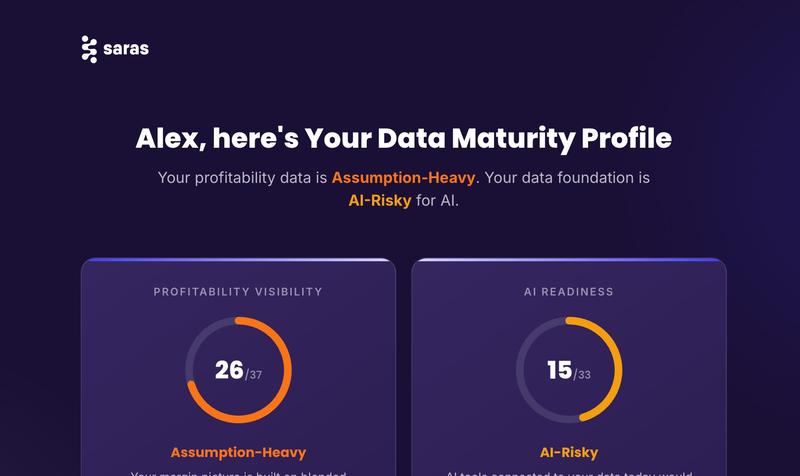
How an MCP Server Works for eCommerce (Without the Jargon)
The easiest way to understand it is as a conversation between three parties: you, the AI, and the MCP server acting as the bridge.
You open Claude and type: "What was my contribution margin by channel last month?"
Claude recognizes it needs data it doesn't have in its training. It reaches out to its connected MCP server. The MCP server receives the request, understands which data source to query, generates the appropriate SQL, runs it against the underlying data, and sends the result back. Claude takes the result, interprets it, and gives you a natural-language answer.
Three things happen inside that MCP server every time. First, authentication: verifying that the AI is allowed to access this data, and that you are allowed to see it. Second, query translation: converting the AI's request into something the data source can actually execute. Third, result formatting: returning data back to the AI in a structure it can reason about, not just dump raw numbers.
This is more than just running a query. A well-built MCP server for eCommerce also enforces access controls, handles errors without silently failing, and provides context about what the data represents. That last part — context — is where the difference between a generic and a purpose-built MCP server for eCommerce data becomes critical. The same standardized protocol works regardless of whether the data sits in BigQuery, Snowflake, or Redshift.
That reliability is also what makes MCP deceptive. The protocol works flawlessly every time. It never throws an error when the underlying data is wrong. It just delivers the wrong answer, cleanly formatted, with full confidence.
The eCommerce Data Journey: From Source to AI Answer
An MCP server for eCommerce data is the last mile of a much longer journey. Understanding where MCP fits requires understanding the full path your data takes before the AI ever sees it.
It starts at the source: Shopify, Amazon Seller Central, Meta Ads, Google Ads, your 3PL, your payment processor. Each of these is its own system with its own API and its own quirks. The data needs to get out of these systems and into one central place.
Saras iQ: The AI Ecommerce Analyst for Shopify Brands Doing $20M+
Most Shopify brands at scale are making decisions from disconnected reports. Shopify, ad platforms, spreadsheets, all telling a different story. Saras iQ sits on top of a certified, AI-ready data foundation so your finance, marketing, and ops teams can ask business questions and get reliable answers instantly. No SQL. No hallucinations. No conflicting numbers.
What you can do with Saras iQ:
- Ask questions in plain English and get answers with visualisations, backed by SQL and business logic you can trace
- Get contribution margin, LTV, cohort analysis, and channel ROI on demand, without waiting for an analyst
- Flag issues and share insights to Slack, email, or Teams in one click
- Connect 200+ data sources including Shopify, Amazon, Meta, Google, and Klaviyo through a single AI-ready data layer
- Plug into Claude or any AI you already use via iQ MCP
Trusted by 200+ eCommerce brands doing $20M+.
Step 1: Ingestion
An ELT tool pulls data from each source and loads it into a cloud data warehouse like BigQuery. For eCommerce, this is harder than it sounds because generic ELT tools often miss the long-tail connectors brands need: Amazon Marketing Cloud, 3PL invoice systems, niche subscription platforms. Saras Daton is a purpose-built eCommerce ELT pipeline with 200+ pre-built eCommerce data connectors for this kind of source diversity.
Step 2: Modeling and the Semantic Layer
Raw data in the warehouse is messy. As one operator described it: buying vegetables is one thing, but then you have to chop everything up and prepare it before you can make a recipe. Orders need to be joined to returns. COGS needs to be applied and updated when costs change. Channels need to be reconciled so the same customer is not counted twice.
On top of those models, a semantic layer defines what every metric means so that every tool querying the data uses the same definition. Saras iQ provides a pre-modelled eCommerce data warehouse with certified datasets and a semantic layer that standardizes this across teams.
True Classic had 40+ disconnected tools before unifying their stack into a single ecosystem, saving over 1,000 hours annually. Read the full case study →
Step 3: The MCP Server
It sits between the semantic layer and the AI. When Claude gets a question, it goes through the MCP server, which queries modeled and semantically defined data — not raw tables — and returns a certified answer.
Setting up an LLM eCommerce data warehouse correctly means getting every step right, not just the last one.
Why the Data Underneath Matters More Than the Protocol
An MCP server is a connection. It is the pipe that lets AI talk to data. But if what flows through that pipe is messy, unmodeled eCommerce data with inconsistent definitions and missing joins, the AI's answers will be equally messy. The MCP server makes data accessible. It does not make data good. Those are two different problems, and conflating them is where most DIY implementations break.
Most eCommerce data warehouses were built for human analysts who catch errors in context. A finance lead would notice if a revenue number seemed off by 30% and go investigate. AI does not have that instinct. It delivers wrong answers with the same confidence as right ones.
As one operator described connecting Claude directly to BigQuery: "Claude scans the database, finds columns that sound like revenue, picks one of them, and responds. If revenue exists in three different tables, Claude will not ask a clarification question. It picks one randomly."
The Risks of Setting Up a Generic MCP Server for eCommerce
Say you connect Claude to your raw Shopify and Amazon tables and ask about total net revenue across channels. The returned number might double-count orders that exist in both Shopify and Amazon for the same customer, use gross revenue instead of net because the returns table is not joined, and miss marketplace fees entirely. The MCP server did its job. The data was the problem. What you end up with is not AI-powered analytics. It is AI-powered confidence in bad numbers.
A second failure mode is specific to eCommerce: retroactive mutations. A return processed 45 days after the original sale changes the margin of that order. In raw tables, the original order record does not update itself. Unless your models apply that return back to the original order, your AI will report margins that are consistently too high for recent months. Data pipelines that work fine for human-reviewed dashboards are often not built for AI-grade quality.
Watch for this signal: When your team gets an AI answer and their first instinct is "let me double-check that in the dashboard," that is a data quality problem, not an AI problem. The MCP connection is working. The data underneath is not structured for AI to reason about correctly.
As Ben Yahalom, CEO of True Classic, put it: "Before Saras, our P&L was built on estimates and pieced together from various tools." That fragmentation is exactly what makes generic MCP connections unreliable. Saras' AI-ready data foundation is built so that when you connect an LLM to your data warehouse, the models, joins, and definitions are already in place — eliminating hallucinations before they start.
Generic MCP Servers vs. MCP Servers Built for eCommerce Data
Anthropic and the open-source community have released reference MCP servers for common tools: PostgreSQL, GitHub, Google Drive, Slack. These are solid general-purpose building blocks. A data engineer can download one, configure it to point at a database, and have Claude querying that database within an hour. That speed is genuinely useful — but it is also where teams get a false sense of "done."
eCommerce data has characteristics generic MCP servers do not handle:
| eCommerce Data Characteristic | What It Means | What a Generic MCP Server Does With It |
|---|---|---|
| Multi-channel reconciliation | The same customer exists in Shopify, Amazon, and your ERP with three different IDs | Counts the same customer multiple times, inflating revenue and order totals |
| Retroactive mutations | Returns processed weeks later change the margin of the original order | Reports margins that are consistently too high because returns are never applied back to original orders |
| Unit economics complexity | Contribution margin depends on dimensional shipping weights, 3PL rate cards, and marketplace fees that vary by product and region | Ignores variable cost components entirely, producing a margin number that bears no resemblance to actual profitability |
| Kit unbundling | A subscription box with four SKUs needs component-level metrics for COGS, pick-and-pack, and shipping weight | Treats the bundle as a single line item, making accurate unit economics impossible |
Saras iQ MCP is a purpose-built MCP server for eCommerce that queries the Saras iQ semantic layer, not raw tables. When you ask about contribution margin, the answer reflects your finance team's actual definition — with COGS applied date-effectively, returns joined at the order level, and marketplace fees attributed by channel.
Here is the practical difference: when operators use a generic Claude BigQuery integration, they get an answer and open their dashboard to verify it. When the data underneath the MCP connection is governed, that verification loop disappears. The AI answer matches the dashboard because both draw from the same certified definitions. AI-powered analytics is not when Claude can query your warehouse. It is when your CFO stops opening the dashboard to check whether Claude got it right.
Important: Before evaluating any MCP implementation, ask your data team one question: "If Claude queries our warehouse right now, does it know the difference between gross revenue and net revenue after returns?" If the answer is no, the MCP server will work perfectly and every answer it delivers will be unreliable.
How an eCommerce MCP Server Handles a Real Question
A CFO at a DTC apparel brand opens Claude and types: "What was our contribution margin by channel for Q3, and which channel improved the most compared to Q2?"
Claude routes the question to the connected MCP server. The server knows that "contribution margin" has a certified definition in the semantic layer: gross revenue minus returns, minus COGS, minus ad spend, minus fulfillment, minus payment processing fees. It queries modeled data where Shopify and Amazon orders are already reconciled, returns are joined at the order level, and COGS is applied date-effectively. Claude formats the result: "Q3 contribution margin was 31% for DTC, 24% for Amazon, and 18% for wholesale. DTC improved most, gaining 4.2 percentage points vs. Q2, driven by a 12% reduction in return rate."
Here is what happens when the same question goes through a generic MCP server pointed at raw tables: Claude sums a total_price column, divides by another column, and returns a number that ignores returns, ignores COGS, and double-counts cross-channel orders. Same protocol, dramatically different answer quality. One answer gets forwarded to the board. The other gets a Slack thread asking whether anyone trusts it.
What Happens After the MCP Server Delivers Data?
Once the MCP server returns certified data, the conversational layer takes over. Saras iQ, the AI eCommerce analyst, asks clarifying questions when a query is ambiguous, provides visualizations with every answer, and shows execution steps so users can audit how a number was calculated. No SQL required. Every answer is backed by traceable logic.
Do You Need to Understand MCP to Use It?
No. You do not need to configure MCP servers or write protocol specifications. What you need is the concept: MCP is the standardized way AI tools connect to data. That lets you have informed conversations with your data team and make better build-vs-buy decisions.
For a DIY approach, you need a data engineer to configure a generic server, point it at your warehouse, and build all the modeling underneath. For a managed approach, Saras iQ MCP comes pre-configured with the server, semantic layer, and eCommerce data models all handled.
What matters regardless of approach is the data foundation. The next time your data team proposes an AI analytics initiative, the first question to ask is not "which AI tool?" It is "what will the AI be querying, and does it match how we actually measure the business?"
Conclusion
Every eCommerce brand will connect AI to their data in the next 12 months. The brands that get value from it will be the ones that invested in the foundation first: clean ingestion, modeled datasets, a semantic layer that locks in what every metric means. Saras iQ MCP connects Claude or any AI tool to a data foundation where the definitions, models, and business logic are already certified.
Curious what this looks like in practice? Talk to the data consultants at Saras Analytics to see how iQ MCP connects your warehouse to Claude in a way your finance team, growth team, and CEO can rely on.

.webp)
%201%20(1).svg)
.svg)















.jpg)
%20Statistics%20in%202026.jpg)

%20Software%20for%20DTC%20Brands%20in%202026.png)

%20Setup%20Guide%20for%20Ecommerce%20Finance%20Team.png)