.webp)
"Which channels actually turned a profit last month after returns and shipping, and what dragged margin down where they didn't?"
A question like that used to take 3 to 10 days. You’d submit a request, wait in the queue, and by the time an analyst pulled the numbers, the moment had often passed. Today, Saras iQ is live, and it answers that question in under a minute, with a source you can trace and a number you can trust. It is the AI data colleague your eCommerce team can always bank upon.
Ask iQ anything in plain English, get a confident answer backed by certified data, and see the SQL behind every response. iQ is not another LLM to wrestle with. It was built by a team of data engineers with over a decade inside eCommerce data problems exactly like yours. It’s time to say hi to the analyst your team never had!
What is Saras iQ?
Saras iQ is an AI data team built for eCommerce. You ask a question in plain English, such as what contribution margin was by channel last week, and iQ returns a written answer, the chart, and the exact SQL it ran, all grounded in your certified data.
Unlike a dashboard you click through or a general-purpose chatbot, iQ knows how your business defines revenue, ROAS, contribution margin, and a new customer, and it applies those definitions the same way every time. That last part is the difference that matters.
A generic AI tool interprets your question against its general training. Saras iQ interprets it against your business logic, so the answer a founder pulls from Slack at night matches the answer a CFO pulls in Claude the next morning. The number stops being a matter of who ran the query.
.png)
Your AI Data Team: the iQ Business Analyst and the iQ Data Engineer
Saras iQ works as an AI data team of two, and both draw on the same certified data and the same business logic. That shared foundation is what keeps their answers aligned, no matter which one you ask.
- The iQ Business Analyst answers business questions and builds summaries and dashboards. Revenue by channel, CAC by cohort, margin by SKU, the questions a growth lead or CFO asks every week become self-serve instead of an analyst request.
- The iQ Data Engineer handles the questions about the data itself. It lives in your Saras Slack channel and answers eight kinds of request, led by explaining how a metric is calculated, confirming whether today's data has loaded, triggering a refresh after you update a source, and investigating a number that looks wrong. It replies in about two minutes, where the same question used to wait one to eight hours for the right engineer to be at their desk.
The split is simple. The Business Analyst answers what your numbers say. The Data Engineer answers whether your data is ready and how it is built. The iQ Business Analyst and the iQ Data Engineer each have a dedicated deep-dive.
Who Saras iQ is For
Saras iQ is built for operators and leaders of high-growth Shopify and multi-channel brands who make high-stakes calls faster than their reporting can keep up. That includes the founder or CEO, the CFO, the head of growth or CMO, the COO, the head of data, and the analysts and ops managers who field everyone else's data requests today.
The moments where it earns its place are the recurring, high-stakes ones: a product launch, a promotion, a bundle decision, a channel expansion, a budget reallocation, or the Monday scramble before a board review. Access is managed with roles, so an admin invites the team and controls who can use iQ, which means the whole team works from the same answers rather than one person owning the query.
Is your data actually Decision-Grade?
9 questions. 3 minutes. Score your Profitability Visibility and Readiness for AI-driven growth.
Start Free Diagnostic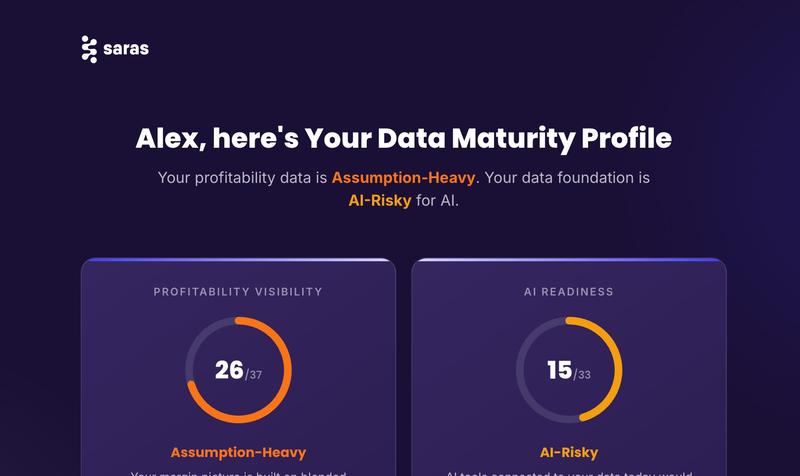
Why eCommerce Teams Stop Trusting Their Own Numbers
Trust breaks when the same metric comes back different depending on which tool or which person ran it. Different systems define revenue and margin differently, so reconciliation turns into a full-time job, teams lose an estimated 16 hours a week to it, and only 15% of data leaders say they have strong confidence in their own numbers (CaliberMind, 2025). The real cost lands later, when decisions stall while people argue about which figure is right.
Why Generic AI and BI Get eCommerce Data Wrong
Pointing a general AI tool at your warehouse feels like the fix, and then it quietly makes the problem worse. The model does not know your business, so it fills the gaps with assumptions, and it fills them differently each time. The failure modes are specific.
| What the AI needs | Where it fails without context | The result |
|---|---|---|
| Your business logic | It does not know your metric definitions or exclusion rules | Wrong logic and calculations |
| Table descriptions | It does not know which table answers a given question | Queries the wrong table |
| Column-level detail | It does not know whether order count is gross or net | Picks the wrong column |
| SQL query patterns | It does not know your joins, filters, and date logic | Builds the wrong query |
| Default handling | It has no rule when a question is ambiguous | A different guess, and a different answer, every time |
| Validation | It has no way to check its own accuracy | No confidence in the answer |
The lesson from the last two years of teams wiring AI to their data is that the model was never the bottleneck. The business context was. The context layer that fixes this is explained in full in a separate guide, and a side-by-side of Saras iQ versus connecting Claude to BigQuery yourself shows the difference.
How Saras iQ Works
iQ answers through a structured, multi-step pipeline rather than one model trying to do everything at once. Each step is visible, so the answer arrives with its work shown rather than as a black box.
From a Plain-English Question to a Trusted Answer
A question moves through five stages:
- iQ reads the business context
- Plans the query
- Writes the SQL
- Summarizes the result
- Renders the chart.
When a question could mean more than one thing, iQ asks the single most useful clarifying question before it answers, so you are not spending time and credits on a guess.
When it makes an assumption, it tells you. Every answer carries three views you can open: the plain-English summary, the SQL that produced it, and the visual. Finance can trace a number back to its query before it goes anywhere near a board deck.
Using Saras iQ in the App, in Slack, and in Claude
iQ meets the team where they already work. There is a native app for self-serve analysis, a Slack presence where anyone in the channel can tag @iQ and get the answer in the thread, and a connection into Claude through iQ MCP, where Claude handles the conversation and builds dashboards or artifacts while iQ supplies the governed data answer underneath. All three read the same certified data and the same business logic, so the surface changes and the number does not. The Slack experience and the iQ MCP capability each have their own walkthrough.
How Saras iQ Keeps Its Answers Accurate
Accuracy in Saras iQ is engineered, and it comes from two things working together:
- A context layer that teaches iQ your business, and
- Validation process that proves the answers before anyone relies on them.
The Context Layer
Like any new hire, iQ has to learn how your business works before it can answer with confidence. That knowledge lives in the context layer, which holds your business logic, a description of every table, column-level detail, ready-made SQL templates, and default definitions for the times a question leaves something unsaid. Because those definitions are set once and enforced on every query, the same question returns the same number across the app, Slack, and Claude. Consistency stops depending on who asked.
.png)
How Every Answer Is Validated Before Go-Live
Before your team logs in, our data experts build and validate the setup against a golden test set of 30 to 100 of your own historical questions, confirming that the SQL iQ generates matches your certified numbers. That runs through automated testing, manual review, and your own sign-off, and you see the results. If something is off, it gets fixed before handoff. You are not building or QA-ing the pipeline yourself.
The other half of trust is what iQ does when it reaches the edge of what it knows. It declines. If the data is not there, iQ tells you rather than inventing a plausible figure.
.png)
Important: A confident wrong number in a board deck is more dangerous than no number at all. iQ is built to say "I don't have that" rather than guess, which is the opposite of how a general-purpose AI behaves when it hits a gap.
Security sits underneath all of it. The language model is never connected directly to your warehouse. iQ constructs the SQL first, then fetches data with read-only access, none of your data is used to train the models, and Saras Analytics is GDPR and SOC 2 compliant.
What DTC eCommerce Teams Get from Saras iQ
The payoff is a faster decision cycle, i.e., less time spent proving whose number is right, more time spent acting on it. Weekly leadership reporting that used to take days lands in under two hours, and the routine questions that used to sit in an analyst's queue get answered in seconds.
The Outcomes: Faster Reports, Leaner Teams, Consistent Numbers
The clearest proof comes from a brand that put iQ in front of its whole team. Over 30 days, Ridge answered 1,069 questions across 18 people spanning the CEO, marketing, product, operations, and finance, at about 35 questions a day, with zero analyst requests. Every one was self-serve.
.png)
Other teams report the same shape of result: leadership reports that once took five to six days now take under two hours, and one operator abandoned two open analyst roles, saving roughly $120,000 in hiring.
.png)
Saras iQ Use Cases Across Marketing, Finance, and Operations
The questions teams bring to iQ cluster around a few jobs.
- Finance runs daily contribution margin across Shopify, Amazon, and retail without logging into each system.
- Merchandising checks how a single SKU performed across every market in minutes.
- Leadership gets a weekly business review that reads like a decision briefing instead of a chart dump.
- Growth teams turn raw behavior into customer segments that predict repeat purchase and act on them.
Each of those is a place where a certified, consistent answer changes what the team does next.
Where Saras iQ Fits in Your Data Stack
Saras iQ is the AI layer on a foundation that was built first. Underneath it, Saras iQ holds your certified, AI-ready datasets, and Saras Daton feeds them through 200+ connectors across 37+ source platforms. That data moves through four layers, from raw ingestion to staging to master datasets to dashboard datasets, with 11 master datasets covering more than 90% of the KPI components a brand calculates.
iQ has nothing to reason over without that foundation, which is why it ships as one system rather than an AI feature bolted onto whatever data happens to be lying around.
Conclusion
Saras iQ turns your data from a source of debate into a source of decisions. It gives every team the same certified answer, shows its work, and tells you when it does not know, so the number stops being a question and starts being a foundation. A brand can go from disconnected data to a governed, AI-queryable system in about ten business days, and use it in the app, in Slack, and in Claude from day one. To see it against your own numbers, talk to our data consultants.
.svg)
.webp)
%201%20(1).svg)





.jpg)
%20Statistics%20in%202026.jpg)

%20Software%20for%20DTC%20Brands%20in%202026.png)

%20Setup%20Guide%20for%20Ecommerce%20Finance%20Team.png)



.webp)
.webp)
.webp)
.webp)