Hevo Data has served many organizations as a general-purpose ELT platform, but ecommerce brands running on Shopify face unique data challenges that generic tools struggle to address. From contribution margin analytics to customer lifetime value (LTV) tracking, DTC brands generating $10M or more in annual revenue need data pipelines purpose-built for retail complexity. This guide examines seven Hevo Data alternatives through the lens of ecommerce data integration, helping CFOs, CMOs, and data leaders at Shopify brands evaluate options that deliver accurate, actionable insights without surprise billing or missing connectors.
Saras Daton stands out as an ELT platform purpose-built for ecommerce, offering 200+ retail-focused connectors and, when paired with Saras iQ, a certified analytics layer that removes the need for a separate BI stack.
Hevo Data Alternatives at a Glance
Ratings pulled from G2 in August 2026.
Why Ecommerce Brands Need Purpose-Built Data Integration
Generic ETL platforms treat Shopify the same as Salesforce. They handle Amazon Seller Central the same as SAP. This one-size-fits-all approach creates problems for DTC brands that need precise tracking of contribution margin (revenue minus variable costs like COGS, fulfillment, and marketing), customer acquisition cost (CAC), and LTV across multiple sales channels.
The core challenges with general-purpose data tools include:
- Missing ecommerce connectors: Platforms like Hevo Data cover Shopify and Amazon Ads but do not list connectors for returns management (Loop Returns), 3PL fulfillment (ShipHero), TikTok Shop, or Amazon Seller Central.
- No built-in business context: Raw data pipelines deliver tables and columns, not definitions of what "revenue" means to your finance team versus your marketing team.
- Unpredictable pricing models: Event-based billing creates budget uncertainty during peak seasons when data volumes spike.
- Separate BI tool requirements: After paying for data ingestion, you still need Tableau, Looker, or Power BI to actually see your metrics.
A quick definition before the list: ETL and ELT tools extract data from sources like Shopify, Amazon, and Meta Ads, then load it into a warehouse such as BigQuery or Snowflake, where it is transformed for analysis. Modern ecommerce stacks mostly run ELT, landing raw data first and transforming inside the warehouse (the FAQ below covers the difference in depth).
Match the alternative to your switching trigger:
- Missing ecommerce sources (returns, subscriptions, 3PL, TikTok Shop): Saras Daton
- Event-based bills spiking at peak season: Saras Daton or Stitch (both row-based)
- You have data engineers and want full control: Airbyte or Apache Airflow
- You need deep ERP coverage alongside ecommerce: Fivetran
- Ingestion is solved and transformation is the bottleneck: Maia by Matillion
- One consolidated tool for a small team: Peliqan
For Shopify brands at $10M to $50M in annual revenue, the right data integration choice affects not just technical operations but daily profitability visibility and board-ready reporting. Basic ETL gets data into your warehouse. A certified data foundation turns that raw data into governed datasets you can trust for contribution margin, cohort analysis, and marketing attribution.
1. Saras Daton: Purpose-Built ELT for Ecommerce Brands
Saras Daton is an ELT platform designed specifically for ecommerce and DTC brands. Rather than offering thousands of connectors across every industry, Daton focuses on the 200+ integrations that Shopify, Amazon, and omnichannel retailers actually need.
Key Capabilities for Ecommerce Teams
- Rare retail connectors: Loop Returns, ShipHero inbound shipment APIs, TikTok Shop commerce data, the full Recharge events API, and detailed Amazon Seller Central API layers across 15+ marketplaces, most of which mainstream ELT platforms do not offer
- Row-based pricing: Transparent $95/month for 5M rows, with fixed tiers up to 100M rows and $28.50 per additional million, so costs scale predictably without event-based surprises
- Certified analytics layer: Paired with Saras iQ, Daton's raw data becomes certified datasets and dashboards for retention, LTV, cohorts, and contribution margin, plus plain-English answers, without a separate BI tool purchase
- White-glove consulting: Complimentary data architect consultation on Enterprise plans
- Fast custom connectors: 2-4 week turnaround for new integrations, often at no additional cost
Ecommerce Use Cases
Saras Daton's job is ingestion: it lands raw, complete data from Shopify, Amazon, ad platforms, subscription tools, and 3PLs in your warehouse, following ELT principles so the raw data stays intact. The analytics happen in the Saras iQ layers above it. For contribution margin, Daton delivers the raw order, cost, and spend data, and Saras iQ's certified data foundation models COGS, fulfillment, platform fees, and marketing spend into daily profitability by SKU and channel. For customer analytics, Daton feeds iQ's CustomerMaster dataset, which adds acquisition attributes and Recency plus Monetary segmentation for clear LTV visibility.
The platform supports subscription commerce through deep Recharge integration, multi-marketplace Amazon selling through detailed Seller Central APIs, and omnichannel operations through connections to Walmart, TikTok Shop, and wholesale systems.
Pricing Structure
- Free: 1M rows/month with 20+ connectors and 7-day historic load
- Growth: $95/month ($79/month annual) for 5M rows with 150+ connectors and setup assistance
- Enterprise: Custom pricing with dedicated manager, RBAC, and custom connector development
Why Saras Daton Leads for Ecommerce
Unlike general-purpose ETL tools, Saras Daton's entire architecture centers on retail data complexity. The platform processes 10M+ jobs daily for 200+ clients and 2,000+ brands representing over $20B in annual GMV. For a worked example, see how True Classic cut its Klaviyo data costs by moving ingestion to Daton.
G2 reviewers rate Saras Daton 4.7/5 stars across 37 reviews, with 31 five-star ratings. Reviewers consistently praise ease of use, responsive support, and how simply it centralizes data from multiple sources, particularly Amazon.
When paired with Saras iQ, the certified data foundation becomes an AI-ready analytics layer where teams can ask plain-English questions and get deterministic, trusted answers.
2. Fivetran: Enterprise-Scale Connector Ecosystem
Fivetran offers one of the largest connector catalogs in the ETL market, with 700+ fully managed connectors spanning ERP systems, databases, SaaS applications, and ecommerce platforms. G2 reviewers rate it 4.3/5 across 829 reviews.
Primary Focus
- Massive connector library: Deep coverage of SAP, Oracle, NetSuite, and enterprise ERP systems alongside standard ecommerce platforms
- Automated schema handling: Detects and adapts to source schema changes without manual intervention
- Set-and-forget reliability: Minimal maintenance once pipelines are configured
- dbt integration: Native support for transformation workflows
- Enterprise SLAs: Strong uptime guarantees for mission-critical pipelines
Ecommerce Considerations
Fivetran covers Shopify, Amazon, and major ad platforms but uses a usage-based MAR (Monthly Active Rows) pricing model that can create budgeting challenges for seasonal ecommerce brands. A 2026 pricing update added a $5 base charge on every connection processing between 1 and 1M MAR (effective January 1, 2026 for monthly plans, and at renewal for annual contracts), so low-volume connectors are no longer free.
The platform serves organizations that need both ecommerce data and broad ERP coverage in a single tool. Brands running NetSuite alongside Shopify may find value in Fivetran's breadth, though Saras Daton also covers NetSuite on its Enterprise tier.
Organizational Fit
Fivetran is designed for large enterprises with dedicated data teams, complex multi-system architectures, and requirements for ERP-level integrations beyond ecommerce. For brands focused primarily on Shopify and DTC channels, the connector breadth may exceed actual needs while the pricing model creates unnecessary budget variance.
For a detailed comparison, see Fivetran alternatives.
3. Airbyte: Open-Source Flexibility for Technical Teams
Airbyte is an open-source ELT platform that offers both self-hosted deployment and a managed cloud option, giving technical teams full control over their data pipelines. G2 reviewers rate it 4.4/5 across 78 reviews.
Primary Focus
- Open-source core: Free self-hosting eliminates SaaS costs for teams with infrastructure capabilities
- 600+ connectors: Large catalog including community-contributed integrations
- Connector Development Kit (CDK): Build custom connectors using Python
- No vendor lock-in: Full control over data processing and pipeline logic
- Cloud option: Managed service starting at $10/month for teams preferring hosted infrastructure
Ecommerce Considerations
Airbyte covers standard ecommerce platforms like Shopify and Amazon but relies on community contributions for many connectors, leading to variable quality and maintenance levels. Teams may need to validate connector reliability for critical data sources.
The platform requires more technical expertise than managed alternatives. Self-hosted deployments need infrastructure management, monitoring setup, and ongoing maintenance that consume engineering resources.
Organizational Fit
Airbyte fits engineering-heavy teams that prioritize control over convenience and have dedicated resources for infrastructure management. For ecommerce brands without strong data engineering capabilities, the operational burden may outweigh cost savings.
4. Stitch Data: Lightweight ELT in the Qlik Ecosystem
Stitch Data (acquired by Talend, now part of Qlik) is a lightweight ELT platform positioned for mid-market organizations seeking straightforward data replication, with plans starting at $100/month. G2 reviewers rate it 4.4/5 across 68 reviews.
Primary Focus
- Simple setup: Quick configuration for common data sources
- Qlik portfolio: Part of Qlik's data integration lineup following the Talend acquisition
- Standard connectors: Coverage of popular SaaS, database, and ecommerce platforms
- Incremental replication: Efficient sync of changed records only
- SOC 2 compliance: Security certifications for enterprise requirements
Ecommerce Considerations
Stitch Data offers basic Shopify and Amazon connectors but lacks the ecommerce-specific depth of purpose-built platforms. The product roadmap and development pace may be affected by its position within the larger Qlik organization.
Organizational Fit
Stitch Data serves organizations already in the Qlik ecosystem or seeking a straightforward, no-frills ELT solution. Ecommerce brands needing specialized retail connectors may find the platform's scope limiting.
5. Maia by Matillion: Cloud Warehouse-Native ETL
Matillion rebranded its Data Productivity Cloud as Maia in early 2026. Maia is a cloud-native data integration and transformation platform that loads data into, and transforms it inside, Snowflake, BigQuery, Databricks, and Redshift. G2 reviewers rate it 4.5/5 across 125 reviews.
Primary Focus
- Warehouse-native processing: Pushes transformations into the warehouse rather than extracting data for external processing
- Visual ETL builder: Low-code interface for designing data pipelines
- Snowflake optimization: Deep integration with Snowflake's architecture and capabilities
- Enterprise scale: Built for high-volume data processing workloads
- Git-based version control: DevOps-friendly pipeline management
Ecommerce Considerations
Maia includes pre-built ingestion connectors, a custom REST API connector, and CDC, but its catalog is built for general enterprise sources rather than ecommerce depth; expect gaps for returns, subscription, and marketplace APIs. Its strength is sophisticated in-warehouse transformation for teams with data engineers.
Organizational Fit
Maia fits data teams that want powerful, warehouse-native transformation and are comfortable building pipelines themselves, particularly those standardized on Snowflake or Databricks. Ecommerce brands seeking retail-specific connectors and ready-made analytics will find it more general-purpose than they need.
6. Peliqan: Consolidated Data Stack
Peliqan positions itself as an all-in-one data platform that combines ELT, transformation, and analytics in a single solution. G2 reviewers rate it 4.8/5 across 87 reviews.
Primary Focus
- Unified platform: Data ingestion, transformation, and visualization in one tool
- Low-code interface: SQL and low-code Python transformations, with a built-in Python IDE and Streamlit apps
- Pre-built templates: Quick-start configurations for common use cases
- Embedded analytics: Share insights directly with stakeholders
- API-first architecture: Extensible through custom integrations
Ecommerce Considerations
Peliqan is a newer entrant in the data stack consolidation trend, claiming 300+ connectors plus a built-in warehouse and an MCP server. It covers standard ecommerce platforms but lacks the retail-specific depth (returns, 3PL, marketplace APIs) and the certified ecommerce datasets that purpose-built tools provide.
Organizational Fit
Peliqan appeals to smaller teams seeking simplicity through consolidation. Established ecommerce brands with mature data requirements may find the platform's feature depth still developing.
7. Apache Airflow: Open-Source Pipeline Orchestration
Apache Airflow is an open-source workflow orchestration platform used to schedule and monitor data pipelines, though it focuses on orchestration rather than data extraction itself. G2 reviewers rate it 4.4/5 across 130 reviews.
Primary Focus
- Workflow orchestration: Schedule, coordinate, and monitor complex data pipelines
- Python-based DAGs: Define pipelines as code using Directed Acyclic Graphs
- Extensive integrations: Operators for AWS, GCP, Azure, and common data tools
- Community ecosystem: Large contributor base and extensive documentation
- Full control: Complete visibility into pipeline execution and dependencies
Ecommerce Considerations
Airflow orchestrates pipelines but does not extract data itself. Ecommerce brands using Airflow typically pair it with other tools for actual data ingestion. The platform requires significant Python expertise and DevOps capabilities to deploy and maintain.
Learn more about Snowflake ETL tools that can work alongside orchestration platforms.
Organizational Fit
Airflow serves data engineering teams building custom pipeline architectures who need orchestration capabilities. Ecommerce brands seeking turnkey solutions will find Airflow's DIY nature requires substantial engineering investment.
Beyond Data Pipelines: Ensuring Accuracy and Trust in Your Ecommerce Data
Moving data is only half the challenge. The bigger problem for ecommerce brands is ensuring that data answers questions accurately and consistently. Generic ETL tools deliver raw tables, but they cannot tell you whether your contribution margin calculation matches your CFO's definition or your CMO's version.
This is where the semantic layer becomes critical. A semantic layer sits between your raw data and your business users, encoding definitions, relationships, and business logic so that "revenue" means the same thing to everyone who asks.
Saras iQ provides this certified data foundation with:
- Context layer: Encodes your specific metric definitions, exclusion rules, and business logic
- Validation layer: Tests answers against a golden set of 30 to 100 client-specific questions
- 500+ daily QA checks: Catches data quality issues before they reach reports
- Monthly reconciliation tolerance: Plus or minus 1% accuracy verified against source systems
The result is deterministic answers: the same question returns the same answer regardless of who asks or when. This eliminates the common scenario where finance, marketing, and ops teams present three different numbers for the same metric.
When to Choose Saras Daton for Ecommerce Data Integration
For Shopify brands at $10M to $500M in annual revenue, Saras Daton delivers the ecommerce specialization, predictable pricing, and built-in analytics that general-purpose ETL tools cannot match.
The platform's rare connectors address gaps that most tools leave open: Loop Returns for tracking return rates and their impact on customer LTV, ShipHero Inbound APIs for connecting warehouse receiving with sales forecasting, TikTok Shop commerce data beyond basic ads metrics, and detailed Amazon Seller Central APIs across 15+ global marketplaces.
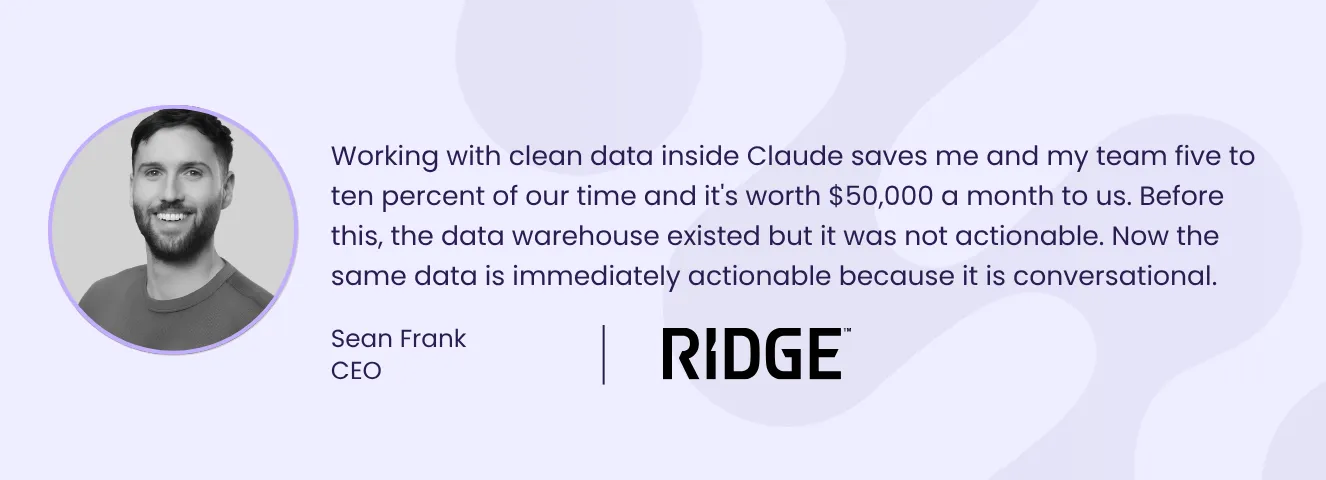
Combined with Saras iQ, the data foundation becomes an AI-ready analytics layer where business questions get instant, trusted answers. Ridge's team asked iQ 1,069 questions in 30 days across 18 users with zero analyst requests. Instant Hydration cut month-end close from 3 days to 2 hours with iQ's semantic layer.
For ecommerce brands ready to move beyond generic data tools, explore Daton's pricing or book a demo to see how purpose-built data integration accelerates profitability visibility.
.svg)
.webp)
%201%20(1).svg)







.jpg)

%20Statistics%20in%202026.jpg)


%20Software%20for%20DTC%20Brands%20in%202026.png)



%20Setup%20Guide%20for%20Ecommerce%20Finance%20Team.png)













.webp)

.webp)
.webp)
.webp)
.webp)






.webp)