
At first glance, apparel profitability forecasting can look reassuring. Sales volume grows, revenue ticks upward, and the P&L report suggests margins are under control. On paper, things look stable. But for finance leaders in eCommerce apparel, this stability often proves to be an illusion.
The reality is that three persistent forces quietly chip away at profitability: aggressive discounts, free shipping subsidies, and soaring ecommerce return rates. Unlike clearly itemized costs, these pressures often remain buried in aggregated expense lines.
For an industry where contribution margins can shift overnight, these blind spots are dangerous. Apparel brands often find themselves scaling losses instead of scaling profit. The problem isn’t just the costs themselves but the lack of visibility. Without sharper reporting tools, it’s nearly impossible for a finance team to measure the true impact of tactics like free returns or steep promotions.
This blog explores how apparel finance teams can avoid these traps. We’ll unpack the silent killers that distort profitability, show why traditional reporting leaves CFOs exposed, and explain how cohort-level dashboards provide the clarity needed to protect margins. Along the way, we’ll highlight real-world examples from apparel brands that turned insights into durable growth.
Is your data actually Decision-Grade?
9 questions. 3 minutes. Score your Profitability Visibility and Readiness for AI-driven growth.
Start Free Diagnostic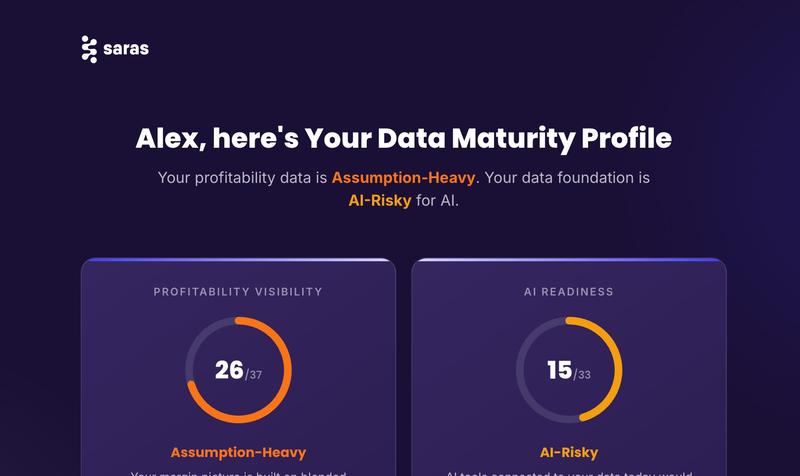
How Returns and Free Shipping Impact Margins
Let’s start with the three levers most responsible for ‘profit erosion’: free returns, promotions, and shipping subsidies. Each seems like a customer-friendly tactic. Together, they create a structural drain that many CFOs underestimate.
In fact, Coresight Research estimates that the average return rate of online apparel orders in the U.S. was 24.4% for the 12 months ending March 2023, which translates to approximately $38 billion in returns in that period.
Free Returns
In apparel, free returns are now a baseline expectation rather than a differentiator. Customers often order multiple sizes or styles, planning to send most of them back. Each return carries a chain of hidden costs: reverse shipping, inspection, repackaging, markdowns, and in many cases outright write-offs. Research suggests that up to 30% of returned apparel can’t be resold at full price, directly hitting the contribution margin.
Discount-Heavy Promotions
Discounts can absolutely drive acquisition and clear seasonal inventory. But when dependency builds, ARPU shrinks and contribution margins collapse. The challenge isn’t to avoid promotions altogether; it’s to measure which campaigns create durable value and which condition customers to wait for markdowns.
Shipping Subsidies
Free shipping has become standard in eCommerce. Apparel brands frequently absorb $6–$9 per order in domestic shipping fees. When costs like these are folded into “operations” or “fulfillment,” they remain invisible to finance leaders until cash flow tightens. During holiday surges, subsidies can run into hundreds of thousands of dollars in a single month.
Why Traditional P&L Models Aren't Helping the CFOs
Traditional P&L statements were designed for compliance and high-level financial reporting. They are not quite good at guiding day-to-day strategic decisions. They work well when the goal is to satisfy auditors or provide investors with a broad picture. But when it comes to managing apparel eCommerce dynamics, they fall short.
Here’s why:
- Aggregation hides the problem: Returns are grouped into “operations.” Discounts show up only as reduced revenue. Shipping subsidies are lumped under “fulfillment.” CFOs end up with blended averages that mask contribution margin erosion.
- Timing creates blind spots: Monthly roll-ups mean by the time finance leaders notice a spike in returns, it’s already too late to course correct.
- False signals mislead strategy: Consider the holiday season; sales surge in December, and the P&L shows strong performance. But in January, when the returns flood back, contribution margins collapse. Without granular visibility, the finance team may double down on what looked like a successful promotion, scaling losses into the new year.
This is where CFO dashboards for apparel profitability makes a huge difference. Instead of hiding these costs in aggregated categories, dashboards connect them directly to transactions, cohorts, and campaigns. The result is a clearer picture of which strategies actually generate profit, and which quietly drain working capital.
The Missing Lens: Why you Need a Customer Cohort Profitability in Apparel Brands
As we know, not all customers contribute equally to profitability. In fact, some customer groups systematically eat up your margins. The problem is that most P&Ls blend profitable and unprofitable segments into a single average. This leaves the finance team with a distorted view of reality.
This is where Customer Cohort Profitability in Apparel provides the missing lens. By analyzing customers in groups, based on purchase behavior, return rates, or promotion dependency, finance teams can see who drives sustainable profit and who erodes it.
Let’s consider a few common apparel cohorts:
| Cohort Type | Buying Behavior | Return Rate | Contribution Margin Impact |
|---|---|---|---|
| Full-Price Loyalty Buyers | Pay full price, keep most purchases | Low | Strong, sustainable profit |
| Discount Hunters | Buy only with promotions/loyalty stacking | Medium | Thin, lower ARPU |
| Frequent Returners | Order multiple items, return 40%+ | High | Often negative margin |
| Bundled Buyers | Buy multiple items per order (higher basket size) | Low–Medium | Spreads shipping cost, healthier margin |
In this case, ARPU segmentation for apparel brands becomes powerful. Segmenting cohorts by ARPU and return behavior allows CFOs or the finance team to identify exactly where profitability lies. For example, a cohort that generates $200 ARPU with a 10% return rate might deliver strong contribution, while another with $180 ARPU but a 40% return rate actually destroys margin. Without segment-level dashboards, both cohorts appear equally valuable in a traditional P&L.
By shifting from averages to cohorts, CFOs gain the insight needed to allocate marketing spend, set up promotion policies, and manage inventory in ways that protect profitability. Rather than subsidizing loss-making cohorts, finance leaders can double down on the customers who build sustainable value.
What CFO Dashboards for Apparel Profitability Must Deliver
Once CFOs recognize the limitations of traditional reporting, the natural next question is:
What should modern dashboards actually deliver?
To be useful, CFO dashboards for apparel profitability must give finance leaders actionable visibility into the drivers of contribution margin.
Here are the essentials:
1. Cohort-Level Contribution Margin Tracking
Dashboards should clearly show contribution margins by customer group. This view makes it obvious which cohorts deserve more acquisition spend and which should be deprioritized.
2. Real-Time Modeling of Discounts and Promotions Margin Impact
Every promotion reshapes buying behavior. A 25% off campaign may look like a quick win, but it can permanently shift customers toward expecting discounts. Dashboards should simulate how a given promotion impacts ARPU, margin, and cash flow, not just for the campaign, but for customer behavior in the months that follow. This is the only way to measure the discounts and promotions margin impact beyond the initial revenue spike.
3. Forecasting for Apparel Returns
Apparel has some of the highest ecommerce return rates of any retail category, ranging from 20% to 40%. CFOs need dashboards that forecast how return spikes will affect margins and working capital in the weeks following campaigns. With effective apparel returns forecasting, finance teams can plan for markdowns, allocate warehouse labor for reverse logistics, and adjust cash flow projections before problems materialize.
4. Shipping Subsidy Visibility
Free shipping isn’t inherently bad. For high-basket-size customers, it can be margin-positive by lifting AOV. The problem is when subsidies apply across the board, draining cash without influencing behavior. Dashboards make this distinction clear, showing where free shipping is an investment and where it’s simply a cost.
Dashboards should track shipping subsidies at the order and cohort level, highlighting where free shipping is driving profitable basket sizes and where it’s simply draining cash. When dashboards deliver these capabilities, finance teams shift from reactive defense to proactive strategy. Instead of discovering problems weeks after they happen, they model outcomes in advance and steer toward profitable growth.
| Dashboard Capability | Why It Matters | Example Use Case |
|---|---|---|
| Cohort-Level Margin Tracking | Separates profitable vs. unprofitable customers | Shift ad spend toward high-ARPU, low-return cohorts |
| Real-Time Promotion Modeling | Shows long-term effects of discounts on ARPU | Predict if a 25% promo will create dependency |
| Returns Forecasting | Anticipates spikes before they hit P&L | Plan markdowns and warehouse labor for January |
| Shipping Subsidy Visibility | Identifies profitable vs. draining free shipping offers | Raise threshold from $50 → $75 for healthier margins |
How Saras Analytics Enables Precision in Apparel Profitability Forecasting
Finance teams can’t achieve this level of clarity if their data lives in silos. For most apparel brands, transaction data sits in the eCommerce platform, shipping costs with 3PL providers, marketing spend in ad platforms, and inventory in ERP systems. Left unconnected, these data points roll up into broad P&L categories that blur the truth.
Some apparel brands solve this by integrating a unified data layer across eCommerce, logistics, and marketing systems. For instance, Saras iQ connects these data points to show true contribution margins at the cohort level.
Here’s how it works in practice:
- Unified Cost Allocation: Every order carries associated costs—COGS, discounts, shipping, and returns. Saras iQ assigns each of these costs directly to transactions, cohorts, and SKUs.
- Granular Visibility: CFOs see not just revenue, but contribution margins by product line, customer cohort, and promotional campaign.
- Forecasting Overlays: Dashboards simulate scenarios—like what happens if return rates spike by 10% after a holiday sale, or if free shipping thresholds are raised from $50 to $75.
This level of precision transforms how finance teams operate. Instead of debating whether free returns are “worth it,” they simulate their financial impact. Instead of assuming discounts will drive sustainable growth, they watch ARPU shift in real time.
Saras iQ: The AI Ecommerce Analyst for Shopify Brands Doing $20M+
Most Shopify brands at scale are making decisions from disconnected reports. Shopify, ad platforms, spreadsheets, all telling a different story. Saras iQ sits on top of a certified, AI-ready data foundation so your finance, marketing, and ops teams can ask business questions and get reliable answers instantly. No SQL. No hallucinations. No conflicting numbers.
What you can do with Saras iQ:
- Ask questions in plain English and get answers with visualisations, backed by SQL and business logic you can trace
- Get contribution margin, LTV, cohort analysis, and channel ROI on demand, without waiting for an analyst
- Flag issues and share insights to Slack, email, or Teams in one click
- Connect 200+ data sources including Shopify, Amazon, Meta, Google, and Klaviyo through a single AI-ready data layer
- Plug into Claude or any AI you already use via iQ MCP
Trusted by 200+ eCommerce brands doing $20M+.
How Saras iQ Helped Faherty Drive $1.1M Incremental Revenue
Faherty, a premium apparel brand, faced a familiar challenge: rapid growth was creating data complexity that obscured profitability. Their customer data lived across Shopify, Klaviyo, and marketing platforms, leaving finance and marketing teams with fragmented insights.
As a result, acquisition spend wasn’t always flowing to the right cohorts, and contribution margins were at risk of eroding under the weight of discounts and free shipping.
By implementing our solution, Faherty gained unified visibility into their customers at a cohort level. They could now track purchase behavior, return rates, and ARPU shifts across different customer groups. This allowed them to:
- Build a Customer 360 that connected data from marketing, eCommerce, and logistics.
- Identify micro-segments and align acquisition spend with profitable cohorts.
- Model the returns and free shipping impact on margins across different customer groups, instead of relying on averages.
The results were striking:
- $1.1M in incremental revenue unlocked.
- 55% increase in ROI on ad spend.
- 5% reduction in overall ad spend, achieved by cutting investment in unprofitable cohorts.
For Faherty’s finance team, the real breakthrough wasn’t just revenue growth; it was confidence. With visibility into cohort profitability, they could forecast contribution margins with accuracy and align acquisition strategy with sustainable profit. Read the Full Case Study.
These results not only transformed Faherty’s bottom line, they also reshaped the way their leadership approached growth. Here’s how Faherty’s team described the impact in their own words:
.avif)
Key Takeaways
Apparel eCommerce has always relied on growth tactics like steep discounts, free shipping, and lenient return policies. These attract customers and drive volume; but they also create fragility. Without visibility, CFOs risk scaling revenue while silently eroding contribution margins.
Traditional P&Ls hide the problem by averaging profitable and unprofitable cohorts into a single blended picture. By contrast, modern dashboards expose the real story, helping CFOs distinguish between growth that creates durable value and growth that destroys it.
The path forward lies in sharper tools:
- CFO dashboards for apparel profitability that isolate contribution margin by cohort.
- Forecasting overlays that model how promotions and return spikes will affect cash flow.
- Cohort-level segmentation to reveal where sustainable profit truly comes from.
For finance leaders, this isn’t optional. With ecommerce return rates climbing and customer expectations for free shipping cemented, profitability will remain under constant pressure. The brands that thrive will be those that invest in data infrastructure and forecasting, not just discounts and volume.
Saras Analytics delivers exactly that: unified data ingestion, real-time dashboards, and forecasting capabilities built for apparel CFOs. With these tools, apparel brands stop chasing vanity growth and start building investor-ready profitability.

.webp)
.svg)
%201%20(1).svg)



















.jpg)




%20Statistics%20in%202026.jpg)



%20Software%20for%20DTC%20Brands%20in%202026.png)










%20Setup%20Guide%20for%20Ecommerce%20Finance%20Team.png)



























.webp)


.webp)
.webp)
.webp)
.webp)