The build vs buy data infrastructure question is one of the highest-stakes capital allocation debates inside scaling DTC brands, and almost every operator who has hit $20M in revenue has wrestled with it. The instinct runs deep: hire a data engineer, spin up Snowflake, connect Shopify, and own the whole thing.
But brands without existing data teams that choose to build frequently underestimate the true data infrastructure cost, the timeline, and the maintenance burden. By the time they realize the build is six months behind and $300K over budget, the window for action on contribution margin, retention, and channel allocation has already closed.
The progression from manual spreadsheets to a reliable, governed data foundation is a maturity milestone, and for most mid-market DTC brands, the fastest path through it is not the one your engineering team builds from scratch.
This article breaks down the real total cost of building in-house, explains why data infrastructure is no longer a core competency for DTC brands, and lays out the concrete advantages of buying a managed solution.
The Hidden Total Cost of Ownership (TCO) of Building In-House
The true cost of building data infrastructure in-house goes far beyond the line item for a data engineer's salary. When DTC operators weigh the build vs buy data infrastructure tradeoff, they tend to anchor on the sticker price of a hire. Most brands dramatically underestimate what it takes to go from "we need better data" to "our leadership team trusts these numbers enough to make decisions from them." The gap between those two states is where the real expense hides.
The Team You Actually Need
The first mistake is assuming one hire solves the problem. A single data engineer can connect Shopify to a warehouse. But building a production-grade in-house data team that delivers reliable, decision-ready reporting requires at minimum three roles:
- an engineer to build and maintain pipelines,
- a business analyst to translate operator questions into data logic,
- and a senior data architect to ensure the whole system scales without collapsing under its own complexity.
Here is what those roles cost in the US as of 2026:
Those are the sticker prices. But most mid-market DTC brands do not hire all three roles on day one. Across Saras' sales conversations with scaling eCommerce brands, three patterns show up repeatedly.
How Brands Actually Try to Build
Pattern A: The Solo Engineer (Most Common)
The brand hires one data engineer at $130K-$160K. That person tries to do engineering, architecture, and some analytics work simultaneously. Six to nine months in, they are spending 70-80% of their time maintaining pipelines and debugging broken API connections. The CFO still does not have a reliable daily contribution margin view. The engineer burns out or gets stuck on maintenance, and the brand realizes they need additional hires they had not budgeted for.
Total year-one spend: $150K-$200K for the hire plus $25K-$60K in tooling, with months of wasted time and no production-grade output to show for it.
One brand's head of planning described the result: her team still spent "20% of the week just pulling data from Netsuite, pulling data from Shopify, putting them together, making sure it's right, validating it," despite having internal data resources.
Pattern B: Engineer Plus Contractor
The brand hires a data engineer AND contracts with a consulting firm or fractional data architect. The contractor handles the initial architecture decisions while the engineer builds the pipelines. This is more realistic but more expensive than most operators expect.
Year-one spend: $130K-$160K salary plus $50K-$100K in consulting plus $25K-$60K in tooling, landing between $205K and $320K. And the consulting relationship often creates a dependency. When the contractor moves on, the in-house engineer inherits an architecture they did not design.
Pattern C: The Outsourced Build (Javi Coffee Pattern)
The brand skips internal hiring entirely and pays an agency or contractor to build the whole stack. One DTC brand went through this exact sequence, investing roughly $100K in tooling and contractor fees for a Fivetran + Snowflake + Metabase build.
The CFO's verdict: "The dashboard was 90% wrong. I had to be on top of them telling them why it's all wrong." The brand eventually abandoned the outsourced build entirely and started over.
Across the implementations Saras has observed, these three patterns share a common thread: the actual cost of building tends to exceed the initial budget, and the time to usable output stretches well past the original plan.
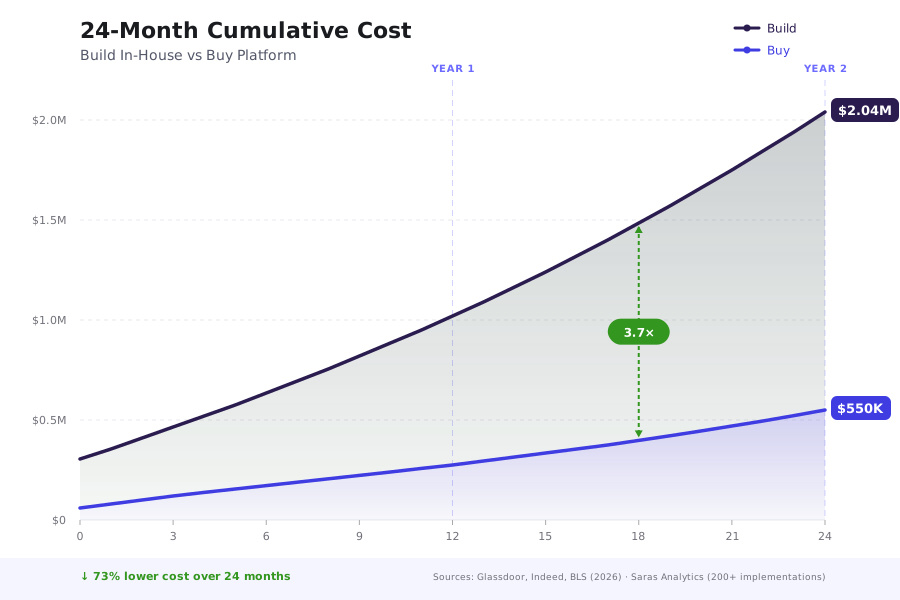
For brands in the $20M-$80M range operating across two to three channels with standard Shopify, Amazon, and ERP data sources, the total cost picture looks like this:
Source: Saras Analytics engagement data across 200+ eCommerce brand implementations; individual salary ranges from Glassdoor, Indeed, and BLS (2026). Ranges assume a $20M-$80M DTC brand operating across 2-3 channels with standard Shopify, Amazon, and ERP data sources. Brands with more complex multi-currency, multi-warehouse, or multi-country setups will land toward the higher end of the build range.
The gap widens in year two. The internal build still carries the full salary load plus ongoing cloud and tooling fees, and maintenance hours tend to grow as systems age and data volume increases. The managed platform cost stays flat or grows only with genuine scope expansion.
The Maintenance Tax
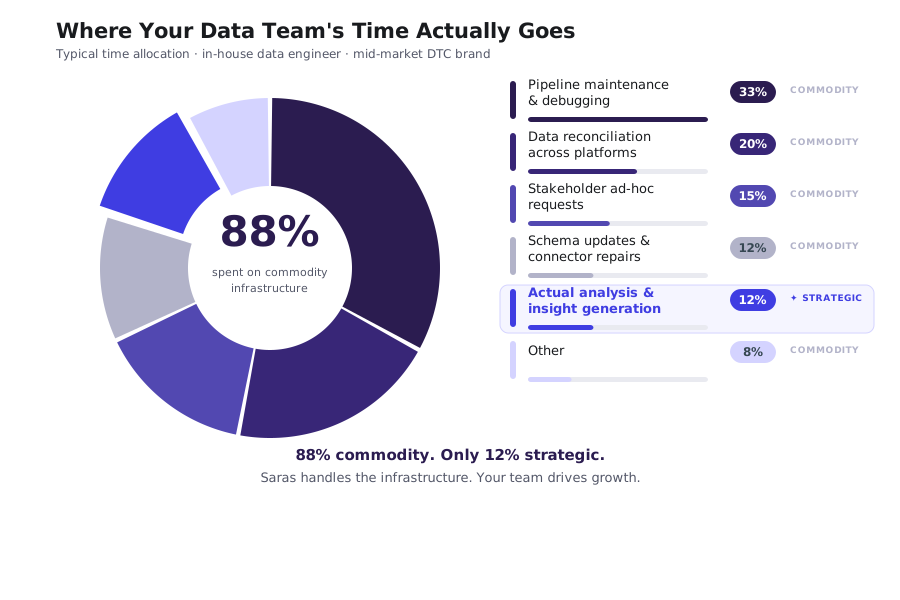
Even after you have the team, a huge chunk of their time goes toward keeping the lights on rather than generating insights. Shopify changes its API schema. Amazon updates its settlement report format. Meta shifts how it attributes conversions. TikTok introduces a new fee structure. Each of these changes breaks a custom pipeline, and your expensive engineer becomes a full-time repairman.
This is not a one-time setup cost. It is a perpetual tax. Across the sales conversations Saras conducts with scaling DTC brands, a consistent pattern surfaces: internal data engineers spend 30-40% of their week on pipeline maintenance and data validation rather than analysis. That ratio only gets worse as data volume grows and more platforms get added to the stack.
Watch for this signal: If pipeline repair consumes more than a quarter of your data engineer's week, the build path is already failing you. You have turned a growth hire into a maintenance hire.
True Classic experienced this firsthand. After migrating from Fivetran to a managed extraction and loading solution through Saras Daton, they reduced their annual ELT costs by 88% while gaining reliability they could not achieve internally. Read the full case study →
As Ben Yahalom, CEO of True Classic, described the pre-Saras state: "Before Saras, our P&L was built on estimates and pieced together from various tools. Saras integrated our ERP in record time, consolidated financials from all channels."
Why Your Data Engineer Should Not Be Building Pipelines
The build vs buy data infrastructure debate often stalls because founders frame it as a technology decision. They ask: what warehouse should we use? Which ETL tool? What BI layer? But those are the wrong questions.
The real question is a resource allocation one: should your brand spend $400K+ and nine months solving a problem that has already been solved thousands of times, or should you deploy that capital toward product development, customer acquisition, and channel expansion?
Think of it the way you think about cloud hosting. No DTC brand in 2026 is building its own physical server farm. You buy AWS or GCP because compute infrastructure is a solved problem and your competitive advantage lies elsewhere. The modern data stack for eCommerce has reached the same inflection point.
Extracting data from Shopify, Amazon, and Meta, transforming it into usable formats, and loading it into a warehouse is commodity work. The value sits in what you do with the data after it is clean, not in how you cleaned it. Connector maintenance, pipeline plumbing, and schema reconciliation are commodity tasks. Business interpretation, operational definitions, and strategic use of clean data remain core competencies worth investing in.
The Talent Retention Problem
Even if you manage to hire strong data talent, DTC brands face a structural disadvantage in retaining them. A skilled data engineer who can build scalable pipelines on Snowflake or BigQuery has no shortage of options. The pull toward larger tech companies, where data infrastructure is the core product and career growth is more visible, is constant.
As one eCommerce CEO put it during an industry roundtable: "the reality is that brands are great places for people who love strategy, marketing, and product. But when it comes to data engineering talent, mid-market brands consistently lose the bidding war against companies where data is the business itself. When your one data engineer leaves, and in this market the median tenure for data engineers is under two years, you are back to zero. The pipelines they built are undocumented, the business logic is in their head, and the six months you invested in ramping them up evaporates overnight. This single-point-of-failure risk is one of the clearest reasons to buy rather than build, and it gets worse, not better, as the business scales."
When Building In-House Actually Makes Sense
This is not a blanket argument against internal data teams. The build vs buy data infrastructure question has a nuanced answer for a specific minority of brands. Building makes sense in a few situations:
- when your brand is developing proprietary ML models or data science IP that is itself a competitive moat
- when you already have a mature data team of three or more engineers with institutional knowledge of your stack
- or when your operational workflows are so unique that no platform can replicate the logic without essentially becoming a custom build anyway.
For the remaining 90% of DTC data infrastructure needs, including extraction, transformation, standard reporting, and analytics for contribution margin, cohorts, and attribution, the economics favor buying.
The "Buy" Advantage: Speed, Scale, and Reliability
Buying data infrastructure from a purpose-built eCommerce analytics platform flips every disadvantage of the build path. Instead of assembling a team, selecting tools, and building from scratch, you get a production-ready data foundation within weeks, backed by a team that has already solved the exact problems your brand is encountering for the first time.
1. Pre-Built Domain Logic and Speed to Value
A managed platform purpose-built for DTC brands comes with contribution margin definitions (CM1 through CM3), cohort models, attribution frameworks, subscription analytics, and SKU-level profitability views already encoded and tested across hundreds of implementations. That eCommerce domain logic is the real advantage of buying, not the connectors.
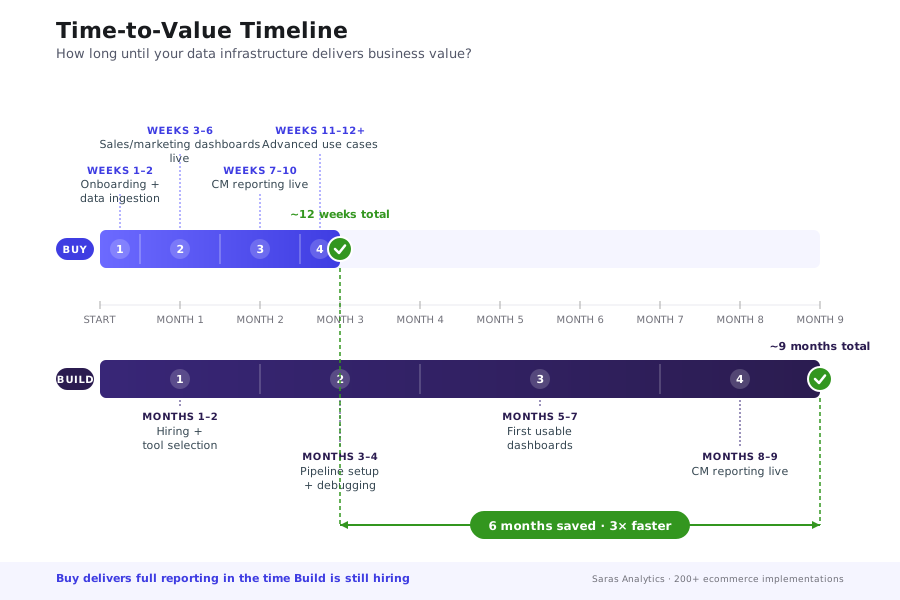
Your internal hire would need three to six months just to learn how contribution margin should be calculated across Shopify, Amazon, and retail channels, accounting for refund timing, shipping surcharges, and platform fees. A managed platform has already worked through those edge cases, and the same certified data foundation also serves as the semantic layer that AI agents need to deliver accurate answers, something that would add another three to six months to an internal build timeline.
When a multi-channel DTC brand recently evaluated Saras, the proposed rollout delivered marketing tracker visibility within two weeks and full contribution margin reporting within eight weeks. An internal build with a strong engineer would take six to nine months to reach the same point.
True Classic unified 40+ disconnected tools into one intelligent data ecosystem through Saras, saving over 1,000 hours of manual work annually. That is time their team reinvested into growth strategy rather than data stitching. Read the full case study →
2. Maintenance Elimination and Risk Reduction
The maintenance tax and talent retention problems covered earlier both disappear when you buy. A managed platform's engineering team patches API changes once across all clients. Your team never sees the breakage. And there is no bus factor: no undocumented scripts, no "only Jake knows how the Amazon reconciliation works" risk.
Note: "Buy" does not mean zero customization. The best managed platforms handle the 80% that is standardized across eCommerce (connectors, data modeling, quality checks, standard dashboards) and then customize the remaining 20% specific to your business: your bundle logic, your channel definitions, your currency conversion rules, your unique cost allocation methodology.
3. Investor-Grade Trust and AI-Readiness
When your CFO needs to present contribution margin data to a board or during a fundraise, they need to know the numbers are auditable and defensible. An internal build rarely has formal data certification, lineage tracking, or automated quality checks. A managed platform includes those by design.
Sam Diacos, CFO of AG1, described Saras Analytics as "a valuable data partner during our period of hypergrowth and two successful fundraises."
That is the kind of trust you need from your data foundation, and it is exceptionally difficult to build from scratch with a two-person data team operating under delivery pressure.
The cautionary tale is equally instructive. One brand's CFO described how the accuracy of their Tableau-based reporting infrastructure, built with significant investment, was being "questioned on an ongoing basis in different business meetings... the most recent one, obviously, was in our Monday All Hands with investors present." When your data foundation loses trust at the leadership level, the entire investment unwinds.
Momentous achieved near-real-time insights by building on Saras' AI-ready data foundation, reducing time-to-insight from days to hours. Read the full case study →
The Edge You Get with Saras Analytics
Saras Analytics has spent ten years building the data infrastructure that DTC brands on Shopify would otherwise need to build from scratch. The platform connects to over 200 data sources, and the implementation team has worked across brands ranging from $15M to $500M+ in revenue, including AG1, HexClad, True Classic, Faherty, and Ridge.
The engagement follows a crawl-walk-run model.
- Phase one builds the trusted data foundation: your product master, SKU mapping, COGS, fulfillment costs, and contribution margin visibility. You get daily or weekly CM reporting and a leadership-ready sales and marketing tracker within the first few weeks.
- Phase two scales the foundation into deeper operational analytics, customer 360 views, and subscription analytics.
- Phase three unlocks forecasting, demand planning, and proactive AI-powered alerts.
Three specific capabilities make this relevant for the build vs buy data infrastructure decision:
Saras Daton, the extraction and loading layer, handles managed eCommerce ETL across every major platform, absorbing API changes, rate limits, and schema updates without any involvement from your team. That alone replaces the most time-consuming part of what an internal data engineer does. For brands comparing the $150K+ salary of an in-house engineer to the cost of a managed tool, the predictable SaaS subscription makes the math straightforward.
For brands with custom ERPs, niche 3PLs, or unusual data sources that fall outside standard connectors, Saras offers specialized eCommerce data engineering services that handle those edge cases without requiring full-time internal hires.
And once the data foundation is in place, the real value shift happens: your team can transition from data engineering to data analysis, using Saras IQ to query clean, certified data through natural language rather than spending weeks building dashboards that go stale the moment a business question changes.
Conclusion
The build vs buy data infrastructure decision comes down to one question: is assembling data pipelines how your brand creates competitive advantage, or is it a distraction from the work that actually grows your business? For the vast majority of DTC brands on Shopify scaling past $20M, the answer is clear. Buy the foundation. Deploy the savings toward product, community, and channel expansion. Talk to our data consultants at Saras Analytics to see what that transition looks like for your specific business.
.svg)
.webp)
%201%20(1).svg)




%20Setup%20Guide%20for%20Ecommerce%20Finance%20Team.png)












.webp)
.webp)
.webp)
.webp)
.webp)






.webp)


.webp)





.webp)




.png)