
In every board meeting, someone eventually asks how the team plans to increase average order value eCommerce can generate without blowing up acquisition spend. That question matters because AOV is one of the three growth levers you actually control: traffic, conversion, and the cash collected per checkout. If you're able to nail the latter, every campaign (be it paid search or loyalty program) will start compounding faster.
If you need proof, consider that 90 % of U.S. shoppers say they add extra items to qualify for free shipping (smartrr.com). A single nudge at checkout can lift revenue without attracting a single new visitor. Yet higher AOV is not a magic bullet. If you think too much about the metric in isolation, you risk spiking return rates, cannibalizing margin, or idling inventory.
That’s why we have put up this guide to unpack why context matters, how to calculate AOV correctly, and most importantly, how to raise it responsibly across segments, channels, and timeframes.
%20(1).avif)
What is AOV Ecommerce
Average Order Value (AOV) measures the mean revenue generated each time a customer places an online order. The formula is simple:
Shopify’s primer defines it as “the average amount spent by customers per transaction” (shopify.com). It may sound simple, but it can also be misleading without context. Reason being averages mask distribution skew. A handful of $600 orders can raise an apparel store’s mean to $120 even when most shoppers spend $60. That disconnect is why Shopify experts advise studying the mean, median, and mode together, and designing levers that move the modal (most frequent) order bracket upward, not just the mean (shopify.com).
Related Read: CAC Payback Period
Saras iQ: The AI Ecommerce Analyst for Shopify Brands Doing $20M+
Most Shopify brands at scale are making decisions from disconnected reports. Shopify, ad platforms, spreadsheets, all telling a different story. Saras iQ sits on top of a certified, AI-ready data foundation so your finance, marketing, and ops teams can ask business questions and get reliable answers instantly. No SQL. No hallucinations. No conflicting numbers.
What you can do with Saras iQ:
- Ask questions in plain English and get answers with visualisations, backed by SQL and business logic you can trace
- Get contribution margin, LTV, cohort analysis, and channel ROI on demand, without waiting for an analyst
- Flag issues and share insights to Slack, email, or Teams in one click
- Connect 200+ data sources including Shopify, Amazon, Meta, Google, and Klaviyo through a single AI-ready data layer
- Plug into Claude or any AI you already use via iQ MCP
Trusted by 200+ eCommerce brands doing $20M+.
Why You Should Aim for Higher Average Order Value
Increasing your AOV does three things, something that most of the eCommerce business owners care about:
It spreads fixed costs
For example, the cardboard mailer, pick-pack labor, gateway’s flat $0.30 fee, and every “handling” minute hit each order whether a customer buys one hoodie or three. When a cart grows from $45 to $80, that $3 packaging cost drops from 6.7% of revenue to 3.8%. Those saved points fall straight to contribution margin and can bankroll faster shipping, better retention perks, or the next product drop. Bigger baskets turn fixed overhead into leverage.
Offsets rising CAC
Ad costs are getting more expensive, whether you're bidding on Meta, Google Shopping, or working with influencers. For many DTC brands, acquiring a new customer now costs over $25, according to multiple industry benchmarks and agency reports. If your average order value is only $50, that $25 eats up half your revenue right away. But if you increase that AOV to $75, your customer acquisition cost becomes just one-third of the revenue, giving you healthier margins. Higher AOV doesn’t reduce your ad costs, but it makes them far more affordable.
Improves cash-conversion cycles
Inventory deposits, 30-day ad terms, and fulfillment payroll all go out the door before revenue clears. Larger baskets pull more cash forward per transaction, and this allows you to recover your ad spend faster and reorder without tapping credit lines. Shave even a week off that working-capital loop, and you cut interest costs, avoid stock-outs, and keep growth self-funded. Every extra penny of AOV can strengthen your operating runway.
The upside is tangible. Upselling and cross-selling programs have been shown to lift revenue and AOV by 10 – 30 % on average (salesgenie.com). Meanwhile, fragrance label WHO IS ELIJAH boosted AOV 46 % during BFCM 2024 after rolling out tiered gift-with-purchase rules on Shopify (shopify.com). These numbers explain why growth teams go after AOV improvements almost as hard as traffic growth.
How Saras iQ helps: Tracking raw AOV alone is risky. Saras iQ overlays profit margins, cohort behavior, and promotion costs, so you see whether a “successful” AOV spike actually created incremental cash or just shifted volume forward.
Is your data actually Decision-Grade?
9 questions. 3 minutes. Score your Profitability Visibility and Readiness for AI-driven growth.
Start Free Diagnostic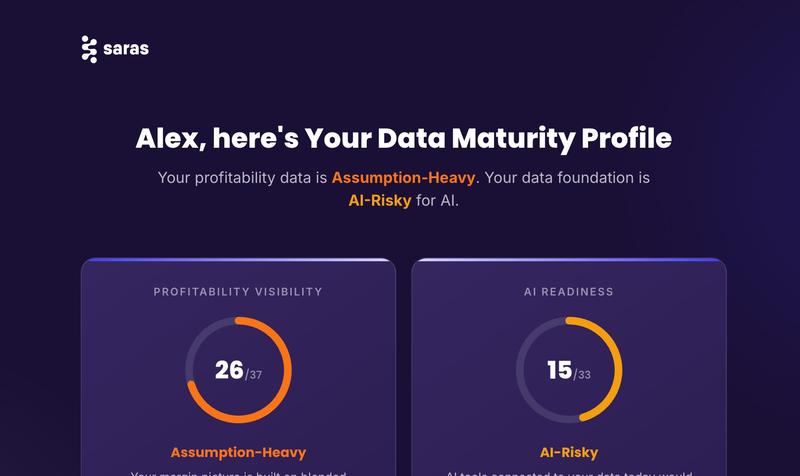
How to Calculate AOV Ecommerce Step by Step
AOV is simple to calculate but crucial to interpret correctly. Each step shapes how you understand buying behavior and revenue efficiency. Here’s how to do it right:
- Pick a time frame. Monthly is common, but weekly granularity helps spot promo distortions.
- Sum gross revenue for that period. Exclude taxes and gift-card redemptions; include shipping fees only if you bank them as revenue.
- Count total orders (not units). A cart with five SKUs still counts as one order.
- Divide revenue by orders. The result is your headline AOV.
Here is an example
Total July revenue: $2,450,000
Total July orders: 31,600
AOV = $2,450,000 ÷ 31,600 ≈ $77.53
In this example, a $77.53 AOV looks healthy. But Saras iQ’s cohort view shows that new-customer baskets from TikTok average just $54 while returning subscribers from email logs a hefty $102. Blended reporting hides that gap, and it could push you to overspend on the wrong channel.
Tip: To improve average order value proactively, log the formula in your BI tool with filterable dimensions (device, campaign, customer type). This lets you explore how to increase average order value eCommerce without waiting on analyst pull-requests.
11 Strategies to Increase Average Order Value Ecommerce
To increase AOV eCommerce, your toolkit needs a mix of intelligent merchandising, well-structured offers, and data that confirms you're boosting profitable sales. Here are eleven strategies that work across brands, both for DTC and multi‑channel operations.
1. Bundling & Product Pairing
First, don’t view each SKU in isolation. You need to think in terms of value bundles that resonate. For instance, a skincare brand might combine moisturizers with travel-size serums. When Greater Than identified moms often rehydrated during postpartum and pregnancy, they leveraged this insight within product bundles. By offering “mom hydration kits”, a combination of their popular electrolyte drink with a postpartum wellness guide, their AOV jumped 20% with the help of Saras iQ analytics. This meant not only more revenue per cart but deeper customer engagement.
Tip: Structure bundles so the aggregated price looks like a good deal compared to individual SKUs, without eroding margin.
2. Tiered Free‑Shipping Thresholds
Setting tiered free‑shipping thresholds creates a psychological bend toward that sweet‑spot price point. For example, if your AOV hovers around $60, offer free shipping at $75 and a small discount at $100. This tier diversifies incentives and nudges mid‑basket shoppers toward upsells.
Tip: Use your cart analytics (like Saras iQ’s cart funnel dashboard) to identify threshold levels with strong uplift potential. For instance, Greater Than tracked cart to checkout drop‑offs through GA4, driving a 7x faster implementation to better understand these micro‑behaviors.
3. Auto‑Upsell & Post‑Purchase Offers
Upselling during checkout and offering discounts after purchase are low-friction ways to increase average order value. Once a shopper adds a hydration pack, prompt them for a related item like a reusable straw or a multi‑pack at a small incremental price.
Setting up a post‑purchase offer like “Add X for 15% off” immediately after checkout is statistically cheaper than acquiring a new shopper. It can often boost incremental AOV by 10–15%, based on industry data.
4. Personalization with Data‑Backed Merchandising
Generic “customers who bought this also bought…” widgets offer modest gains. In comparison, personalization tailored to segment behaviors unlocks more. You can leverage a platform like Saras iQ to analyze past purchases and forecast affinities. Imagine customers who bought hydration during pregnancy getting personalized offers just before expected postpartum replenishment; this is both relevant and effective. This strategy in the Greater Than case lifted conversion efficiency and added to the 20% AOV lift.
5. Volume Discounts and Tiered Pricing
Volume or tiered pricing, such as “Buy 2 get 10% off, buy 3 get 15% off”, plays on savings psychology. You need to ensure the savings feel meaningful. Plus, you must align them with product margins. Track uptake across tiers so you know if you’re cannibalizing higher-margin SKUs.
Tip: Analyze historical basket data to decide optimal tiers, maybe "$50+, $75+, $100+" instead of guesswork.
6. Subscription Upsells
If any products lend themselves to recurring purchase, offer subscriptions during checkout. Now that Greater Than tracks subscription behavior, they can upsell larger packs or combine subscriptions with one-time bundles based on customer lifetime purchase trends. Subscription options can lift AOV while deepening CLV. These are the two levers that multiply over time.
7. Loyalty & Points Incentives
A points program where customers earn credit toward free products with each purchase can shape purchase frequency and basket size. For example, awarding 1 point per dollar spent, redeemable in $10 increments, encourages shoppers to spend slightly more to earn redeemable points in the current session.
Tip: Use your purchase data to model how points influence basket size. If you can drive a $5 AOV uptick at the cost of $1 redeemable credit, that’s a solid profit enhancer.
8. Limited-Time Offers & Countdown Promotions
You can create urgency around add-ons to tap into impulse behavior. For example, an offer like “Add this within the next 10 minutes and get 20% off” for complementary SKUs can bring in some good numbers. Time limits boost cart AOV. But the key is to use them sparingly, as overuse undermines trust and trains customers to wait for deals.
9. Gift-With-Purchase Tiers
Tiered GWP is one of the most elegant ways to increase AOV. It encourages shoppers to spend more to unlock more perceived value. To protect margins, ensure your free gifts come from low-cost SKU lines or retired seasonal promos. And monitor AOV shifts using tools like Saras iQ to help verify the uplift isn’t offset by increased COGS hidden in gift costs.
10. Smart Cross-Sell on Cart Page
A sleek cart page that highlights relevant add-ons based on what’s currently in the cart can push AOV higher without intrusion. Visuals and clear pricing often help. Again, this should be backed up and driven by data. A hydrated mom’s cart may display postpartum-specific snack packs, while a fitness enthusiast’s cart shows recovery drinks.
11. Campaign-Level AOV Testing
Each paid or owned campaign should tie to AOV uplift, not just clicks or conversions. With Saras iQ’s campaign dashboards you track AOV by channel, campaign, or even creative. That segmentation identifies which campaign drove high-AOV baskets. This way, the marketing teams can allocate budget more profitably and replicate winning combos.
For example, Greater Than cut back on broad social campaigns once they realized email‑driven hydration bundle ads generated 30% higher AOV. That clarity came only after reporting was stitched together, not siloed.
Best Practices to Sustain AOV Growth
Getting customers to spend more per order is only half the equation. The other half is keeping that growth stable, without trading margin for vanity metrics. If your AOV spikes during a promotion, but your return rate jumps 15%, you're not ahead. Sustaining AOV growth means bringing in some smarter tactics into your core operations.
So, let’s walk through a few foundational best practices that will help you improve the average order value without compromising profitability or customer trust.
1. Monitor Contribution Margin, Not Just AOV
Not all dollars are equal. A $20 increase in AOV doesn’t matter if the extra product added is heavily discounted or costs you $18 to fulfill. You need to understand the contribution margin per order, not just the gross value.
This is where most traditional analytics tools fall short. They show the “what” but not the “should.” Saras iQ closes that gap by overlaying cost of goods sold (COGS), fulfillment, and returns data. Loaded with this information, teams have a clear view of margin per basket, not just AOV.
Tip: Always measure AOV alongside margin per order and customer lifetime value (CLV). Growth leaders track incremental gross profit per customer, not just revenue.
2. Track AOV by Campaign and Cohort
If your email campaigns are driving a $110 AOV while your Meta ads bring in $75, those two audiences require entirely different merchandising strategies. Similarly, if subscribers spend more over time than one-time buyers, AOV from lifecycle campaigns will show higher long-term returns.
Saras iQ allows eCommerce operators to segment AOV by acquisition source, retention cohort, and purchase frequency. Greater Than, for example, used cohort-based views to understand how postpartum customers purchased compared to first-time buyers. That clarity shaped their hydration bundle strategy and directly contributed to their 20% AOV lift.
3. Understand Channel Biases
Different sales channels behave differently. Mobile tends to yield lower AOVs due to screen size and UX constraints. Amazon sales often favor speed over cart building. Shopify lets you customize the experience and incentivize bundle behavior more freely.
If your blended AOV looks flat, it's often because high-value channels are getting drowned out by low-value ones. Use a tool like Saras iQ to filter AOV by channel so you don’t over-optimize for the wrong one.
Industry Benchmark: According to Shopify, the average AOV across U.S. eCommerce is around $85–$100, but varies drastically by vertical (e.g., beauty averages $70–$90 while electronics exceeds $120).
4. Avoid Over-Incentivization
Offering “Buy 3, Get 1 Free” or “Free Shipping Over $50” can spike AOV—but they come at a cost. If used too aggressively, such tactics can train customers to delay purchases until the next deal, or they can eat into profit margins.
The trick is to have A/B test incentives and monitor how they perform across different segments. Saras iQ helps marketers test incentive strategies while isolating their impact on CLTV, churn, and repurchase rates.
Best Practice: Time-limited promotions should be followed with non-incentivized offers to test whether customers stay without the deal.
5. Consider UX & Checkout Optimization
Every time a customer adds a product to their cart, your UX has a chance to drive incremental revenue. Smart upsells, relevant recommendations, tiered shipping thresholds, and trust signals can meaningfully lift AOV, especially on mobile.
Here’s what to monitor:
- Are add-on items getting clicked?
- Where do most drop-offs occur during the checkout process?
- Do cart totals tend to stop right below your shipping threshold?
Saras iQ integrates behavioral funnels and AOV tracking so you can tie user flow to transaction outcomes. For example, if your mobile cart sees lower AOV, Saras iQ might reveal the bundle layout is poorly optimized for thumb-scroll behavior.
6. Why AOV in eCommerce Can Be Misleading Without Context
This is the most important mindset shift for anyone trying to increase AOV eCommerce: AOV alone is not a North Star metric. It must be evaluated in conjunction with:
- CLTV: Are your high-AOV customers returning?
- CAC: Did you pay $45 in ads to get someone to spend $80?
- Return Rate: Are your add-ons spiking refunds?
- Gross Profit: Are bundles selling but eroding contribution margin?
Salesforce rightly points out that optimizing for AOV without looking at related KPIs can give you a false sense of success. For example, a $130 AOV might look great until you realize 35% of that revenue is from a promo item with a 2% repurchase rate and 40% return rate.
Turn Higher AOV Into Real Business Impact with Saras iQ
There are many ways to increase AOV, but only a few ways to do it sustainably. Smart operators don’t chase single metrics; instead, they track how every dollar added to the cart changes their retention curve, margin profile, and marketing payback. That’s the level of visibility Saras iQ brings to your business.
At Saras, we believe every metric should connect to outcomes. Higher AOV is exciting, but what matters is profit, along with repeatable and predictable growth.
With Saras iQ, you’re not just measuring what happened. You’re learning:
- Which channel or campaign drove high-margin AOV increases.
- Whether those increases came from first-time or repeat buyers.
- If the strategy works across segments, or just for one demographic.
- How product pairings and bundles affect long-term repurchase rates.
That’s how brands like Greater Than took a high-level goal like “improve average order value” and turned it into a 20% gain backed by concrete insights, without sacrificing experience or profitability.
Saras iQ helped them:
- Cut reporting turnaround by 80%
- Analyze cart funnel behavior across Shopify and Amazon
- Attribute AOV uplift to specific promotions and landing page UX changes
If you’re a DTC or multi-channel brand trying to increase AOV eCommerce-wide, and actually understand why it’s happening, Saras iQ is built for you.
Learn how Saras iQ can help you grow profitably.

.webp)
.svg)
%201%20(1).svg)























.jpg)




%20Statistics%20in%202026.jpg)




%20Software%20for%20DTC%20Brands%20in%202026.png)






%20Setup%20Guide%20for%20Ecommerce%20Finance%20Team.png)



















.webp)

.webp)
.webp)
.webp)
.webp)