Native Shopify analytics works, but mostly for stores under $500K a year in revenue. Independent testing from Blackbelt Commerce puts that as the ceiling; past it, the same 60-plus built-in reports stop matching what your business is actually living. This is the moment brands start searching for an enterprise Shopify analytics platform, and most of what they find explains what Shopify provides, not what's missing once you've crossed the line.
The gap isn't just a missing feature. It's five specific breaks in five different places: attribution, margin, data integration, cross-team reporting, and AI-readiness. None of them get solved by adding another single-purpose app to an already crowded stack. They get solved by replacing point solutions with one foundation built to hold all of it, which is the approach Saras iQ takes. This article maps exactly where native reporting stops and what has to replace it.
What Shopify's Native Analytics Actually Provides, and Where It Stops
Shopify ships more analytics than most merchants ever open: 60-plus pre-built reports spanning sales, traffic, customers, inventory, and marketing. Shopify Plus brands also get cross-store analytics for unified reporting across multiple storefronts, plus a customizable report builder with filtering and export. Under $500K in annual revenue, this is genuinely enough. It covers the operational questions a growing store actually asks, without an additional tool in the stack.
Native Shopify reporting includes:
- Sales performance by channel, product, geography, and time period
- Traffic and conversion, from session to purchase
- Customer reports, including new-versus-returning and basic cohort charts grouped by first order date
- Inventory levels, days-of-stock remaining, and sell-through rate
- Cross-store analytics for brands running multiple Shopify Plus storefronts
Every gap below is structural, not cosmetic. None of them get fixed with a new report, a plan upgrade, or a setting buried three menus deep. The data required to close them doesn't live inside Shopify, and the architecture was never built to go looking for it there. Closing them is exactly the job of an enterprise Shopify analytics platform, which is the specification the rest of this piece maps out.
The Five Enterprise Analytics Gaps Shopify Native Cannot Fill
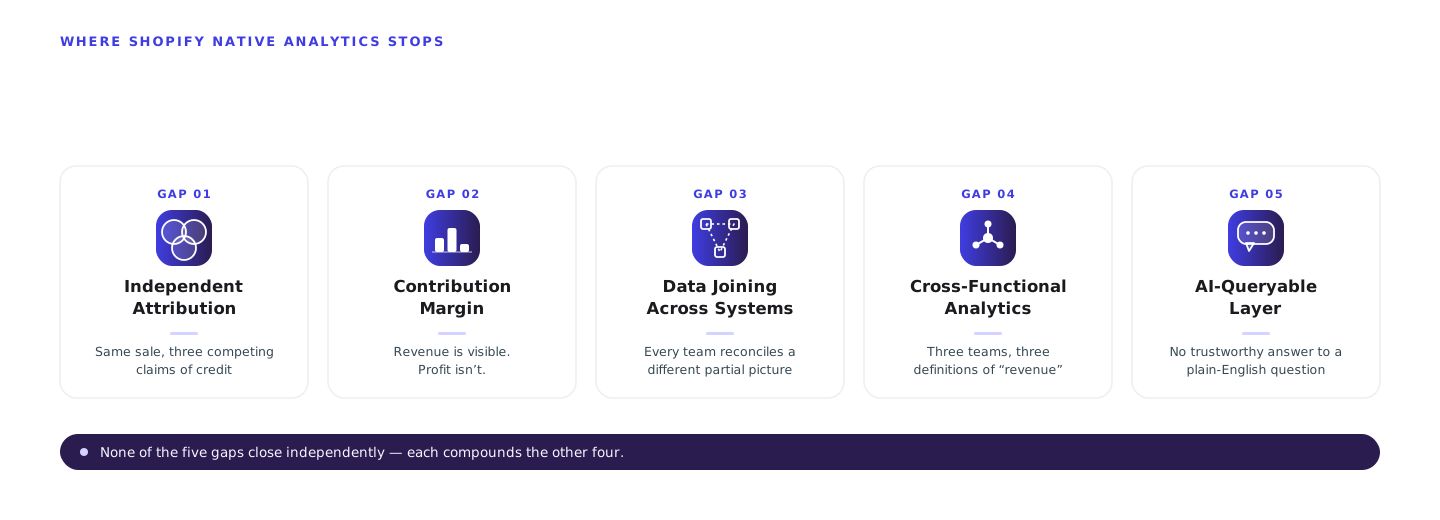
Five gaps show up at the exact point where Shopify's native analytics stops being enough, and none of them get solved independently of the others.
Gap 1: Independent attribution across every marketing channel
Shopify's attribution model credits whoever gets the last click before checkout. That's workable for a single-channel store and misleading once a brand runs Meta, Google, TikTok, affiliates, and retail media at the same time, because the same sale gets claimed by three or four platforms, each using a different rule for who gets credit.
Closing this gap requires first-party, multi-touch attribution built outside all of them: attribution the brand owns and can audit, not attribution borrowed from whichever platform's pixel fired last.
Important: Third-party cookie deprecation and iOS 14.5 have quietly made last-click attribution unreliable for any brand running paid media across more than one platform. The fix is server-side, first-party tracking that reconstructs the customer journey without depending on a browser cookie that may not survive to checkout.
Let’s say, a $75M brand employs a paid social manager, an affiliate manager running 200+ creator contracts, and a retail media budget on Amazon DSP: three people whose bonuses depend on their channel showing results. The CFO needs one board slide showing which channel drives contribution margin, not revenue. Even with a $70K-a-year attribution platform already in place, that platform stops at ROAS. It was never built to connect to COGS or fulfillment cost, so the board still gets three competing claims of credit and no answer on which channel is actually profitable.
Anatta closed a version of this exact gap using Saras and saw a 40% improvement in GA4 data accuracy as a result. Read the full case study →
Gap 2: Contribution margin by channel, SKU, and cohort
This is the most consequential gap for enterprise brands, because Shopify shows revenue and stops there. The difference between gross revenue and true contribution margin by channel and SKU, after COGS, fulfillment, returns, marketplace fees, and ad spend, often runs 40-60% of revenue, distributed unevenly across channels, products, and cohorts. A channel driving 30% of Shopify revenue might produce a fraction of that in actual profit.
Let’s take this example: a $90M brand sells one hero SKU through DTC, Amazon 1P, and a major big-box retailer. The retailer deducts chargebacks, co-op marketing, and slotting fees from remittances weeks after the sale, landing in the ERP as one lump adjustment instead of being allocated back to the SKU. DTC and Amazon COGS are tracked cleanly; retail margin isn't. When the CFO needs channel-level EBITDA for a lender covenant, the retail number is a plug, and a plug doesn't survive a covenant audit.
Native Shopify analytics also can't isolate which acquisition cohorts are actually worth pursuing further. Revenue per cohort is visible; cohort analysis and LTV by acquisition channel tied to contribution margin, not just repeat-purchase rate, is not. Without it, brands keep funding acquisition channels that look healthy on a cohort chart and lose money on every order.
Gap 3: Data joining across external systems
Enterprise Shopify Plus brands never operate in Shopify alone. A typical brand at this scale runs Shopify for DTC, Amazon Seller Central for marketplace, a 3PL for fulfillment, NetSuite or another ERP for financials, and two or three paid media platforms on top. Native Shopify analytics reports on what happens inside Shopify. It cannot join that data with Amazon order revenue, 3PL fulfillment invoices, or ERP-recognized COGS, which means every team is reconciling a different partial picture of the same business.
Another example: a $70M or $80M brand runs US and EU entities on one NetSuite instance, plus a Snowflake warehouse an in-house team built two years ago pulling from both. During the annual audit, external auditors flag a persistent contribution margin variance between the two entities, traced to which exchange-rate snapshot each system uses for intercompany transactions. It's a recurring audit finding, and "we manually adjust for it every quarter" isn't an answer an audit committee accepts twice.
.png)
Closing this gap takes an ingestion layer built specifically for eCommerce's long tail of connectors, covering Amazon Marketing Cloud, 3PL systems, ERP integrations, and regional platforms, which is exactly where generic ETL tools stop short.
Gap 4: Cross-functional analytics from a single source
Shopify Plus cross-store analytics solves one specific problem: unified reporting across multiple storefronts. It doesn't solve the bigger one, which is that finance, marketing, and operations need entirely different views of the same underlying data, pulled from the same certified source. Marketing needs channel-level attribution and ROI. Finance needs contribution margin and P&L reconciliation. Operations needs inventory health, 3PL performance, and demand planning. The executive team needs a summary that rolls all three into one board-ready view.
Native Shopify analytics can't serve all four audiences from one dataset, because it was designed around one, i.e., the merchant running the store. Each team ends up in a separate tool, working from a separate definition of "revenue," and cross-functional meetings turn into reconciliation exercises instead of decisions.
Gap 5: AI-queryable analytics layer
By 2026, the highest-value capability in enterprise analytics isn't another dashboard. It's the ability to ask a plain-English business question and get a trustworthy, auditable answer. "What was contribution margin by channel last quarter" or "which acquisition cohorts have the highest 90-day LTV" are questions Shopify's native analytics can't answer, and most standalone analytics tools can't either. That requires a semantic layer with certified business definitions sitting above a unified data foundation, so an AI system is querying meaning, not raw column names it has to guess at. That capability, more than any single dashboard, is what separates a reporting tool from an enterprise Shopify analytics platform.
What an Enterprise Shopify Analytics Platform Must Deliver
Everything above points to the same specification. An enterprise Shopify analytics platform needs to deliver six capabilities in a single foundation, not six separate tools bought one gap at a time.
| Capability | What It Requires |
|---|---|
| First-party multi-touch attribution | Independent of platform reporting, server-side tracking, a model the brand controls and can audit |
| Contribution margin by channel, SKU, and cohort | Shopify revenue connected to COGS, fulfillment, returns, marketplace fees, and ad spend in one daily view |
| Full eCommerce data ingestion | 200+ connectors covering Shopify, Amazon, paid media, 3PL, ERP, email, and subscription platforms |
| Cross-functional dashboards | Role-specific views for marketing, finance, and operations, all from the same certified data |
| AI-queryable semantic layer | Natural language analytics on certified definitions, so any team member can ask a question without SQL |
| Enterprise security | SOC 2 Type II compliance, a documented uptime SLA, and implementation measured in weeks |
Saras iQ: The Enterprise Shopify Analytics Platform Built for Shopify Plus Brands
Saras iQ is the AI-ready data foundation built for Shopify Plus brands from roughly $20M to $200M+ in revenue. It closes all five gaps in one platform, deployed on the brand's own data warehouse, with no fragmented app stack and no monthly reconciliation project.
- Attribution runs first-party and multi-touch, connecting paid media spend to Shopify order data and customer behavior across every channel the brand operates, independent of what Meta, Google, or TikTok separately claim.
- Contribution margin by channel and SKU is calculated daily, weekly, and monthly, with COGS, fulfillment, returns, marketplace fees, and ad spend properly allocated: the P&L view native Shopify can't produce and every enterprise CFO eventually needs.
- Data integration runs through 200+ eCommerce data connectors, covering Shopify Plus, Amazon (Seller Central, FBA, Ads, Brand Analytics), 3PL systems, ERP, and every major paid media and email platform.
- Marketing, finance, and operations each get a role-specific dashboard from the same certified semantic layer, so a CMO's attribution view and a CFO's P&L view never disagree on what "revenue" means.
Saras iQ functions as an AI eCommerce analyst on top of the Saras iQ foundation, answering business questions in plain English with every answer traceable to the SQL, tables, and logic behind it. The AI-ready data foundation underneath is what makes those answers trustworthy, not just fast.
Momentous used that same foundation to move from days-long reporting cycles to near-real-time insight. Read the full case study →
How to Evaluate a Shopify Analytics Platform for Enterprise DTC Brands: A Checklist
Six questions separate a real evaluation from a features tour:
- Does it close the attribution gap? First-party, multi-touch attribution that sits outside Shopify, Meta, and Google, producing a channel view the brand can act on and defend.
- Does it show contribution margin, not just revenue? Can it connect Shopify revenue to COGS, fulfillment, returns, and ad spend to produce daily margin at the channel and SKU level, not just at month-end close?
- Does it connect your specific data sources? Check the connector list by name for your Amazon setup, your 3PL, and your ERP. A "200+ connectors" claim that doesn't include your actual 3PL is producing answers on incomplete data.
- Does it serve every team from one foundation? Finance, marketing, and operations should each get their own view from the same certified data, not four tools with four definitions of the same metric.
- Is it AI-ready? Can any team member ask a plain-English question and get an auditable answer, grounded in a semantic layer that certifies what "margin" and "CAC" actually mean?
- Does it have enterprise security and predictable pricing? SOC 2 Type II compliance, a documented SLA, and pricing that doesn't escalate as GMV grows.
Note: Verify the connector list line by line before signing. A platform can legitimately advertise 200+ connectors and still be missing the one 3PL or regional marketplace integration a specific business actually depends on.
Conclusion
Native Shopify analytics is an excellent operational tool for the merchant it was built for. Past $50M in revenue, running omnichannel operations across Shopify, Amazon, retail, and international entities, it stops being enough. Missing cross-system integration means finance, marketing, and operations are each working from a different partial truth, and every reconciliation meeting proves it.
An enterprise Shopify analytics platform closes all five gaps in one certified foundation instead of five separate tools bolted onto Shopify. Saras iQ was built specifically for Shopify Plus brands that have outgrown native analytics and need contribution margin, integrated data, cross-functional dashboards, and an AI-ready data foundation, all from one platform.

.svg)
.webp)
%201%20(1).svg)











.jpg)
%20Statistics%20in%202026.jpg)

%20Software%20for%20DTC%20Brands%20in%202026.png)




%20Setup%20Guide%20for%20Ecommerce%20Finance%20Team.png)
























.webp)

.webp)
.webp)
.webp)
.webp)