Customer acquisition now costs more, takes longer, and spreads across more channels than most budgets can handle. Multiple studies show that customer acquisition costs rose roughly 60% over the last decade, which means “buying growth” without discipline, can negatively affect margins and runway.
Amid this complexity, the brands that win are the ones that treat acquisition as a system, and not a spend line. Having a clear customer acquisition strategy can turn fragmented marketing efforts into measurable, ROI-driven growth.
In this context, Data as ROI becomes the foundation for every efficient acquisition decision. With attribution clarity, brands connect spend to profit, turning marketing performance from a guessing game into a measurable, ROI-driven growth engine.
This article explains what customer acquisition really means, how customer acquisition strategies work, and why it’s the foundation for predictable, profitable scaling in 2025 and beyond.
What Is Customer Acquisition
Customer acquisition is the structured process of attracting, engaging, and converting new customers to your brand through coordinated marketing and sales activities. It’s how a business transforms potential interest into paying relationships.
In practice, acquisition spans multiple layers:
- Awareness: Capturing attention through content, paid media, SEO, or partnerships.
- Consideration: Nurturing interest through personalized messaging and offers.
- Conversion: Closing the loop by turning intent into actual purchase.
For eCommerce and SaaS companies, acquisition isn’t just about traffic; it’s about efficiency. Every channel has a cost attached, and the objective is to lower CAC without compromising growth velocity.
Acquisition vs. Retention
While acquisition focuses on bringing new customers in, retention ensures that these customers stay, engage, and spend repeatedly. They power the same growth engine, just at different speeds.
- Acquisition = short-term revenue acceleration.
- Retention = long-term profit stability.
Strong brands align the two. Acquisition teams analyze cohort behavior to understand which campaigns attract high-LTV customers, while retention teams use the same data to extend payback periods and increase repeat purchases. In data-mature organizations, both acquisition and retention become parts of the same profitability loop.
What Is a Customer Acquisition Strategy
You can think of your acquisition strategy as a blueprint; it’s how you find, convince, and convert the right customers without setting your budget on fire. A well-designed customer acquisition strategy covers three layers:
- Audience Clarity – Knowing who your most valuable customers are and where to find them.
- Channel Economics – Understanding the cost, return, and scalability of each acquisition path (organic, paid, referral, or product-led).
- Measurement Discipline – Connecting every dollar spent to its downstream revenue and retention impact.
When these three layers align, teams can make confident, data-backed investment decisions instead of just chasing metrics like impressions or follower counts.
Aligning Strategy with Business Goals
Customer acquisition strategy isn’t one-size-fits-all.
- For a D2C brand, success might mean improving CAC-to-LTV ratios by optimizing ad efficiency and order values.
- For a SaaS business, it may focus on reducing payback periods through trial conversions and product-qualified leads.
- For a marketplace, it could mean balancing acquisition between buyers and sellers while maintaining liquidity.
Examples of Effective Acquisition Approaches
- Content-Driven Growth: Building SEO-rich resources that attract high-intent traffic and compound over time.
- Paid-Driven Growth: Leveraging platforms like Google Ads, Meta, or LinkedIn to capture demand quickly, while monitoring ROI in real time.
- Product-Led Growth: Using free trials, freemium models, or gated features to convert users based on product experience.
In each approach, the goal is the same: spend smarter, not more. Tools that unify acquisition data across platforms help marketing and finance teams work from one version of the truth: cost, conversion, and customer value. That’s where analytics platforms like Saras Analytics act as enablers, tying together ad spend, revenue, and behavioral data to improve CAC predictability and channel-level visibility.
.avif)
Benefits of Customer Acquisition Strategy
When acquisition is left to intuition, brands end up over-spending on channels that drive clicks but not customers. A clear customer acquisition strategy brings structure and predictability to growth by turning data into action.
1. Sharper Targeting and Lower CAC
A well-defined acquisition plan helps identify who actually converts profitably. Teams can isolate high-LTV customer segments and redirect their marketing spend toward audiences that share similar behaviors. Data-driven segmentation (built from CRM, transaction, and ad performance signals) typically reduces wasted impressions and lowers CAC by double digits.
2. Predictable, Scalable Growth
Instead of chasing short-term revenue spikes, customer acquisition strategies introduce measurable unit economics. Marketers in DTC eCommerce brands can forecast how much marketing budget is required to acquire X customers at Y return, and this gives finance teams visibility into payback periods and burn efficiency.
3. Smarter Resource Allocation
Your growth budget stretches further when you double down on what’s proven to pay back, and not what just looks good on a dashboard. Knowing which channels and creatives produce profitable customers lets teams double down where contribution margin is highest instead of spreading budgets thin.
4. Improved Cross-Functional Alignment
Without shared acquisition metrics, marketing optimizes for clicks, sales pushes volume, and finance questions ROI. A cohesive strategy unifies them around one performance language, which is CAC, LTV, and payback; and this creates accountability across departments.
5. Enhanced Brand Credibility
Consistent, targeted acquisition also strengthens positioning. When the right customers engage repeatedly, their advocacy compounds. This helps fuel referrals, reviews, and word-of-mouth that lowers future acquisition costs.
Key Components of a Customer Acquisition Strategy
Every effective customer acquisition marketing strategy has a framework behind it. Here are the five components that separate disciplined growth engines from scattered campaigns.
1. Clear Goals and KPIs
Start by defining what success means beyond revenue; whether it’s CAC <$40, payback < 90 days, or a 3:1 LTV:CAC ratio. These metrics keep growth teams aligned on profitability instead of vanity numbers.
2. Audience Segmentation
Precise segmentation drives efficiency. Leading eCommerce and SaaS brands move beyond demographics into behavioral cohorts: first-purchase channel, repeat cadence, and average order value.
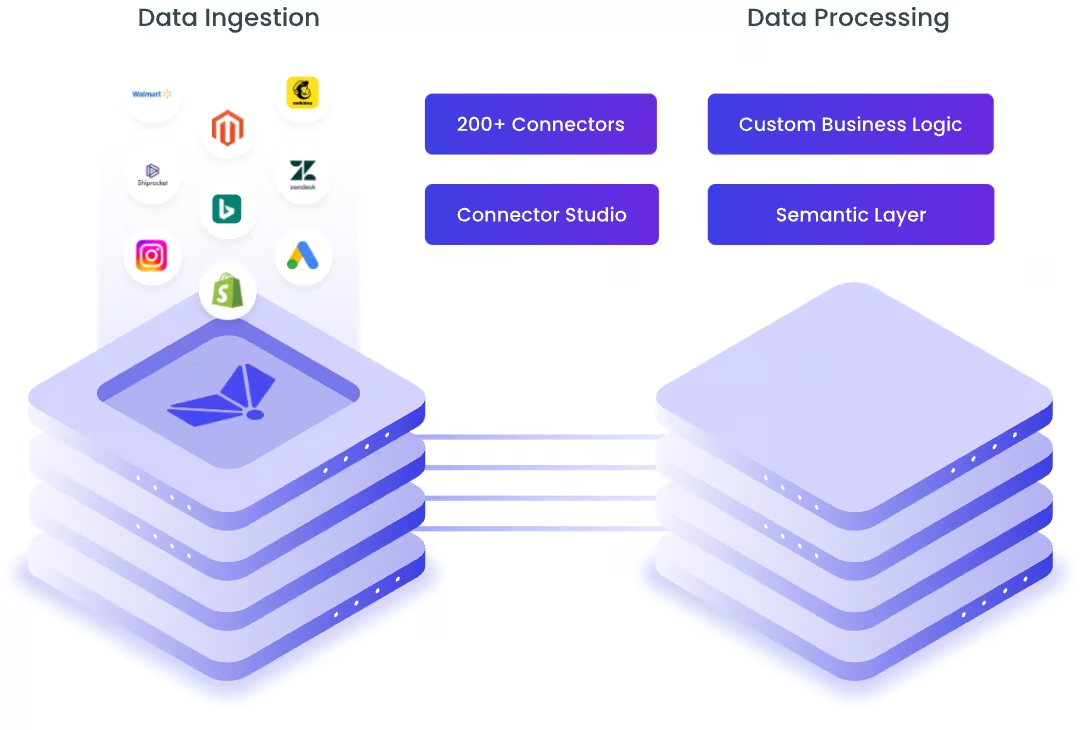
This is where platforms like Saras Analytics help marketing teams unify data across Shopify, Amazon, and paid channels. As a result, segmentation reflects both spend and lifetime value, and not just acquisition source.
3. Channel Mix and Strategy
Diversifying acquisition channels reduces dependency on any single platform. Paid social may drive quick wins, but organic content and referral loops compound over time. A healthy mix balances short-term conversion and long-term efficiency.
4. Budget Allocation
Growth leaders now allocate marketing spend using contribution-margin logic, not last-click ROAS. By tying cost and revenue data together, marketers can shift dollars from high-reach/low-profit channels to those delivering durable payback.
5. Tracking and Measurement
Accurate measurement is the backbone of every client's acquisition strategy. Without clean data, even strong campaigns underperform. Unified analytics tools allow teams to:
- Attribute revenue across touchpoints.
- Track CAC and LTV by cohort, channel, or geography.
- Automate dashboards that merge marketing, finance, and retention data.
This is where Saras Analytics adds real value by providing a single acquisition-to-ROI view that both finance and marketing teams can trust.
Customer Acquisition Channels
We all know that different channels deliver different economics. Hence, choosing the right mix and measuring them on comparable terms matters a lot. It helps you convert your acquisition tactics into sustainable growth. These are some of the customer acquisition channels you must cover:
1. Organic Marketing
Content, SEO, and thought-leadership assets compound visibility without recurring spend. Though slower to scale, they offer the lowest long-term CAC and establish brand authority. For example, educational blog series and conversion-optimized landing pages often rank for problem-based queries.
2. Paid Advertising
Paid search, social, and display networks provide immediate reach but require precision. Rising CPMs means marketers must track CAC at a granular level, i.e., per audience and per creative. Cohort dashboards showing LTV by ad source can reveal whether campaigns are profit-positive or just inflating revenue.
3. Referral and Partnership Programs
Word-of-mouth remains one of the best customer acquisition strategies. Incentivized referral systems lower CAC and boost retention simultaneously, since referred customers tend to stay longer and spend more.
4. Product-Led Growth
Offering free trials, freemium tiers, or feature-gated plans allows prospects to experience value before committing. PLG works especially well for SaaS and subscription models where conversion depends on product engagement rather than ad persuasion.
5. Outbound Sales and ABM
For high-ticket or B2B products, outbound campaigns like email sequences, LinkedIn prospecting, or account-based marketing can provide targeted reach. Success here depends on clean ICP definitions, and timely data triggers that align sales outreach with buyer intent.
Each channel’s effectiveness shifts over time, but brands that continuously track CAC, LTV, and cohort retention across them maintain control of their growth economics.
Customer Acquisition Cost (CAC) and ROI
Every customer you acquire carries a cost. But only when that cost is compared to lifetime value, it tells you whether growth is sustainable. That’s where tracking Customer Acquisition Cost (CAC) and Return on Investment (ROI) becomes essential.
CAC is the total marketing and sales expenditure required to acquire a single customer. It includes ad costs, creative production, agency fees, and technology expenses divided by the number of new customers gained in that period.
While CAC tells you how much you paid to acquire, LTV tells you what that customer brings back. The LTV:CAC ratio acts as the ultimate performance benchmark:
- 3:1 or higher indicates efficient growth.
- 1:1 means break-even acquisition.
- Below 1:1 signals margin erosion.
Most DTC eCommerce companies leverage modern acquisition strategies that combine CAC and LTV into predictive dashboards. Instead of chasing ROAS (Return on Ad Spend) alone, finance and marketing teams evaluate payback periods, i.e., how quickly a customer repays their acquisition cost through contribution margin.
In this regard, Saras iQ enables this by consolidating spend, transaction, and engagement data into a unified CAC-to-LTV view. This allows operators to see which campaigns or cohorts deliver profitable customers, and which are merely adding noise. The result is tighter control on spend, faster iteration cycles, and an accurate understanding of what drives ROI.
9 Customer Acquisition Strategies That Lower CAC and Build Long-Term Value
Each channel offers potential, but only a disciplined, data-informed approach converts that potential into profit. These are the nine customer acquisition strategies shaping 2025’s growth playbooks.
1. SEO and Content Marketing
Organic acquisition compounds over time and typically delivers the lowest CAC once content ranks. According to HubSpot, inbound-focused businesses reduce cost per lead by 61% compared to outbound models (HubSpot State of Inbound). Hence, operators must treat SEO as a profit funnel, not a traffic generator. They should build clusters around purchase-intent and profitability topics, measure ROI by assisted conversions, and refresh content quarterly based on conversion decay.
With unified data platforms like Saras iQ, teams can connect web sessions with transaction and retention metrics. This can reveal which content or channels drive profitable cohorts.
2. Paid Acquisition (Google, Meta, LinkedIn Ads)
Paid channels offer instant scale but are also the easiest way to destroy margins if left unmonitored. High-performing teams manage paid CAC like a balance sheet item. They segment by creative, audience, and geography to understand where incremental spend improves LTV, not just ROAS.
When you have a unified reporting platform like Saras iQ, it allows you to bring together ad spend, conversion performance, and repeat behavior. This way, you can identify which campaigns deliver both short-term ROAS and long-term contribution margin.
Real world example: Epallet partnered with Saras Analytics to restore accurate revenue and conversion tracking across its digital ecosystem. With reliable data, the brand regained confidence in its channel attribution and performance insights, an essential step before optimizing paid acquisition efficiency.
Read case study →
3. Social Proof and Testimonials
Trust converts faster than targeting. PowerReviews found 99% of consumers read reviews before purchasing, and products with 5+ reviews see 270% higher conversion (PowerReviews 2024 Report).
Operationally, social proof should be embedded across every acquisition touchpoint, such as ad creatives, landing pages, and retargeting flows. The objective is to shorten time-to-trust and lower CAC by lifting on-page conversion rates without additional marketing spend.
4. Referral Programs
You can leverage referrals to blend acquisition and retention. As a result, you can convert your satisfied customers into micro-channels. ReferralCandy’s 2024 benchmark shows that referred customers deliver 16–25% higher LTV and convert 3–5x faster than paid leads (ReferralCandy Benchmarks 2024).
Here, the idea is to tier your incentives. Offer higher rewards for second-tier referrals or milestone-based bonuses (e.g., after 3 referred conversions). You should measure performance not by number of referrals but by CAC payback per referred cohort (often the shortest of all channels).
5. Influencer and Partner Marketing
Influencers drive relevance but rarely measure profitability. According to a report by Upfluence, influencer campaigns deliver an average of $5.78 return per $1 spent when attribution is properly tracked (Upfluence ROI Study 2024).
But what should be the right framework? Here are a few points to keep in mind:
- Track campaign-level CAC by influencer segment (nano, micro, macro).
- Attribute conversions to influencers using discount codes, affiliate links, and post-purchase surveys.
- Compare influencer CAC vs. blended CAC to assess efficiency.
Saras Daton consolidates influencer, affiliate, and ad-platform data, and this provides a clean attribution layer that ties the marketing spend to order-level profitability.
6. Email Marketing and Nurture Campaigns
It wouldn’t be wrong to say that retention-driven acquisition is still an acquisition. If you’re running email marketing or nurture campaigns, you should design behavior-triggered sequences (abandoned cart, first purchase, or churn risk) and evaluate CAC recovery by measuring reactivated customers against re-acquisition costs.
Integrating these insights into a centralized dashboard like Saras iQ ensures marketing sees the direct payback impact of every lifecycle trigger.
Real world example: BPN generated $900K in incremental revenue by reactivating inactive subscribers using Recharge data integrated through Saras Analytics. By identifying high-LTV subscribers with reactivation potential, the team converted churn risk into profitable repeat customers, lowering blended CAC without expanding ad budgets. Read case study →
7. Conversational Commerce & Live Shopping
Customer acquisition in today’s time isn’t limited to ads and email funnels; it’s increasingly happening inside conversations and live sessions. Conversational commerce combines live shopping, chat-based selling, and in-app messaging to shorten the distance between discovery and purchase.
According to Salesforce’s 2025 eCommerce Trends Report, 68% of digital consumers now expect real-time interaction before making a purchase (Salesforce 2025 Report). To leverage this, here are a few best practices you can follow:
- Integrate shoppable video or live-stream events directly on-site or social channels.
- Use post-event chatbots or WhatsApp automations to re-engage drop-offs and collect first-party data.
- Track not just engagement, but CAC, payback, and LTV of customers originating from these sessions.
8. Community and Events
Community-driven acquisition compounds trust and retention simultaneously. CMX’s 2024 Community Industry Report found that 86% of companies using community programs saw measurable improvement in customer retention and lifetime value (CMX 2024 Report).
Here’s how to make it work: track how many members actually turn into customers, and whether your community costs recover through conversions. When done right, communities lower CAC because customers start recruiting future customers for you.
9. Data-Driven Personalization
As third-party cookies disappear, first-party data becomes the ultimate acquisition asset. Segment’s 2024 research shows brands using advanced personalization achieve 20% higher LTV and 15% lower acquisition costs (Segment Personalization Study 2024).
Here, personalization means merging transactional, behavioral, and marketing signals into unified profiles. Campaigns should dynamically adjust messaging and offers based on a customer’s predicted margin potential. Saras iQ connects marketing, sales, and engagement data in one unified view. As a result, teams can identify which audiences and offers deliver the best lifetime value and margin trends.
Best Practices for Applying a Customer Acquisition Strategy
1. Align Acquisition with Business Goals
Acquisition metrics must connect to financial outcomes. If you focus just on growth, without having margin discipline, it will burn your runway. You must align your campaigns with ROI and payback targets to ensure scalability.
2. Invest in Multi-Channel Tracking
It is crucial to track customer journeys across paid, organic, referral, and influencer channels. Without unified tracking, attribution gaps can distort performance. Saras iQ can help you here by centralizing multi-channel data. This way, your teams can view CAC and ROI consistently, and marketers can shift the budget toward the channels that convert profitably.
3. Prioritize First-Party Data
Cookie loss and privacy rules have made first-party data the foundation of acquisition. Collecting consented emails, purchase histories, and engagement signals can help you build durable audience intelligence, which can be used for personalization and retention.
4. Measure and Optimize CAC vs LTV
Efficient growth depends on the LTV:CAC ratio. When Daton and Saras iQ unify cost and revenue data, both finance and marketing teams can monitor profitability every day, preventing over-spending on low-value segments.
5. Test, Learn, and Iterate
There is no doubt that acquisition dynamics evolve monthly. Continuous experimentation with creatives, offers, and targeting ensures campaigns follow audience behavior, and not last quarter’s assumptions.
6. Break Down Silos Between Teams
Growth, finance, and operations must share one profitability lens. Saras iQ connects marketing performance with revenue outcomes, replacing fragmented dashboards with a unified acquisition-to-profitability view.
Drive Growth with a Data-Driven Customer Acquisition Strategy
Customer acquisition will always be expensive, but it doesn’t have to be unpredictable. A data-driven strategy transforms it from a marketing expense into an investment engine. By connecting every campaign, channel, and cohort to measurable profit, teams gain the confidence to scale responsibly.
Saras Analytics equips ecommerce and DTC leaders with that clarity. Its unified dashboards consolidate ad spend, order data, and lifetime value signals across platforms, helping brands reduce CAC, improve LTV, and align every team around ROI.
If your goal is to move beyond surface-level metrics and build a customer acquisition system that scales profitably, it’s time to make data your competitive edge.
→ Talk to our data consultants at Saras Analytics to build a data-backed acquisition strategy that drives sustainable growth.
.webp)
.svg)
%201%20(1).svg)






.jpg)


%20Statistics%20in%202026.jpg)



%20Software%20for%20DTC%20Brands%20in%202026.png)

%20Setup%20Guide%20for%20Ecommerce%20Finance%20Team.png)












.webp)

.webp)
.webp)
.webp)
.webp)