
If you’ve ever stared at two dashboards showing the same revenue but different results one from marketing, one from finance, then this is your story. For early-stage brands, prebuilt dashboards are essential as they standardize metrics, simplify reporting, and make performance visible in real time.
But as brands mature, scale complexity exposes a hidden risk: metrics without shared definitions.
A “returning customer” in one platform might mean someone who bought twice in 90 days; in another, it means anyone who’s ever bought before. Marketing’s “revenue” may include cancellations and discounts, while Finance excludes them. The dashboards still look right but they’re telling different stories.
That’s the 60% Problem: Dashboards automate visibility but not alignment. They deliver numbers but not shared truth.
Saras iQ was built to close that gap. It doesn’t replace dashboards it redefines them around a brand’s specific financial reality, ensuring every metric is clearly defined, transparently calculated, and collectively owned.
Is your data actually Decision-Grade?
9 questions. 3 minutes. Score your Profitability Visibility and Readiness for AI-driven growth.
Start Free Diagnostic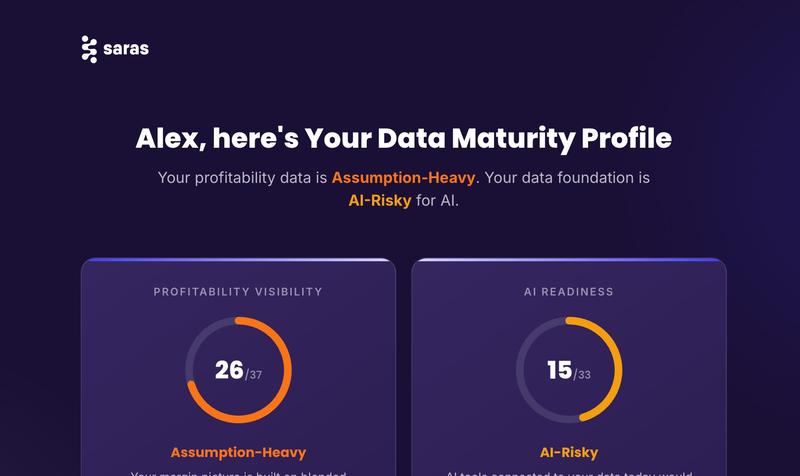
When Marketing and Finance Work from Different Definitions
In many e-commerce organizations, the real challenge isn’t data accuracy, it’s data interpretation.
Every team brings its own mental model:
- Marketing optimizes for ROAS and blended CAC.
- Finance measures contribution margin and cash flow.
- Operations monitor fulfilment cost and return.
These models are valid individually but create tension collectively when they rely on different definitions of success.
The issue isn’t that teams disagree. It’s that their definitions live in people’s heads, not in systems. They aren’t codified, documented, or visible to others. So, when dashboards pull data using assumptions that vary by function, reconciliation turns into debate.
After implementing Saras iQ, dashboards were reconfigured with shared definitions. Saras iQ unified data from Shopify, Amazon, and ad platforms into a central repository, applying customer-level logic to separate new and returning buyers and aligning contribution margin formulas with Finance’s view of COGS.
The result:
- Finance and Marketing now use the same definitions.
- CAC, ROAS, and margin reports reconcile automatically.
- Analyst hours spent reconciling data dropped by 80%.
Shared definitions didn’t just resolve arguments, they accelerated decisions.
The 60-30-10 Analytics Maturity Model
As brands evolve, analytics maturity follows three predictable stages.
60%: The Automation Layer
- Plug-and-play dashboards aggregate data across channels: Shopify, Meta, Google, and Amazon and compute universal metrics like orders, revenue, AOV, CAC, and ROAS.
- For smaller brands, this is a game-changer. But it’s also where complexity begins metrics that look standardized often carry invisible assumptions.
30%: The Custom Integration Layer
Growing brands demand more than automation. They need data models that reflect their unique business reality:
- Customer-level tracking and deduplication
- Cohort analysis and retention logic
- Product- or channel-specific margin calculations
- Multi-touch attribution across platforms
You should be able to combine ready-to-use dashboards with brand-specific configuration, transforming standard metrics into decision-grade insights.
10%: The Strategic Judgment Layer
- Even the best data systems can’t interpret context.
- That’s why Saras iQ integrates human QA data experts who validate anomalies daily, flag inconsistencies, and interpret whether changes reflect genuine performance shifts or data sync variances.
The Amazon Attribution Blind Spot
Amazon’s scale makes it indispensable, but it’s metrics create a hidden distortion in most dashboards.
| Why your dashboard is reporting misleading CAC number? | ||
|---|---|---|
| Today’s Reporting | Reporting 6 months later | |
| Other Reports | A brand launches on Amazon, spends $9,000, acquires 200 customers.Report shows: $45 CAC. | Six months later, 60% of Amazon orders come from returning customers.The dashboard still reports $45 CAC because it divides spend by total orders. |
| Saras iQ Contribution Margin with Custom Logic | Report shows: $45 CAC. | In reality is the new-customer CAC has doubled to $112.50. |
This happens because most dashboards aggregate orders, not customers. They skip Amazon’s customer ID matching, avoiding the computational overhead of classifying new versus returning buyers.
Saras iQ fixes this through customer-level lineage:
- Every order is mapped to its first purchase source.
- Returning customers are identified and excluded from new-customer CAC.
- Cross-channel duplicates (Shopify ↔ Amazon) are automatically deduplicated.
This single correction can recover 15–25% in misallocated marketing spends, especially for brands selling on both DTC and Amazon.
How CFOs Lose Confidence Without Shared Truth
When definitions and reconciliation aren’t systematized, teams drift into parallel realities.
Operational Cost
Analytics teams spend 15–25 hours weekly reconciling mismatched reports, validating exports, and checking sync delays. It’s not data analysis, it’s data archaeology.
Strategic Cost
Without trusted attribution, decision velocity drops. Budget approvals stall. Channel experiments get delayed. Even when data looks good, leaders hesitate to act.
Talent Cost
Analysts hired for strategy end up debugging metrics. Repetition drives attrition, and each replacement costs $20,000–$40,000.
Opportunity Cost
The largest loss is invisible: initiatives not launched, campaigns not scaled, and insights ignored because no one trusts the data enough to take risk.
Saras iQ turns this friction into focus. With transparent, brand-specific definitions, CFOs, CMOs, and COOs see the same version of truth, every day.
The CFO’s Playbook for Complete Data Confidence
Every CFO evaluating analytics should expect five foundational capabilities.
1. Customer-Level Processing
Analytics must track data at the customer level, not just by order.
- Identify new vs. returning customers automatically.
- Deduplicate across Amazon and Shopify.
- Link every purchase to its acquisition source.
Saras iQ delivers this through built-in customer matching and real-time updates.
2. Cross-Channel Deduplication
- Your customer doesn’t see channels; they see your brand.
- Systems must identify when one buyer appears in multiple platforms and merge journeys cleanly. Saras iQ performs this using confidence scoring, address normalization, and cross-platform matching.
3. Daily Reconciliation with Finance
- Marketing dashboards should tie directly to the P&L.
- Saras iQ integrates accounting-ready revenue, refunds, and COGS, showing contribution margin by channel, SKU, and customer segment.
4. Transparent Metric Definitions
Every metric should come with a definition and calculation formula that is visible to everyone. Saras iQ embeds methodology documentation alongside dashboards, ensuring no hidden logic or “black box” reporting.
5. Human QA Layer
- Automated systems miss context. APIs change quietly.
- Saras iQ’s QA team reviews anomalies daily, validating syncs before they reach your reports, so you act on verified data, not surprises.
Audit Your 60% Problem with Saras iQ
Use this cheat sheet to evaluate whether your current analytics setup gives you 60% visibility or full confidence.
| Checkpoint | What to Review | What Saras iQ Does |
|---|---|---|
| Metric Definitions | Are CAC, ROAS, and revenue definitions documented and consistent across teams? | Establishes shared metric dictionary embedded within your dashboards. |
| Attribution Accuracy | Do dashboards separate new vs. returning customers for Amazon and Shopify? | Tracks customer IDs across all channels; recalculates CAC by true acquisition. |
| Financial Reconciliation | Does dashboard revenue match P&L line items? | Syncs accounting data daily to contribution margin dashboards. |
| Anomaly Detection | Are sync errors or API mismatches proactively flagged? | Human QA layer reviews all anomalies before dashboard updates. |
| Decision Velocity | How long does it take to approve a marketing budget change? | Reduces review cycles by providing CFO-verified data confidence. |
If three or more of these areas fail the test, your organization is operating with partial truth, likely around 60% accuracy.
Next Step: You don’t have to live with 60% accuracy Audit your data confidence with Saras iQ.Talk to a data consultant for free to see how customer-level accuracy and shared definitions can transform your decision-making

.webp)
.svg)
%201%20(1).svg)










%20Setup%20Guide%20for%20Ecommerce%20Finance%20Team.png)



























.webp)

.webp)
.webp)
.webp)
.webp)










.webp)





.webp)








.webp)







.png)