

A customer buys a $65 hoodie from your store. Your eCommerce forecasting model sees $65 in revenue, applies a 35% margin assumption, and projects $22.75 in profit. What the model misses: the customer chose PayPal ($2.28 fee), the order shipped to Zone 8 ($11.40 instead of the modeled $7.50), and the customer returned it two weeks later.
Return label: $6.80. 3PL inspection: $4.50. The hoodie came back stained and cannot be resold. That single order generated negative $27.23 in contribution margin analysis. Multiply that across 15,000 monthly orders with varying return rates, shipping zones, and payment methods, and the gap between forecasted profit and actual cash becomes structural.
Most eCommerce forecasts are demand models being used as profitability models, and the gap between the two is where cash flow surprises live. This article breaks down why the standard model misses profit, which variable costs create the largest variance, and how to build a profit forecasting approach grounded in actual unit economics.
Is your data actually Decision-Grade?
9 questions. 3 minutes. Score your Profitability Visibility and Readiness for AI-driven growth.
Start Free Diagnostic
The Mirage of Simple ECommerce Revenue Forecasting
The standard eCommerce forecasting model is built on three inputs: traffic, conversion rate, and average order value. Multiply them together and you get a revenue projection. Finance teams then apply a gross margin percentage, usually derived from last quarter's blended average, and report a profit forecast.
Why the formula is structurally incomplete
This model works when margins are stable and costs are predictable. Neither condition holds for scaling DTC brands. A brand selling 200 SKUs across Shopify and Amazon, shipping from two warehouses to 48 states, running promotions that shift product mix weekly, does not have a "blended margin." It has hundreds of micro-margins that change with every order. The Traffic x CVR x AOV formula captures demand. But it says nothing about what that demand costs to fulfill, ship, process, and potentially take back as a return.
How top-line targets incentivize margin destruction
When revenue is the forecasted metric, teams optimize for revenue. Marketing increases spend to hit the number. Merchandising runs deeper discounts to accelerate sell-through. Operations pushes expedited shipping to reduce cart abandonment. Each of these decisions makes the revenue forecast more likely to land while making the profit outcome less predictable.
A brand that discounts 25% to hit a $5M revenue target instead of selling at full price for $4.2M may celebrate the larger number while generating less cash. The forecast said $5M. The bank account tells a different story.
The Silent Margin Killers Missing from Your Forecast
Revenue forecasts miss profit because they exclude, underestimate, or average out the variable costs that sit between revenue and cash. These costs are not small rounding errors. For most DTC brands doing $20-100M, they collectively represent 30-50% of gross revenue.
The true cost of returns
Returns are the single largest source of margin variance during month-end close. The average eCommerce return rate now exceeds 19% for online sales, with apparel brands often seeing 25-30%. Each return is a double hit: you lose the sale revenue, and you absorb the cost of outbound shipping, a return shipping label, 3PL processing and inspection fees ($10-$65 per item), and potential inventory write-down if the product cannot be resold. A brand forecasting 12% returns that experiences 19% is not off by 7 percentage points. It is off by the full loaded cost of every incremental return, which compounds across thousands of orders.
The fulfillment trap
Pick-and-pack fees, packaging materials, inserts, and multi-item order handling do not scale linearly with revenue. A single-item order costs $2.50-$4.00 to fulfill. A three-item bundle might cost $6-$8, but the revenue per order only increased by 2x, not 3x. Fulfillment costs consume roughly 70% of the average order value for many online retailers, yet most forecasts model fulfillment as a flat percentage of revenue that stays constant regardless of order composition. When product mix shifts toward heavier items or multi-piece bundles, fulfillment costs jump without the forecast reflecting it.
Shipping and dimensional weight surprises
We all know that carrier rates change quarterly. Peak-season surcharges arrive in Q4 and disappear in January. Dimensional weight pricing means a large, lightweight product costs as much to ship as a small, heavy one, even though the forecast probably uses weight-based averages. Geographic customer distribution matters too: acquiring a wave of new customers in Zone 7 and 8 shipping zones can invalidate your average shipping cost overnight.
A CFO at a multi-country DTC brand described receiving a 33GB shipping data file at month-end that nobody could open in Excel, let alone reconcile against the forecast.
Watch for this signal: If your finance team discovers margin erosion 15-20 days after the month closes, the forecast was built on assumptions that could not be validated in real time. By the time you know the numbers, you have already committed the next month's spend based on the old projection.
Payment processing and platform fees
Shopify Payments, Stripe, PayPal, Klarna, and Afterpay each take 2-3.5% of every transaction. These fees vary by payment method, and the mix of payment methods shifts with customer demographics and promotions. A brand that runs a "buy now, pay later" campaign through Klarna may see payment processing fees jump from 2.8% to 3.5% for those transactions. Across $5M in quarterly revenue, that 0.7% difference is $35,000 in unforecasted cost. Most revenue forecasts treat payment fees as a single blended percentage, if they include them at all.
The Compound Effect of Forecasting Errors
Small misses on individual cost lines do not stay small. They stack. And because they all sit between revenue and profit, the compounding effect lands directly on contribution margin.
A scenario that shows why CM varies from forecast to actual
Consider a DTC brand forecasting $2M in monthly revenue with a projected 35% gross margin and a target 18% contribution margin after variable costs.
The revenue forecast was perfect. The profit forecast missed by 30%. Each individual variance looks manageable in isolation. Together, they erased $85,000 in monthly profit, or $255,000 per quarter. That is the compound effect, and it is invisible to any model that forecasts revenue and applies a static margin percentage.
The blended average trap
The danger gets worse when the product mix changes. Historical blended averages assume next quarter looks like last quarter. If your hero SKU (high margin, low return rate, lightweight) declines from 40% to 25% of sales while a newer product line (lower margin, higher return rate, heavier) grows from 15% to 30%, the blended average margin shifts significantly without any single cost category triggering an alert. This is contribution margin forecast volatility driven by mix, and it is the hardest variance to catch without SKU-level profitability cost visibility.
4 Steps to Build a Profit-First Forecast
Avoiding month-end margin surprises requires moving from revenue forecasting to profit forecasting. That means building variable costs into the model at a level of granularity that matches how those costs behave.
Step 1: Forecast at the SKU level
Stop projecting aggregate catalog revenue. Different SKUs have different return profiles, different dimensional weights, different COGS, and different fulfillment costs. A forecast that models 200 SKUs individually, even with rough per-SKU assumptions, will outperform one that applies a single blended margin across the entire catalog. This is where accurate margin forecasting across COGS, returns, and fees begins: at the product level.
What this looks like in practice: Your demand planner forecasts unit sales by SKU. Each SKU carries its own COGS, return rate (based on trailing 90-day actuals), estimated shipping cost (based on weight and zone distribution), and fulfillment cost (single vs. multi-item). The forecast rolls up from SKU-level unit economics to a catalog-level margin projection.
💡 Real-World Profitability: Faherty used granular customer and product data to drive $1.1M in incremental revenue by identifying which segments and products delivered margin.👉 Read the Faherty case study
Step 2: Integrate dynamic landed COGS
Factory PO price is only the starting point. Landed COGS includes ocean freight, air freight (when you need to expedite), duties, tariffs, and warehouse receiving costs. These change by shipment, by batch, and by supplier. A brand importing from multiple countries may see landed COGS fluctuate 5-15% between batches. Your forecast should use the most recent landed cost per SKU from your ERP, not a static annual average.
What this looks like in practice: Your ERP (Netsuite, Brightpearl) calculates landed COGS per receipt. That number flows into your data warehouse daily and automatically updates the per-SKU cost baseline in your forecasting model. When a new shipment arrives with higher freight costs, the forecast adjusts within 24 hours instead of waiting for the next quarterly review.
Step 3: Model variable fulfillment dynamically
Fulfillment cost per order depends on item count, packaging requirements, warehouse location, and carrier selection. A single lightweight item ships in a poly mailer for $3. A three-item bundle needs a box, dunnage, and possibly a gift insert, pushing fulfillment to $8+. Your forecast should model fulfillment cost by order type, not as a flat per-order average.
Important: The organizational shift that matters most is targeting CM2 or CM3 as the primary forecasting metric, not gross margin. Gross margin tells you what your products earn before you sell and ship them. Contribution margin tells you what is left after every variable cost is paid. For improving margin predictability for financial planning, the CM target needs to be the number the forecast is built to hit, with revenue as an input, not the output.
As Sean Frank, CEO of Ridge, described his operating rhythm: "Every single day I'm going in there, looking at my contribution margin. I'm looking at my sales breakdown, my sales by product type." That daily CM visibility is what turns a forecast from a quarterly hope into a weekly instrument.
Step 4: Build scenario models, not single-point forecasts
Static forecasts break the moment an assumption changes. Build three scenarios: a base case (current trends hold), a stress case (return rates spike 3-5%, carrier fees rise, COGS increase from tariff changes), and an upside case (new product launch lands with lower return rate, shipping optimization reduces costs). Each scenario should flow through the same SKU-level model with different variable cost assumptions. This is where reliable unit economics become critical: if your per-SKU costs are wrong, all three scenarios are wrong in different directions.
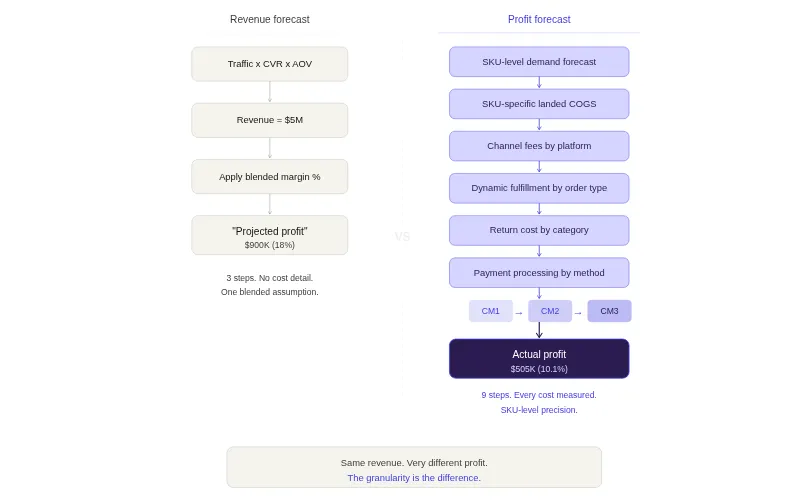
Profit Forecasting with Saras Pulse
Saras Pulse connects Shopify, Amazon, 3PLs, ERPs, and ad platforms into a unified data model that calculates fully burdened, SKU-level contribution margin automatically and daily. Instead of reconciling spreadsheets at month-end, finance teams get SKU-level profit forecasting inputs that update as costs land.
Jason Panzer, President of HexClad: "We go to Saras Pulse and get our daily contribution margin reporting. We get all of our marketing metrics by channel, by category, even down to the SKU. Everything is pulled in automatically."
💡 Stop Inventory Write-Offs: BPN used Saras to build inventory visibility that saved $500K annually in write-offs by catching overstock before it became dead inventory.👉 Read the BPN case study
Conclusion
Revenue forecasts tell you how much demand you expect. Profit forecasts tell you how much cash that demand will generate. Every DTC brand that has been surprised by a thin quarter despite hitting its revenue target has experienced the gap between the two. The fix is structural: build variable costs into the forecast at the SKU level, update them daily instead of monthly, and target contribution margin as the metric the business plans against.
Get the contribution margin intelligence platform that factors in every fee, shipping cost, and return to deliver forecasts you can finally trust. Talk to our data consultants about moving from revenue forecasting to profit forecasting.

.webp)
.svg)
%201%20(1).svg)





















.webp)

.webp)
.webp)
.webp)
.webp)












.webp)





.webp)











.webp)









.png)








.webp)




.webp)










.webp)