
.webp)
A brand connects an LLM to their data warehouse, asks for contribution margin by channel, and gets a number that looks precise and authoritative. The CFO compares it to the reconciled P&L and the numbers are off by 14 percentage points. The AI calculated exactly what it was asked to calculate, using whatever data it could find. The data was the problem.
LLM hallucinations in eCommerce analytics have become one of the most quietly expensive failure modes for scaling brands. According to IBM research, 72% of AI failures in enterprise settings trace back to inadequate context, not model capability. The root cause is almost always upstream: incomplete data, missing business logic, or raw tables that bypass every definition your finance team has certified. That gap is what separates an AI eCommerce analyst that guesses from one that knows. This article breaks down the three structural root causes and the concrete fix for each.
Is your data actually Decision-Grade?
9 questions. 3 minutes. Score your Profitability Visibility and Readiness for AI-driven growth.
Start Free Diagnostic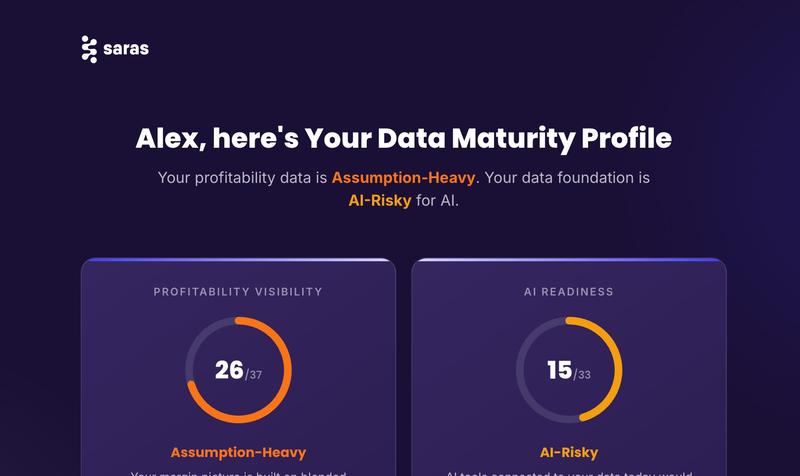
Why AI Tools Are Now a Competitive Requirement in eCommerce
Two shifts happened between 2024 and 2026 that made AI tools non-optional for eCommerce brands.
The first is market scale. The global AI-in-eCommerce market reached $7.25 billion in 2024 and is projected to hit $64 billion by 2034, growing at a 24.34% CAGR. McKinsey found that 78% of organizations were using AI in at least one business function by 2025, up from 55% just two years earlier. AI adoption is no longer a signal of sophistication. It's baseline.
The second is tool sprawl. The 2025 State of Your Stack survey from MarTech found that 62.1% of marketers use more tools than they did two years ago, and 65.7% cite data integration as their top challenge. Brands added AI tools for attribution, for content, for support, for personalisation. Each tool brought its own data model, its own metric definitions, and its own version of the truth. The result of it is five dashboards showing five different answers to the same question.
The One Thing Most AI Tool Guides Get Wrong
Every competitor guide lists 15 to 24 AI tools for eCommerce and treats them as a single category. That's the mistake. These tools split into two fundamentally different types based on how they relate to your data, and that distinction changes how you should evaluate, buy, and implement them.
Data-Independent Tools
Content generators, customer support chatbots, product description AI, and creative production tools work without a clean data foundation. They use their own training data or your help center content. These tools are lower-risk first purchases because they don't depend on data you haven't unified yet.
Data-Dependent Tools
Analytics platforms, attribution tools, BI and reporting, AI analysts, customer intelligence engines, inventory forecasters, and personalisation systems are completely dependent on the quality of the data underneath them. Any AI data analytics eCommerce tool that queries your business data without a governed layer will eventually produce an answer that looks right but isn't.
Salesforce research found that only 31% of marketers are fully satisfied with their ability to unify customer data. That means roughly 69% of brands considering analytics AI tools have a data problem that will undermine the tool before it ever launches. This is where the AI-ready data foundation conversation starts, and it's the question no other buyer's guide asks.
.svg)
Best AI eCommerce Analytics Tools: Marketing Reporting vs. Data Intelligence
Analytics is the category that matters most for brands growing on tighter margins, and it's the category where the buyer's decision is hardest to get right. In 2026, the eCommerce AI tools market for analytics has split into two distinct tiers that most buyer guides conflate.
The first tier is marketing analytics platforms. These are built to answer attribution and performance marketing questions. They centralise ad spend, orders, and customer data, surface dashboards, and increasingly offer natural language querying. Well-built products with strong brand recognition, but they're built on marketing data models, not business data models. They don't model true profitability, they don't reconcile with finance, and most are Shopify-centric. This tier includes Triple Whale, Northbeam, Polar Analytics, Peel Insights, and Lifetimely.
The second tier is data intelligence platforms, a fundamentally different class. A unified data foundation combining clean ingestion, pre-modelled eCommerce data, and a semantic layer with locked metric definitions that every team in the business queries from the same verified source of truth. When the CFO asks why the ROAS in the dashboard doesn't match the P&L, marketing analytics tools have no answer because they were never designed to produce one.
Let's know more about them.
Saras Analytics (iQ + Saras iQ + Daton)
Saras Analytics is purpose-built as a full-stack eCommerce data intelligence platform for Shopify DTC brands in the US, scaling $20 million in revenue and beyond. The eCommerce data pipeline, Daton, ingests from 200+ sources including the long-tail connectors that generic ETL tools miss: Amazon Seller Central report types, DSP, niche 3PLs, ERPs, and custom wholesale channels.
The pre-modelled eCommerce data warehouse, Saras iQ, provides certified data models with locked metric definitions for net revenue, contribution margin, LTV, CAC, and ROAS. Every team queries from the same agreed numbers. Saras iQ, the AI eCommerce analyst, queries the semantic layer in plain English with answers that are traceable back to SQL and business logic, which materially reduces hallucination risk because every answer is grounded in governed, auditable context.
What makes iQ different from connecting Claude or another LLM directly to your data warehouse: iQ is trained on your warehouse schema, metric definitions, and business context, so it knows what "revenue" means in your organisation, not just in general.
The purpose-built MCP server for eCommerce means Claude answers through iQ's governed context layer rather than raw data. Answers are trustworthy because the context is governed, auditable, and continuously improved through a feedback loop specific to your business.
Momentous DTC brand used this foundation to move from days-long reporting cycles to near-real-time insights across their entire operation. Read the full case study →
Triple Whale / Moby
Triple Whale is the dominant attribution and analytics platform among AI tools for Shopify DTC brands. Its Moby AI agent queries data and generates recommendations in natural language, and its paid media attribution models are among the most sophisticated available for brands running primarily on Shopify.
Where Triple Whale excels is speed to value: connecting a Shopify store takes under 30 minutes, and its creative analytics and cohort analysis features give growth teams actionable campaign-level insights that are difficult to replicate manually.
The free tier is genuinely useful for early-stage brands building data hygiene habits.
G2 rating: ~4.5/5. Pricing starts at $1,490/year (Starter), with a free tier available for basic attribution.
Limitation: Shopify-only by design, no contribution margin analytics modelling, no COGS-adjusted profitability, and no cross-functional intelligence that finance can verify against the general ledger.
Polar Analytics
Snowflake-backed dashboards with 45+ connectors and natural language queries via "Ask Polar" give it broader data source coverage than most attribution tools. GMV-based pricing makes costs predictable for smaller brands, and the setup experience is cleaner than most. Polar's standout feature is direct Snowflake access on premium plans, which gives technically skilled teams the ability to run custom SQL queries on their raw data without a separate warehouse.
The custom dashboard builder is genuinely flexible, and its Klaviyo enrichment integration pushes purchase data back into email segments automatically.
G2 rating: ~4.5/5. Pricing is GMV-based, with custom plans for brands above $20M.
Limitation: Metric definitions are not locked in a semantic layer, which means the AI can interpret the same metric differently depending on how a question is phrased.
Northbeam
Purpose-built for media mix modelling and multi-touch attribution, Northbeam is among the most rigorous eCommerce attribution tools in the market for brands running complex, multi-channel paid campaigns. Its incrementality testing and media mix modelling capabilities give sophisticated marketing teams a level of measurement rigour that simpler attribution tools can't match.
For brands spending heavily across Meta, Google, TikTok, and connected TV simultaneously, Northbeam's cross-channel measurement methodology is one of the strongest available. Pricing: contact for custom plans.
Limitation: Steep learning curve that often requires a dedicated analyst to run effectively, and no conversational AI analyst layer. Insights are surfaced through its own reporting UI rather than queried in plain English.
How to Evaluate Any Analytics AI Tool — A Checklist
Watch for this signal: If your analytics AI tool can't produce a number your CFO would sign off on, it's a reporting tool, not a business intelligence platform. Before committing to any eCommerce AI tools comparison, ask these five questions:
- Does it model true profitability (contribution margin, COGS, fulfillment costs) or just revenue and ROAS?
- Does it work with all your data sources, including long-tail ones like Amazon DSP, niche 3PLs, and custom ERPs?
- Are metric definitions locked in a semantic layer, or does the AI guess based on column names?
- Can your CFO and finance team verify and trust the numbers it produces, or will it always be a "marketing number"?
- Is it omnichannel, or Shopify-only?
Any tool that can't answer yes to all five is a marketing reporting tool. Marketing reporting tools have their place, but they're not the foundation your eCommerce AI tool stack should be built on.
| Capability | Saras Analytics | Triple Whale | Polar Analytics | Northbeam |
|---|---|---|---|---|
| Data Sources | 200+ (incl. long-tail 3PLs, ERPs, Amazon report types) | Shopify-centric + major ad platforms | 45+ connectors | Major ad platforms |
| Profitability Modelling | CM1/CM2/CM3/CM4, COGS-adjusted, SKU-level | Revenue and ROAS only | Revenue and basic margins | Revenue and ROAS only |
| Semantic Layer | Locked, certified metric definitions | No | No | No |
| Omnichannel | Shopify, Amazon, retail, wholesale, B2B | Shopify-only | Shopify + Amazon | Multi-channel ads |
| AI Analyst | iQ (plain English, SQL-traceable, governed) | Moby (natural language on marketing data) | Ask Polar (NL queries) | No conversational AI |
| G2 Rating | ~4.7/5 | ~4.5/5 | ~4.5/5 | ~4.5/5 |
| Pricing | Contact for pricing | Free tier; from $1,490/yr | GMV-based | Contact for pricing |
(Green for full capability, Yellow for partial, Red for absent)
Ratings and pricing verified as of May 2026. Check vendor sites for current plans.
AI Tools for Customer Support, Content, Personalisation, and Operations
These categories are where the best AI tools for eCommerce outside analytics live. The evaluation criteria here are simpler: output quality, speed, setup effort, and cost per outcome.
AI Customer Support Tools
This is the most mature AI category in eCommerce. Gorgias reports that 96% of brands using conversational AI deploy it for customer support.
Here is the full blog output:
AI Tools for Customer Support, Content, Personalisation, and Operations
These categories are where the best AI tools for ecommerce outside analytics live. The evaluation criteria here are simpler: output quality, speed, setup effort, and cost per outcome.
AI Customer Support Tools
This is the most mature AI category in ecommerce. Gorgias reports that 96% of brands using conversational AI deploy it for customer support.
Buyer evaluation note: Evaluate on automation rate (not deflection rate), cost per resolution, and whether the tool integrates with order management for action capability, not just answers. These tools are largely independent of your analytics data stack, making them an easier first AI purchase. One exception: if support AI needs to answer data-driven questions ("what is my average delivery time this month"), it needs to pull from the data layer, which is where data quality starts to matter again.
AI Content and Creative Tools
Content AI is the most-adopted category, and also the most commoditised. Competitive advantage comes from the categories that are harder to implement. These tools are the best AI for eCommerce marketing creative production.
AI Personalisation and Product Discovery
Personalisation AI tools train on behavioural and transactional data. Their output quality scales directly with the quality of the underlying data and the volume of events they train on. Brands with fragmented customer data and no unified identity layer will see limited lift.
AI Operations and Inventory
Inventory AI tools are the most data-dependent category outside analytics. They require clean, historical sales data across all channels and SKUs to forecast accurately. Kit unbundling, multi-channel reconciliation, and date-effective COGS are ecommerce-specific data problems that generic tools handle poorly.
How to Build an AI Stack That Actually Works Together
A typical eCommerce brand runs five to eight AI tools by 2026. Those tools don't talk to each other. The numbers disagree. Adoption stalls when teams can't agree on which dashboard is right.
As Ben Yahalom, CEO of True Classic, described it: "Before Saras, our P&L was built on estimates and pieced together from various tools." True Classic ran 40+ disconnected tools before consolidating into a single data ecosystem through Saras, saving over 1,000 hours annually. Read the full case study →
The brands winning in 2026 are building fewer, better-connected layers:
Layer 1: Data Foundation (ingestion, modelling, semantic layer). This is the prerequisite. For AI tools for D2C brands at the $20M–$100M range, this is where tool consolidation starts.
Layer 2: AI Analytics (queries the semantic layer). This is where the intelligence lives. Tools like Saras iQ, Triple Whale, and Polar Analytics sit here, but only the ones built on a governed semantic layer can produce answers that finance trusts.
Layer 3: Point Solutions (content, support, personalisation). These work independently of the data layer. They can be added, swapped, or removed without affecting the foundation.
The practical takeaway: start with Layer 1, get finance to sign off on the numbers, then add everything else. That's how an agentic AI eCommerce future gets built.
.svg)
Watch for this signal: If your AI tools agree on revenue but disagree on profitability, the problem is in the cost attribution layer, not the tools themselves.
What Saras Analytics Brings to the Stack That No Single Tool Does
For brands evaluating analytics AI, the question that surfaces repeatedly is: can a single platform handle ingestion, modelling, and AI querying without stitching together three separate vendors? Saras Analytics was built to answer that question.
Daton handles ingestion from 200+ eCommerce-specific connectors, covering the long-tail sources that generic ETL tools miss. Saras iQ provides pre-built eCommerce data models with certified metric definitions. iQ gives every team member a governed AI analyst that queries the semantic layer in plain English, with answers traceable to SQL and business logic.
As Jason Panzer, President of HexClad, put it: "We go to Saras iQ and get our daily contribution margin reporting. We get all of our marketing metrics by channel, by category, even down to the SKU. Everything is pulled in automatically."
If your AI analytics for eCommerce tools produce numbers that don't survive month-end reconciliation, the gap is almost always in the data layer, not the tools themselves. Talk to the data consultants at Saras Analytics to see where the gap sits in your stack.

.svg)
.webp)
%201%20(1).svg)


%20Setup%20Guide%20for%20Ecommerce%20Finance%20Team.png)























.webp)

.webp)
.webp)
.webp)
.webp)







.webp)











.webp)







.png)


.webp)

.webp)