
Finaloop has built a strong reputation for ecommerce accounting, combining AI-powered bookkeeping with human accountant oversight to deliver real-time financial visibility. But Shopify brands at $10M or more in annual revenue often discover a gap: accounting tells you what happened last month, not why your contribution margin (revenue minus variable costs like COGS, fulfillment, and marketing) dropped or which customer cohorts drive the highest lifetime value (LTV).
This guide examines eight Finaloop alternatives across two categories. The first four serve brands that have outgrown basic financial dashboards and need analytics, forecasting, and AI-powered intelligence. The remaining four address brands seeking different accounting or bookkeeping solutions with varied service models and pricing structures.
Saras iQ leads as the analytics layer that transforms clean books into actionable intelligence, offering certified data, AI-powered Q&A, and contribution margin analytics that accounting tools cannot match.
Finaloop Alternatives at a Glance
*G2 rating for Saras Daton (the data layer powering iQ)
Ratings pulled from G2 in January 2026.
Why Ecommerce Brands Need More Than Accounting Software
Finaloop and similar accounting platforms solve critical problems: reconciling marketplace payouts, tracking COGS and inventory, generating P&L statements, and ensuring tax compliance. For brands under $5M in revenue, these capabilities often suffice.
But Shopify brands scaling past $10M face questions accounting tools cannot answer:
- Which marketing channels deliver the best customer acquisition cost (CAC) relative to LTV? Accounting tracks spend totals, not channel-level efficiency.
- What is your contribution margin by SKU and channel, updated daily? Most accounting closes monthly, leaving weeks of blind spots.
- Which customer cohorts have the highest repeat purchase rates? Accounting tracks revenue, not customer behavior patterns.
- Why did your margin drop 2% last week? Accounting shows the number changed, not the product, channel, or geography driving the change.
The core distinction: accounting platforms tell you what happened in your financials. Analytics platforms tell you why it happened and what to do next.
Match the alternative to your switching trigger:
- You need analytics, attribution, and forecasting beyond financial reporting: Saras iQ
- You want marketing-focused attribution for a mid-market DTC brand: Triple Whale or Polar Analytics
- You need LTV and cohort basics on a tight budget: Lifetimely
- You want full control over accounting with data portability: QuickBooks Online + A2X
- You operate internationally with multi-currency complexity: Xero + A2X
- You need weekly bookkeeping cadence with in-house CPAs: Xendoo
- You want CFO advisory alongside bookkeeping: Pilot
1. Saras iQ: AI-Powered Analytics for Omnichannel Ecommerce
Saras iQ is an AI Data Team for ecommerce, built to answer the questions that accounting tools leave unanswered. Rather than replacing your bookkeeping, iQ sits above your financial data (including Finaloop exports) and adds marketing attribution, customer analytics, contribution margin tracking, and AI-powered forecasting.
Key Capabilities
- Certified data foundation: 200+ sources modeled into 11 governed master datasets, with 500+ daily QA checks and monthly reconciliation tolerance of plus or minus 1%
- Context layer: Encodes your specific metric definitions so "revenue" means the same thing to your CFO and CMO
- iQ Business Analyst: Ask plain-English questions about margin, customers, or channels and get deterministic answers
- iQ Data Engineer: Slack-based agent for data operations, from metric explanations to data freshness checks
- iQ MCP: Connects the certified foundation to Claude through the Model Context Protocol, so governed answers work inside Claude
Ecommerce Use Cases
For contribution margin, iQ delivers daily profitability by SKU and channel, standardizing net sales and integrating COGS, fulfillment, platform fees, fixed costs, and marketing spend. Your finance and marketing teams query the same governed definition, eliminating the scenario where three teams present three different numbers.
For customer analytics, iQ provides CustomerMaster with acquisition attributes and Recency plus Monetary segmentation for Shopify and TikTok Shop cohorts. You can identify which customer segments drive the highest LTV and adjust acquisition strategy accordingly.
For marketing performance, iQ standardizes paid-media grouping across Meta, Google, TikTok, Amazon Ads, and more, with pacing versus targets so you catch budget issues before month-end.
Proof of Impact
Ridge's team asked iQ 1,069 questions in 30 days across 18 users spanning the CEO, marketing, product, ops, and finance, with zero analyst requests. CEO Sean Frank has stated that once you get Saras iQ inside Claude, it's worth over $50,000 a month for them.
Pricing Structure
- iQ Essentials: From $1,999/month for Shopify brands at $10M to $50M, live in about three weeks
- iQ Enterprise: Custom pricing for brands at $50M to $500M, with advanced Customer 360, inventory visibility, AIBC (AI Business Colleagues), and custom integrations
G2 reviewers rate Saras Daton (the data layer powering iQ) 4.7/5 across 37 reviews.
Why Saras iQ Leads for Analytics
Unlike accounting tools that deliver financial statements, Saras iQ delivers answers. The platform's validation layer tests iQ against a golden set of 30 to 100 client-specific questions, refining accuracy to 90% or higher. The LLM never touches the warehouse directly; SQL is generated first and run read-only, ensuring deterministic outputs without hallucinated benchmarks or fabricated data.
For brands ready to move beyond accounting dashboards, see iQ pricing or book a demo.
.webp)
2. Triple Whale: Marketing Attribution for DTC Brands
Triple Whale is a Shopify-centric analytics platform built for performance marketers. Its Triple Pixel tracks first-click, last-click, and multi-touch attribution across ad platforms, while Creative Cockpit aggregates ad creative performance from Meta, TikTok, and Google.
Primary Focus
- Attribution tracking: Pixel-based attribution to connect ad spend with revenue
- Creative analytics: Performance metrics for ad creatives across platforms
- Revenue dashboards: Channel, product, and campaign profitability views
- Cohort analysis: LTV and subscription analytics for Shopify stores
- AI integrations: LLM-powered metric queries
Ecommerce Considerations
Triple Whale serves Shopify-first brands well but offers limited omnichannel support. Data lives in Triple Whale's proprietary system rather than your warehouse, which can create challenges for brands wanting full data ownership or custom modeling.
The platform uses GMV-based pricing that scales with revenue. A free plan is available, while paid plans start at $219/month and vary based on GMV and plan selection.
Organizational Fit
Triple Whale fits mid-market DTC brands with performance marketing teams focused on ad attribution and creative optimization. Brands needing certified data governance, custom semantic layers, or multi-entity support may find the platform's scope limiting.
For a detailed comparison, see Saras iQ vs Triple Whale.
3. Polar Analytics: Warehouse-Native BI for Data-Savvy Teams
Polar Analytics is a warehouse-native DTC analytics platform that combines BI dashboards, a tracking pixel, and incrementality testing. The platform offers modular pricing where you select the capabilities you need.
Primary Focus
- Warehouse integration: Data model sits in Snowflake, giving you ownership and access
- Polar Pixel: Attribution tracking with CAPI enhancement for iOS privacy changes
- Incrementality testing: Advanced measurement capability available as part of the Custom Plan
- MCP support: AI agent compatibility for governed data queries
- Klaviyo activation: Direct audience sync for retention campaigns
Ecommerce Considerations
Polar offers Core and Custom plans, with pricing available on request. Enterprise options include add-ons such as intraday refresh, SQL access, and custom connectors.
The platform requires data literacy to maximize value. Teams expecting plug-and-play simplicity may face a steeper learning curve.
Organizational Fit
Polar Analytics fits data-savvy teams wanting warehouse control and the option for advanced incrementality measurement. For brands preferring a managed service with strategic consulting included, Saras iQ provides a more comprehensive approach.
For more options in this category, see Polar Analytics alternatives.
4. Lifetimely: Budget LTV Analytics for Small Brands
Lifetimely is a Shopify app focused on customer lifetime value calculations, cohort analysis, and basic retention metrics. Its lower price point makes it accessible for earlier-stage brands.
Primary Focus
- LTV projections: Customer lifetime value calculations and payback period estimates
- Cohort dashboards: Visual retention tracking by acquisition period
- Profit tracking: Basic margin calculations at the order level
- Subscription metrics: Support for subscription commerce analytics
Ecommerce Considerations
Lifetimely covers Shopify only, with limited attribution capabilities compared to dedicated marketing analytics platforms. Data stays in the Shopify app ecosystem rather than your warehouse.
Pricing scales with order volume: a free plan covers up to 50 orders per month, with paid plans available up to $299/month for up to 7,000 orders.
Organizational Fit
Lifetimely serves budget-conscious Shopify brands wanting LTV visibility without enterprise analytics overhead. Brands scaling past $10M typically need the depth and governance that platforms like Saras iQ provide.
For a detailed comparison, see this comparison.
5. QuickBooks Online + A2X: DIY Control with Ecommerce Reconciliation
QuickBooks Online is the most widely used small business accounting software in the US, with a massive ecosystem of integrations and accountants who know the platform. Paired with A2X for ecommerce reconciliation, it provides clean books without Finaloop's done-for-you service model.
Primary Focus
- General-purpose accounting: Chart of accounts, expense tracking, invoicing, and financial statements
- Bookkeeper ecosystem: Easy to find accountants familiar with QuickBooks
- A2X reconciliation layer: Posts clean, detailed marketplace settlement summaries rather than lump-sum deposits
- Data ownership: Your books live in standard accounting format that transfers to any accountant
Ecommerce Considerations
QuickBooks is not ecommerce-native. Without A2X, marketplace payouts appear as single deposits without breakdown of sales, fees, refunds, and taxes. A2X solves this by translating Shopify, Amazon, and other marketplace settlements into proper journal entries.
Combined pricing starts at $67/month, based on QuickBooks Simple Start at $38/month and A2X Mini at $29/month, with higher tiers scaling by plan and order volume. You still need accounting knowledge or a bookkeeper ($300 to $1,000/month additional) to maintain the books.
Organizational Fit
QuickBooks plus A2X fits brands wanting full control over their accounting, data portability, and the ability to choose their own bookkeeper. The total cost often approaches Finaloop pricing when you factor in bookkeeper fees, but you retain complete ownership.
6. Xero + A2X: International and Multi-Currency Accounting
Xero is a cloud-based accounting platform popular internationally, with strong multi-currency support and a clean interface. Like QuickBooks, it pairs with A2X for proper ecommerce reconciliation.
Primary Focus
- Multi-currency excellence: Built-in support for international transactions and currency conversion
- Modern interface: Clean, intuitive design for day-to-day accounting tasks
- International compliance: Strong support for UK, EU, and Australian accounting standards
- Integration ecosystem: Connects with major ecommerce platforms through A2X
Ecommerce Considerations
Xero shares QuickBooks' limitation: it's not ecommerce-native without A2X. Combined pricing starts at $54/month, based on Xero Early at $25/month and A2X Mini at $29/month, with higher tiers scaling by plan and order volume, plus bookkeeper costs.
Finding Xero-experienced bookkeepers in the US market is harder than QuickBooks, though this is less of an issue for international brands.
Organizational Fit
Xero plus A2X fits international ecommerce brands or those with significant multi-currency operations. US-focused brands may find QuickBooks' larger domestic ecosystem more practical.
7. Xendoo: Weekly Bookkeeping with CPA Tax Support
Xendoo is a done-for-you bookkeeping service built on QuickBooks or Xero, offering weekly cadence rather than monthly closes. In-house CPAs handle tax filing as part of the service.
Primary Focus
- Weekly cadence: Financial updates every week rather than waiting for month-end
- CPA tax support: In-house certified public accountants for tax preparation and filing
- Data portability: Books live in QuickBooks or Xero, so you can leave with your data
- Ecommerce expertise: Strong support for Amazon and multichannel sellers
Ecommerce Considerations
Xendoo's pricing starts higher than Finaloop at $395/month (up to $50K monthly expenses) versus Finaloop's $245/month entry. However, Xendoo includes tax filing that Finaloop charges extra for on higher tiers.
The weekly cadence provides more frequent visibility than typical monthly bookkeeping, though it still does not match Finaloop's 24/7 real-time access.
Organizational Fit
Xendoo fits high-volume sellers (especially on Amazon) who value weekly financial updates and want CPA tax support bundled into their service. Brands prioritizing real-time access may prefer Finaloop's 24/7 model.
8. Pilot: CFO Advisory Beyond Bookkeeping
Pilot is a full-service bookkeeping and CFO advisory firm serving startups and growing businesses across industries. The platform goes beyond bookkeeping to provide strategic financial guidance for companies navigating growth.
Primary Focus
- CFO services: Strategic financial advisory, forecasting, and investor-ready reporting
- Bookkeeping: Monthly financial statement preparation and expense categorization
- Tax support: Annual tax preparation and filing services
- Multi-industry: Serves startups across technology, ecommerce, and professional services
Ecommerce Considerations
Pilot is not ecommerce-specific. The platform serves companies across industries, which means less specialized handling of marketplace reconciliation, COGS tracking, and inventory management compared to Finaloop.
Pricing starts at $99/month for Essentials, with Core and Custom options available based on business needs.
Organizational Fit
Pilot fits venture-backed startups wanting CFO-level guidance alongside bookkeeping, particularly those with investors requiring sophisticated financial reporting. Pure-play ecommerce brands may find Finaloop's retail specialization more relevant.
Choosing the Right Alternative: A Decision Framework
If You Need Analytics Beyond Accounting
Your finance team closes the books on time, but you still cannot answer "why did margin drop 2% last week?" in under an hour. You need an analytics layer, not a different accounting platform.
Choose Saras iQ if:
- You run a Shopify brand at $10M to $500M in annual revenue
- You need contribution margin by SKU and channel, updated daily
- Your teams present different numbers for the same metrics
- You want AI-powered answers from certified data without SQL skills
Choose Triple Whale or Polar if:
- You are Shopify-first at $1M to $30M focused on marketing attribution
- Your primary need is connecting ad spend to revenue
- You have data literacy (Polar) or prefer plug-and-play simplicity (Triple Whale)
Choose Lifetimely if:
- You are under $5M and need basic LTV and cohort visibility
- Budget is the primary constraint
- Shopify is your only sales channel
If You Need Different Accounting
Your challenge is the accounting itself: reconciliation accuracy, service model, pricing, or tax support.
Choose QuickBooks + A2X if:
- You want full control and data portability
- You have or will hire a bookkeeper
- You prefer DIY flexibility over done-for-you service
Choose Xero + A2X if:
- You operate internationally or in multiple currencies
- You have a Xero-experienced bookkeeper
- UK/EU compliance is a factor
Choose Xendoo if:
- You need weekly (not monthly) financial visibility
- You want CPA tax filing included
- Amazon is a significant channel
Choose Pilot if:
- You need CFO-level strategic advisory
- You are venture-backed with investor reporting requirements
- Ecommerce-specific features are less critical than financial strategy
The Two-Layer Stack
Many brands at $10M or more actually need both: clean accounting AND advanced analytics. The ideal stack looks like:
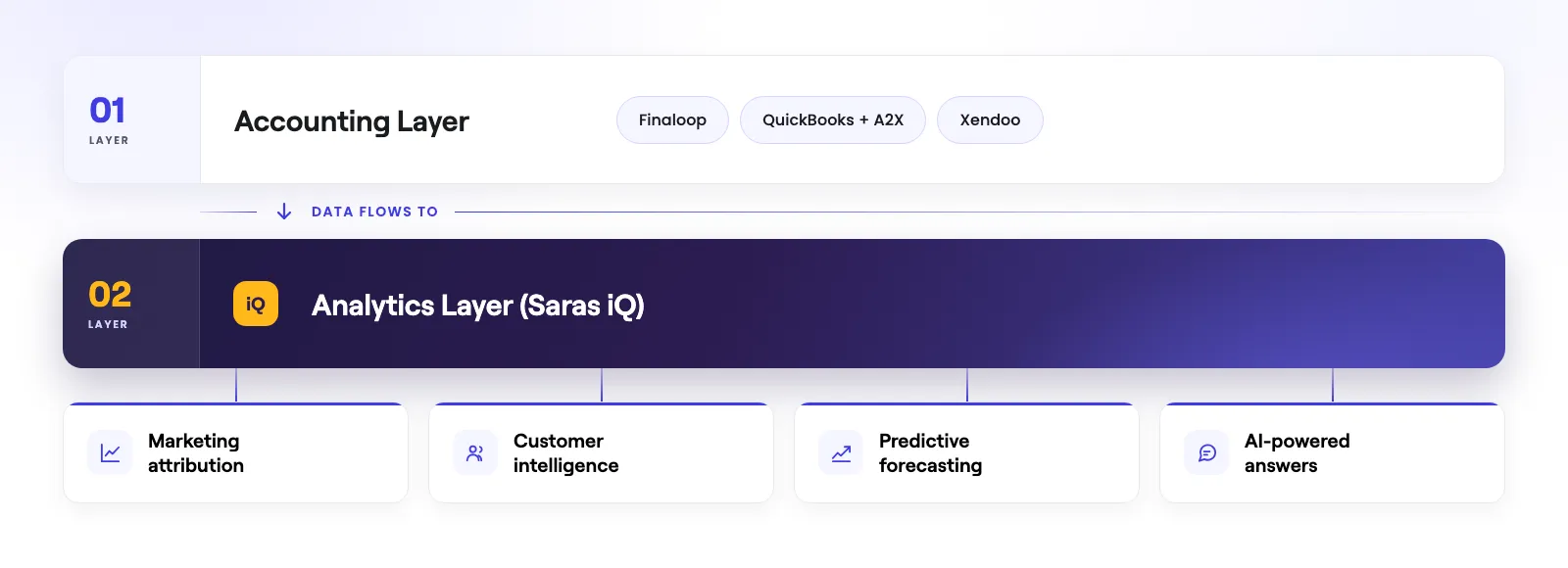
Saras iQ integrates with accounting platforms including Finaloop, QuickBooks, and NetSuite to pull financial data into unified analytics. The result: your CFO trusts the books while your entire team gets intelligence they can act on.
Moving Beyond Basic Financial Reporting
Finaloop solves real problems: automated bookkeeping, multi-channel reconciliation, inventory tracking, and tax compliance. For many brands, these capabilities justify the investment.
But as you scale past $10M, the questions change. "Are we profitable?" becomes "Why are we more or less profitable than last month, and what should we do about it?" Accounting answers the first question. Analytics answers the second.
Saras iQ provides the analytics layer that accounting tools cannot match: certified data, governed definitions, AI-powered Q&A, and daily visibility into the metrics that drive growth. The platform serves 200+ clients and 2,000+ brands representing over $20B in annual GMV, with monthly reconciliation tolerance of plus or minus 1%.
For Shopify brands ready to move from financial reporting to financial intelligence, see iQ pricing or book a demo to see how certified analytics transforms decision-making.

.svg)
.webp)
%201%20(1).svg)

















.jpg)



%20Statistics%20in%202026.jpg)

%20Software%20for%20DTC%20Brands%20in%202026.png)







%20Setup%20Guide%20for%20Ecommerce%20Finance%20Team.png)






















.webp)

.webp)
.webp)
.webp)
.webp)