
Conjura has carved out a niche for ecommerce brands seeking SKU-level profitability and LTV heatmap visualization, but Shopify merchants generating $10M or more in annual revenue often hit limitations when they need deeper integrations, data ownership, or enterprise-grade analytics. From fragmented reporting across channels to the challenge of getting finance and marketing to agree on a single definition of customer acquisition cost (CAC, the total cost to acquire one new customer), DTC brands need platforms that deliver more than visual dashboards.
This guide examines seven Conjura alternatives through the lens of contribution margin analytics (revenue minus variable costs like COGS, fulfillment, and marketing), customer lifetime value (LTV) tracking, and certified data foundations for Shopify brands ready to scale.
Saras iQ stands out as an AI Data Team for ecommerce, combining 200+ connectors with a certified data foundation and governed metrics that ensure the same answer regardless of who asks or when.
Conjura Alternatives at a Glance
Why Your $10M+ Shopify Brand Needs More Than Conjura
Conjura delivers visual LTV analysis and SKU-level profitability, but Shopify brands scaling past $10M in annual revenue encounter specific limitations that affect daily decision-making and board-ready reporting.
The core challenges with Conjura for growing DTC brands include:
- Limited integration ecosystem: Conjura covers approximately 20-30 native connectors, while platforms like Saras iQ offer 200+ ecommerce integrations including rare sources like Loop Returns, ShipHero, TikTok Shop, and the full Recharge events API.
- No dedicated data warehouse: Data stays locked within Conjura's platform, limiting export options and SQL access for custom analysis.
- Basic attribution capabilities: Conjura focuses on profitability rather than marketing attribution, making it difficult to validate platform ROAS against warehouse data.
- No semantic layer for governed metrics: Without enforced definitions, finance and marketing teams can still present different numbers for the same metric. Data governance remains a top challenge for growing ecommerce brands.
Quick definitions before the list: Contribution margin is revenue minus variable costs (COGS, fulfillment, platform fees, marketing spend). LTV measures the total revenue a customer generates over their relationship with your brand. MER (Marketing Efficiency Ratio) is total revenue divided by total marketing spend. MCP (Model Context Protocol) connects AI assistants like Claude to external data sources through a standardized interface.
Match the alternative to your switching trigger:
- Need contribution-margin truth that finance, marketing, and ops all agree on: Saras iQ
- Prioritize marketing attribution and AI campaign optimization: Triple Whale
- Require full data ownership in your own Snowflake warehouse: Polar Analytics
- Want lowest-cost LTV tracking for Shopify-only operations: Lifetimely
- Need cross-channel reporting across multiple platforms: Glew.io
- Running high ad spend and need MMM or incrementality testing: Northbeam
- Building an enterprise data warehouse for omnichannel: Daasity
For Shopify brands at $10M to $50M in annual revenue, the right analytics platform affects not just reporting accuracy but daily contribution margin visibility and the ability to defend numbers to the board. Visual dashboards show data. A certified data foundation ensures that data is trustworthy.
1. Saras iQ: The Certified Data Foundation for Confident Ecommerce Decisions
Saras iQ is an AI Data Team for ecommerce that combines a certified data foundation with plain-English Q&A, governed metrics, and integrations that work inside Slack and Claude. Unlike platforms that deliver dashboards with raw data, iQ ensures the same answer regardless of who asks or when, because definitions are encoded once and enforced everywhere.
Key Capabilities for Ecommerce Teams
- Certified data foundation: 200+ sources modeled into 11 governed master datasets covering orders, sales, customers, returns, advertising, traffic, subscriptions, products, targets, finance, and inventory
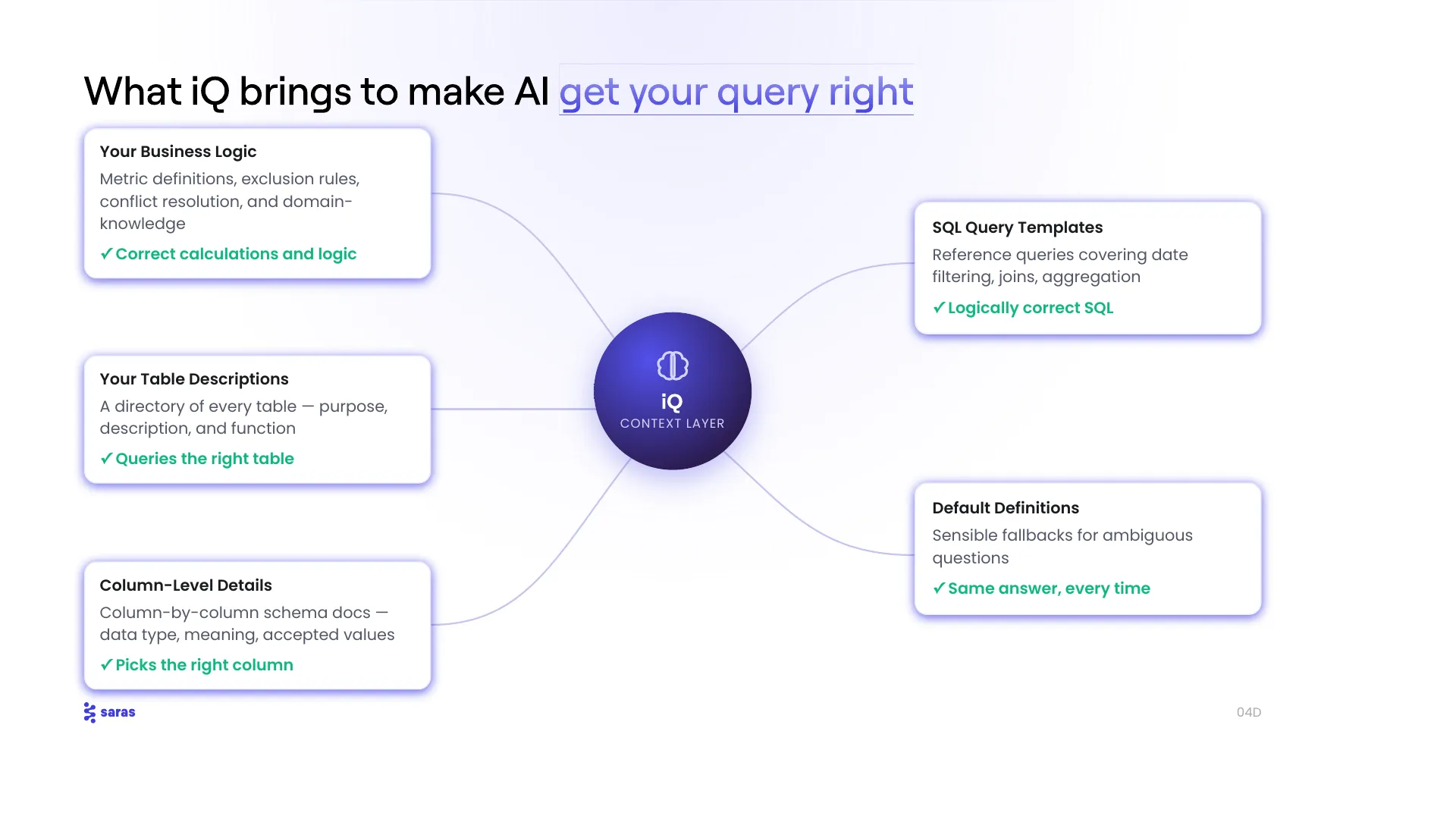
- Context layer: Encodes your specific metric definitions, exclusion rules, table and column descriptions, and default definitions for ambiguous questions
- Validation layer: Tests iQ against a golden set of 30 to 100 client-specific questions, refining logic to 90%+ accuracy with client UAT and regression tests on every change
- 500+ daily QA checks: Catches data quality issues before they reach reports, with monthly reconciliation tolerance of plus or minus 1%
- iQ Business Analyst: Answers plain-English business questions, writes summaries, and builds dashboards across contribution margin, customer analytics, and sales performance
- iQ Data Engineer: Lives in your Slack support channel and handles routine data ops (explaining how a metric is calculated, confirming today's data has loaded, triggering refreshes, logging bugs)
- iQ MCP: Connects the certified foundation to Claude through the Model Context Protocol so the same governed answers are available inside Claude
Ecommerce Use Cases
iQ Essentials ships with three certified use cases designed for Shopify brands at $10M to $50M:
Contribution margin analytics: Order-line sales data model with standardized net sales (gross minus discounts minus refunds plus shipping), SKU COGS, fulfillment costs, platform fees, fixed costs, and marketing spend. Client-supplied COGS and fee templates, targets vs actuals, and manual or offline spend via Google Sheets.
Customer analytics: CustomerMaster with acquisition attributes, Recency plus Monetary segmentation, and Shopify and TikTok Shop cohorts. This answers the question "what is my true CAC vs LTV by channel" without manual Excel work.
Sales and marketing analytics: Standardized paid-media grouping across Meta, Google, TikTok, Microsoft, Snapchat, Pinterest, AppLovin, Amazon Ads, and MNTN, with pacing vs targets to validate platform claims against certified revenue.
Pricing Structure
- iQ Essentials: From $1,999/month for Shopify brands at $10M to $50M, live in about three weeks
- iQ Enterprise: Custom pricing for brands at $50M to $500M, adding Advanced Customer 360, inventory visibility, custom semantic and context layer, multi-entity support, and dedicated consulting
Why Saras iQ Leads for Ecommerce
The core problem with generic analytics tools is accuracy. They are right maybe eight times out of ten, but you never know which eight, so you doubt every answer. iQ solves this through engineered accuracy: the context layer holds your business logic, the validation layer tests against known questions, and the LLM never touches the warehouse directly (SQL is generated first and run read-only).
Ridge's team asked iQ 1,069 questions in 30 days across 18 users spanning the CEO, marketing, product, ops, and finance, with zero analyst requests. CEO Sean Frank stated that once you get Saras iQ inside of Claude, it is worth over $50,000 a month for them.
For brands evaluating Claude + BigQuery MCP as a DIY alternative, the difference is context and validation. Generic AI on raw warehouse data fuses ad channels incorrectly, omits marketing spend, and fabricates benchmarks. iQ adds the business logic that makes answers deterministic.
2. Triple Whale: Attribution-First Analytics with AI Campaign Management
Triple Whale positions itself as an all-in-one attribution and marketing analytics platform for Shopify brands, with a first-party pixel and AI assistant for campaign management. G2 reviewers rate it 4.5/5 across 482 reviews.
Primary Focus
- Triple Pixel: First-party tracking that captures events missed by platform pixels, improving attribution accuracy
- 10+ attribution models: Multiple models including first-touch, last-touch, linear, and data-driven options
- Moby 2 AI: AI assistant for campaign management, creative analysis, and automated recommendations
- Sonar Send and Optimize: Recovers email events and enriches Meta and Google CAPI with missing conversion data
- Free tier available: Entry point for testing platform capabilities before committing to paid plans
Ecommerce Considerations
Triple Whale excels at marketing attribution for Shopify-first DTC brands but uses GMV-based pricing that can scale quickly as brands grow. The platform focuses on attribution and campaign optimization rather than deep profitability analytics or data warehouse infrastructure.
For brands needing contribution margin by SKU, Triple Whale provides profit tracking but not the governed metric definitions that ensure finance and marketing report the same numbers.
Organizational Fit
Triple Whale fits DTC brands whose primary pain is attribution clarity and campaign optimization. Brands needing enterprise data infrastructure, ERP integration, or certified analytics across multiple business functions may find the platform's scope limiting.
For a detailed comparison, see Saras iQ vs Triple Whale.
3. Polar Analytics: Warehouse-Native BI with Data Ownership
Polar Analytics provides warehouse-native business intelligence with a dedicated Snowflake data warehouse per customer, ensuring full data ownership and SQL access. G2 reviewers rate it 4.7/5 across 23 reviews.
Primary Focus
- Dedicated Snowflake warehouse: Each customer gets their own warehouse instance with full SQL access
- Polar Pixel: First-party tracking comparable to Triple Whale's pixel
- 10+ attribution models: Multiple attribution options for marketing analysis
- MCP integration: AI queries through the Model Context Protocol
- Custom metrics: Build unlimited custom dashboards and models on your own data
Ecommerce Considerations
Polar Analytics offers strong data ownership and attribution capabilities but uses quote-based pricing that can create sales friction. The platform focuses on Shopify-first brands and has limited support for non-Shopify platforms like Amazon or wholesale channels.
For brands needing customer segmentation across multiple channels, Polar's Shopify focus may limit visibility into full customer behavior.
Organizational Fit
Polar Analytics serves mid-market Shopify brands that prioritize data ownership and have technical resources to leverage SQL access. Brands needing certified metrics, ERP integration, or omnichannel coverage may find the platform's scope insufficient.
For alternatives with broader scope, see Polar Analytics alternatives.
4. Lifetimely: Lowest-Cost LTV Tracking for Shopify
Lifetimely delivers LTV, cohort analysis, and profit tracking specifically for Shopify merchants, with the fastest setup time and lowest entry price in the category.
Primary Focus
- LTV and cohort analysis: Core strength in customer lifetime value tracking and cohort visualization
- Profit and loss reporting: Automated P&L with cost inputs for contribution margin visibility
- Profit Agent AI: Proactive anomaly detection that surfaces profit issues
- Klaviyo deep integration: Sync segments and customer data to Klaviyo for activation
- Free tier: Entry point for stores with up to 50 orders per month
Ecommerce Considerations
Lifetimely focuses exclusively on Shopify, with no support for Amazon, wholesale, or multi-platform operations. The platform provides basic last-touch attribution rather than advanced models, and lacks a first-party tracking pixel.
For brands outgrowing Shopify-only analytics, Lifetimely's limitations become apparent when tracking customers across channels.
Organizational Fit
Lifetimely fits Shopify-only brands under $10M seeking the fastest path to LTV visibility without enterprise complexity. Growing brands expanding to Amazon or wholesale will need to re-platform as channel mix diversifies.
For alternatives with broader scope, see Lifetimely alternatives.
5. Glew.io: Multi-Channel Commerce Reporting
Glew.io provides multi-channel commerce reporting for retailers selling across Shopify, BigCommerce, WooCommerce, Amazon, and other platforms. G2 reviewers rate it 4.0/5 across 57 reviews.
Primary Focus
- Multi-platform support: Coverage across major ecommerce platforms including Shopify, BigCommerce, and WooCommerce
- Cross-channel reporting: Unified view of sales, customers, and products across channels
- Pre-built dashboards: Ready-made reports for common ecommerce metrics
- Customer segmentation: RFM-based segmentation for marketing activation
Ecommerce Considerations
Glew.io covers multiple platforms but lacks the AI-powered analytics, attribution models, and data warehouse capabilities of more advanced alternatives. The platform focuses on reporting rather than certified analytics or governed metrics.
For brands needing single source of truth, Glew's reporting focus may not address the underlying problem of conflicting metric definitions.
Organizational Fit
Glew.io serves multi-platform retailers seeking unified reporting without the investment in enterprise data infrastructure. Brands needing AI-powered insights, marketing attribution, or certified analytics will find the platform's capabilities limited.
For a comparison, see Saras Daton vs Glew.
6. Northbeam: MMM and Incrementality for High Ad Spend Brands
Northbeam provides media mix modeling (MMM) and incrementality testing for enterprise brands with significant paid media investments. G2 reviewers rate it 4.5/5 across 16 reviews.
Primary Focus
- Media mix modeling: Statistical modeling to understand channel effectiveness beyond last-click attribution
- Incrementality testing: Geo-lift and holdout experiments to measure true campaign impact
- Creative analytics: Performance insights at the creative and ad level
- First-party pixel: Server-side tracking for attribution accuracy
Ecommerce Considerations
Northbeam's pricing starts at $1,500/month, positioning it for enterprise brands with substantial ad budgets. The platform focuses specifically on paid media optimization rather than full-stack ecommerce analytics including profitability and customer LTV.
For brands needing marketing analytics alongside profitability, Northbeam's paid media focus may require additional tools for complete visibility.
Organizational Fit
Northbeam serves enterprise brands spending $1M or more annually on paid media who need sophisticated attribution beyond pixel-based models. Mid-market brands may find the pricing and scope misaligned with their needs.
For a comparison of attribution approaches, see Saras Analytics vs Northbeam.
7. Daasity: Enterprise Data Warehouse for Omnichannel
Daasity provides a commerce data warehouse platform for enterprise brands with complex omnichannel operations, combining data integration with analytics and reporting. G2 reviewers rate it 4.7/5.
Primary Focus
- Commerce data warehouse: Pre-built data models for ecommerce metrics and KPIs
- Multi-channel coverage: Support for Shopify, Amazon, wholesale, and retail channels
- Managed analytics: Pre-built reports and dashboards on top of the warehouse
- Custom source support: Ability to integrate proprietary data sources
Ecommerce Considerations
Daasity's pricing starts at $1,499/month for Starter Essentials, with Essentials at $1,999/month and custom pricing for Enterprise. The platform provides strong wholesale and custom source coverage but adds AI capabilities as an add-on rather than native functionality.
For brands evaluating enterprise Shopify analytics, Daasity's data warehouse approach competes with Saras iQ's certified data foundation, with different philosophies on AI integration.
Organizational Fit
Daasity serves enterprise omnichannel brands ($50M+) needing wholesale channel coverage and custom data sources. Mid-market Shopify brands may find the pricing exceeds their needs, while brands wanting AI-native analytics may prefer platforms with deeper AI integration.
Beyond Dashboards: The Power of Governed Metrics and a Semantic Layer
Moving data is only half the challenge. The bigger problem for ecommerce brands is ensuring that data answers questions consistently, regardless of who asks. Every alternative above delivers dashboards, but dashboards built on ungoverned data perpetuate the "three teams, three numbers" problem that plagues growing brands.
This is where the semantic layer becomes critical. A semantic layer sits between your raw data and your business users, encoding definitions, relationships, and business logic so that "contribution margin" means the same thing to your CFO, CMO, and CEO.
Saras iQ provides this certified data foundation with:
- Context layer: Encodes your specific metric definitions, exclusion rules, and business logic so "revenue" means the same thing everywhere
- Validation layer: Tests answers against a golden set of 30 to 100 client-specific questions, refining to 90%+ accuracy
- 500+ daily QA checks: Catches data quality issues before they reach reports
- Monthly reconciliation tolerance: Plus or minus 1% accuracy verified against source systems
The result is deterministic answers: the same question returns the same answer regardless of who asks or when. This eliminates the Friday question that gets answered Tuesday, and the board meeting where finance and marketing present conflicting numbers.
For teams evaluating why LLMs get data wrong, the answer is context. Generic AI on raw warehouse data lacks the business logic to interpret ambiguous questions correctly. iQ's context layer provides that missing intelligence.
.webp)
When to Choose Saras iQ for Ecommerce Analytics
For Shopify brands at $10M to $500M in annual revenue, Saras iQ delivers the certified analytics, governed metrics, and AI Data Team that visual dashboards and point tools cannot match.
The platform's 200+ connectors address gaps that Conjura and other alternatives leave open: Loop Returns for tracking return impact on customer LTV, ShipHero APIs for connecting warehouse operations with sales forecasting, TikTok Shop commerce data beyond basic ads metrics, and detailed Amazon Seller Central APIs across 15+ global marketplaces.
Combined with iQ Business Analyst and iQ Data Engineer, the data foundation becomes an AI-ready analytics layer where business questions get instant, trusted answers. The same answer in iQ Chat, Slack, or Claude, because the context layer governs how every metric is calculated.
For brands ready to move beyond fragmented reporting and conflicting numbers:
- Explore iQ pricing to see Essentials and Enterprise options
- Book a demo to see how certified analytics works for Shopify brands at $10M+
.svg)
.webp)
%201%20(1).svg)









.jpg)
%20Statistics%20in%202026.jpg)

%20Software%20for%20DTC%20Brands%20in%202026.png)


%20Setup%20Guide%20for%20Ecommerce%20Finance%20Team.png)















.webp)

.webp)
.webp)
.webp)
.webp)