Polar Analytics does not publish a simple flat monthly price for every customer. Its pricing is tied in part to GMV, which means the amount a brand pays can increase as sales grow. For a Shopify business generating $10M or more annually, that makes the headline subscription price only one part of the buying decision.
The more important question is what that growing spend actually delivers. Brands need to consider the data sources included, reporting capabilities, metric consistency, implementation requirements, and whether additional tools or internal work are still needed to produce trusted numbers.
This guide breaks down Polar Analytics pricing in 2026, what influences the total cost, and what ecommerce teams should evaluate before committing. It also looks at how Saras iQ differs by building analytics on a certified data foundation with governed business logic.
Understanding Polar Analytics Pricing: What to Expect in 2026
Polar Analytics Base Plans and Add-ons
Polar Analytics structures its pricing around gross merchandise value (GMV) rather than flat subscription tiers. This approach means your monthly cost scales with your revenue, which can be advantageous during slower periods but creates budget unpredictability during growth spurts.
Pricing is based on GMV and requires a custom quote from Polar Analytics. Contact their sales team for specific pricing based on your revenue band.
Annual billing may provide savings; contact Polar Analytics for a quote.
All Polar plans include unlimited users, unlimited historical data, and unlimited connectors. This unlimited user model is relatively rare in the ecommerce analytics space and provides genuine value for organizations with large teams needing data access.
Factors Influencing Polar Analytics Costs
The base subscription tells only part of the story. Polar offers modular add-ons that can substantially increase your monthly spend. Add-ons like Incrementality Testing and Polar Headless MCP are available; contact Polar Analytics for pricing.
Additional capabilities typically offered include:
- Business Intelligence Only for dashboard library and custom reporting
- Core Plan Bundle including BI, Klaviyo Audiences, Advertising Signals, and Polar MCP
- Klaviyo Audiences for missed abandonment event identification
This modular approach provides flexibility but requires careful budget planning.
Polar Analytics vs. Saras iQ Essentials: A Pricing and Feature Showdown for $10M to $50M Shopify Brands
For Shopify brands in the $10M to $50M revenue range, the pricing comparison becomes more nuanced than raw monthly costs suggest.
At-a-Glance Comparison
Key Differences in Data Accuracy and Reporting
The fundamental difference lies in how each platform treats data accuracy.
Polar Analytics provides a warehouse-native architecture with a semantic layer containing 400+ pre-built metrics. This approach accelerates time to insight by providing pre-calculated ecommerce metrics out of the box.
Saras iQ takes a different approach with its certified data foundation. Rather than pre-built metrics alone, iQ applies a context layer that holds your business's specific definitions, exclusion rules, and calculation logic. The validation layer then tests every answer against a golden set of 30 to 100 client-specific questions, refining logic to 90%+ accuracy before deployment.
This matters because generic tools, including AI on raw warehouse data, are right maybe eight times out of ten. The problem is you never know which eight. When the difference between 2% and 5% EBITDA determines your next capital allocation decision, directionally right is not good enough.
Attribution Capabilities: Where Polar May Lead, and Where iQ Excels
Polar offers first-party attribution with server-side tracking, providing independence from ad platform APIs that have become less reliable post-iOS 14. This is a genuine strength for brands whose primary concern is marketing attribution.
Saras iQ Essentials does not include multi-touch attribution, media mix modeling (MMM), or incrementality testing. The platform focuses instead on customer analytics with cohort analysis, Recency plus Monetary segmentation, and CAC (customer acquisition cost) versus LTV (customer lifetime value) analysis that verifies platform claims against certified revenue.
The choice depends on your primary pain point. If your CMO needs attribution clarity for ad budget decisions, Polar's first-party pixel fills that need. If your CFO needs contribution margin by channel that matches the general ledger, the certified data approach becomes more valuable.
Beyond the Dashboard: How Polar Analytics and Saras iQ Address Marketing Analytics
Evaluating Marketing Spend with Polar vs. Saras iQ
Marketing teams at $10M+ Shopify brands face a consistent problem: platform ROAS (return on ad spend) does not match actual revenue. The board asks for true CAC by channel and it becomes a manual Excel project that takes three days.
Polar addresses this through its first-party attribution and Advertising Signals module. The platform provides standardized ad platform integrations with daily refresh (4x daily standard), enabling marketing teams to track spend and performance across Meta, Google, TikTok, and other channels.
Saras iQ approaches marketing analytics through the lens of sales and marketing analytics as one of its three certified use cases. The platform standardizes paid media grouping (Amazon to Amazon, TikTok to TikTok, everything else to DTC) and tracks pacing versus targets. This enables reallocation of 15 to 25% of ad spend based on verified performance rather than platform-reported metrics.
Customer Lifetime Value Analysis: A Comparative Look
Both platforms provide LTV analysis, but the underlying data treatment differs.
Polar's semantic layer with 400+ pre-built metrics includes standard LTV calculations. The warehouse-native approach means you own your data and can query it directly through Snowflake.
Saras iQ builds LTV analysis on CustomerMaster, a governed dataset that includes acquisition attributes and cohort retention analysis. Because CAC and LTV are defined once in the context layer, marketing and finance always reference the same number. No more debates where marketing says CAC is $50 and finance says $80.
Business Intelligence Software: Where Polar Analytics Fits and When to Consider Saras iQ
Defining Data Governance for Ecommerce Brands
The question for growing Shopify brands is not whether you need business intelligence. The question is whether your BI tool gives you a single source of truth or just another place to argue about numbers.
Polar Analytics provides a warehouse-native architecture that gives customers their own isolated Snowflake instance. This approach provides data ownership and governance at the warehouse level. You can connect your existing BI tools (Tableau, Looker, Mode) directly to your Snowflake instance.
The tradeoff is that governance happens at the infrastructure level rather than the semantic level. You own the data, but metric definitions still require configuration and maintenance.
Saras iQ's Approach to a Governed Semantic Layer
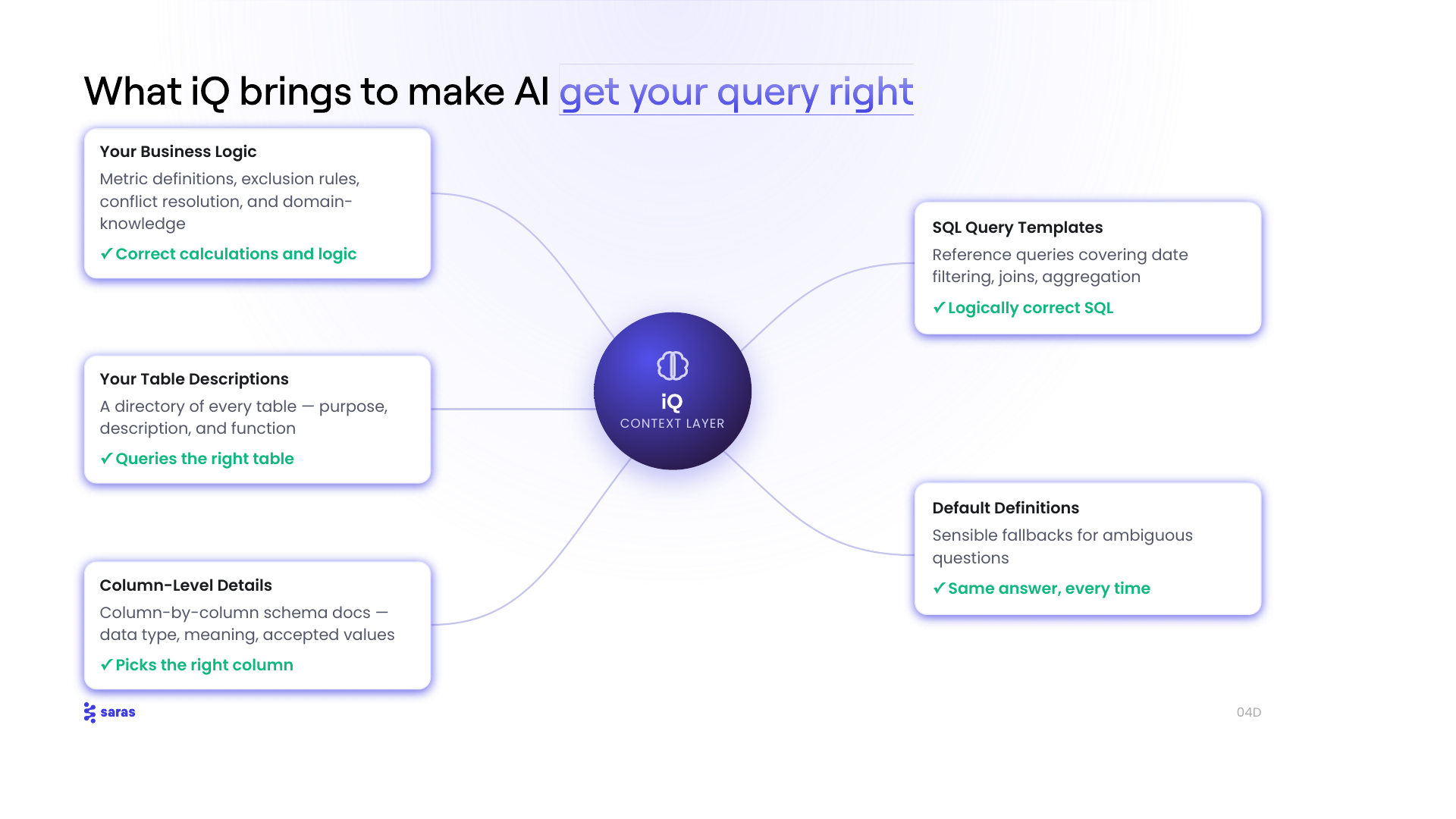
Saras iQ treats the semantic layer as the core product feature rather than an add-on. The context layer holds:
- Metric definitions and exclusion rules
- Table and column descriptions
- SQL query templates
- Default definitions for ambiguous questions (because "revenue" means something different to finance than to marketing)
This approach means iQ answers the same question the same way regardless of who asks or when.
Data Visualization Tools: How Polar Analytics and Saras iQ Present Your Data
Polar's Visualization Strengths for Ecommerce
Polar provides customizable omnichannel dashboards out of the box. The platform's Business Intelligence module includes a dashboard library with standard ecommerce reports covering revenue, marketing performance, customer analytics, and inventory.
The semantic layer with 400+ pre-built metrics accelerates dashboard creation by providing pre-calculated metrics. Marketing teams can build reports without waiting for an analyst to write SQL.
Ensuring Trust and Accuracy in Visualized Data with Saras iQ
Dashboards are only valuable if you trust the numbers in them. Saras iQ addresses this through 500+ daily QA checks and weekly historical certification, maintaining a reconciliation tolerance of plus or minus 1%.
The platform also provides iQ Data Engineer, which lives in Slack and handles routine data operations: explaining how a metric is calculated, confirming today's data has loaded, triggering a refresh after a COGS sheet changes, and logging bugs and change requests. Instead of waiting 60+ hours across time zones for an analyst to confirm data freshness, you get an answer in minutes.
Is Polar Analytics the Right Fit for Your Ecommerce Business?
Evaluating Polar's Strengths: Attribution and Real-Time Insights
Polar Analytics excels in specific scenarios:
Best for:
- Brands prioritizing first-party attribution post-iOS 14
- Organizations wanting warehouse data ownership through dedicated Snowflake
- Teams comfortable with self-serve analytics
- Brands needing 4x daily data refresh
Not ideal for:
- Brands requiring 200+ connectors for complex tech stacks
- Organizations needing native ERP integrations (NetSuite, Acumatica)
- Teams wanting consulting and data engineering services included
- Brands where the "three teams, three numbers" problem is the primary pain point
Limitations: Data Accuracy and Metric Governance
Polar's GMV-based pricing can feel expensive for lower-margin business models. A brand generating $20M in revenue on slim margins pays the same as a brand with healthy margins at the same GMV.
The platform's 45 native connectors may not cover complex omnichannel tech stacks. Saras Daton, by comparison, offers 200+ ecommerce-specific connectors including rare ones like Loop Returns, ShipHero inbound shipments, TikTok Shop, full Recharge events API, and detailed Amazon Seller Central APIs across 15+ marketplaces.
Why Certified Data and Metric Governance Matter More Than Ever
The Cost of Inaccurate Data: Why Directionally Right is Not Enough
When your gross margins improve but advertising and fulfillment costs erase the gains, you need to know exactly where margin is leaking. Directionally right answers do not cut it.
Consider the scenario: you ask an AI tool why contribution margin dropped this month. A tool operating on raw warehouse data might give you an answer that is plausible but wrong. It might attribute the drop to increased shipping costs when the actual cause is a COGS data entry error on your three best-selling SKUs.
Saras iQ's validation layer catches these errors because it tests against known correct answers before deployment. The LLM never touches the warehouse directly. SQL is generated first and run read-only, preventing both hallucinations and unintended data modifications.
Saras iQ: Your Partner for Board and Investor Readiness
The CEO/Founder at a $10M to $50M Shopify brand cares about one thing above all else: the same answer regardless of who asks. When the board asks about contribution margin, finance and marketing should present identical numbers.
Saras iQ delivers this through:
- Context layer: Metric definitions enforced across every query
- Validation layer: 30 to 100 client-specific questions tested to 90%+ accuracy
- Deterministic output: Same question, same answer, every time
- Audit trail: Full lineage showing how every metric was calculated
Driving Profitability: Polar Analytics vs. Saras iQ's Contribution Margin Focus
Measuring Daily Profitability: The Foundation of Confident Decisions
Contribution margin analytics is the number one use case driving demand since VC money dried up and growth-at-all-costs gave way to profitability.
Both platforms offer contribution margin tracking, but the implementation differs substantially.
Polar provides contribution margin within its pre-built metric library. The calculation is available, but you configure the inputs and logic within the platform.
Saras iQ Essentials ships with contribution margin as a certified use case:
- Order-line sales data model
- Standardized net sales (gross minus discounts minus refunds plus shipping)
- CM with SKU COGS, fulfillment, platform fees, fixed costs, and marketing costs
- Client-supplied COGS and fee templates
- Targets versus actuals
- Manual or offline spend via Google Sheets
This means daily profitability you can defend to the board, defined once, with the same answer for finance and marketing.
How Saras iQ Enables Margin Recovery for DTC Brands
For a $100M brand, the quantified outcome is $500K to $1M in annual margin recovered within 90 days. This comes from three sources:
- Identifying hidden cost leakage: Returns distorting CM pricing, 3PL cost variations, fulfillment and finance timing gaps
- Reallocating ad spend: 15 to 25% of media budget moved from underperforming to high-performing channels
- SKU-level profitability: Discovering that best-selling SKUs are draining working capital instead of generating profit
These insights require certified data because the margin between profitable and unprofitable is measured in percentage points, not directional trends.
Replacing Fragmented Systems: The Build vs. Buy Decision with Polar Analytics and Saras iQ
The Hidden Costs of DIY Data Solutions
The real alternatives in buyers' heads are not just Polar versus Saras. They are:
- Spreadsheets maintained by one analyst who knows all the formulas
- Internal SQL developer plus Tableau dashboards that take three days to update
- Fivetran plus a BI tool that technically works but requires constant maintenance
- DIY Claude on BigQuery that gives different answers in different sessions
- Point tools that solve one problem but create three more
Each approach carries hidden costs. The internal build requires 30 to 40% of your data engineer's time on pipeline maintenance. The DIY AI approach produces answers that vary based on how the question is phrased. The point tool approach creates the exact "three teams, three numbers" problem you are trying to solve.
Saras iQ: A Productized Answer for the Scale Segment
Saras iQ Essentials is purpose-built for Shopify brands at $10M to $50M that have outgrown native dashboards but do not want enterprise complexity or another analytics hire.
At from $1,999 per month, Essentials includes:
- Three certified use cases (contribution margin, customer analytics, sales and marketing)
- iQ Chat and iQ Business Analyst for plain-English queries
- iQ Data Engineer in Slack for data operations
- iQ MCP for Claude integration
- Standard integrations with nightly refresh
- Response verification and sharing
Compare this to building the equivalent in-house: one senior data analyst ($120K+ annually), Fivetran or similar ($1,000+ monthly for meaningful volume), BI tool licenses ($500+ monthly), and ongoing maintenance that pulls engineers away from product work.
The build versus buy math usually favors buy for brands under $50M. For why most $20M+ DTC brands regret building in-house, the pattern is consistent: six months and $200K later, you have dashboards that still require manual reconciliation every month.
The Value of a Certified Data Foundation: Comparing Polar Analytics' Data Approach with Saras iQ's
Polar's Data Infrastructure: What You Need to Know
Polar provides warehouse-native architecture with a dedicated Snowflake instance per customer. This approach offers:
- Data ownership (you can query your Snowflake directly)
- BYOT (bring your own tools) flexibility
- Standard data refresh at 4x daily
- 45+ native connectors for common ecommerce platforms
The architecture works well for organizations with existing data teams that want to extend their Snowflake environment with ecommerce-specific data models.
Saras iQ: A BigQuery-Native Foundation for AI-Native Operations
Saras iQ is built BigQuery-native with the foundation designed for AI from the start, not retrofitted.
The certified data foundation includes:
- 200+ sources modeled into 11 governed master datasets
- 500+ daily QA checks with weekly historical certification
- Plus or minus 1% monthly reconciliation tolerance
- 107 Amazon transaction types cleaned and standardized
- Timezone and FX handling across all sources
This matters for the CTO or Head of Data persona because it scales analytical capacity without scaling headcount. When analysts spend 60% of their time answering repetitive questions, iQ becomes the force multiplier. When engineers spend 30 to 40% of their time on pipeline maintenance, the certified foundation frees them for higher-value work.
For brands considering Polar Analytics alternatives, the decision often comes down to whether you need attribution-first capabilities or certified-data-first capabilities.
Getting Started: Next Steps for Shopify Brands
If you are a Shopify brand doing $10M or more annually and the "three teams, three numbers" problem is costing you confidence in board meetings, margin visibility, or marketing spend decisions, book a demo to see how Saras iQ delivers deterministic answers from certified data.
For brands where first-party attribution is the primary concern, Polar Analytics provides genuine value in that specific use case.
Evaluate based on your primary pain point, not feature lists.
.svg)
.webp)
%201%20(1).svg)













.jpg)

%20Statistics%20in%202026.jpg)

%20Software%20for%20DTC%20Brands%20in%202026.png)

%20Setup%20Guide%20for%20Ecommerce%20Finance%20Team.png)