
You searched "Daasity pricing" expecting a straightforward answer. Instead, you found five different sources showing five different numbers: $199, $1,499, $1,899, $1,999, and "custom." Your CFO wants a budget number. Your board wants to understand the ROI. And nobody can agree on what this platform actually costs before you even factor in implementation, training, and the hidden fees that show up after you sign.
For Shopify brands generating $10M or more in annual revenue, this pricing confusion is not just frustrating. It is a symptom of a deeper problem: analytics platforms that scale their costs unpredictably as your business grows.
Saras iQ was built to solve exactly this problem, offering transparent pricing, certified data, and deterministic answers that mean your finance team and marketing team finally report the same numbers.
At-a-Glance: Daasity vs. Analytics Alternatives
Ratings pulled from G2 in September 2026.
Understanding Daasity's Pricing Model in 2026
Official Published Tiers
Daasity structures its 2026 pricing around three core tiers:
- Starter Essentials ($1,499/month): Native Daasity connections, dashboards, and reports for brands getting started with warehouse-native analytics
- Essentials ($1,999/month): Full data foundation with contribution margin (revenue minus variable costs like COGS, fulfillment, and marketing spend) built in from day one
- Enterprise (Custom): Built for brands expanding across retail, DTC, and digital channels with unified views of sales, inventory, and marketing
A limited-time add-on, Syndicated Data plus AI Analyst, runs $499/month for industry benchmarks and competitive context.
The Revenue-Based Pricing Reality
The official tiers tell only part of the story. Daasity uses revenue-based pricing that scales with your business. The Shopify App Store listing states: "Usage charges are based on an annualized rolling 3 month average of your total revenue."
This means two brands on identical feature sets can pay vastly different amounts. A $15M brand might pay close to the listed price. A $50M brand on the same plan could pay significantly more once revenue-based charges apply.
Third-party research confirms this variability. Documented deployments range from $1,500 to $5,000 per month on annual contracts, with implementation timelines of four to eight weeks.
Why Published Pricing Rarely Matches Final Cost
The pricing confusion stems from multiple factors:
- Rolling revenue calculations that adjust quarterly based on your sales performance
- Annual contract requirements that lock in commitments before you validate ROI
- Implementation services that may be quoted separately from subscription fees
- Add-on features for advanced dashboards, connectors, or premium support
For brands evaluating ecommerce analytics, this lack of transparency makes budgeting difficult and ROI calculations unreliable.
Hidden Costs and Total Cost of Ownership
Beyond the Subscription Fee
While Daasity's official pricing page shows $1,499 to $1,999/month, the real total cost includes components that rarely appear in initial sales conversations:
First-Year TCO Estimates by Complexity
Based on typical deployment patterns:
- Simple Setup (single-channel DTC): 1.2x to 1.5x subscription cost
- Mid-Market Omnichannel Brand: 1.5x to 2.5x subscription cost
- Complex Multi-Brand Deployment: 2.5x or higher subscription cost
For a brand paying $2,000/month in base fees, first-year total cost of ownership could realistically range from $28,800 to $60,000 once implementation, scaling, and operational costs are included.
Questions to Ask Before Signing
Before committing to any analytics platform, get clarity on:
- Implementation fees: Are onboarding and data mapping included, or quoted separately?
- Contract terms: What is the minimum commitment period, and what are early termination penalties?
- Revenue scaling: How exactly do costs change as your rolling three-month revenue grows?
- Add-on pricing: Which features require additional fees beyond the base subscription?
- Support tiers: What level of support is included, and what costs extra?
When Daasity Makes Sense for Your Brand
Ideal Use Cases
Daasity has built genuine strengths that serve specific brand profiles well:
- Omnichannel brands with retail presence: Unlike attribution-focused tools, Daasity handles DTC, Amazon, retail, and wholesale data in one platform. If you sell through Target, Whole Foods, or other retail partners, Daasity is one of few tools that can ingest syndicated sell-through data from Nielsen or SPINS.
- Brands wanting packaged dashboards: Daasity ships with 130+ pre-built dashboards covering LTV (customer lifetime value, or the total revenue you expect from a customer over their relationship with your brand), cohort analysis, RFM segmentation, and inventory velocity. This eliminates months of analytics development for teams that do not need custom models.
- Organizations with analyst capacity: Daasity's warehouse-native approach requires some analytics knowledge to extract full value. Brands with dedicated analysts who can write SQL or build custom reports will get more from the platform than lean teams expecting purely self-serve insights.
Where Daasity Excels
The platform's legitimate strengths include:
- Managed data infrastructure that handles pipeline maintenance without requiring data engineers
- Audience segmentation and activation that pushes segments directly to Meta, Google, and Klaviyo
- Retail analytics for brands selling through brick-and-mortar channels
- Contribution margin reporting built into the Essentials tier
For brands matching this profile, Daasity can deliver meaningful value despite its pricing complexity.
Where Daasity May Not Be Ideal for Growing DTC Brands
Considerations to Evaluate
- Best for: Omnichannel brands with retail presence, analyst teams, and $20M+ revenue
- Not ideal for: Amazon-heavy operations, brands needing real-time data, or teams without dedicated analytics resources
Several structural considerations emerge in third-party reviews and competitive analysis:
Managed Warehouse Environment
Daasity provides a managed data warehouse environment using platforms like Snowflake, BigQuery, or Redshift. While this simplifies infrastructure management, it means you work within Daasity's managed environment rather than directly accessing your own warehouse. If you later want to run custom models or integrate deeply with other tools in your stack, you may need additional work to extract and remodel your data.
For brands building an AI-ready foundation, this approach may present some flexibility constraints for future growth.
Overnight Data Refresh
Reports refresh overnight rather than in real time. For time-sensitive decisions during peak sales periods or flash promotions, this cadence may present challenges. Brands running aggressive marketing campaigns sometimes need more frequent data updates.
Learning Curve
The platform requires analytics knowledge even without SQL. Teams expecting plug-and-play simplicity may need dedicated training or consulting support to extract full value.
Marketplace Coverage
While Daasity covers Amazon at a functional level, brands with complex marketplace operations across Amazon, Walmart, TikTok Shop, and other channels may find connector coverage thinner than specialized alternatives. For Amazon-heavy brands, this consideration can be significant.
Alternatives to Daasity: Matching Tools to Your Switching Trigger
Different pain points call for different solutions. Match your primary frustration to the right alternative:
If Your Problem Is Data Trust and Accuracy
Saras iQ addresses the accuracy problem directly through certified data and a validation layer that ensures deterministic answers. When your CFO and CMO ask the same question, they get the same number. The platform starts from $1,999/month for Shopify brands at $10M to $50M in revenue.
- Eliminate data disputes across finance, marketing, and ops teams with certified accuracy
- Get answers in seconds from an AI analyst trained on your business logic and metrics
- Deploy in three weeks rather than months, with hourly refresh and your data in BigQuery or Snowflake
- Scale predictably with transparent flat pricing that does not surprise your CFO
If Your Problem Is Budget
Lifetimely offers LTV and profit analytics starting with a free tier. It provides focused retention insights without the complexity of a full data platform.
- Start with zero cost and upgrade only when your retention analytics needs grow
- Focus on retention with purpose-built cohort and LTV tracking
- Keep it simple with Shopify-native integration and no data engineering required
Glew.io serves multi-store retailers. It covers broader BI use cases than attribution-only tools but with less depth than Daasity in any single area.
- Connect multiple stores across Shopify, Magento, WooCommerce in one dashboard
- Access pre-built reports for inventory, customers, and products
- Avoid enterprise complexity with a streamlined setup for multi-platform operations
If Your Problem Is Attribution Clarity
Triple Whale focuses on Shopify DTC attribution with first-party pixel tracking. It offers a lower entry point than Daasity but lacks the omnichannel depth.
- Track attribution with first-party pixels when third-party cookies fail
- Optimize paid media with real-time campaign performance data
- Get started quickly with Shopify-native installation and dashboards
Saras iQ: The Alternative Built for Certified Data and Transparent Pricing
Why Data Certification Matters More Than Features
Generic analytics tools are accurate maybe eight times out of ten. The problem: you never know which eight. Every answer gets doubted. Every board meeting requires manual reconciliation. Every campaign decision carries uncertainty.
The gap between "directionally right" and "certified accurate" becomes critical when the difference between 2% and 5% EBITDA determines your next funding round or your ability to weather a slow quarter.
Saras iQ addresses this through three layers:
- Certified data foundation: 200+ sources modeled into 11 governed master datasets, with 500+ daily QA checks and a published monthly reconciliation tolerance of plus or minus 1%
- Context layer: Your business logic, metric definitions, and exclusion rules encoded so the AI understands that "revenue" means something different to your finance team than to your marketing team
- Validation layer: Golden test set of 30 to 100 client-specific questions, refined to 90%+ accuracy through client UAT, with regression testing on every change
The result: the same question returns the same answer regardless of who asks or when. This deterministic output is what separates certified analytics from "probably right" dashboards.
Transparent Pricing for Predictable Budgets
Unlike Daasity's revenue-based model, Saras iQ Essentials starts from $1,999/month with clear scope:
Included in Essentials:
- Three certified use cases: contribution margin, customer analytics with cohorts and segmentation, and sales and marketing analytics
- iQ Chat for plain-English questions answered from certified data
- iQ Data Engineer in Slack for data freshness checks and metric explanations
- iQ MCP (Model Context Protocol, a standard for connecting AI agents to data sources) for Claude integration
- Nightly refresh with BigQuery or Snowflake storage
- Response verification and sharing
Not included in Essentials: Multi-touch attribution, MMM and incrementality testing, custom or ERP sources, multi-currency reporting. These capabilities require iQ Enterprise for brands at $50M to $500M needing custom business logic.
Real Results: Ridge's 1,069 Questions in 30 Days
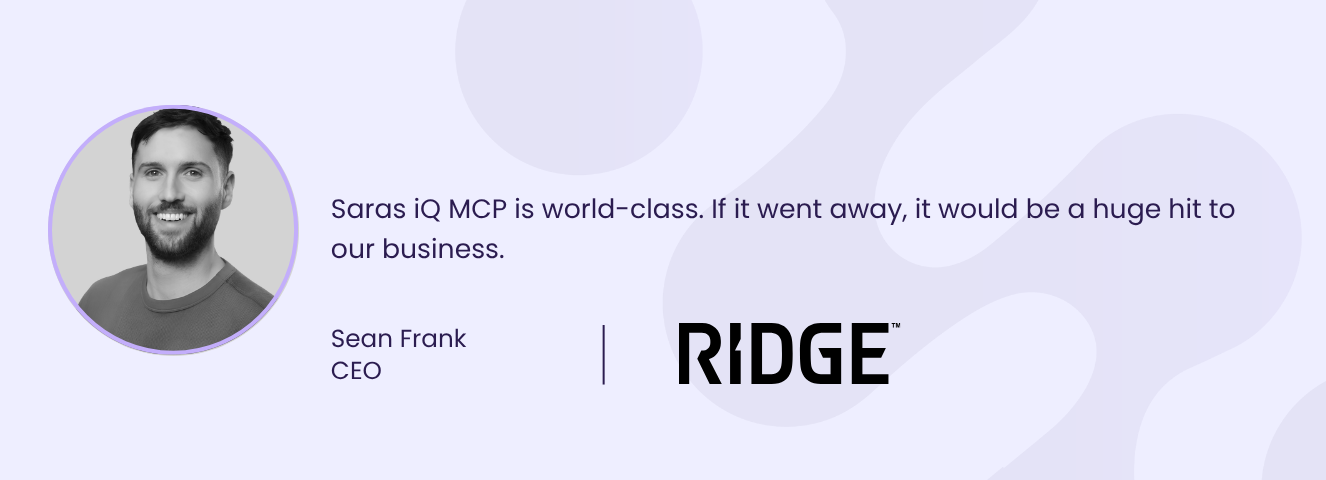
Ridge deployed Saras iQ across 35 team members spanning CEO, marketing, product, ops, and finance. In a 30-day period from May 8 to June 5, 2026, the team asked 1,069 questions through iQ, averaging 18 questions per business day, with zero analyst requests.
Sean Frank, CEO of Ridge, put it directly: "Once you get Saras iQ inside of Claude, it's worth over $50,000 a month for us."
This is not about replacing analysts. It is about freeing analysts from repetitive questions so they can focus on strategic work while every team member gets instant access to certified answers.
How to Choose the Right Analytics Platform for Your Brand
Decision Framework by Revenue Stage
Decision Framework by Primary Pain Point
Questions to Ask Any Analytics Vendor
- Where does my data live, and can I access it directly in my own warehouse?
- How exactly does pricing scale as my business grows?
- What is your reconciliation tolerance, and how do you validate accuracy?
- How long until I can ask my first question and trust the answer?
- What happens when my marketing team and finance team define the same metric differently?
Getting Started with Certified Analytics
The difference between "probably accurate" and "certified accurate" is not a technical detail. It is the foundation for every decision your leadership team makes.
If you are running a Shopify brand at $10M or more in annual revenue and your current analytics leave you reconciling spreadsheets instead of making decisions, book a demo to see how Saras iQ delivers the same answer regardless of who asks or when.
For brands evaluating Daasity alongside alternatives, the choice comes down to what you value most: pre-built dashboards and retail data coverage, or certified accuracy and transparent pricing. Both have their place. The question is which problem you need solved first.
.svg)
.webp)
%201%20(1).svg)










.jpg)
%20Statistics%20in%202026.jpg)

%20Software%20for%20DTC%20Brands%20in%202026.png)

%20Setup%20Guide%20for%20Ecommerce%20Finance%20Team.png)