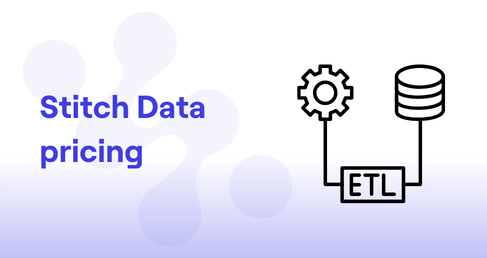
Stitch Data's $100/month starting price covers its core function: replicating data from supported sources into a destination such as a cloud data warehouse. Ecommerce teams evaluating Stitch should also account for the transformation, analytics, metric-governance, and reverse ETL capabilities they may need outside the platform.
When teams calculate the same metric using different sources, attribution rules, or business definitions, reporting can become inconsistent across functions.
A certified data foundation can address this by connecting ingestion with governed data models and analytics so that key ecommerce metrics are calculated consistently.
Understanding the True Cost of Stitch Data for Your Ecommerce Business
What Stitch Data Actually Does
Stitch Data is primarily a data integration tool that replicates data from supported SaaS applications, databases, and APIs into cloud data warehouses.
Acquired by Talend in 2018 and subsequently becoming part of Qlik, Stitch is designed around source-to-destination data movement.
Capabilities that may require separate tooling include:
- Data transformations: Teams generally perform modeling and transformation downstream rather than inside Stitch.
- Reverse ETL: Operational activation into tools such as CRM or marketing platforms requires another workflow or product.
- Analytics and dashboards: Stitch delivers data to the warehouse rather than providing a complete business-intelligence layer.
- Semantic modeling: Business definitions such as contribution margin, CAC, or LTV must be established elsewhere in the stack.
For ecommerce teams, Stitch can therefore cover the ingestion layer while transformation, BI, metric governance, and activation remain separate considerations.
The Gap Between List Price and Total Cost
The Stitch subscription is only one component of the cost of operating a complete analytics stack. Additional costs may include transformation software, reverse ETL, BI tools, warehouse usage, implementation, and engineering support.
A Stitch-based stack may include:
Actual spending depends on data volume, source count, warehouse architecture, tooling choices, and internal engineering requirements.
This is why brands comparing ecommerce analytics tools should evaluate both subscription price and the additional components required to produce usable business reporting.
Stitch Data Pricing Tiers and Features: What's Included in 2026?
Standard Plan: Entry-Level ETL
The Standard plan is positioned for teams starting with source-to-warehouse data replication.
According to Stitch's published pricing information:
- Monthly price: Starting at $100
- Billing options: Monthly or annual options are available for Standard.
- Row limits: Pricing varies with replicated row volume.
- Destinations: Intended for relatively simple warehouse configurations.
- Sources: Standard connector availability depends on the selected plan and source type.
- Users and retention: Limits vary by plan configuration.
Teams evaluating Standard should compare their required sources, historical-sync needs, user access, and expected monthly replication volume with the current limits shown on Stitch's pricing page.
Advanced Plan: Higher-Capability Requirements
The Advanced plan is designed for organizations that require capabilities beyond the entry-level tier.
Published pricing lists:
- Monthly equivalent: $1,500
- Billing: Annual commitment
- Additional capabilities: Higher data volumes, expanded source access, additional destinations, and enhanced support options depending on the current plan specification.
At $1,500 per month billed annually, the stated annual commitment is $18,000. Teams should therefore confirm source coverage, expected row consumption, warehouse requirements, and downstream tooling before selecting the plan.
Premium Plan: High-Volume Operations
The Premium plan is positioned for larger data workloads and organizations requiring Stitch's highest service tier.
Published pricing lists:
- Monthly equivalent: $3,000
- Billing: Annual commitment
- Higher-volume support: Designed for larger replication requirements and additional enterprise capabilities.
At $3,000 per month billed annually, the listed annual commitment is $36,000.
Because plan specifications can change, teams should confirm current row limits, destinations, support terms, historical-sync options, and SLA details directly with Stitch before purchase.
Exact limits and inclusions should be checked against Stitch's current pricing documentation.
Beyond Stitch: Comparing ETL Tool Alternatives for Ecommerce Data Pipelines
The ETL Pricing Landscape in 2026
Stitch is one of several approaches to cloud data integration.
- Fivetran: Provides a broad managed-connector catalog and integrates with modern cloud data stacks. Its consumption-based model should be evaluated against expected connector activity and data volume.
- Airbyte: Offers open-source and managed cloud options. It can appeal to technical teams that want greater control over connector deployment and infrastructure.
- Hevo Data: Provides managed data pipelines with real-time and transformation-related capabilities depending on the plan. Current pricing should be checked directly because plan structures may change.
- Integrate.io: Combines data integration with transformation functionality. Its pricing model differs from Stitch's replicated-row approach.
- Portable: Focuses on connector-based data integration and offers pricing organized around individual data flows.
Because connector availability, plan structures, and pricing change over time, teams should compare current vendor documentation using their actual source list and expected data volumes.
Where Stitch May Fit
Stitch may be suitable when:
- Your primary requirement is source-to-warehouse replication.
- Your required sources are supported by Stitch.
- Your team already uses separate transformation and BI tooling.
- Your replicated row volume fits comfortably within the selected plan.
Additional tooling may be required when:
- You need extensive transformation inside the integration layer.
- You want to send modeled warehouse data back to operational applications.
- Your replication volume changes substantially from month to month.
- You require ecommerce-specific sources that are not available in Stitch's current connector catalog.
Teams evaluating sources such as TikTok Shop, Loop Returns, or Recharge should compare connector depth as well as basic connector availability.
Why Ecommerce Brands Need More Than ETL
After ingestion, ecommerce data generally still requires modeling, reconciliation, and shared metric definitions before it is ready for financial or operational reporting.
Common requirements include:
- Standardizing data models: Shopify orders, marketplace transactions, advertising data, and other sources need consistent schemas.
- Calculating contribution margin: Revenue, discounts, refunds, COGS, fulfillment costs, platform fees, and marketing spend must be combined using agreed definitions.
- Building customer cohorts: Customer performance can be analyzed by acquisition channel, product, geography, and other attributes.
- Governing metrics: Finance, marketing, and operations need consistent definitions for metrics such as revenue, CAC, LTV, and contribution margin.
Stitch focuses on ingestion, so these downstream capabilities must be handled elsewhere.
The Hidden Costs of DIY Data Integration with Apache Airflow or Azure Data Factory
The Build vs. Buy Calculation
Some teams build their own data pipelines with orchestration products such as Apache Airflow or Azure Data Factory instead of relying entirely on managed ELT platforms.
The software-license comparison alone does not capture the full operating requirement.
- Engineering time: DIY pipelines require developers to build, monitor, troubleshoot, and update workflows.
- Connector maintenance: Source APIs and schemas can change, requiring connector updates and additional testing.
- Security and compliance: Custom integrations may require internal security review, access-control design, monitoring, and compliance documentation.
- Scaling: Pipeline architecture may need additional optimization as source count, data volume, processing frequency, and transformation complexity increase.
These factors should be included when comparing custom infrastructure with managed integration products.
Why Engineering Capacity Matters
For CTOs and Heads of Data, the decision is not simply whether the team is capable of building pipelines. It is also a question of how engineering resources should be allocated.
Pipeline maintenance consumes capacity that could otherwise be used for:
- Building contribution-margin models
- Creating customer and cohort analytics
- Implementing customer segmentation
- Developing business-specific data products
- Improving testing and reconciliation
A certified data foundation can reduce the amount of ingestion, transformation, and modeling infrastructure that a team must maintain independently.
Why Your Cloud Data Warehouse Needs Certified Data Beyond Raw ETL
The Accuracy Problem with Raw Data
Stitch delivers source data into destinations such as BigQuery or Snowflake. The quality of downstream reporting then depends on how that data is modeled, reconciled, and governed.
Consider a question such as: “What was our contribution margin last month?”
Answering it may require:
- Joining orders, refunds, returns, and adjustment data.
- Applying SKU-level COGS.
- Allocating fulfillment costs.
- Subtracting channel or platform fees.
- Combining advertising spend from separate marketing systems.
Each step adds business logic that should be tested and documented.
Differences in source data, attribution rules, cost allocation, or metric definitions can otherwise produce inconsistent results across reports.
What Certified Data Actually Means
A certified data foundation extends beyond raw replication.
- Governed master datasets: Modeled datasets for orders, customers, returns, advertising, inventory, and other domains can establish consistent structures.
- QA checks: Automated tests can detect missing data, schema changes, reconciliation issues, and other anomalies before they reach downstream reporting.
- Reconciliation: Comparing modeled results with source systems provides a way to verify data completeness and accuracy.
- Semantic layer: Common business metrics can be defined once and reused across dashboards, analysis, and AI interfaces.
For brands conducting contribution margin analysis, reliable results depend on reconciled source data and clearly defined revenue and cost calculations.
Saras iQ vs. Stitch Data: Unlocking Profitability with Accurate Ecommerce Analytics
Different Products for Different Problems
Stitch Data and Saras iQ operate at different layers of the analytics stack.
- Stitch Data primarily moves data from supported sources into a warehouse. Transformation, business modeling, BI, and activation are handled separately.
- Saras iQ combines ingestion through Saras Daton with governed data models, analytics, dashboards, and AI-based querying.
For ecommerce teams, the relevant comparison is therefore not only connector pricing. It is also how much of the downstream analytics workflow is included in each approach.
What Saras iQ Adds Beyond Raw ETL
Saras iQ is designed to provide additional layers above ingestion.
- Certified data foundation: Saras states that its platform supports 200+ connectors, governed datasets, and automated QA processes.
- Contribution margin models: Revenue, discounts, refunds, COGS, fulfillment costs, platform fees, and marketing spend can be combined into profitability reporting.
- Customer analytics: Customer data can be modeled for acquisition, cohort, and segmentation analysis.
- AI-powered Q&A: Users can query governed ecommerce data in natural language and investigate performance by product, channel, geography, and other dimensions.
- iQ MCP for Claude: Governed data can also be made available through supported Model Context Protocol workflows.
These capabilities address analytics and modeling requirements that sit outside Stitch's primary replication function.
Is your data actually Decision-Grade?
9 questions. 3 minutes. Score your Profitability Visibility and Readiness for AI-driven growth.
Start Free Diagnostic
The True Classic Case Study
When True Classic evaluated the cost of one of its data pipelines, the company migrated its Klaviyo integration to Saras Daton.
According to the Saras case study, the company achieved a 95% reduction in Klaviyo data integration costs for that specific migrated pipeline.
The result is useful as an example of connector-cost optimization, although it should not be interpreted as a universal percentage reduction for every data stack or workload.
Pricing Comparison: Component vs. Platform
A Stitch-based analytics environment may require separate spending for:
- Stitch
- Transformation tooling
- Reverse ETL
- BI software
- Cloud warehouse usage
- Implementation
- Ongoing engineering support
Actual TCO depends on the products selected, data volume, staffing model, and complexity of the required business logic.
Saras iQ Essentials:
- Platform license: From $1,999 per month
- Transformations: Included within the platform's analytics workflow
- Pre-built dashboards: Included
- AI analytics: Included
- Implementation support: Provided by Saras
The products are not identical, so the most useful comparison is which functions a team needs to purchase and manage separately.
For Shopify brands focused primarily on profitability, customer, and channel analytics, Saras iQ packages more of those capabilities within one platform.
From Raw Data to Business Insights: The Value of a Certified Data Foundation for Shopify Plus Brands
What Complex Ecommerce Operations May Require
As ecommerce businesses add stores, marketplaces, ERPs, fulfillment partners, and advertising channels, their reporting requirements can extend beyond basic source-to-warehouse replication.
Common needs include:
- Multi-entity reporting: Consolidating reporting across multiple Shopify stores, marketplaces, wholesale channels, or legal entities.
- Custom business logic: Applying company-specific definitions for net revenue, returns, discounts, COGS, or other financial metrics.
- ERP integration: Combining systems such as NetSuite or Acumatica with ecommerce and marketing data.
- Customer 360: Building cross-channel customer profiles and segmentation across multiple revenue sources.
The suitability of a particular data stack depends on how much of this modeling and governance the business wants to build internally.
iQ Enterprise for Complex Operations
Saras iQ Enterprise extends the platform for more complex data environments with capabilities such as:
- Advanced Customer 360: Cross-channel customer profiles
- Inventory visibility: Demand and inventory analytics as available within the product roadmap
- AIBC: AI-based functionality designed around business workflows
- Advanced integrations: Support for ERP and other enterprise data sources
- Custom semantic layer: Organization-specific business definitions
- Multi-entity support: Consolidated reporting across business units
- Consulting support: Assistance with implementation and analytics requirements
The evaluation therefore depends on whether an organization wants a dedicated replication component or a broader managed data and analytics environment.
%202.png)
Stitch Data Cost vs. Saras iQ Value: When to Consider a Broader Data Platform
Signs Your Requirements Extend Beyond Stitch
A broader analytics platform may be worth evaluating when:
- Different reports use different definitions for the same metric. Differences in attribution models, source systems, or calculation logic can lead to inconsistent CAC, revenue, LTV, or margin reporting.
- Month-end reporting requires substantial reconciliation work. Repeated manual reconciliation can indicate that definitions and data models are distributed across too many systems.
- Platform attribution and first-party revenue are difficult to reconcile. Privacy changes and differences in attribution methodology can make paid-media reporting harder to compare directly with transaction data.
- Financial metrics require stronger validation. Analytics used for financial or operational decisions benefit from documented definitions, reconciliation processes, and repeatable quality checks.
These conditions do not necessarily require replacing Stitch. They indicate that ingestion alone may not address the organization's full analytics requirements.
The Migration Path
A migration from a replication-focused stack to a broader analytics platform can be phased by use case.
- Contribution margin: Combine revenue and variable-cost data when product- or channel-level profitability is a priority.
- Customer analytics: Add cohorts, LTV, and acquisition-channel analysis.
- Sales and marketing analytics: Standardize channel grouping, paid-media reporting, and pacing.
- Enterprise requirements: Add custom sources, multi-entity reporting, ERP data, and advanced business logic.
Migration scope and timing depend on source systems, historical data, data quality, business definitions, and reporting requirements.
For Shopify brands evaluating a broader alternative to a standalone ETL tool, iQ Essentials combines data integration with governed ecommerce models, contribution-margin analytics, customer analytics, dashboards, and AI-powered querying.
Pricing starts at $1,999 per month according to Saras' published pricing information.
Book a demo to evaluate how your data sources, reporting requirements, and business logic would map to the platform.

.svg)
.webp)
%201%20(1).svg)


%20Setup%20Guide%20for%20Ecommerce%20Finance%20Team.png)









.webp)
.webp)
.webp)
.webp)
.webp)




.webp)

.webp)





.webp)



.png)
.webp)