Do You know, out of so many ETL tools available in the market, which one suits best for your business? If you are already a Snowflake customer, are you having trouble setting up and maintaining a reliable Snowflake ETL tool for data loading? This article lists down some of the popular ETL platforms which will seamlessly load data into the Snowflake data warehouse.
Introduction to Snowflake
Snowflake is a cloud-based data warehouse created by three data warehousing experts at Oracle Corporation in 2012. Snowflake Computing, the vendor behind the Snowflake Cloud Data Warehouse product, raised over $400 million over the past eight years and acquired thousands of customers. One might wonder if another data warehouse vendor is needed in an already crowded field of traditional data warehousing technologies like Oracle, Teradata, SQL Server, and cloud data warehouses like Amazon Redshift and Google Big Query. Well, the answer is the disruption caused by cloud technologies and cloud opportunities for new technology companies. Public clouds enabled start-ups to shed past baggage, learn from the past, challenge the status quo, and take a fresh look at cloud opportunities to create a new data warehouse product. Read Snowflake's pros and Cons to understand the modern, cloud-built data warehouse for consumers of cloud technologies.
You can register for a $400 free trial of Snowflake within minutes. This credit is sufficient to store a terabyte of data and run a small data warehouse environment for a few days.
What is Snowflake ETL
ETL (Extract Transform Load) is the process of data extraction from various sources, transformation into compatible formats, and loading into a destination. Snowflake ETL, similarly refers to the extraction of relevant data from data sources, transforming and then loading it into Snowflake.
Modern businesses prefer ELT tools over the traditional ETL system. With the ELT approach, necessary transformations are made after it is loaded into the data warehouse.
Why ETL your Data into Snowflake
If you are already storing your valuable data in some other database, here are some of the unique features of Snowflake:
- Decoupled architecture: Decoupled layers of storage, compute, and cloud services in Snowflake architecture allow independent scaling.
- JSON using SQL: Snowflake supports JSON data using a set of functions like a variant, parse_json.
- Fast Clone: Fast Clone is a feature that enables you to clone a table or an entire database, instantly with no additional service cost.
- Encryption: Snowflake supports various encryption mechanisms like end-to-end encryption, and client-side encryption, guaranteeing a high level of data security.
- Query optimization: Query optimization engines automatically run in the background to improve the query performances and take care of processes such as indexing or partitioning.
Related Read: Best ETL Tools
How to Evaluate Snowflake ETL Tools
Every organization needs to invest in the right ETL tool for its business operations. We have listed some major factors to be considered before choosing an ETL service:
- Ease of use: Check, whether you can use the tool effortlessly. It can be a simple drag and drop GUIs or writing SQL or Python scripts to enable complex transformations in the ETL process.
- Supports multiple data sources: The ETL service provider should support various data sources for analytics.
- Extensibility: Most ETL tools support a fixed set of data sources, but there should also be an option for custom additions of new data sources.
- Data Transformation: Check the level of data transformation supported by the ETL tool.
- Pricing: Cost is always a concern and the price depends on a range of factors and uses cases.
- Product Documentation: Detailed documentation for in-house engineers is always helpful.
- Customer support: Timely, efficient, and multi-channel customer support is very essential for troubleshooting an ETL tool.
Top 10 ETL Tools for Snowflake Data Warehouse (2026)
Selecting the best ETL tool for Snowflake isn’t just about connectors, it’s about handling schema drift, real-time syncs, and cost at scale. So, let us now review the top 10 ETL and ELT tools for Snowflake Data Warehouse (2026), including no-code Snowflake pipelines and flexible ETL vs ELT approaches.
1. Saras Daton
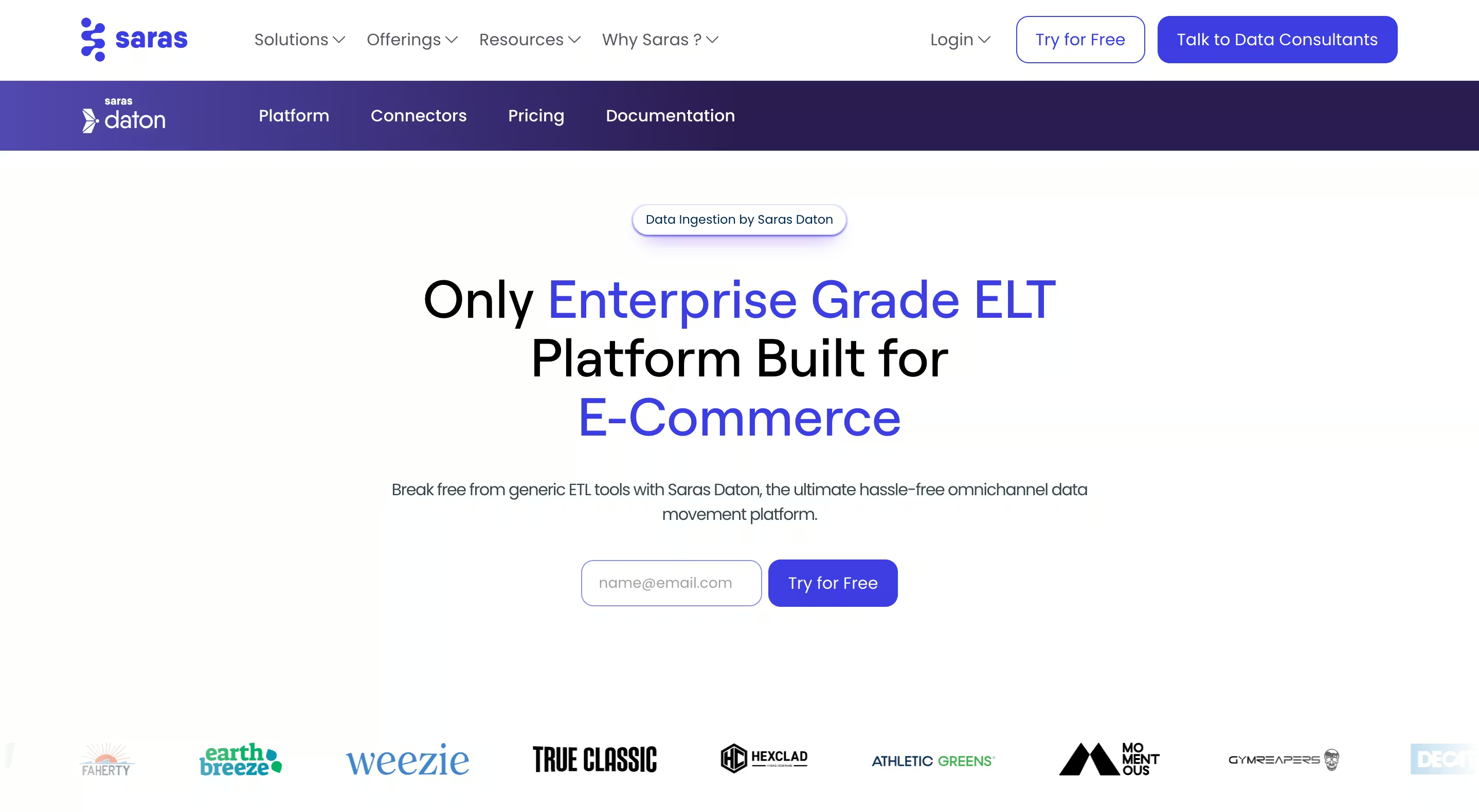
Saras Daton is a no-code ETL platform built specifically for cloud warehouses like Snowflake. Instead of wrestling with scripts or maintaining fragile pipelines, teams can connect their data sources in minutes and start syncing almost immediately. Whether you need to load Amazon S3 to Snowflake, replicate Dropbox to Snowflake, or migrate from Amazon Redshift to Snowflake, Daton handles it without the engineering burden. With pre-modeled templates, automatic schema handling, and transparent row-based pricing, costs stay predictable from day one.
Key Features:
- 150+ prebuilt SaaS, ads, and database connectors
- Near real-time syncs (as fast as 5 minutes)
- Templates for ecommerce and marketing analytics
- SOC 2 compliant with optional VPC deployment
- Dedicated success team for fast support
Pros: Snowflake-first design, fast setup, transparent pricingCons: Limited flexibility for very niche sources
Pricing: Simple, row-based pricing with no MAR surprises
2. Fivetran
Fivetran is often the first tool that comes up when people think about Snowflake ETL. It's known for its massive connector library and "set it and forget it" reliability. Enterprises choose it for automatic schema management and dependable syncs, but the tradeoff is cost — many teams find expenses climb quickly as row counts and connectors grow.
Key Features:
- 400+ prebuilt connectors across SaaS and databases
- Automatic schema evolution for Snowflake
- Incremental updates for efficiency
- SOC 2 Type II compliance and enterprise-grade security
Pros: Best-in-class connector coverage, low maintenanceCons: Expensive at scale, limited built-in transformations
Pricing: Usage-based, tied to Monthly Active Rows (MAR)
Related Read: Saras Daton vs Fivetran
3. Airbyte
Airbyte has quickly gained traction as the open-source alternative to traditional ETL vendors. It gives teams full control over their pipelines and the freedom to customize connectors for any source system. The community edition is free to run, but the tradeoff is maintenance overhead — especially if you need production-grade reliability without a managed service. Teams that want to sync GCS to Snowflake or work with less common sources will need to invest engineering time to configure and maintain those connectors reliably.
Key Features:
- 350+ open-source connectors and growing SDK for building custom connectors
- ELT-first design with dbt integration
- Both cloud and self-hosted editions available
Pros: Highly flexible, open-source, avoids vendor lock-inCons: Connector quality can vary, requires engineering support
Pricing: Free community edition; usage-based cloud pricing
4. Hevo Data
Hevo positions itself as a no-code, real-time data pipeline tool that makes Snowflake integration accessible to analysts and business users. Its intuitive interface, monitoring features, and fast syncs reduce reliance on engineering teams. Teams working with customer communication tools can use it to connect Knowlarity to Snowflake or move data from Exotel to Snowflake without writing a line of code. However, the convenience comes at a price — Hevo can get expensive as data volumes increase or refresh intervals become more frequent.
Key Features:
- 150+ connectors with near real-time syncs
- No-code transformations and prebuilt pipelines
- Monitoring with alerts, retries, and observability dashboards
- Fully managed cloud platform with 24/7 support
Pros: Easy to use, strong monitoring, good supportCons: Premium pricing, limited for highly custom workflowsPricing: Event-based pricing tiers with free trial
5. Stitch (Talend Stitch)
Stitch is a lightweight ETL service that appeals to teams who just want to get data into Snowflake quickly without fuss. Now part of Talend, Stitch keeps things simple with a clean interface and incremental loading. It's best for small to mid-sized use cases, though it lacks real-time syncs and advanced transformation features. If your stack includes support tools and you want to export Livechat to Snowflake, Stitch can handle it — though you'll be limited if you need more complex transformations downstream.
Key Features:
- 130+ supported data sources
- Incremental loading for efficiency
- Simple UI and quick onboarding
- Core replication features for basic use cases
Pros: Affordable entry-level option, fast setup, easy to learnCons: Limited transformations, lacks robust real-time syncs
Pricing: Volume-based tiers, with low-cost starting plans
6. Matillion
Matillion is a cloud-native ETL platform that stands out for its strong transformation layer. Rather than just moving raw data into Snowflake, Matillion allows teams to design complex SQL-based workflows through a visual interface. It's a good fit for organizations that want more control over data modeling, but setup and learning can take longer than simpler SaaS tools.
Key Features:
- Native integration with Snowflake and other cloud warehouses
- Visual pipeline builder with SQL transformations
- API integration support for custom sources
- Orchestration and scheduling within the platform
Pros: Strong for complex transformations, visual orchestration, enterprise-readyCons: Higher learning curve, heavier setup, more expensive at scale
Pricing: Subscription or usage-based depending on deployment
7. Talend
Talend offers a full-featured integration and governance suite, making it popular with large enterprises that need more than just ETL. Beyond data movement, Talend provides data quality, lineage, and compliance features that heavily regulated industries require. While it's very powerful, smaller teams often find it too complex and costly compared to leaner ETL tools.
Key Features:
- Wide range of connectors and integration options
- Governance, lineage, and data quality modules
- Customizable workflows with scripting support
- Enterprise security and compliance certifications
Pros: Extremely customizable, robust governance, enterprise-readyCons: Expensive licenses, steep learning curve, heavy operations overhead
Pricing: Enterprise licensing, usually requires a custom quote
8. Rivery
Rivery is a modern ELT and orchestration platform that combines ingestion with flexible workflow automation. It's designed to help teams orchestrate data pipelines without relying on separate tools like Airflow. With its "Rivers" (modular pipelines), teams can quickly pull data from APIs and sync to Snowflake, though pricing and workflow complexity can be challenging for newcomers.
Key Features:
- ELT + orchestration in one platform
- 200+ prebuilt connectors
- Custom API pipeline builder
- Dynamic workflows with triggers and schedules
Pros: Combines ingestion and orchestration, strong API support, flexible pipelinesCons: Learning curve for advanced workflows, pricing complexity
Pricing: Usage-based credits system; enterprise contracts available
9. StreamSets
StreamSets specializes in continuous data ingestion, making it a strong choice for organizations with streaming or hybrid pipelines. It can handle schema changes gracefully and offers deep monitoring to keep pipelines stable. However, StreamSets typically requires more engineering involvement than SaaS competitors, and many smaller teams find it heavier than their needs demand.
Key Features:
- Batch and streaming ingestion for Snowflake
- Adaptive pipelines that adjust to schema drift
- Real-time monitoring and error handling
- Deployable across cloud, on-prem, or hybrid
Pros: Handles streaming and batch, strong monitoring, flexible deploymentCons: Engineering-heavy setup, higher learning curve than SaaS tools
Pricing: Enterprise licensing, typically via sales engagement
10. Apache Airflow
Apache Airflow isn't a plug-and-play ETL tool but a workflow orchestrator used to manage data pipelines at scale. For Snowflake users, Airflow provides fine-grained control over dependencies, retries, and scheduling. It's extremely powerful in the right hands, but it demands engineering expertise and isn't ideal for teams looking for simple, ready-made connectors.
Key Features:
- DAG-based orchestration for complex workflows
- Extensible with Python operators and plugins
- Large community ecosystem and integrations
- Available as open-source or via managed services (Astronomer, MWAA)
Pros: Highly flexible, enterprise-proven, rich ecosystemCons: Requires engineering resources, not a turnkey ETL tool
Pricing: Free open-source; managed services available at additional cost
Conclusion
There are several Snowflake ETL tools available in the market. Modern businesses are more comfortable outsourcing their data needs to these ETL service providers, so they can dedicate more time and resources to effective analytics and business intelligence. Daton is a no-code data pipeline that takes care of all the business data for organizations using the Snowflake data warehouse.

.svg)
.webp)
%201%20(1).svg)























.jpg)




%20Statistics%20in%202026.jpg)





%20Software%20for%20DTC%20Brands%20in%202026.png)



%20Setup%20Guide%20for%20Ecommerce%20Finance%20Team.png)


















.webp)

.webp)
.webp)
.webp)
.webp)