
Hightouch pioneered reverse ETL, the practice of syncing data from your warehouse back to operational tools like ad platforms and email systems. But for Shopify brands generating $10M or more in annual revenue, reverse ETL solves only part of the problem. You still need certified data entering your warehouse, governed metric definitions that finance and marketing agree on, and analytics that translate raw tables into contribution margin (revenue minus variable costs like COGS, fulfillment, and marketing spend), customer lifetime value (LTV), and customer acquisition cost (CAC) by channel.
This guide examines nine Hightouch alternatives through the lens of ecommerce data infrastructure, helping CFOs, CMOs, and data leaders at DTC brands evaluate options that deliver trusted, deterministic answers rather than directionally correct guesses.
Saras iQ stands out as a certified data foundation purpose-built for ecommerce, combining 200+ retail-focused connectors with an AI-native analytics layer that removes the need for a separate BI stack, warehouse management, or data engineering team.
Is your data actually Decision-Grade?
9 questions. 3 minutes. Score your Profitability Visibility and Readiness for AI-driven growth.
Start Free Diagnostic
Hightouch Alternatives at a Glance
Ratings pulled from G2 in November 2026.
What Are Hightouch Alternatives and Why Do Ecommerce Brands Need Them?
Hightouch excels at reverse ETL: syncing customer segments, product catalogs, and campaign data from your warehouse to 250+ destinations like Meta Ads, Klaviyo, and Salesforce. But reverse ETL assumes your warehouse already contains clean, governed data with consistent metric definitions.
For ecommerce brands, that assumption often breaks down.
The core challenges with reverse ETL-only platforms:
- No data ingestion: Hightouch's reverse ETL workflow does not extract data from Shopify, Amazon, or ad platforms into your warehouse. You need separate ELT tools like Fivetran or Airbyte to get data into your warehouse first.
- No ecommerce-specific semantic layer: Raw data arrives as tables and columns without definitions. "Revenue" might mean gross sales to marketing and net sales after returns to finance.
- No ecommerce context by default: Generic platforms treat Shopify orders the same as Salesforce opportunities. They may need additional modeling for subscription rebills, marketplace fee structures, and 3PL fulfillment costs.
- Multiple vendors to manage: A complete stack may require Fivetran (ingestion), dbt (transformation), Hightouch (activation), and Tableau or Looker (visualization), each with separate contracts, pricing models, and support relationships.
A quick definition: a semantic layer sits between raw warehouse data and business users, encoding metric definitions, relationships, and business logic so "contribution margin" means the same thing to everyone who queries it. MCP (Model Context Protocol) is an open standard that allows AI assistants like Claude to securely access data sources through governed connections.
Match the alternative to your switching trigger:
- Finance, marketing, and ops present three different numbers for the same metric: Saras iQ (certified data foundation with governed definitions)
- Platform ROAS does not match actual revenue post-iOS: Triple Whale or Northbeam (attribution focus)
- Need warehouse plus analytics without data engineers: Polar Analytics or Daasity
- Building a custom data stack with ERP and SaaS coverage: Fivetran + Tableau
- Want event streaming and developer control: RudderStack
- Need customer identity resolution and CDP capabilities: Twilio Segment
- Already have a warehouse and want activation only: Census or Hightouch
For Shopify brands at $10M to $500M in annual revenue, the right choice affects not just technical operations but daily profitability visibility and board-ready reporting. Reverse ETL gets data out of your warehouse. A certified data foundation ensures the data entering your warehouse and the metrics built on it are trusted from the start.
1. Saras iQ: The Certified Data Foundation for Profitable Ecommerce Growth
Saras iQ is an AI Data Team for ecommerce brands, combining data ingestion through Saras Daton, certified analytics, and AI-powered question answering in a single platform. Rather than stitching together multiple vendors for ingestion, transformation, visualization, and activation, Saras iQ delivers trusted answers from one governed system.
How Saras iQ Delivers Trust and Accuracy
The platform addresses the core problem with generic data tools: accuracy that is right maybe eight times out of ten, with no way to know which eight. For CFOs making million-dollar decisions on contribution margin, "directionally correct" is not good enough.
Three layers ensure deterministic answers:
- Certified data foundation: 200+ ecommerce-specific connectors feed 11 governed master datasets (orders, sales, customers, returns, advertising, traffic, subscriptions, products, targets, finance, inventory) with 500+ daily QA checks and monthly reconciliation tolerance of plus or minus 1%
- Context layer: Encodes your specific metric definitions, exclusion rules, table descriptions, SQL templates, and default definitions so "revenue" means the same thing to your CFO and CMO
- Validation layer: Tests iQ against a golden set of 30 to 100 client-specific questions, refines logic to 90%+ accuracy, runs client UAT, and regression-tests every change
The result: the same question returns the same answer regardless of who asks or when.
Key Use Cases: From Daily Profitability to Customer LTV Growth
Contribution margin analytics: Daily profitability by SKU, channel, and geography with COGS, fulfillment, platform fees, fixed costs, and marketing spend mapped to your GL. Ask why margin dropped 2% and get the product, channel, and geography drivers in one answer.
Customer analytics: CustomerMaster with acquisition attributes, Recency plus Monetary segmentation, and Shopify and TikTok Shop cohorts. Track CAC versus LTV by acquisition channel to identify which campaigns acquire profitable customers versus one-time buyers.
Sales and marketing analytics: Standardized paid-media grouping across Meta, Google, TikTok, Microsoft, Snapchat, Pinterest, AppLovin, Amazon Ads, and MNTN with pacing versus targets.
AI-native operations: iQ Business Analyst answers plain-English questions, iQ Data Engineer handles routine data ops in Slack (metric explanations, freshness checks, refresh triggers), and iQ MCP connects the certified foundation to Claude so the same governed answers are available in your preferred AI client.
Pricing Structure
- iQ Essentials: From $1,999/month for Shopify brands at $10M to $50M. Includes three certified use cases, iQ Chat, iQ Data Engineer, iQ MCP for Claude, Slack integration, and dashboards. Nightly refresh. Live in about three weeks.
- iQ Enterprise: Custom pricing for brands at $50M to $500M. Adds Advanced Customer 360, AI Business Colleagues (AIBC), 200+ advanced integrations including NetSuite, custom semantic layer, multi-entity support, and dedicated consulting lead. Inventory visibility is planned.
Why Saras iQ Leads for Ecommerce
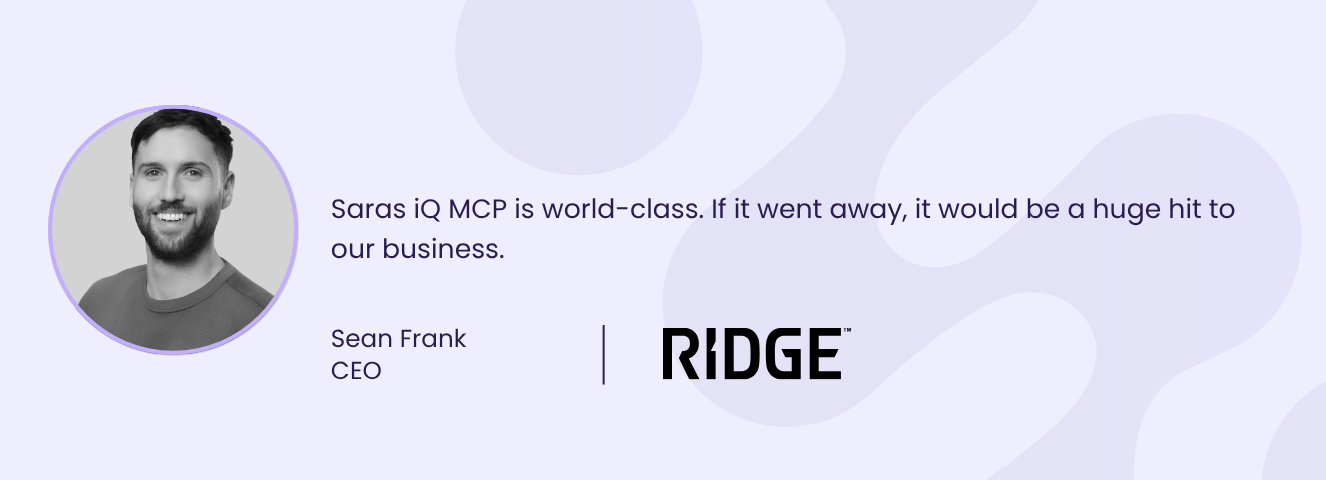
Ridge's team asked iQ 1,069 questions in 30 days across 18 users spanning CEO, marketing, product, ops, and finance, with zero analyst requests.
Unlike Hightouch's reverse ETL workflow, which requires a pre-existing warehouse and separate BI tools for analytics, Saras iQ includes the data foundation, analytics layer, and AI assistant. Unlike generic analytics platforms, every metric is certified against your source systems and governed by definitions your finance team trusts.
G2 reviewers rate Saras Daton 4.7/5 across 37 reviews, consistently praising ease of use, responsive support, and depth of ecommerce connectors.
This rating is for Daton, not Saras iQ.
2. Triple Whale + Moby
Triple Whale built its reputation on solving post-iOS attribution challenges for Shopify brands. The platform's Triple Pixel provides first-party tracking, while Moby AI answers marketing questions in natural language.
Primary Focus
- Multi-touch attribution: Track customer journeys across paid social, email, and organic channels with first-party data
- Creative analytics: Measure performance at the ad creative level to identify winning content
- Moby AI: Conversational AI assistant for marketing insights and reporting
- Shopify-first design: Deep native integration with Shopify storefronts
- Quick setup: Days to value for basic attribution reporting
Ecommerce Considerations
Triple Whale excels at marketing attribution but takes a different approach to data accuracy than Saras iQ. Some users report discrepancies between Triple Whale numbers and Shopify records. For marketing teams optimizing campaigns daily, these variances may be acceptable. For CFOs presenting contribution margin to the board, they create reconciliation challenges.
The platform's core attribution features focus primarily on DTC channels, while its Enterprise offering also supports retail and wholesale data. Brands selling through Amazon, wholesale, or retail alongside Shopify should evaluate the reporting scope of each plan. Paid plan pricing also requires consultation with sales.
Organizational Fit
Triple Whale fits marketing-led Shopify brands where attribution clarity is the primary need. For brands where the CFO, CMO, and COO all need to work from the same numbers, Saras iQ's certified data foundation provides defined reconciliation controls.
For a detailed comparison, see Saras iQ vs Triple Whale.
3. Polar Analytics + Polar MCP
Polar Analytics positions itself as an all-in-one analytics platform that provides a dedicated Snowflake warehouse alongside pre-built dashboards and reporting. The platform now offers Polar MCP for AI-assisted analysis.
Primary Focus
- Included warehouse: Dedicated Snowflake environment eliminates infrastructure management
- Pre-built dashboards: Quick access to acquisition, retention, and LTV metrics
- 40+ connectors: Coverage of major ecommerce and advertising platforms
- AI analytics: Natural language querying through Polar MCP integration
- Custom metrics: Build additional KPIs beyond standard templates
Ecommerce Considerations
Polar Analytics offers a compelling entry point for brands wanting warehouse capabilities without data engineering overhead. The included Snowflake environment removes infrastructure decisions that slow implementation.
However, the platform's approach to data accuracy differs from Saras iQ's certified model. Polar provides an ecommerce semantic layer and governed metrics but does not publish the same reconciliation tolerances or daily QA check counts as Saras iQ. Brands requiring documented reconciliation controls should evaluate these differences.
Polar supports Shopify and Amazon integrations. Brands with significant marketplace revenue should verify coverage of the specific data and reporting workflows they require.
Organizational Fit
Polar Analytics serves fast-growing DTC brands that want analytics and warehouse capabilities without maintaining a separate data engineering team. The included warehouse removes technical barriers, making it accessible to teams without data engineering resources. For brands where marketing leads analytics decisions, Polar offers a platform with reporting, attribution, and AI-assisted analysis.
For a detailed comparison, see Polar Analytics alternatives.
4. Daasity
Daasity focuses on omnichannel complexity, serving brands that sell through Shopify, Amazon, wholesale, and retail simultaneously. The platform emphasizes operational depth across inventory, finance, and fulfillment alongside marketing analytics.
Primary Focus
- Omnichannel unification: Connect Shopify, Amazon, wholesale EDI, and retail POS in one view
- Operational analytics: Deep inventory, finance, and fulfillment reporting beyond marketing metrics
- Custom integrations: Support for ERP systems and bespoke data sources
- AI Analyst: Natural language querying with MCP integration
- Managed data foundation: Handles data infrastructure so brands focus on insights
Ecommerce Considerations
Daasity's strength is operational breadth. Brands with complex distribution, significant wholesale revenue, or inventory challenges across multiple warehouses find value in the platform's depth. The AI Analyst and MCP integration add modern querying capabilities.
Starting at $1,499/month for Starter Essentials (and $1,999/month for Essentials), Daasity positions at a similar price point to Saras iQ but emphasizes different use cases. Where Saras iQ leads with certified contribution margin and deterministic AI answers, Daasity emphasizes omnichannel operational coverage.
The learning curve is noted as steeper than simpler analytics tools. The platform's depth requires dedicated owner investment to maximize value.
Organizational Fit
Daasity fits brands where wholesale and retail represent meaningful revenue alongside DTC. If your operations team needs inventory visibility across distribution channels as much as your marketing team needs attribution, Daasity's breadth makes sense. For pure Shopify DTC brands, the operational depth may exceed actual requirements.
For a detailed comparison, see Daasity alternatives.
5. Glew
Glew provides commerce analytics focused on customer lifetime value, product performance, and inventory insights. The platform positions as an accessible entry point for brands building their analytics capabilities.
Primary Focus
- Customer analytics: LTV, segmentation, and cohort analysis for understanding buyer behavior
- Product insights: Performance tracking across SKUs and categories
- Inventory visibility: Stock levels and sell-through metrics
- Reporting dashboards: Pre-built views for common ecommerce KPIs
Ecommerce Considerations
Glew offers a broader feature set than attribution-focused tools, covering inventory and product analytics alongside customer metrics. The platform serves brands earlier in their data maturity journey who need foundational analytics before enterprise capabilities.
Glew Pro starts at $250/month with annual prepayment, while Glew Plus uses custom pricing.
Organizational Fit
Glew fits emerging brands that need analytics beyond Shopify native dashboards but are not yet ready for enterprise platforms. For Shopify brands at $10M+ where finance needs certified contribution margin and marketing needs governed CAC definitions, Saras iQ's certified approach offers documented accuracy and validation controls.
For a detailed comparison, see Glew alternatives.
6. Fivetran + Tableau
The combination of Fivetran for data ingestion and Tableau for visualization represents the traditional enterprise approach to data infrastructure. This stack offers maximum flexibility at the cost of complexity.
Primary Focus
Fivetran capabilities:
- 700+ connectors: Broad coverage including SAP, Oracle, NetSuite, and enterprise ERPs
- Automated schema handling: Adapts to source changes without manual intervention
- Set-and-forget reliability: Minimal maintenance once configured
- dbt integration: Native support for transformation workflows
Tableau capabilities:
- Visual analytics: Advanced data visualization and dashboarding
- Enterprise governance: Permissions, data policies, and audit trails
- Embedded analytics: Share insights within other applications
- Tableau Pulse/AI: AI-powered insights and natural language querying
The Hidden Costs of DIY Data Infrastructure
The Fivetran + Tableau stack appears modular and flexible but introduces additional costs for ecommerce brands:
- Data engineering overhead: Someone must model raw Fivetran data into usable analytics. Pipeline maintenance and transformation workflows require ongoing engineering attention.
- Semantic layer configuration: Tableau supports governed metric definitions, but the team must configure them against transformed ecommerce data. Your finance team's "contribution margin" and marketing's "contribution margin" may calculate differently without shared definitions.
- Multiple vendor management: Separate contracts, pricing models, support relationships, and renewal cycles.
- Total cost of ownership: Costs depend on Fivetran data usage, Tableau license types, warehouse infrastructure, and the engineering resources needed to build and maintain the stack.
Fivetran uses consumption-based MAR (Monthly Active Rows) pricing. Seasonal brands may see costs rise during peak periods as the number of changed rows increases.
Why a Certified Data Foundation Can Simplify Custom Builds
For ecommerce brands, the build-versus-buy calculation may favor platforms purpose-built for retail data. Saras iQ includes ingestion (Daton), transformation, analytics, and AI in one platform with published starting pricing and certified metrics that reconcile to source systems.
The Ridge case study of Saras demonstrates the value of governed AI analytics: Ridge's team asked iQ 1,069 questions in 30 days across 18 users, with zero analyst requests.
For brands with existing Tableau deployments, Saras iQ's certified datasets can also be used with existing BI tools rather than replacing them entirely.
7. Twilio Segment
Twilio Segment positions as a customer data platform (CDP) focused on identity resolution and audience activation. The platform unifies customer data across touchpoints and syncs segments to marketing tools.
Primary Focus
- Identity resolution: Merge customer profiles across devices, channels, and sessions
- Event streaming: Real-time data collection from websites, apps, and servers
- Audience segmentation: Build and sync audiences to marketing destinations
- Customer profiles: Unified view of customer behavior and attributes
- 400+ integrations: Broad destination coverage for activation
Ecommerce Considerations
Segment solves a different problem than Hightouch or Saras iQ. Where Hightouch focuses on reverse ETL from warehouses and Saras iQ focuses on certified ecommerce analytics, Segment focuses on real-time identity and activation.
For ecommerce brands, Segment adds value when customer identity across channels is fragmented. If the same customer appears as three different profiles in Shopify, Klaviyo, and your mobile app, Segment helps resolve that fragmentation.
However, Segment does not offer the same out-of-the-box ecommerce contribution margin and financial reporting workflows as Saras iQ. Brands may still need separate tools for profitability visibility.
Organizational Fit
Segment fits brands with significant identity fragmentation across web, mobile, and retail channels where real-time activation matters more than historical analytics. For Shopify brands where identity is reasonably unified through native tracking and the priority is certified profitability metrics, Saras iQ addresses a different need.
8. Census
Census, now part of Fivetran Activations, focuses on reverse ETL, syncing data from your warehouse to operational destinations. The platform competes directly with Hightouch in the reverse ETL category.
Primary Focus
- Reverse ETL: Sync warehouse data to operational destinations
- No-code audience builder: Create segments without SQL for marketing teams
- Incremental syncing: Efficient sync of changed records only
- dbt integration: Support for transformation workflows
- Fivetran ecosystem: Part of broader Fivetran data platform
Ecommerce Considerations
Census positions as a reverse ETL alternative to Hightouch for teams with warehouse-native activation needs. The Fivetran acquisition creates potential for one-vendor simplicity if you already use Fivetran for ingestion.
Like Hightouch's reverse ETL workflow, Census works with existing warehouse data. Its activation capabilities complement data transformation and governance, while ecommerce-specific financial analytics may require additional modeling and reporting tools.
For use cases requiring precise sync scheduling, teams should evaluate the available controls.
Organizational Fit
Census fits data teams that already have warehouse infrastructure with modeled data and need efficient activation. For brands evaluating their first data platform investment, Census addresses the activation layer, while ingestion, transformation, and analytics requirements must also be considered.
9. RudderStack
RudderStack provides event streaming and reverse ETL, giving engineering teams control over their customer data infrastructure. The platform appeals to developers who prioritize flexibility and warehouse-first data workflows.
Primary Focus
- Event streaming: Collect and route customer events in real-time
- Reverse ETL: Sync warehouse data to operational tools
- Developer-focused foundation: Flexible event collection and routing
- Warehouse-first architecture: Use your warehouse as the system of record
- Transformations: JavaScript transformations for data shaping
Ecommerce Considerations
RudderStack's free cloud plan offers an entry point for teams building customer data infrastructure. Paid plans add higher event volumes and operational capabilities.
However, the platform requires engineering involvement for complex implementations. Setting up, monitoring, and maintaining custom data flows consumes resources that might otherwise focus on revenue-generating work. For ecommerce brands without dedicated data engineers, that operational burden should be considered.
The platform's primary focus is customer data collection, governance, and activation rather than out-of-the-box ecommerce contribution margin reporting. Teams may still need separate tools for financial reporting and specialized cohort analysis.
Organizational Fit
RudderStack fits engineering-led organizations that prioritize control over convenience and have dedicated infrastructure teams. For Shopify brands where the CEO, CFO, and CMO need daily profitability visibility, RudderStack addresses customer data infrastructure without replacing a dedicated ecommerce analytics solution.
Why Your Claude + BigQuery Setup Might Be Getting Ecommerce Data Wrong
Some brands may attempt to bypass dedicated analytics platforms by connecting Claude directly to their BigQuery or Snowflake warehouse through MCP. The appeal is obvious: skip the monthly SaaS fee and ask an AI assistant questions about your data.
The problem: without governed metric definitions and validation, AI on raw warehouse data can return inconsistent or incorrect answers.
What Goes Wrong with DIY AI Analytics
Saras tested identical questions against Claude on raw BigQuery data versus iQ MCP on certified data. The results:
- Claude on raw BigQuery fused four ad channels into "Shopify," misattributing marketing spend
- Subscription rebills returned 0 (iQ returned approximately 123,000)
- CAC ranged wildly from $27 to $19,415 (iQ: $100 to $107 consistently)
- Marketing spend missed approximately $145K per month
- Claude fabricated retention benchmarks, competitor CAC, and a "$2.1B market size" that did not exist
The LLM was not broken. It simply lacked context about what the tables meant, how metrics should be calculated, and when to admit it did not have external data.
Why Context and Validation Matter
Saras iQ's context layer encodes your business logic: how you define revenue (gross versus net of returns), which transactions to exclude, how to attribute marketing spend to channels. The validation layer tests answers against a golden set of questions before the system goes live.
The result is deterministic answers: ask the same question today and tomorrow, from Claude or Slack or iQ Chat, and get the same answer from the same certified data. That consistency is what makes AI useful for decisions rather than just exploration.
For a deeper comparison, see Saras iQ vs Claude + BigQuery MCP.
When to Choose Saras iQ Over Other Hightouch Alternatives
Choosing a Hightouch alternative depends on whether the primary requirement is reverse ETL, customer activation, data infrastructure, or certified ecommerce analytics. Each category solves a different part of the data workflow.
For Shopify brands generating $10M to $500M annually, the evaluation should focus on:
- Data ingestion and governance: Whether the platform connects ecommerce sources and standardizes financial and operational metrics.
- Contribution margin accuracy: Whether revenue, COGS, fulfillment, and marketing costs reconcile to source systems.
- Analytics and AI: Whether business teams can answer questions without maintaining SQL workflows or relying on unvalidated AI responses.
- Implementation and ownership: Whether the solution requires a warehouse, data engineers, additional BI licenses, or multiple vendor contracts.
Saras iQ brings ingestion through Daton, 11 governed master datasets, 500+ daily QA checks, and an AI analyst into one platform. Its Essentials plan starts at $1,999/month for Shopify brands generating $10M to $50M, while Enterprise supports more complex business requirements.
Qualified Shopify brands can request a 30-day trial to evaluate their own sales, contribution margin CM1, and customer analytics with assisted onboarding before making an upfront implementation-fee commitment.