When finance, marketing, and operations use different definitions of contribution margin, channel profitability becomes difficult to assess. Inconsistent metrics can delay decisions about where to invest
In fact, 68% of ecommerce CMOs report they don't trust their marketing attribution data. The question isn't whether you need better analytics. It's whether you need a consultant to fix your data foundation, dedicated ecommerce analytics software to operationalize insights, or both. For Shopify brands doing $10M or more annually, the consulting versus software decision determines whether you invest in a custom implementation or a productized analytics solution.
This guide breaks down when each approach makes sense, what each actually costs, and how to choose the path that delivers daily profitability visibility rather than another dashboard your team ignores.
Is your data actually Decision-Grade?
9 questions. 3 minutes. Score your Profitability Visibility and Readiness for AI-driven growth.
Start Free Diagnostic
The Real Choice: Consulting vs Software for Ecommerce Analytics
The consulting versus software debate misses the point. Both solve different problems at different stages of data maturity. Consulting fixes broken foundations. Software operationalizes working ones. Choosing based on budget alone rather than diagnosing what's actually broken can lead to the wrong investment.
What Consulting Actually Delivers
A quality ecommerce analytics consulting engagement produces six core deliverables:
- Measurement audit covering GA4, Google Tag Manager, ecommerce events, ad pixels, and consent behavior
- KPI definition sheet with agreed calculations for revenue, CAC (customer acquisition cost), ROAS, and conversion rate
- Data model or reporting layer connecting store, marketing, and customer data
- Dashboard build for specific teams with role-appropriate views
- Insight process defining review cadence and action triggers
- Handover documentation covering sources, limitations, and maintenance procedures
The handover matters most. Consulting engagements that don't include documentation leave you dependent on external help indefinitely.
What Software Actually Delivers
Dedicated analytics platforms automate what consulting sets up manually:
- Automated data ingestion from connected sources without custom ETL work
- Pre-built data models with standardized definitions for common ecommerce metrics
- Daily refresh cycles keeping dashboards current without manual pulls
- Self-serve analysis enabling marketing, finance, and ops to answer their own questions
- Governed definitions ensuring everyone queries the same calculation
The difference between consulting and software isn't capability. It's sustainability. Consulting produces a point-in-time fix. Software produces ongoing operational capacity.
When Ecommerce Analytics Consulting Makes Sense
Consulting solves problems software assumes you've already fixed. If your data infrastructure has fundamental gaps, throwing a dashboard on top just visualizes garbage.
Signs You Need a Consultant First
Choose consulting when:
- Decisions are delayed because teams don't trust the numbers
- GA4 migration happened recently without full event verification
- Checkout tracking changed and conversion data looks inconsistent
- You're expanding channels (Amazon, TikTok Shop, wholesale) without defined attribution rules
- Finance and marketing use different revenue definitions
The consulting decision tree is straightforward: if your current analytics produce numbers that make people argue about methodology rather than strategy, you have a foundation problem. Software won't fix that.
What Quality Consulting Looks Like
The useful work in ecommerce analytics consulting is rarely just a nicer dashboard. It's usually a mix of tracking repair, GA4 ecommerce setup, KPI definition, channel reporting, customer analysis, and clear handover so your team can maintain the system afterward.
A good consultant starts with a business question and scopes the data, integrations, validation, ownership, and decision workflow required to answer it. Business-first approaches beat technology-first implementations because they focus resources on decisions that actually matter.
Consulting costs and timelines vary by scope, from smaller measurement audits lasting a few weeks to comprehensive implementations requiring several months. Request an itemized proposal covering deliverables, implementation, and ongoing support.
Why Your $10M+ Shopify Brand Needs Dedicated Analytics Software
At $10M in annual revenue, Shopify's native analytics may no longer cover your reporting needs. As your business grows, spreadsheets can become harder to maintain. The question is what comes next.
The Limits of Native Dashboards
Shopify Analytics works for store-level visibility. Additional tools may be needed when you require:
- Cross-channel attribution connecting Shopify orders to Meta, Google, TikTok, and email touchpoints
- Customer lifetime value (LTV) analysis showing how acquisition channel affects long-term profitability
- Contribution margin calculations incorporating COGS, fulfillment costs, and marketing spend
- Cohort analysis comparing customer behavior across acquisition periods
GA4 adds traffic insights but creates its own problems. A GA4 migration without full event verification can create data gaps that remain undiscovered until an audit.
What Dedicated Software Enables
Modern ecommerce analytics platforms solve the integration problem by:
- Unifying data sources from store platforms, ad accounts, email tools, and subscription systems
- Standardizing metric definitions so revenue means the same thing to every team
- Automating data quality checks that catch issues before they corrupt reports
- Enabling self-serve analysis without requiring SQL knowledge
For brands between $10M and $50M, the choice isn't whether you need dedicated software. It's whether you build it yourself (expensive, slow) or buy it productized (faster, more sustainable).
Navigating the Data Landscape: Google Analytics, Shopify, and Beyond
The fragmentation problem becomes clear when your CFO asks a question like "What's our true CAC by channel?" and different teams produce different answers.
Why Platform Metrics Don't Match
GA4 shows one number. Shopify shows another. Meta claims credit for conversions Google also claims. This happens because:
- Attribution windows differ across platforms and campaign settings
- Conversion definitions vary (GA4 tracks events, Shopify reports orders, Meta counts attributed events)
- Data collection methods conflict due to tracking restrictions, consent settings, and browser limitations
The result: advertising platforms can over-report conversions by 25-40% due to overlapping attribution windows and multiple platforms claiming the same sale.
Building a Single Source of Truth
Unifying Shopify and Google Analytics data requires a data foundation approach that:
- Ingests raw data from all sources into a single warehouse
- Applies consistent definitions for metrics like revenue, CAC, and LTV
- Validates against finance actuals to catch platform over-reporting
- Documents methodology so every user understands what they're querying
Without this foundation, you're just aggregating inconsistent numbers into a prettier inconsistent dashboard.
Data Analytics Software vs. Consulting: Cost, Speed, and Expertise
The "should I hire a consultant or buy software" question usually starts with budget. That's the wrong starting point. Start with the total cost of ownership.
The Real Cost of Analytics Infrastructure
A $500/month analytics platform can become $5,000+ per month when you account for additional infrastructure and staffing costs. For a mid-market ecommerce business with $5M to $50M in annual revenue, Improvado estimates the following costs:
Total monthly TCO for a mid-market analytics stack ranges from $7,400 to $21,500 in Improvado's estimates. Engineering time often exceeds tool licensing costs.
When "Free" Isn't Free
A "free" open-source analytics stack can cost $5,000+ monthly in staff time. The savings evaporate when your data engineer spends significant time maintaining pipelines instead of delivering insights.
The hidden costs that destroy ROI:
- Integration maintenance as APIs change and break connections
- Data quality monitoring requiring manual review of discrepancies
- Dashboard updates as business logic evolves
- Onboarding new team members to undocumented systems
For brands without dedicated data teams, productized platforms with built-in support often cost less than DIY approaches that look cheaper on paper.
Marketing Dashboards and Attribution Clarity in 2027
Your CMO's CAC calculation may differ from your CFO's because each uses different definitions and cost inputs. Neither figure is useful for company-wide decisions without an agreed methodology.
Beyond ROAS: Measuring True Profitability
ROAS (return on ad spend) looks great until you realize it ignores:
- Product costs varying by SKU
- Fulfillment expenses that scale with order volume
- Return rates that differ dramatically by channel
- Customer quality affecting repeat purchase likelihood
The shift from activity metrics (clicks, sessions, reported ROAS) to business outcomes (contribution margin, true CAC, verified LTV) defines revenue intelligence. Brands using this approach see 28-35% higher marketing efficiency compared to those using traditional analytics.
The Attribution Reality Check
One mid-market fashion brand discovered Instagram (their highest ROAS channel) delivered customers with 60% lower repeat rates and 40% higher return rates versus Google Shopping. Platform-reported ROAS looked great. Actual contribution margin didn't.
This pattern repeats across brands: 51% of brands discovered at least one "profitable" marketing channel was actually losing money when measured against true contribution margin.
Building dashboards that drive actionable marketing decisions requires connecting ad spend to actual profitability, not just platform-reported conversions.
Building a Robust Data Foundation: Why DIY AI Falls Short
The promise of AI-powered analytics has brands connecting Claude or ChatGPT directly to their BigQuery warehouse. The reality is messier.
The Problem with Generic AI on Raw Data
Generic AI tools analyzing raw warehouse data can produce inconsistent or incorrect answers because they lack business context. A Saras Analytics comparison demonstrates how governed business definitions affect answer accuracy.
Testing identical questions on Claude connected directly to BigQuery versus a governed analytics layer showed the raw approach:
- Fused four ad channels into "Shopify" incorrectly
- Returned zero subscription rebills when the actual count was approximately 123,000
- Produced CAC ranging from $27 to $19,415 for the same data (governed answer: $100 to $107)
- Omitted roughly $145K per month of marketing spend
- Fabricated retention benchmarks, competitor CAC, and a "$2.1B market size" that didn't exist
What Trusted Analytics Requires
Deterministic answers (the same answer regardless of who asks or when) require three layers:
- Certified data foundation with daily QA checks, historical validation, and reconciliation against finance actuals
- Context layer encoding business logic, metric definitions, and rules for ambiguous questions
- Validation layer testing against known-good answers before deployment
In Saras iQ, the LLM does not access the warehouse directly. SQL gets generated first and runs read-only, with no client data used to train any model. This architecture reduces the risk of fabricated answers by engineering accuracy through governed business context and validation.
Achieving Daily Profitability and Contribution Margin Accuracy
The demand for contribution margin analytics grew as ecommerce brands placed greater emphasis on profitability. Now CFOs want daily visibility, not monthly reconciliation.
Why Daily Margin Matters
Your gross margins might be climbing. But if advertising and fulfillment costs are erasing those gains, you're flying blind until month-end close reveals the damage. Daily contribution margin visibility lets you:
- Catch margin erosion before it compounds across weeks
- Reallocate spend from unprofitable channels based on updated profitability data
- Defend numbers to the board with confidence rather than caveats
- Align finance and marketing on one calculation
For a $100M brand, identifying and reallocating $500K to $1M in annual spending over the first 90 days can be a meaningful optimization opportunity, depending on the brand's margins and existing spending patterns.
The Single Definition Problem
Contribution margin (CM) sounds simple: revenue minus variable costs. But which variable costs? Calculated when? At what level of granularity?
A proper CM calculation includes:
- Order-line sales (gross minus discounts minus refunds plus shipping)
- SKU-level COGS applied to each line item
- Fulfillment costs by order, not averaged across the business
- Platform fees from Shopify, Amazon, or other channels
- Marketing spend allocated by attribution logic you've defined
When these components come from different systems with different update cadences, reconciliation breaks. The solution is defining CM once in a governed layer and enforcing that definition across every query.
Case Study: From Three Days to Two Hours
Instant Hydration used Saras iQ's semantic layer to cut month-end close from three days to two hours. The improvement came from eliminating reconciliation work: finance and marketing finally queried the same definitions from the same source.
The Role of an Ecommerce Consultant: Guiding Digital Growth
Even with excellent software, some situations demand human expertise.
When Consultants Add Irreplaceable Value
Strategic consulting shines during:
- Technology transitions where institutional knowledge guides platform selection
- Complex integrations involving ERP systems, custom data sources, or multi-entity structures
- Organizational change requiring cross-team alignment on metrics and processes
- Vendor evaluation when internal teams lack market context
The consultant's value isn't doing work your team can't. It's doing work faster because they've done it before, avoiding mistakes your team would make through trial and error.
The Handover Test
Good consultants work themselves out of a job. Ask any prospective consultant: "What does my team own after you leave?" If the answer involves ongoing dependency, keep looking.
Documentation requirements for sustainable handover:
- Data dictionary explaining every table, column, and metric calculation
- Integration map showing data flows and dependencies
- Maintenance procedures for common issues
- Escalation paths for problems beyond internal capability
Why Saras iQ Delivers Certified Analytics for Shopify Brands
While this guide outlines the consulting versus software decision framework, Saras iQ represents a different category: an AI Data Team that combines the trust of a certified data foundation with the accessibility of plain-English queries.
What Makes Saras iQ Different
Saras iQ addresses a core challenge for analytics teams: getting the same trusted answer regardless of who asks or when. The platform includes:
- iQ Business Analyst answering plain-English questions with governed calculations
- iQ Data Engineer handling routine data operations through Slack (metric explanations, freshness checks, refresh triggers)
- iQ MCP connecting the certified foundation to Claude through the Model Context Protocol (MCP), so governed answers work inside your AI environment
- Certified data foundation with 200+ connectors, 11 master datasets, and 500+ daily QA checks
The difference from connecting Claude directly to BigQuery: Saras iQ's context layer holds your business logic, definitions, and rules. The validation layer tests against known-good answers. The system is designed to avoid inventing external benchmarks or fabricating data.
Proof at Scale
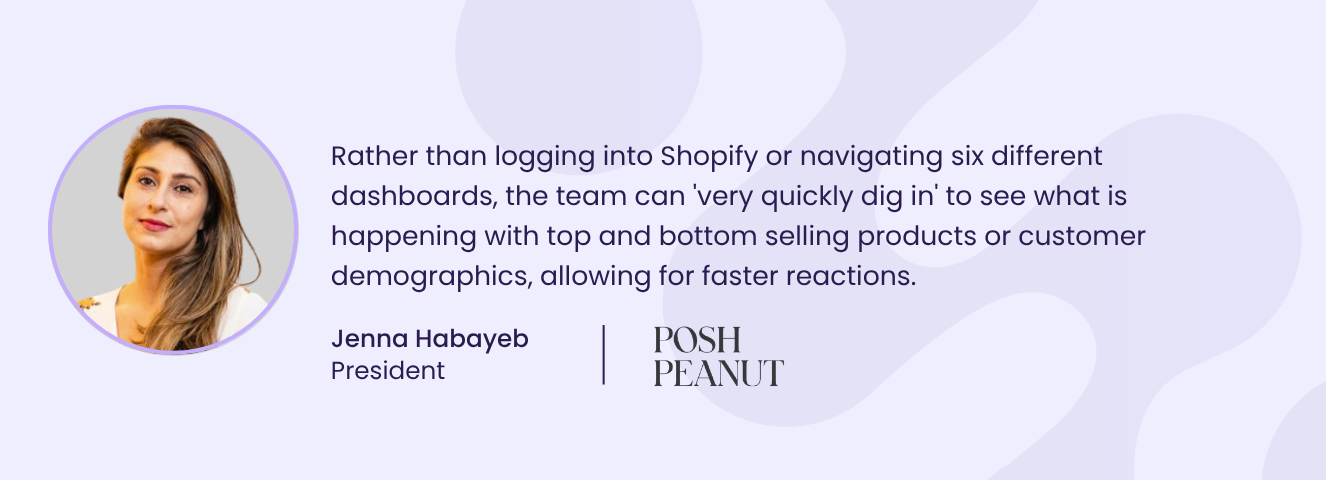
Ridge's team asked iQ 1,069 questions in 30 days across 18 users spanning the CEO, marketing, product, ops, and finance, with zero analyst requests. Ridge CEO Sean Frank has valued access to Saras iQ through Claude at over $50,000 per month for his business.
For Shopify brands doing $10M to $50M annually, iQ Essentials starts from $1,999 per month with three certified use cases: contribution margin analytics, customer analytics with cohorts, and sales and marketing analytics.
Qualified brands can request a 30-day human-assisted trial to see their own sales, contribution margin CM1, and customer analytics before committing. After required platform connections, six business inputs, and assisted onboarding are complete, trial data becomes available within five business days.
Choosing Saras iQ or Consulting for Long-Term Ecommerce Analytics
The right choice depends on whether your Shopify brand needs to repair its data foundation or make reliable analytics accessible across the business. Consulting can address broken tracking, custom integrations, and undefined metrics. Dedicated software supports ongoing reporting and analysis without rebuilding the same workflows manually.
For brands generating $10M to $50M annually, compare solutions based on:
- Data quality: Can the solution reconcile sales, marketing, and finance metrics?
- Implementation: Does the approach require custom engineering or offer standardized integrations?
- Ongoing costs: Are engineering, maintenance, and support included in the total budget?
- Usability: Can finance and marketing access governed answers without relying on SQL specialists?
Saras iQ Essentials combines certified ecommerce data with an AI Business Analyst, governed calculations, and nightly data refreshes. It is designed for Shopify brands seeking consistent contribution margin, customer, and marketing analytics without building an entire analytics stack.
Request an assisted trial to see your own numbers during a 30-day evaluation before committing to Saras iQ.