
Northbeam has earned its reputation as one of the most rigorous attribution platforms for DTC brands, with sophisticated multi-touch attribution, media mix modeling (MMM), and incrementality testing. But for Shopify brands generating $10M or more in annual revenue, knowing which channels drove sales is not the same as knowing which channels drove profitable sales.
Attribution platforms like Northbeam report revenue and ROAS (return on ad spend). They do not provide the same governed contribution margin (CM) reporting, the revenue remaining after subtracting variable costs like COGS, fulfillment, platform fees, and marketing spend. When your CFO asks whether last month's TikTok campaign actually made money, ROAS alone cannot answer that question.
Saras iQ addresses this gap by providing certified contribution margin analytics, customer intelligence, and sales and marketing performance in one governed data foundation. For Shopify brands that have outgrown basic attribution and need cross-functional profitability visibility, Saras iQ delivers the same answer regardless of who asks or when.
Is your data actually Decision-Grade?
9 questions. 3 minutes. Score your Profitability Visibility and Readiness for AI-driven growth.
Start Free Diagnostic
Northbeam Alternatives at a Glance
Ratings pulled from G2 in November 2026.
Why Attribution Alone Falls Short for Profitability
Attribution platforms solve one problem well: they tell you which marketing channels and creatives contributed to a conversion. Northbeam does this with deterministic view-through attribution and media mix modeling for evaluating channel performance.
But attribution has a blind spot. Revenue attribution alone does not establish profitability. Consider two campaigns:
- Campaign A shows higher ROAS and better attributed revenue
- Campaign B shows lower ROAS but sells higher-margin products with lower return rates
Which should you scale? Attribution metrics alone cannot answer this without contribution margin data. The result is that brands may optimize for revenue while margin leaks go undetected.
The core challenges with attribution-first analytics include:
- Revenue without profit context: Knowing a channel drove $100K in sales means little if fulfillment, returns, and COGS consumed $95K of it.
- Marketing metrics isolated from finance: CMOs report platform ROAS while CFOs calculate a different CAC (customer acquisition cost, the total cost to acquire one customer). The numbers may not reconcile.
- No governed definitions: "Revenue" means something different to marketing than to finance. Without a semantic layer encoding business logic, teams may calculate metrics differently.
- Limited cross-functional visibility: Attribution platforms primarily serve performance marketers. Finance and operations teams may need additional reporting for profitability and inventory decisions.
Match the alternative to your switching trigger:
- Need certified contribution margin with finance-grade accuracy: Saras iQ
- Need attribution depth with MMM and incrementality: Stay with Northbeam or consider Measured
- Need fast, affordable Shopify attribution: Triple Whale
- Need profit attribution without cross-functional requirements: Admetrics
- Need warehouse access with SQL flexibility: Polar Analytics
- Need cross-channel measurement and attribution: SegmentStream
For Shopify brands at $10M to $500M in annual revenue, the right choice depends on whether your primary pain is attribution precision or profitability visibility. Northbeam is built for attribution. If your CFO and board are asking about margin, not just channel performance, keep reading.
1. Saras iQ: Certified Contribution Margin for Shopify Brands
Saras iQ is not an attribution platform. It is an AI Data Team for ecommerce that delivers certified contribution margin, customer analytics, and sales and marketing performance from a governed data foundation. The platform answers the questions attribution alone cannot: Which channels drive profitable sales? Which customer cohorts deliver the highest lifetime value (LTV, the total revenue a customer generates over their relationship with your brand)? What is our true CAC by acquisition source?
Key Capabilities
- Certified contribution margin (CM1-CM4): Standardized net sales minus relevant costs, including COGS, fulfillment, platform fees, and marketing spend, calculated according to the selected CM level with plus or minus 1% monthly reconciliation tolerance
- 500+ daily QA checks: Automated validation catches data quality issues before they reach reports, helping finance and marketing see the same numbers
- AI-powered Q&A: Ask business questions in plain English through iQ Chat, Slack, or Claude via iQ MCP and get deterministic, validated answers
- Customer analytics: CustomerMaster dataset with acquisition attributes, Recency plus Monetary segmentation, and cohort analysis for Shopify and TikTok Shop
- Cross-functional governance: Context layer encodes your specific metric definitions, so "revenue" means the same thing to every team
Ecommerce Use Cases
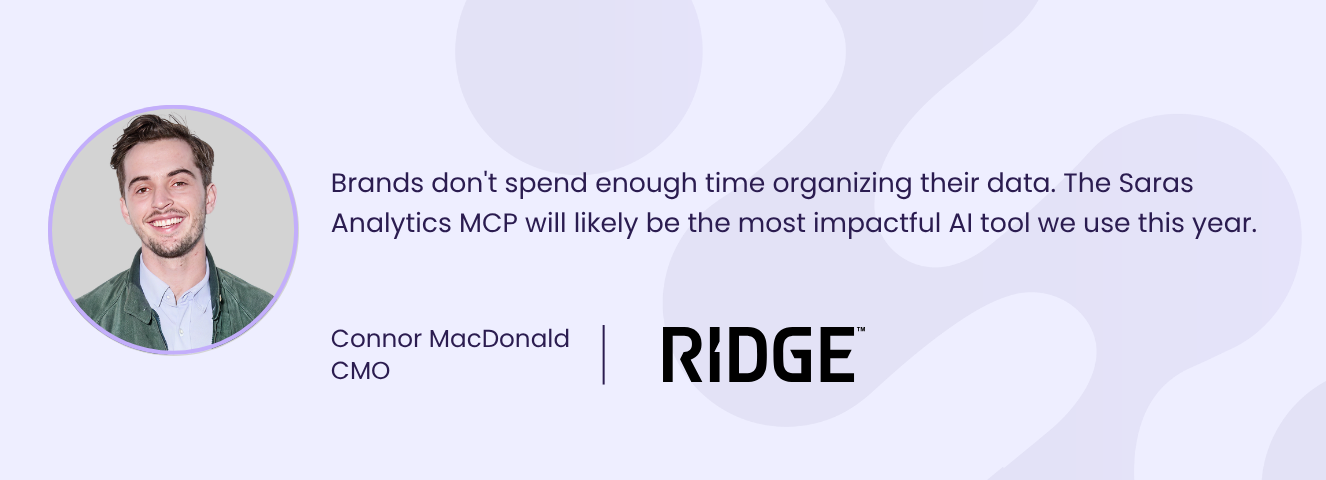
Ridge's team asked Saras iQ 1,069 questions in 30 days across 18 users spanning the CEO, marketing, product, ops, and finance, with zero analyst requests. Sean Frank, Ridge's CEO, valued using Saras iQ inside Claude at over $50,000 per month for Ridge.
For brands struggling with the "three different numbers" problem, where finance, marketing, and operations each present different metrics for the same question, Saras iQ's semantic layer defines contribution margin once and enforces it everywhere. Instant Hydration cut month-end close from 3 days to 2 hours using this approach.
Pricing Structure
- iQ Essentials: From $1,999/month for Shopify brands at 10M-50M in annual revenue, live in about three weeks
- iQ Enterprise: Custom pricing for 50M-500M brands needing multi-entity support, NetSuite integration, and advanced Customer 360
Why Saras iQ Leads for Margin-Focused Brands
Unlike Northbeam, which focuses on attributed revenue and ROAS, Saras iQ reports certified contribution margin by channel and SKU, with customer cohort analytics. The platform's validation layer tests answers against a golden set of 30 to 100 client-specific questions, refining logic to 90%+ accuracy before deployment. The LLM never touches the warehouse directly; SQL is generated first and run read-only, reducing the risk of hallucinated numbers.
2. Triple Whale
Triple Whale positions itself as an accessible analytics platform for Shopify, with a free tier and streamlined setup. The platform includes Triple Pixel for server-side tracking, multi-touch attribution, and Moby AI for conversational analytics.
Primary Focus
- Fast implementation: Shopify installation with streamlined data connections
- Server-side tracking: Triple Pixel helps recover conversions lost to browser restrictions and ad blockers
- Attribution plus profit: Combines channel attribution with profit tracking
- Moby AI: Conversational interface for ad-hoc marketing questions
- Free tier available: Entry point for small brands testing attribution
Ecommerce Considerations
Triple Whale's profit tracking depends on keeping SKU-level costs accurate and current through its cost data inputs and integrations. The platform serves performance marketers well, while finance teams needing auditable, governed contribution margin should evaluate its reporting definitions. Pricing scales with GMV and selected features, so costs can increase at higher revenue levels.
For a detailed comparison, see Triple Whale review.
Organizational Fit
Triple Whale fits small Shopify brands seeking fast, affordable attribution with basic profit visibility. Brands at $10M+ needing certified CM analytics and cross-functional governance should compare its capabilities with their specific reporting requirements.
3. Admetrics
Admetrics positions itself as a profit-first attribution platform, calculating POAS rather than ROAS by incorporating COGS, shipping, payment fees, refunds, and returns at the SKU level. The platform's server-to-server tracking helps recover conversions missed by browser-based pixels.
Primary Focus
- POAS attribution: Profit on ad spend calculated after variable costs, not just revenue
- Server-side tracking: First-party S2S helps recover conversions lost to browser restrictions
- Budget automation: Budget management features, with advanced optimization available as an add-on
- Multi-market support: Separate views for brands operating across geographies
- Unlimited users: All plans include unlimited team access
Ecommerce Considerations
Admetrics focuses on profit attribution for performance marketing teams. The platform also offers customer and cohort analysis, while teams requiring broader cross-functional BI should assess its reporting scope. Pricing is Euro-based with additional charges scaling with ad spend, which may create budgeting complexity for US brands.
Organizational Fit
Admetrics fits brands whose primary need is profit attribution without broader cross-functional requirements. Teams needing customer intelligence, finance-grade CM reporting, or AI-powered insights across the organization should evaluate whether additional tools are necessary.
4. Polar Analytics
Polar Analytics combines marketing analytics, attribution, and BI dashboards with a managed Snowflake warehouse, giving data teams access to their underlying data. The platform supports multiple ecommerce integrations and attribution models.
Primary Focus
- Snowflake warehouse: Warehouse-backed data with SQL and API access options
- Customizable dashboards: Highly flexible reporting beyond pre-built templates
- Attribution models: Multiple models including first-party attribution
- AI-assisted analysis: Conversational interface for data exploration
- Data portability: Access data for BI tools or custom analysis
Ecommerce Considerations
Polar Analytics offers pre-built reporting alongside more advanced configuration and data modeling options. Teams without SQL-proficient analysts may need additional support for complex custom analysis. The platform does not publish QA checks or reconciliation tolerances directly comparable to Saras iQ's certified accuracy.
For a detailed comparison, see Polar Analytics alternatives.
Organizational Fit
Polar Analytics fits data teams that want warehouse access and custom analysis capabilities. Brands seeking pre-built, certified contribution margin and customer analytics with minimal configuration may find Saras iQ a more suitable option.
5. SegmentStream
SegmentStream uses machine learning for attribution and marketing measurement, focusing on brands that want to understand channel performance and incrementality.
Primary Focus
- Causal attribution: ML-powered measurement that models incremental impact
- Cross-channel measurement: Attribution analysis across connected marketing channels
- Enterprise measurement: Designed for brands with complex media measurement requirements
- Predictive modeling: Data-driven models supporting marketing performance analysis
Ecommerce Considerations
SegmentStream requires appropriate campaign data and measurement configuration to deliver value from its ML models. The platform focuses on marketing measurement rather than certified cross-functional profitability analytics. Smaller brands should evaluate whether its implementation scope matches their current needs.
Organizational Fit
SegmentStream fits brands wanting cross-channel marketing measurement. Brands needing certified contribution margin, customer analytics, and finance-grade reporting may need to pair SegmentStream with additional tools.
6. ThoughtMetric
ThoughtMetric provides multi-touch attribution for small to mid-market ecommerce brands at accessible price points, focusing on channel performance visibility.
Primary Focus
- Affordable entry point: Pricing designed for smaller ecommerce brands
- Multi-touch attribution: MTA across common ad platforms
- Shopify integration: Native connection to Shopify data
- Customer surveys: Post-purchase attribution surveys
Ecommerce Considerations
ThoughtMetric serves brands seeking accessible attribution and ecommerce analytics. The platform also offers customer and product analytics, while brands needing governed contribution margin should evaluate whether its reporting meets their finance requirements.
Organizational Fit
ThoughtMetric fits small brands wanting attribution at accessible prices. Brands approaching $10M+ in revenue may need more sophisticated profitability analytics and should assess whether the platform supports their reporting complexity.
7. Measured
Measured is an AI-powered marketing effectiveness platform that combines incrementality testing, media mix modeling (MMM), and cross-channel reporting. The platform helps enterprise brands understand how marketing investments contribute to incremental revenue and optimize budgets across channels.
Primary Focus
- Incrementality testing: Controlled experiments measure the incremental impact of marketing campaigns and channels
- Media mix modeling: Test-calibrated MMM estimates channel contributions and predicts marketing ROI
- Cross-channel reporting: Unified measurement compares marketing effectiveness across channels
- Media plan optimization: Budget planning tools help marketers allocate spend based on modeled performance
- Enterprise measurement: Designed for brands managing complex marketing portfolios
Ecommerce Considerations
Measured focuses on marketing effectiveness through incrementality experiments and media mix modeling. While these capabilities help brands evaluate advertising performance, the platform is not primarily designed for certified SKU-level contribution margin reporting or customer analytics across finance and operations.
Brands requiring governed profitability data alongside marketing measurement may need an additional analytics solution.
Organizational Fit
Measured fits enterprise brands seeking incrementality testing, MMM, and cross-channel measurement. Shopify brands focused on certified contribution margin, customer analytics, and finance-grade reporting may find Saras iQ more aligned with their requirements.
Beyond Attribution: Why Governance Matters for Profitability
Moving from attribution to profitability analytics requires more than different metrics. It requires data governance that ensures everyone, from the CMO to the CFO to the board, sees the same numbers.
This is where the semantic layer becomes critical. A semantic layer sits between your raw data and your business users, encoding definitions, relationships, and business logic so that "contribution margin" means the same thing to everyone who asks.
Saras iQ provides this certified data foundation with:
- Context layer: Encodes your specific metric definitions, exclusion rules, and business logic
- Validation layer: Tests answers against a golden set of 30 to 100 client-specific questions
- 500+ daily QA checks: Catches data quality issues before they reach reports
- Monthly reconciliation tolerance: Plus or minus 1% accuracy verified against source systems
The result is deterministic answers: the same question returns the same answer regardless of who asks or when. This addresses the common scenario where finance, marketing, and ops teams present three different numbers for the same metric.
When to Choose Saras iQ Over Northbeam
For Shopify brands at $10M to $500M in annual revenue, the decision between Northbeam and Saras iQ depends on your primary pain point.
Choose Saras iQ when:
- Your CFO demands auditable contribution margin by channel and SKU, alongside customer cohort analytics
- Finance, marketing, and operations need the same governed numbers
- You want AI-powered insights that work in Claude, Slack, and iQ Chat
- You have outgrown basic profit trackers and need cross-functional analytics
Qualified Shopify DTC brands can see their own numbers with a 30-day assisted trial before committing. Data becomes available within five business days after completing required platform connections and business inputs.
Choose Saras iQ When Profitability Matters More Than Attribution Alone
The right Northbeam alternative depends on whether your team needs better marketing measurement or a governed view of ecommerce profitability. Northbeam remains relevant for brands prioritizing multi-touch attribution, MMM, and incrementality. But those capabilities do not replace consistent contribution margin reporting across finance and marketing.
For Shopify brands generating $10M or more annually, evaluate alternatives against three requirements:
- Profitability visibility: Can the platform calculate contribution margin using your actual product, fulfillment, platform, and marketing costs?
- Data accuracy: Are revenue and cost definitions consistent across departments, with documented validation and reconciliation?
- Cross-functional access: Can finance, marketing, and operations answer business questions without relying on separate spreadsheets or analysts?
Saras iQ addresses these requirements through certified ecommerce datasets, governed metric definitions, and AI-powered analysis. Its Essentials plan starts at $1,999 per month for qualifying Shopify brands.
Request your 30-day assisted trial to evaluate Saras iQ using your own sales, contribution margin, and customer data before making an implementation commitment.