
RetentionX helps ecommerce brands understand customer retention, lifetime value, and purchasing behavior through cohort analysis, segmentation, and marketing activation. The platform has earned a 5.0/5 rating on the Shopify App Store across 127 reviews.
For brands expanding beyond Shopify or requiring consistent metrics across finance, marketing, and operations, the question becomes whether RetentionX can support their broader analytics requirements.
This review examines where RetentionX excels, where it has limitations, and when Saras iQ provides a more comprehensive data foundation for growing omnichannel brands.
Is your data actually Decision-Grade?
9 questions. 3 minutes. Score your Profitability Visibility and Readiness for AI-driven growth.
Start Free Diagnostic
At-a-Glance Comparison
Ratings pulled from G2 and Shopify App Store in October 2026.
What RetentionX Does Well for Shopify Brands
RetentionX focuses on customer intelligence, cohort tracking, and the ability to act on retention insights without leaving the platform.
Customer Intelligence and Segmentation
RetentionX provides customer analytics for Shopify stores. The platform offers:
- LTV tracking across customer segments
- RFM segmentation (Recency, Frequency, Monetary) to identify valuable customers
- Cohort analysis showing how customer behavior changes over time
- Predictive churn analysis on Growth tier plans to identify at-risk customers
- Up to 100 custom segments depending on the pricing tier
For Shopify brands, these capabilities cover core retention analytics use cases. The platform's Shopify App Store reviews highlight its customer insights, reporting capabilities, and segmentation tools.
Marketing Activation Built-In
Where RetentionX differentiates from pure analytics tools is its integrated marketing activation. The platform includes:
- Email and SMS flow triggers that sync segments to supported marketing platforms
- Site merchandising automation for organizing product collections based on customer insights
- Conversion APIs for server-side event tracking to supported advertising platforms
- RX Identity resolution for connecting customer interactions across devices
This combination of analytics and execution can reduce the need to move between separate tools for customer segmentation and marketing activation.
Account Support That Users Appreciate
User reviews frequently highlight RetentionX's customer support. Account strategists receive positive mentions for responsiveness and product knowledge, with merchants appreciating their assistance during implementation and ongoing reporting.
Where RetentionX Hits Limits for Growing Brands
RetentionX offers useful customer analytics and marketing activation capabilities. However, brands with more complex reporting requirements should evaluate how its data coverage, governance, and customization options fit their needs.
Omnichannel Blind Spots
RetentionX supports Shopify and BigCommerce, but its core analytics are designed around connected ecommerce stores rather than a unified data foundation for every sales channel.
Brands operating across multiple channels should evaluate:
- Amazon customer data: Whether marketplace purchases can be incorporated into cross-channel retention reporting
- TikTok Shop orders: Whether transactions can be unified with existing customer analytics
- Wholesale and retail: Whether offline transactions can be combined with DTC customer data
If a customer buys from a Shopify store and later purchases through Amazon, store-level retention reporting may not capture the complete customer relationship. This can affect cohort analysis and cross-channel LTV calculations.
Data Governance Gaps
RetentionX provides analytics dashboards and standardized reporting, but organizations with complex business logic may require additional metric governance.
For example, teams may calculate CAC differently depending on which acquisition costs they include:
- Finance calculations may incorporate a broader set of acquisition expenses.
- Marketing calculations may focus on advertising and campaign costs.
- Executive reporting may require one agreed definition across departments.
RetentionX provides built-in analytics definitions, but brands requiring company-specific metric governance across multiple data sources should evaluate whether those definitions meet their reporting needs.
Warehouse Ownership Limitations
RetentionX operates primarily as an application-based analytics platform rather than a customer-owned data warehouse.
For brands with existing data infrastructure, important considerations include:
- SQL access: Whether teams can run custom queries against the underlying data
- Data portability: Which datasets and historical reports can be exported
- BI integrations: How RetentionX data can be incorporated into existing reporting workflows
- Customization: Whether the platform supports business logic beyond its built-in analytics
For brands with data science teams or complex reporting requirements, these factors can influence platform selection.
Setup and Learning Curve
RetentionX offers onboarding support, but configuration requirements depend on the merchant's integrations, customer data, and reporting objectives.
Brands with limited historical customer data should also evaluate whether their available transaction volume supports meaningful predictive insights.
What Growing Ecommerce Brands Actually Need from Retention Analytics
As ecommerce brands expand across channels, their analytics requirements often extend beyond retention dashboards to consistent customer, revenue, and profitability reporting.
A Single Source of Truth Across Channels
Omnichannel brands need customer analytics that bring together data from relevant sales channels. This may include:
- Shopify orders combined with Amazon sales
- TikTok Shop transactions included in channel-level reporting
- Wholesale and retail data incorporated into broader sales analysis
- Marketing spend across advertising platforms measured consistently
Without this unified view, questions about customer LTV, channel performance, and profitable acquisition become harder to answer reliably.
Governed Metrics That Finance and Marketing Trust
When finance, marketing, and operations use different definitions for the same metric, adding another dashboard does not necessarily resolve the disagreement.
Brands with complex reporting needs benefit from:
- Metric definitions established and applied consistently
- Business logic reflecting how the organization calculates contribution margin, CAC, and LTV
- Auditability showing how reported numbers were calculated
- Consistent answers based on the same underlying data and definitions
A governed semantic layer helps maintain these definitions across analytics workflows.
AI That Knows Your Business Logic
Connecting AI directly to raw warehouse data does not automatically produce reliable business answers. Without appropriate context, an AI system may misinterpret fields, apply incorrect calculations, or overlook company-specific rules.
Effective AI analytics requires:
- Business definitions included in the AI's context
- Validation against known answers before deployment
- Consistent calculations based on governed metrics
- Clear handling of missing data rather than unsupported estimates
Head-to-Head: RetentionX vs Saras iQ
For Shopify brands evaluating retention analytics options, the choice depends on current scale, channel mix, and data governance requirements.
Data Accuracy and Governance
RetentionX: Provides built-in customer analytics and reporting definitions. Teams requiring organization-specific calculations across multiple systems should assess whether the available customization supports their requirements.
Saras iQ: Delivers a certified data foundation with 500+ daily QA checks, a monthly reconciliation tolerance of plus or minus 1%, and a context layer that maintains business-specific metric definitions.
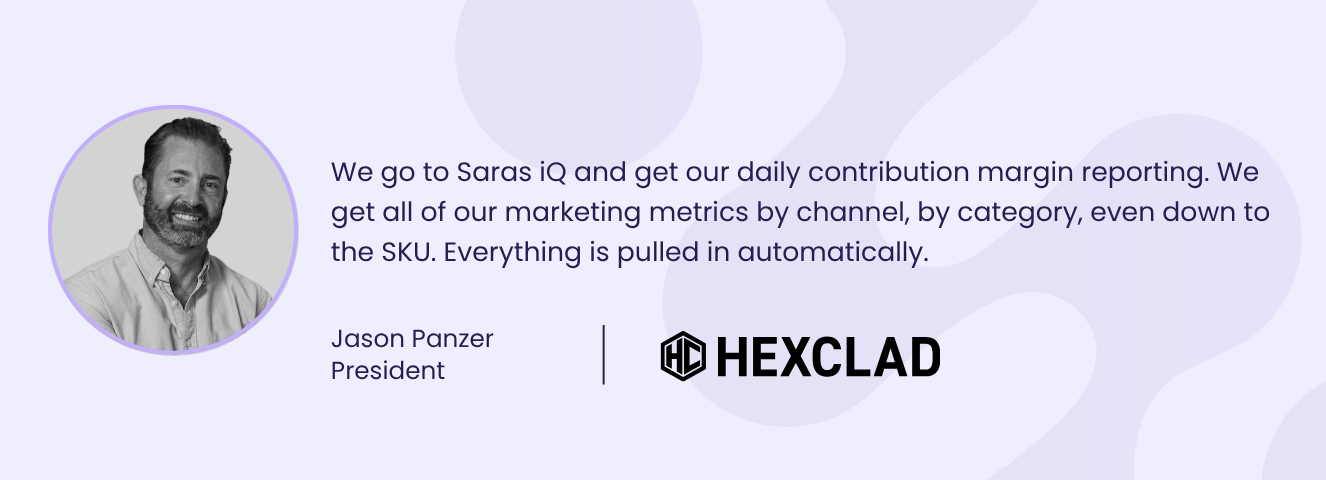
Ridge's team asked iQ 1,069 questions in 30 days across 35 team members, spanning leadership and operational functions, with zero analyst requests generated. Ridge CEO Sean Frank has described Saras iQ inside Claude as worth over $50,000 per month to the business.
Channel Coverage
RetentionX: Supports Shopify and BigCommerce. Brands requiring unified reporting across Amazon, TikTok Shop, or wholesale transactions should assess whether additional data infrastructure is necessary.
Saras iQ: Its certified data foundation uses 200+ data connectors, including Shopify, Amazon Seller Central and Vendor Central, TikTok Shop, Walmart, Klaviyo, Recharge, Meta, and Google Ads. Advanced and custom integrations depend on the selected tier.
The foundation models ecommerce data into 11 governed master datasets covering orders, sales, customers, returns, advertising, traffic, subscriptions, products, targets, finance, and inventory.
Where You Ask Questions
RetentionX: Offers an AI Analyst feature on Growth tier plans for natural-language queries within its analytics platform.
Saras iQ: Provides iQ Business Analyst for business questions, iQ in Slack for data operations questions, and iQ MCP (Model Context Protocol) for accessing governed answers inside Claude.
The LLM does not access the warehouse directly. Queries run through a controlled, read-only SQL workflow supported by the context and validation layers.
Pricing and Value
RetentionX: Offers three publicly listed plans for stores with up to $250,000 in annual sales:
- Starter: $49/month for customer analytics, reporting, and segmentation
- Core: $149/month, adding capabilities such as marketing attribution, Conversion APIs, and additional automation
- Growth: $249/month, adding predictive modeling, AI Analyst capabilities, and higher limits
Pricing increases with revenue, and brands in higher revenue bands should confirm applicable rates directly with RetentionX.
Saras iQ: Starts at $1,999/month for Essentials, designed for Shopify brands generating $10M to $50M annually. Enterprise is custom-priced for larger brands with more complex requirements.
The pricing considerations extend beyond monthly subscription costs:
- Implementation: RetentionX provides onboarding support, while Saras iQ includes a structured implementation process for its paid offerings.
- Data warehouse: RetentionX primarily operates within its application, while Saras iQ uses a customer-owned BigQuery or Snowflake warehouse.
- Integrations: RetentionX provides ecommerce and marketing integrations, while Saras iQ offers standard integrations in Essentials and broader integration options in Enterprise.
- Total cost: Brands should consider subscription fees, implementation requirements, data infrastructure, and ongoing reporting needs.
The price difference is significant. The question is whether certified, governed analytics and broader data infrastructure justify the additional investment for a particular business.
When RetentionX Is the Right Choice
RetentionX fits brands with the following requirements.
Best for:
- Shopify-focused brands primarily interested in retention and customer analytics
- Smaller ecommerce brands seeking an accessible starting price
- Teams wanting customer analytics and marketing activation in one platform
- Brands that do not require direct SQL access or ownership of a dedicated analytics warehouse
- Organizations with relatively straightforward reporting and metric governance requirements
Not ideal for:
- Omnichannel brands requiring unified Amazon, TikTok Shop, and wholesale analytics
- Organizations requiring complex, company-specific metric definitions across departments
- Teams that need direct warehouse access for custom analytics workflows
- Brands planning to develop extensive custom data science models using their underlying ecommerce data
For businesses primarily focused on Shopify retention reporting, segmentation, and marketing activation, RetentionX offers a practical combination of analytics and campaign capabilities.
When to Choose Saras iQ Instead
Saras iQ fits Shopify brands that need certified data and governed analytics across business functions.
Best for:
- Omnichannel brands selling across Shopify, Amazon, TikTok Shop, wholesale, or retail
- Shopify brands generating $10M+ annually with more complex reporting needs
- Organizations where finance, marketing, and operations need consistent metric definitions
- Brands requiring customer-owned data in BigQuery or Snowflake
- Teams that want to ask business questions in plain English and receive validated answers
Not ideal for:
- Smaller Shopify brands with straightforward retention reporting requirements and limited analytics budgets
- Brands wanting built-in email and SMS campaign execution, since Saras iQ integrates with marketing platforms rather than replacing them
The core difference is the scope of the analytics workflow. RetentionX emphasizes customer intelligence and marketing activation. Saras iQ provides a certified data foundation with governed business metrics, cross-functional analytics, and AI-assisted question answering.
Getting Started
For Shopify brands evaluating retention analytics, the path forward depends on their current requirements.
For Shopify-focused brands with straightforward retention needs: RetentionX's Starter, Core, and Growth plans provide customer analytics, segmentation, and marketing activation at different feature levels. Brands should select a plan based on their required capabilities and confirm pricing for their annual sales volume.
For Shopify brands generating $10M+ with broader analytics needs: Qualified DTC brands can request a 30-day human-assisted Saras iQ Essentials trial using their own business data.
The process involves qualification, connecting applicable sales, advertising, and subscription platforms, providing six required business inputs, and completing assisted onboarding. Data becomes available within five business days after all required connections and inputs are complete.
The trial includes Sales & Marketing Analytics, CM1 contribution margin, and Customer Analytics. CM2/CM3, SKU-level costs, wholesale analytics, and sales targets are reserved for paid access. Qualified brands can evaluate their own data without committing to the $10,000 implementation fee upfront.
RetentionX vs Saras iQ: Choose the Right Analytics Foundation for Your Brand
RetentionX is a strong option for Shopify brands focused on customer retention, segmentation, and marketing activation. Its accessible entry pricing and built-in capabilities make it worth considering when the primary objective is understanding and engaging existing customers.
For Shopify brands generating $10M+ annually, the evaluation should also consider whether retention analytics can support broader business reporting.
Key decision criteria include:
- Channel coverage: Determine whether Shopify analytics are sufficient or whether Amazon, TikTok Shop, and other channels need unified reporting.
- Metric consistency: Assess whether finance and marketing require governed definitions of CAC, LTV, and contribution margin.
- Data ownership: Consider whether a customer-owned warehouse and custom analytics workflows are important.
- AI analytics: Evaluate whether natural-language answers need to reflect validated, business-specific definitions.
Saras iQ addresses these requirements through certified ecommerce data, governed metrics, and an AI Data Team designed for growing Shopify brands.
Request your 30-day assisted trial to see your own sales, margin, and customer numbers before committing to implementation.