Connecting Claude or ChatGPT to your ecommerce data sounds simple: point the AI at your warehouse and start asking questions. But generic AI on raw data is accurate maybe eight times out of ten, and you never know which eight. For Shopify brands making decisions about contribution margin (revenue minus variable costs like COGS, shipping, and marketing), customer acquisition cost (CAC), and lifetime value (LTV), "directionally right" is not good enough when the difference between 2% and 5% EBITDA determines your next move.
The Model Context Protocol (MCP) emerged in late 2024 as the standard for connecting AI models to external data sources. OpenAI, Google, and Microsoft adopted MCP support during 2025 and 2026. But having an MCP connection does not mean having trustworthy answers. The gap between raw data access and governed analytics is where AI implementations can fail.
This guide covers 8 tools that connect Claude and ChatGPT to ecommerce data, ranked by their fit for Shopify brands generating $10M or more that need more than basic querying. For a deeper look at how Saras iQ MCP compares to wiring Claude directly to your warehouse, see our full comparison.
Is your data actually Decision-Grade?
9 questions. 3 minutes. Score your Profitability Visibility and Readiness for AI-driven growth.
Start Free Diagnostic
AI Tools for Ecommerce Data at a Glance
Ratings pulled from G2 in November 2026. The Saras rating refers to Daton, not a separate Saras iQ review listing.
What Shopify Brands Should Look for in AI Data Tools
Most tools that connect AI to ecommerce data were built for general querying, not for the specific challenges of running a DTC business. A Shopify brand selling across multiple channels needs more than raw table access. You need AI that understands your business logic: how you define revenue, what counts as a return versus a refund, which costs go into contribution margin, and how to attribute marketing spend.
When evaluating AI tools for ecommerce data, prioritize:
- Semantic layer with governed metrics that define contribution margin, CAC, LTV, and other metrics once so every query returns the same answer
- Ecommerce-specific data models covering orders, customers, products, inventory, advertising, and returns with the nuance each platform requires
- Validation layer that tests AI responses against known answers rather than trusting the model to interpret raw columns correctly
- MCP support for connecting to Claude or other AI assistants while maintaining data governance
- Deterministic outputs where the same question returns the same answer regardless of who asks or when
The critical distinction is between tools that simply move data and tools that also govern it. Raw MCP connections to BigQuery or Snowflake give you flexibility, but Claude can misinterpret column meanings and can fabricate benchmarks when data is missing. A certified data foundation turns that raw access into answers you can trust for board reporting and capital allocation.
1) Saras iQ MCP: Governed AI Analytics with a Certified Data Foundation
Saras iQ MCP connects the Saras iQ certified data foundation to Claude through the Model Context Protocol, delivering the same governed answers whether you query in iQ Chat, Slack, or directly in Claude Desktop. The platform serves as an "AI Data Team" for Shopify DTC brands, combining iQ Business Analyst for plain-English questions, iQ Data Engineer for data ops, and iQ MCP for Claude connectivity.
Why It Fits Shopify Brands
Saras iQ addresses the core problem with generic AI on warehouse data: context and validation. The platform's context layer encodes your business logic, metric definitions, exclusion rules, and SQL query templates. When you ask about contribution margin, iQ applies your specific COGS, fulfillment rates, platform fees, and marketing allocations.
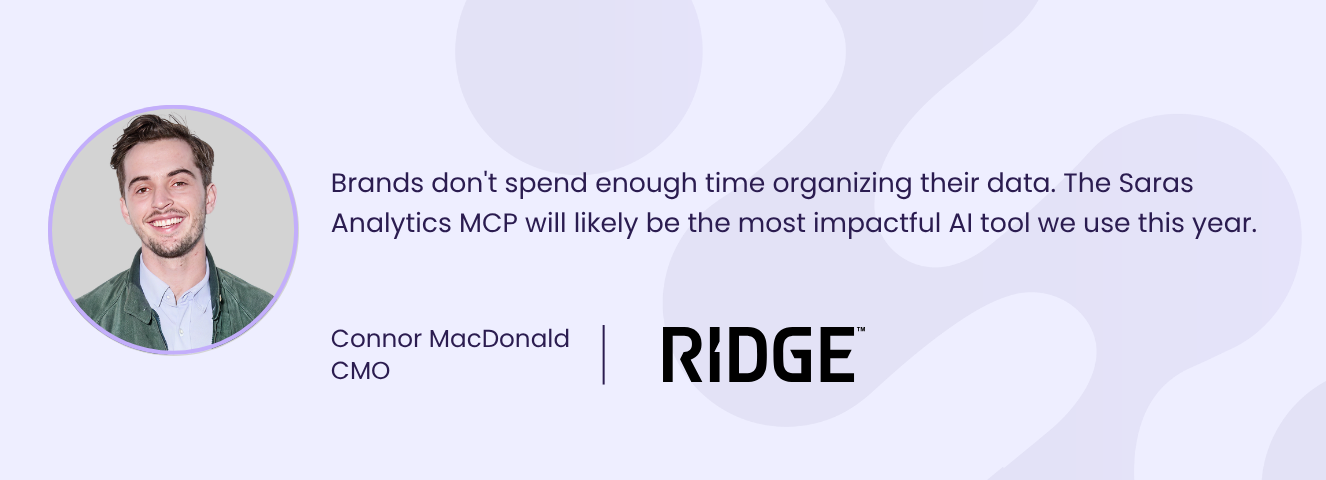
The validation layer tests iQ against 30 to 100 client-specific questions and refines logic to 90%+ accuracy before deployment. Ridge's team asked iQ 1,069 questions in 30 days across 18 users spanning CEO, marketing, product, ops, and finance, with zero analyst requests.
Key Features
- 200+ ecommerce connectors including Shopify, Amazon, TikTok Shop, Recharge, Meta Ads, Google Ads, and Klaviyo
- 500+ daily QA checks with weekly historical certification and plus or minus 1% monthly reconciliation tolerance
- Context layer with metric definitions, business logic, table descriptions, and default definitions for ambiguous queries
- iQ Business Analyst, iQ Data Engineer (Slack), and iQ MCP for Claude integration
- Deterministic outputs: same question, same answer, regardless of who asks or when
What to Review
Saras iQ fits Shopify brands that have outgrown native dashboards and need governed analytics without building a semantic layer from scratch. iQ Essentials starts from $1,999 per month with three certified use cases: contribution margin analytics, customer analytics with cohorts and segmentation, and sales and marketing analytics. The platform goes live in about three weeks.
For brands at $50M to $500M with custom business logic or multi-entity requirements, iQ Enterprise adds advanced Customer 360, multi-entity support, and dedicated consulting.
2) SnapLogic Enterprise MCP
SnapLogic is an enterprise iPaaS platform with native MCP support, allowing organizations to create MCP servers from existing integrations without rebuilding. The platform offers bidirectional MCP support (both server and client modes) with enterprise governance, observability, and access controls across connections.
Why It Fits Some Shopify Brands
SnapLogic appeals to enterprise teams that already have extensive integration infrastructure and want to add AI connectivity without starting over. The platform's MCP Server Pipeline Builder enables no-code MCP server creation, exposing existing integrations as MCP endpoints.
For large Shopify Plus brands with complex ERP integrations, fulfillment systems, and custom data flows, SnapLogic provides a path to AI-enabling existing pipelines while maintaining enterprise-grade security and audit trails.
Key Features
- MCP Server Pipeline Builder for no-code MCP server creation
- Bidirectional MCP support (server and client modes)
- Role-based access controls and authentication management
- Request traces, latency metrics, and failure diagnostics at the MCP layer
- Integration with existing enterprise data governance frameworks
3) Shopify MCP Server
The Shopify MCP Server is an open-source implementation that connects Claude to Shopify store data. Depending on the implementation and permissions, it can provide natural-language access to orders, products, customers, and inventory without requiring SQL or API knowledge.
Why It Fits Shopify Brands
The Shopify MCP Server offers a direct path from question to answer for basic store queries. Ask Claude about recent orders, product inventory, or customer counts, and get responses pulled from your Shopify data. Setup requirements depend on the implementation, and open-source server software may have no separate license fee beyond existing services.
For merchants exploring what AI-powered analytics could look like, this is a starting point.
Key Features
- Direct Claude access to Shopify orders, products, customers, and inventory
- Natural-language queries without SQL
- Authentication and permissions depending on the implementation
- Direct store data access (not warehouse sync)
- Open-source implementations available
4) BigQuery MCP Server
Google's BigQuery MCP Server connects Claude to your BigQuery warehouse, enabling natural-language SQL generation against your ecommerce tables. Google launched a managed remote server in January 2026 (Preview), reducing local setup requirements for teams already on Google Cloud.
Why It Fits Some Shopify Brands
BigQuery is a common warehouse choice for ecommerce data, and the MCP server provides direct AI access to data you have centralized there. For brands that have already invested in Shopify to BigQuery pipelines and dbt transformations, the MCP server adds conversational querying without additional data movement.
The server supports query-related tools and can use read-only access controls for safety. Teams comfortable with SQL and warehouse management can iterate quickly on ad-hoc questions.
Key Features
- Natural-language SQL generation against BigQuery tables
- Query cost estimation capabilities
- Read-only access through appropriate permissions
- Google-managed remote server option
- Access to data in your BigQuery warehouse
5) Triple Whale Moby
Triple Whale is a widely used AI analytics platform in DTC marketing, with Moby providing natural-language access to advertising performance, attribution, and customer data. The platform includes the Triple Pixel for first-party tracking and offers multi-touch attribution and media mix modeling.
Why It Fits Shopify Brands
Triple Whale's strength is marketing attribution and ad platform connectivity. Moby connects to Meta Ads, Google Ads, TikTok Ads, Klaviyo, and Triple Pixel events, allowing marketing teams to ask questions about campaign performance, creative analysis, and channel efficiency in plain English.
Moby 2, launched in May 2026, moves from reporting into configured actions inside ad platforms, pushing toward agentic marketing workflows.
Key Features
- Triple Pixel first-party tracking for post-iOS 14 measurement
- Moby AI for natural-language ad campaign analysis
- Multi-touch attribution and media mix modeling
- Integration with major ad platforms and marketing tools
- Server-side measurement capabilities
6) Polar Analytics (Ask Polar)
Polar Analytics is an ecommerce BI platform with Ask Polar, its natural-language query feature. The platform includes a dedicated Snowflake data environment and pre-built ecommerce semantic layer, targeting teams that want analytics without warehouse management.
Why It Fits Shopify Brands
Polar delivers fast time-to-value in the category. Its managed data platform reduces the engineering work required for custom warehouse builds.
The pre-built semantic layer handles common ecommerce metrics, and the included Snowflake environment eliminates the need to manage a separate warehouse. For brands that want to move quickly and prioritize ease of use over customization, Polar is a strong option.
Key Features
- Dedicated Snowflake data environment included
- Pre-built ecommerce semantic layer
- Ask Polar for natural-language queries
- Multi-touch attribution and incrementality testing
- Polar Headless MCP for AI-agent connectivity
7) Google Ads MCP
The Google Ads MCP Server is a community-built server that connects Claude to Google Ads campaign data through the Model Context Protocol. It provides natural-language access to campaign performance, ad group metrics, and keyword data.
Why It Fits Shopify Brands
For Shopify brands running significant Google Ads spend, the MCP server enables Claude-based analysis of campaign performance without exporting to spreadsheets. Ask about ROAS by campaign, compare ad group performance, or analyze keyword trends directly in Claude.
The server can be used alongside Shopify MCP to examine advertising spend and store revenue, though accurate campaign-level attribution requires shared identifiers and reconciled data. OAuth authentication with ad account permissions maintains security.
Key Features
- Campaign performance data in Claude via natural language
- OAuth authentication with ad account permissions
- Read-only access through appropriate permissions
- Access to campaign metrics through Google Ads APIs
- Free and open-source implementations available
8) Meta Ads MCP
The Meta Ads MCP Server (community implementation) connects Claude to Facebook Ads Manager campaign data, enabling natural-language queries about creative performance, audience targeting, and campaign metrics.
Why It Fits Shopify Brands
Meta is a major advertising channel for many DTC ecommerce brands. The MCP server provides direct access to campaign performance data, creative analysis, and audience insights without manual export.
For brands running Meta as their primary acquisition channel, the server enables quick Claude-based analysis of what is working, which creatives are fatiguing, and where budget might be reallocated.
Key Features
- Access to Meta Ads Manager campaign data
- Creative performance analysis in Claude
- Authentication for ad account access
- Read-only configurations available
- Free community server implementations
How Saras iQ Turns MCP Connections into Governed Ecommerce Decisions
An MCP connection gets Claude talking to your data. But raw warehouse access does not automatically give you contribution margin by SKU, CAC by channel, or cohort retention curves. That requires a semantic layer with governed metric definitions and validation to ensure the numbers are accurate.
For Shopify brands generating $10M or more, Saras iQ builds on Daton's certified data foundation to deliver governed analytics. When evaluating the right approach, consider:
- Data accuracy: iQ's certified foundation uses 500+ daily QA checks, weekly certification, and governed metric definitions to support consistent reporting.
- AI accessibility: iQ Business Analyst answers plain-English business questions, iQ Data Engineer handles data operations in Slack, and iQ MCP provides governed answers through Claude.
- Business coverage: iQ Essentials includes contribution margin, customer analytics, and sales and marketing analytics. Enterprise supports more complex business logic and multi-entity requirements.
- Implementation: iQ Essentials starts at $1,999 per month and typically goes live in about three weeks.
Qualified Shopify brands can see their own numbers through a 30-day human-assisted trial. After qualification, completing the required platform connections and providing six business inputs, trial data becomes available within five business days.
Request your assisted trial to evaluate governed sales, contribution margin CM1, and customer analytics using your own ecommerce data before making an upfront implementation-fee commitment.