In 2026, Claude AI can analyze data from across your business, if you connect it right. The Model Context Protocol (MCP), an open standard that lets Claude connect to external data sources, enables Shopify brands to analyze their operations through AI assistants. But should you buy a pre-built analytics agent or build your own?
For Shopify brands generating $10M or more in annual revenue, the stakes are higher than choosing a dashboard. You need accurate contribution margin (revenue minus variable costs like COGS, shipping, and marketing), reliable customer acquisition cost (CAC), and clear customer lifetime value (LTV) calculations. Generic AI on raw warehouse data can produce inconsistent metrics when business definitions and validation are missing. When profitability figures inform major financial decisions, directionally right is not good enough.
This guide compares 10 Claude analytics agents and approaches, from custom builds to $1,999/month for iQ Essentials, ranked by their fit for ecommerce brands that need governed, trusted answers.
Is your data actually Decision-Grade?
9 questions. 3 minutes. Score your Profitability Visibility and Readiness for AI-driven growth.
Start Free Diagnostic
Claude Analytics Agents at a Glance
Ratings pulled from G2 in November 2026.
What Shopify Brands Should Look for in a Claude Analytics Agent
Most AI analytics tools were built for general business intelligence, not for the specific challenges of ecommerce. A Shopify brand selling across multiple channels needs an analytics agent that understands platform-specific quirks: Amazon's 107 transaction types, TikTok Shop's attribution windows, Meta's post-iOS reporting gaps, and Shopify's own discount and refund logic.
When evaluating Claude analytics agents for Shopify, prioritize:
- A certified data foundation that handles timezone standardization, currency conversion, and platform quirks before Claude sees the data
- A context layer that encodes your metric definitions, exclusion rules, and business logic so every question gets answered the same way
- Validation and testing against real questions from your team to ensure accuracy before deployment
- Contribution margin tracking that goes beyond revenue to include COGS, shipping, platform fees, and marketing spend
- Customer analytics with cohort analysis, CAC by channel, and LTV calculations based on your actual data
- MCP integration that connects governed answers directly to Claude, not raw warehouse tables
The real question is not whether to connect Claude to your data. It is whether you need a tool that simply moves data or one that certifies, governs, and validates it for ecommerce-specific decisions.
The Build vs Buy Decision Framework
Build your own when you have:
- In-house data engineering resources with time to dedicate
- Unique data sources no pre-built connector supports
- Business logic so custom that no platform can accommodate it
- A willingness to maintain pipelines, handle schema changes, and validate accuracy yourself
Buy a pre-built agent when you need:
- Governed metrics that finance, marketing, and ops can all trust
- Accuracy you can defend to the board without manual verification
- Time-to-value measured in weeks, not months
- Ongoing support for connector maintenance and data model updates
For Shopify brands at $10M+, compare the total cost of building and maintaining custom AI analytics with the subscription and implementation cost of a managed platform.
1) Saras iQ: Governed Analytics with Deterministic Answers
Saras iQ is the AI Data Team for ecommerce brands, built to deliver the same answer regardless of who asks or when. The platform connects Claude to a certified data foundation through iQ MCP, ensuring your AI assistant queries governed datasets rather than raw warehouse tables.
Why It Fits Shopify Brands
Saras iQ addresses the core problem with generic AI on ecommerce data: inconsistency. When finance and marketing ask Claude about contribution margin, differing metric definitions can produce conflicting answers. The platform addresses this with three layers:
- Certified data foundation: 200+ connectors (Shopify, Amazon, TikTok Shop, Meta Ads, Google Ads, Klaviyo, Recharge) modeled into 11 governed master datasets with 500+ daily QA checks and monthly reconciliation tolerance of plus or minus 1%
- Context layer: Your metric definitions, exclusion rules, table descriptions, and default handling encoded so Claude interprets questions consistently
- Validation layer: Testing against 30-100 client-specific questions, refined to 90%+ accuracy, with regression tests on every change
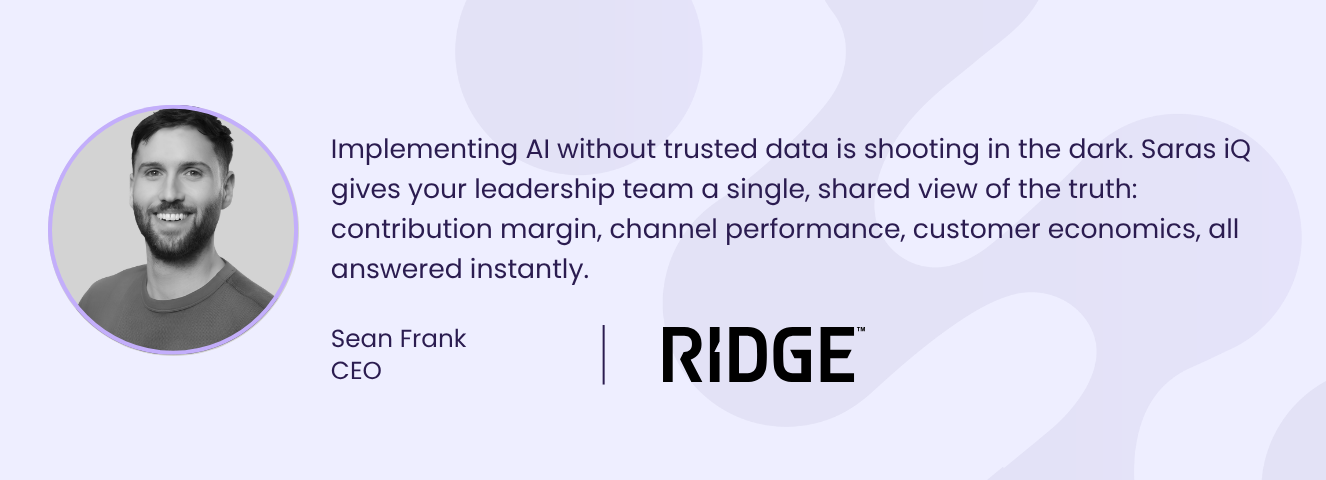
Ridge's team asked iQ 1,069 questions in 30 days across 18 users spanning CEO, marketing, product, ops, and finance, with zero analyst requests. Ridge CEO Sean Frank has also highlighted the value of using Saras iQ inside Claude for cross-functional decision-making.
Key Features
- iQ Business Analyst: Plain-English Q&A, summaries, and dashboards over certified data
- iQ Data Engineer: Slack agent that answers "Has today's data loaded?" and "How is this metric calculated?" in minutes
- iQ MCP for Claude: Same governed answers inside your AI assistant
- Contribution margin analytics: Standardized net sales, COGS, fulfillment, platform fees, fixed costs, and marketing spend
- Customer analytics: CustomerMaster with acquisition attributes, Recency plus Monetary segmentation, cohorts for Shopify and TikTok Shop
What to Review
Saras iQ Essentials starts from $1,999/month for Shopify brands at $10M- 50M, with three certified use cases (contribution margin, customer analytics, sales and marketing) and goes live in about three weeks. The platform uses nightly data refresh (not real-time), which works for many operational decisions but may not fit brands needing intraday updates.
Enterprise pricing is custom for brands at $50- 500M+ that need advanced Customer 360, multi-entity support, and custom semantic layers. Inventory visibility is planned rather than a currently available feature.
For qualified brands evaluating iQ, the 30-day assisted trial includes Sales & Marketing Analytics, Contribution Margin CM1, and Customer Analytics using their own connected data.
It requires applicable platform connections, six business inputs, and assisted onboarding. CM2/CM3, SKU-level costs, wholesale analytics, and sales targets are available only after paid conversion.
2) StoreHero
StoreHero is a profit analytics platform with MCP integration that connects Shopify, Meta Ads, Google Ads, and Klaviyo to Claude in 2-3 minutes without API keys or code. The platform emphasizes margin-true P&L over revenue dashboards.
Why It Fits Shopify Brands
StoreHero's quick setup appeals to teams that want immediate Claude access to their ecommerce data. The platform's MCP server connects your profit data (not just Shopify orders) so Claude can answer "why did margin drop" rather than just "what sold."
The AI Skills Library includes 20+ pre-built prompts for common ecommerce analyses: Meta Ads waste finder, inventory actions, and margin calculations.
Key Features
- 2-3 minute MCP setup with no API keys or coding required
- Margin-true P&L connecting Shopify sales, COGS, shipping, fees, and multi-platform ad spend
- AI Skills Library with 20+ pre-built prompts for ecommerce analysis
- Multi-platform support for Claude, ChatGPT, and other MCP-compatible assistants
What to Review
Teams requiring custom business logic, governed metric definitions, or formal validation testing should assess how StoreHero supports these requirements. Best suited for brands that want fast setup and are comfortable with the platform's standard metric definitions.
3) Triple Whale (Moby AI)
Triple Whale is an AI analytics platform for DTC brands, with Moby AI providing anomaly detection, budget simulation, and agentic capabilities for campaign management. The platform's Triple Pixel provides first-party tracking designed to improve attribution after iOS privacy changes.
Why It Fits Shopify Brands
Triple Whale focuses on marketing analytics and attribution, the areas where platform-reported metrics can diverge from actual revenue. The Moby 2 launch in May 2026 added agentic features that move beyond reporting to automated actions.
Key Features
- Triple Pixel first-party tracking for post-iOS attribution accuracy
- Moby AI Pro with anomaly detection, budget simulation, and campaign automation
- Marketing mix modeling (MMM) and incrementality testing via Compass
- MCP access included in Professional tier for Claude integration
What to Review
The platform is strong on marketing drivers but has a different focus from accounting-oriented contribution margin reporting. Brands that need board-ready financial reporting alongside attribution should pair Triple Whale with a governed analytics platform or evaluate whether their use case justifies running two tools.
4) Polar Analytics
Polar Analytics combines ecommerce BI with Ask Polar AI and a Polar MCP for Claude integration. The platform provides a dedicated Snowflake warehouse for each customer with 400+ pre-built ecommerce metrics, getting data flowing within hours of install.
Why It Fits Shopify Brands
The platform's speed to first data (hours rather than weeks) makes it attractive for teams that need immediate visibility.
The 2026 additions of multi-touch attribution and incrementality testing expanded Polar beyond pure BI into marketing measurement.
Key Features
- Dedicated Snowflake warehouse for each customer with full data ownership
- 400+ pre-built ecommerce metrics covering sales, customers, and marketing
- Ask Polar AI analyst plus Polar MCP for Claude integration
- Multi-touch attribution and incrementality testing (2026 additions)
What to Review
The pre-built metrics work well for standard use cases but may require customization for brands with unique business logic. Best for teams that prioritize speed and ease of use over deep customization.
5) Mipler Reports MCP
Mipler Reports MCP is purpose-built for Shopify analytics workloads, providing pre-synced, indexed data that Claude can query without hitting GraphQL rate limits. The platform handles queries across 10,000 orders in a single request, something Shopify's native API cannot do.
Why It Fits Shopify Brands
Mipler solves a specific technical problem: large Shopify GraphQL queries can require multiple API requests and encounter rate limits. Mipler pre-indexes Shopify data with 164 fields per sale line, enabling complex analytical queries without repeatedly querying the native API.
The platform works with Claude Desktop, Web, Code CLI, ChatGPT (with MCP plugins), and Gemini CLI, providing flexibility across AI assistants.
Key Features
- Pre-synced, indexed Shopify data for heavy analytical workloads
- 164 Shopify fields per sale line available to Claude
- Server-side aggregations and joins without GraphQL rate limits
- Multi-assistant support for Claude, ChatGPT, and Gemini
What to Review
Mipler focuses exclusively on Shopify data, so brands needing multi-channel analytics (Amazon, TikTok Shop, wholesale) or contribution margin calculations will need additional tools. Best suited as a complement to Shopify's official AI Toolkit (which handles store operations) rather than a standalone analytics solution.
6) Bloom Analytics
Bloom Analytics provides a profit layer that fills the gap between Shopify's order data and true margin analysis. The platform's Bloom Pixel captures first-party attribution data while connecting product costs, shipping, fees, and multi-channel ad spend.
Why It Fits Shopify Brands
Shopify's official MCP gives Claude access to store data and operations, but a complete margin calculation also requires cost and advertising data. Bloom closes this gap with a layered profit framework:
- Gross Revenue: What Shopify reports
- CM1: Revenue minus COGS
- CM2: CM1 minus shipping and fees
- CM3: CM2 minus marketing costs
This structure lets Claude answer "why did profit drop" by identifying whether the issue was pricing, costs, fees, or ad spend.
Key Features
- Layered profit data with CM1, CM2, CM3 framework
- Bloom Pixel for first-party attribution
- Multi-platform ad spend integration for Meta, Google, and TikTok
- No-code MCP setup in minutes
What to Review
The profit framework relies on accurate cost inputs, so brands with messy COGS data will need cleanup before getting meaningful results. Best for teams that have their cost data organized and want Claude to analyze profitability directly.
7) Porter Metrics
Porter Metrics offers a free-forever plan with 15 days of data in AI chats and unlimited accounts, providing a low-cost entry point for Claude analytics. The same Porter account feeds Claude, ChatGPT, Data Studio, Google Sheets, and BigQuery.
Why It Fits Shopify Brands
The platform provides 164 Shopify fields including COGS, gross profit, and repeat customer metrics, with stored order history that supports historical analysis beyond the data available through some native API queries.
For agencies, the multi-store support allows comparing client stores in a single query, simplifying cross-account analysis.
Key Features
- Free plan with unlimited accounts and 15 days of data in AI chats
- 164 Shopify fields including COGS, gross profit, repeat customer metrics
- Stored order history for historical Shopify reporting
- Multi-destination support for Claude, ChatGPT, Data Studio, Sheets, BigQuery
- Store operations including product updates, inventory management, and discount code creation
What to Review
Brands requiring a governed semantic layer and formal validation testing should assess those capabilities separately and verify critical answers. Best for agencies and small brands that need broad capabilities at minimal cost.
8) Windsor.ai MCP
Windsor.ai streams Shopify data alongside 350+ other sources for multi-channel analysis, preserving customer tags and UTM parameters used in campaign tracking. The platform supports analysis of advertising campaigns alongside Shopify orders using connected data.
Why It Fits Shopify Brands
Windsor supports brands with complex data ecosystems. Beyond ecommerce platforms and ad networks, the connectors include CRMs, helpdesks, and operational tools, enabling analysis that spans the entire customer journey.
The platform supports 330+ Shopify fields across sales, customers, products, inventory, and marketing data.
Key Features
- 350+ data source connectors including Shopify and major ad platforms
- 330+ Shopify fields with customer tags and UTM preservation
- Auto-joined data (Orders + Customers + Products) without manual VLOOKUPs
- Real-time data versus static CSV exports
What to Review
The platform excels at data connectivity but teams needing ecommerce-specific metric definitions and contribution margin calculations should evaluate how those are configured. Best as a data connector for teams that handle metric definitions and validation elsewhere.
9) Coupler.io
Coupler.io provides an Analytical Engine that runs calculations rather than relying on Claude to produce arithmetic results. The platform's 400+ integrations for ecommerce sources feed data through a schema and context layer that helps Claude interpret columns correctly.
Why It Fits Shopify Brands
Claude generates responses using a language model, so arithmetic performed without calculation tools can be incorrect. Coupler's Analytical Engine performs calculations and feeds results to Claude.
The platform holds SOC 2 Type II compliance and supports GDPR-related data protection requirements.
Key Features
- Analytical Engine that performs calculations before Claude sees results
- 400+ integrations including Shopify and major ecommerce sources
- Schema and context layer for interpreting data columns
- BigQuery destination option for long-term data retention
What to Review
The platform is primarily a data integration and analytics tool rather than a dedicated ecommerce profit analytics solution. Brands with specialized metric requirements may need to configure their own definitions and dashboards.
10) Custom Claude Code Build
Building your own Claude analytics agent using Claude Code and the Shopify API provides complete control over data transformations, queries, and business logic. Development effort varies with the available templates, data sources, security requirements, and required validation.
Why It Fits Some Shopify Brands
Custom builds reduce reliance on a managed analytics platform but still involve infrastructure, Claude usage, development, and maintenance costs. For brands with proprietary data sources, unique attribution models, or highly specialized business logic that no platform supports, building custom may be the only option.
The investment includes initial development and ongoing maintenance, which can make sense for brands with strong engineering teams and stable requirements.
Key Features
- Complete customization for unique business logic and data sources
- No dependency on a managed analytics platform for application logic
- Proprietary data integration for sources no connector supports
- Full control over metric definitions and calculations
What to Review
A custom build requires teams to implement the context layer and validation testing needed to reduce incorrect AI-generated answers. When Claude connects directly to raw warehouse data without governed definitions, metric interpretation and numerical accuracy can vary. Brands choosing this path should budget for:
- Initial development: Scope according to data sources, complexity, and validation requirements
- Ongoing maintenance: Schema changes, connector updates, accuracy monitoring
- Validation: Manual testing of critical queries on an ongoing basis
For Shopify brands at $10M+, the total cost of ownership for custom builds should include ongoing maintenance, validation, infrastructure, and the opportunity cost of engineering time, not just initial development.
Beyond the Agent: Why Data Foundation Matters More Than the AI
A Claude analytics agent is only as smart as the data it queries. Raw Shopify data in BigQuery does not automatically give you contribution margin by SKU, CAC by channel, or cohort retention curves. That requires a semantic layer with governed metric definitions and validation to ensure the numbers are accurate.
The gap between "Claude can see my data" and "Claude gives me trusted answers" is the difference between raw tables and a certified data foundation:
- Raw data: Orders, customers, products as Shopify exports them, with all the platform quirks, timezone issues, and duplicate records
- Certified foundation: Cleaned, standardized, validated datasets with consistent definitions that finance, marketing, and ops can all trust
Saras iQ builds on Daton's ingestion layer to deliver this certified foundation. The iQ Business Analyst answers questions with deterministic responses, so the same question returns the same answer regardless of who asks. The iQ Data Engineer handles operational questions in Slack. And the iQ MCP connects it all to Claude so you get governed answers inside your AI assistant.
Build vs Buy: Choosing Trusted Claude Analytics for Shopify
The right Claude analytics approach depends on your Shopify brand's data complexity, internal engineering capacity, and need for reliable financial metrics. A lightweight MCP connector may suit teams that need access to existing data
Custom builds offer flexibility but require ongoing maintenance, business logic configuration, and accuracy testing.
For Shopify brands generating $10M+ annually, evaluate three priorities:
- Data foundation: Can the solution reconcile Shopify, advertising, and cost data into consistent metrics?
- Accuracy and governance: Does it apply business-specific definitions and validate calculations before delivering answers?
- Implementation and ownership: Who maintains connectors, business logic, and validation as your operations change?
Saras iQ addresses these requirements through its certified data foundation, context layer, and validation process. Its MCP integration brings governed analytics into Claude, while Essentials offers contribution margin, customer, and sales analytics starting at $1,999/month.
For qualified Shopify brands, request a 30-day assisted trial to see your own sales, contribution margin CM1, and customer numbers before committing to a paid implementation.