
Your finance team says contribution margin is 12%. Marketing claims 18%. Operations presents a third number entirely. Meanwhile, the board question lands on Friday, and the answer arrives Tuesday. For Shopify brands doing $10M or more in annual revenue, this data chaos creates a painful choice: invest six to nine months building a custom data warehouse, or accept fragmented reporting that erodes confidence in every decision.
Modern AI data platforms now offer a third path, but understanding the warehouse landscape remains essential for making the right infrastructure choice for 2027.
Is your data actually Decision-Grade?
9 questions. 3 minutes. Score your Profitability Visibility and Readiness for AI-driven growth.
Start Free Diagnostic
Understanding the Cloud Data Warehouse Landscape
The cloud data warehouse market includes three leading platforms, each with distinct strengths for ecommerce operations. Choosing between Snowflake, BigQuery, and Databricks depends on your existing tech stack, team capabilities, and specific analytical requirements.
What Makes Each Platform Unique?
- Snowflake: Credit-based pricing with separate compute and storage scaling, runs on AWS, Azure, and GCP
- BigQuery: Google's serverless warehouse with per-TB or slot-based pricing, native GA4 and Google Ads integration
- Databricks: Lakehouse architecture combining data lakes and warehouse capabilities, built on Apache Spark
For ecommerce brands, the choice often comes down to existing infrastructure investments, team skills, and whether you need basic reporting or advanced ML capabilities. Most $10M to $50M Shopify brands find that none of these platforms deliver ecommerce-specific logic out of the box, requiring significant customization regardless of which you choose.
Snowflake for Ecommerce: Scalability and Ecosystem Integration
Snowflake is a popular cloud warehouse for ecommerce due to its extensive ecosystem and flexibility. The platform separates compute from storage, allowing you to scale query performance independently from data volume.
Why Ecommerce Brands Choose Snowflake
- Multi-cloud deployment: Available on AWS, Azure, and GCP
- Data sharing: Share live data with agencies, partners, and vendors without copying
- Ecosystem depth: Most ETL tools, BI platforms, and reverse ETL solutions integrate natively
- Scaling flexibility: Add compute clusters during peak seasons without architectural changes
Typical Monthly Costs for Ecommerce Brands
- Small brands: $50K monthly revenue; usage-based Snowflake cost
- Mid-size brands: $500K monthly revenue; usage-based Snowflake cost
- Enterprise brands: $5M+ monthly revenue; usage-based Snowflake cost
The challenge with Snowflake lies not in the platform itself but in what you must build on top of it. Contribution margin calculations, customer cohort analysis, and marketing attribution require custom data models that most ecommerce brands spend months developing and validating.
Google BigQuery as an Ecommerce Data Warehouse: Speed and Google Ecosystem Integration
BigQuery offers a serverless experience among the three platforms, eliminating cluster management entirely. For brands already invested in Google's ecosystem, BigQuery provides native integrations that reduce implementation complexity.
BigQuery Strengths for Ecommerce
- Native GA4 integration: Direct connection to Google Analytics 4 without ETL
- Google Ads sync: Marketing data can flow through native integrations with minimal configuration
- Serverless architecture: No warehouse sizing decisions or cluster management
- Generous free tier: 1 TiB of on-demand queries per month at no cost
Cost Comparison Versus Snowflake
BigQuery uses usage-based pricing, with on-demand queries starting at $6.25 per TiB scanned after the monthly free allowance. Snowflake charges for compute credits and storage separately. Actual costs for equivalent workloads depend on query volume, compute usage, and storage requirements.
The limitation for ecommerce brands is BigQuery's GCP-only deployment. If your tech stack spans multiple clouds or you anticipate platform changes, Snowflake's portability becomes more valuable. Additionally, BigQuery's SQL dialect differs enough from standard SQL that queries from other platforms often require modification.
Databricks for Ecommerce: Unifying Data, Analytics, and AI
Databricks takes a fundamentally different approach through its Lakehouse architecture, combining data lake flexibility with warehouse performance. For ecommerce brands with sophisticated ML requirements, Databricks offers an integrated environment for data engineering, analytics, and machine learning.
Where Databricks Excels
- Real-time streaming: Structured Streaming for fraud detection, live personalization, and inventory alerts
- ML operations: Native platform for demand forecasting, pricing optimization, and customer propensity models
- Unified environment: Data engineering, analytics, and data science in one platform
- Multi-cloud support: Runs on AWS, Azure, and GCP like Snowflake
Databricks Considerations for Ecommerce
- Requires Apache Spark expertise for some workloads, increasing hiring costs
- Usage-based pricing: Databricks Units (DBUs) plus underlying cloud costs
- May be more complex than necessary for brands focused primarily on reporting and dashboards
- Best suited for brands with dedicated data science teams and complex analytical requirements
For most Shopify brands in the $10M to $50M range, Databricks' power comes with complexity that exceeds actual requirements. The platform shines when you need real-time ML inference at scale, but represents unnecessary overhead for contribution margin tracking and cohort analysis.
Choosing the Right Data Warehouse: A Comparison Framework for 2027
Snowflake
- Cloud Support: AWS, Azure, GCP
- Ease of Use: Excellent
- ML Capabilities: Good (Snowpark ML)
- Real-time Processing: Good
- Typical Mid-size Cost: Usage-based compute and storage
- Best For: Multi-cloud, ecosystem depth
BigQuery
- Cloud Support: GCP only
- Ease of Use: Excellent (serverless)
- ML Capabilities: Good (BigQuery ML)
- Real-time Processing: Good
- Typical Mid-size Cost: Usage-based queries and storage
- Best For: Google-heavy brands
Databricks
- Cloud Support: AWS, Azure, GCP
- Ease of Use: Moderate (Spark knowledge)
- ML Capabilities: Excellent (native platform)
- Real-time Processing: Excellent
- Typical Mid-size Cost: DBU-based plus cloud costs
- Best For: ML-intensive operations
Decision Framework by Brand Profile
- Shopify-only, under $10M: Native Shopify analytics or simple BI tools may suffice
- Shopify plus two to three channels, $10M to $50M: Consider managed platforms over DIY warehouses
- Multi-channel with wholesale, $50M+: DIY warehouse investment may become justifiable
- Google Ads and GA4 heavy: BigQuery's native integrations provide real advantages
- ML and forecasting critical: Databricks worth considering for sophisticated use cases
The total cost of ownership extends far beyond platform fees. A DIY warehouse implementation requires data engineers, ETL tools, and months of integration work before delivering reliable reporting.
The Role of Data Warehouse Consulting in Ecommerce Implementation
Data warehouse consulting firms bridge the gap between platform capabilities and production-ready analytics. Rather than hiring full-time data engineers, brands engage consultants for architecture design, implementation, and optimization.
What Consulting Firms Typically Deliver
- Assessment of existing data sources and analytical requirements
- Architecture design for chosen warehouse platform
- ETL pipeline implementation connecting ecommerce sources
- Dimensional modeling for sales, marketing, and customer analytics
- Performance optimization and cost management
- Migration support from legacy systems
Leading Consulting Approaches by Specialty
Ecommerce specialists
- Strength: DTC orders, marketing, fulfillment
- Typical Engagement: Full implementation with domain expertise
Platform specialists
- Strength: Snowflake, BigQuery, or Databricks depth
- Typical Engagement: Technical implementation and optimization
Enterprise generalists
- Strength: Multi-system integration
- Typical Engagement: Complex environments with ERP connections
The consulting model can reduce implementation time compared with a fully in-house build, but introduces its own challenges. Knowledge transfer gaps appear when consultants complete engagements, and business logic changes require new consulting work rather than internal iteration.
Implementation Considerations: Building Your Ecommerce Data Foundation
Whether you pursue DIY warehouse, consulting engagement, or managed platform, certain fundamentals determine success. Data quality issues compound through every downstream analysis, making foundation work critical.
Essential Data Sources for Ecommerce Warehousing
- Sales platforms: Shopify, Amazon Seller Central, TikTok Shop, wholesale systems
- Marketing platforms: Meta Ads, Google Ads, TikTok Ads, email and SMS tools
- Operations systems: 3PLs, inventory management, returns processing
- Finance sources: Payment processors, accounting systems, subscription platforms
Building reliable data pipelines for these sources requires handling API rate limits, schema changes, and timezone normalization. Amazon settlement reports contain numerous transaction types that must be categorized correctly for accurate reporting.
Critical Implementation Milestones
- Week 1-4: Source connection and initial data extraction
- Week 5-12: Data modeling and transformation logic
- Week 13-20: Business logic validation and reconciliation
- Week 21-26: Dashboard development and user training
- Ongoing: Maintenance, schema updates, and optimization
For many $20M+ DTC brands, the regret from building in-house stems not from the initial implementation but from ongoing maintenance. API changes break connectors, platform updates alter schemas, and business logic requires constant refinement as the company evolves.
Why Saras iQ Delivers a Faster Path to Trusted Ecommerce Analytics
For Shopify brands in the $10M to $50M range that have outgrown native dashboards but cannot justify the cost and complexity of DIY warehouses, Saras iQ provides a purpose-built alternative. Rather than starting with infrastructure and building toward insights, iQ begins with certified ecommerce analytics and works backward to ensure accuracy.
What Separates Saras iQ From DIY Approaches
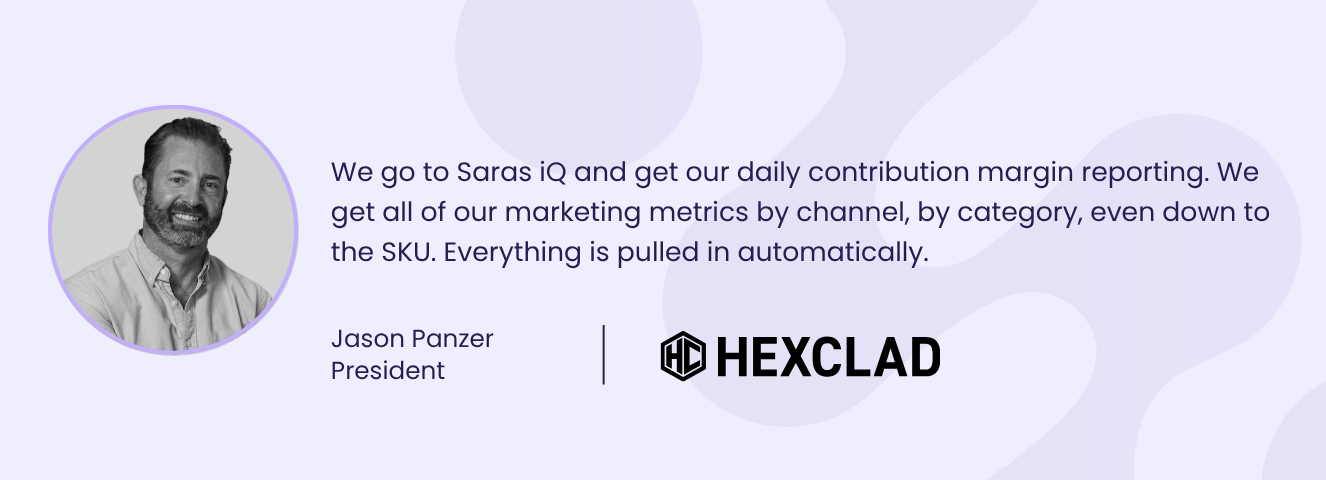
- Certified data foundation: 500+ daily QA checks to support reliable reporting
- Context layer: Your business logic, metric definitions, and exclusion rules encoded and applied consistently
- Validation layer: Testing against business-specific questions to check answer accuracy
- AI integration: Ask questions in plain English through Claude, Slack, or iQ Chat with consistent, governed answers
Speed Comparison
DIY Warehouse
- Time to First Report: 6–9 months
- First-Year TCO: 305K–610K+
Consulting Build
- Time to First Report: Varies by scope
- First-Year TCO: Custom pricing
Managed Platforms
- Time to First Report: 2–3 weeks
- First-Year TCO: 60K–200K
Saras iQ Essentials
- Time to First Report: As little as 10 days
- First-Year TCO: From $23,988
Ridge's team asked iQ 1,069 questions in 30 days across 35 users. CEO Sean Frank stated that Saras iQ inside Claude is worth over $50,000 monthly to their operations.
The critical difference lies in what happens when you ask a question. Generic AI connected to raw warehouse data can produce answers that vary based on how you phrase the query, which session you use, or even which Claude model responds. iQ's context and validation layers help ensure the same question returns a consistent answer regardless of who asks or when, because the business logic is defined rather than interpreted independently on each query.
Qualified Shopify brands can see their own sales, contribution margin, and customer analytics before committing through a 30-day assisted trial. Data becomes available within five business days after completing required platform connections and business inputs.
Start your free trial to see your own numbers before you commit.