
Glew users evaluating alternatives may face data reconciliation challenges, limited AI-powered analysis, and uncertainty around pricing following Everest Group's acquisition of Glew in March 2026.
For Shopify brands generating $10M or more in annual revenue, these friction points signal the need for an analytics platform that delivers certified accuracy without vendor lock-in. Saras iQ stands out as the top Glew alternative for DTC brands seeking governed metrics and AI-powered analytics
Unlike platforms that require manual reconciliation, iQ's certified data foundation runs 500+ daily QA checks and delivers deterministic answers: the same question returns the same answer regardless of who asks or when.
Is your data actually Decision-Grade?
9 questions. 3 minutes. Score your Profitability Visibility and Readiness for AI-driven growth.
Start Free Diagnostic
Glew Alternatives at a Glance
Ratings pulled from G2 in November 2026.
Why Shopify Brands Outgrow Glew Analytics
Glew built its reputation on multi-channel reporting, covering Amazon, Shopify, BigCommerce, and point-of-sale systems in unified dashboards. But for Shopify brands scaling past $10M in annual revenue, the platform's limitations become increasingly visible.
Match the alternative to your switching trigger:
- Data accuracy problems requiring manual reconciliation: Saras iQ
- Vendor lock-in with proprietary warehouse and high migration costs: Saras iQ or Polar Analytics
- Need AI natural language queries instead of dashboard-only reporting: Saras iQ or Triple Whale
- Budget uncertainty from opaque post-acquisition pricing: Saras iQ (transparent starting price of $1,999/mo)
- Marketing attribution as primary use case: Triple Whale
- Omnichannel DTC plus Amazon plus wholesale: Daasity
- Retention and RFM segmentation depth: Peel Insights
The core challenges driving Glew users to alternatives include:
- Data accuracy issues: Users report spending 1-2 hours weekly on manual reconciliation because Glew data does not match source systems. One reviewer noted "more than half of revenue appearing under unknown channel."
- Proprietary warehouse lock-in: Glew stores data in its own AWS infrastructure, potentially creating migration costs when switching platforms. Moving data and rebuilding reports can require additional work.
- No AI capabilities: Glew offers dashboard reporting without natural language queries. While competitors have added AI assistants, Glew users must manually navigate pre-built reports.
- Removed pricing transparency: Since the March 2026 Everest Group acquisition, Glew no longer publishes pricing, requiring custom quotes for all plans and creating budget uncertainty.
- Support delays: Reviews cite tickets taking months and slow follow-up, problematic during peak season when data issues need immediate resolution.
For Shopify brands at $10M to $50M in annual revenue, a quick definition: contribution margin refers to revenue minus variable costs including COGS (cost of goods sold), fulfillment, platform fees, and marketing spend. Customer acquisition cost (CAC) measures the total cost to acquire a new customer, while customer lifetime value (LTV) measures the total revenue a customer generates over their relationship with your brand.
These metrics require certified data foundations to calculate accurately across finance, marketing, and operations teams.
1. Saras iQ: Certified AI Data Team for Ecommerce
Saras iQ is an AI Data Team purpose-built for ecommerce brands. Rather than delivering another dashboard that requires manual interpretation, iQ provides certified datasets and AI agents that answer business questions in plain English with deterministic accuracy.
Key Capabilities
- Certified data foundation: 500+ daily QA checks, weekly historical certification, and monthly reconciliation tolerance of plus or minus 1% help ensure your numbers match your source systems.
- AI Data Team: iQ Business Analyst answers questions about margin, customers, and channels. iQ Data Engineer handles data operations in Slack, answering "has today's data loaded" or "how is this metric calculated" in minutes rather than hours.
- Governed semantic layer: The context layer encodes your specific metric definitions, exclusion rules, and business logic so "revenue" means the same thing to finance and marketing.
- Claude MCP integration: The Model Context Protocol (MCP) connects iQ's certified foundation to Claude, delivering the same governed answers inside Claude Desktop that you get in iQ Chat or Slack.
- Data ownership: Your data lives in your BigQuery or Snowflake warehouse with read-only iQ access, reducing vendor lock-in and simplifying future migrations.
Ecommerce Use Cases
For contribution margin analytics, iQ Essentials delivers order-line sales data modeled with standardized net sales (gross minus discounts minus refunds plus shipping), COGS, fulfillment costs, platform fees, and marketing spend. You get daily profitability by SKU and channel that finance can defend to the board.
For customer analytics, iQ provides CustomerMaster with acquisition attributes, Recency plus Monetary segmentation, and Shopify and TikTok Shop cohorts. You can track CAC versus LTV by acquisition channel and identify which customer segments drive profitable growth.
For sales and marketing analytics, iQ standardizes paid-media grouping across Meta, Google, TikTok, Microsoft, Snapchat, Pinterest, AppLovin, Amazon Ads, and MNTN, with pacing versus targets to identify where you are over or under spending.
Pricing Structure
- Essentials: From $1,999/month for Shopify brands at $10M to $50M, including three certified use cases, iQ Chat, iQ Data Engineer, Claude MCP, Slack integration, and nightly refresh
- Enterprise: Custom pricing for brands at $50M to $500M+, adding Advanced Customer 360, inventory visibility (coming soon), AI Business Colleagues, 200+ advanced integrations including NetSuite, and custom semantic layer
Why Saras iQ Leads for Ecommerce
Unlike Glew's proprietary warehouse that creates switching costs, iQ puts data in your warehouse from day one. Unlike dashboard-only platforms, iQ's AI agents answer questions directly. Unlike tools that require manual reconciliation, iQ's certified foundation delivers numbers you can trust without weekly cleanup.
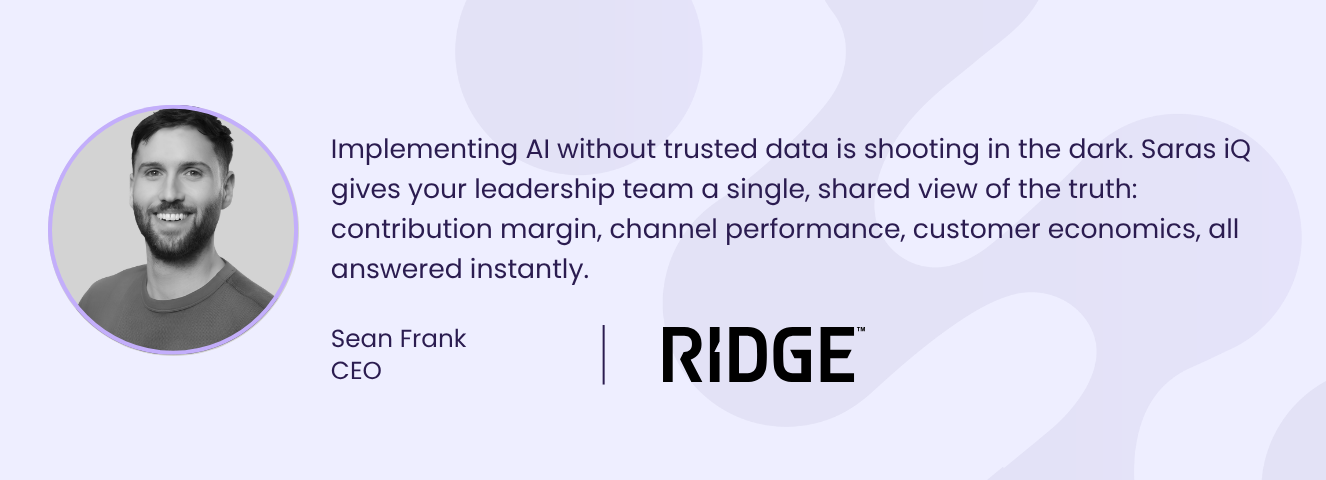
Ridge's team asked iQ 1,069 questions in 30 days across 18 users spanning CEO, marketing, product, ops, and finance, with zero analyst requests. CEO Sean Frank described the value of iQ's Claude integration: "Saras iQ MCP is world class. It's the best use case for a data warehouse. Once you get Saras iQ inside of Claude, it's worth over $50,000 a month for us."
For a deeper comparison of Glew's capabilities and limitations, see our Glew review.
2. Triple Whale
Triple Whale built its platform around marketing attribution, offering the Triple Pixel for first-party tracking in a post-iOS14 world. The platform serves Shopify DTC brands that need to understand which ads drive conversions.
Primary Focus
- First-party attribution: Triple Pixel provides attribution data independent of platform pixels, helping marketers understand true campaign performance
- Creative analytics: Campaign and ad-level performance insights show which creative assets drive results
- Moby AI: Natural language interface for querying marketing data
- Shopify-native: Purpose-built integration for DTC brands on Shopify
- Free tier: Entry point for testing before committing budget
Ecommerce Considerations
Triple Whale excels at attribution but offers paid plans with quote-based pricing. As your brand grows, costs may increase depending on the selected plan and usage. The platform focuses primarily on Shopify, with coverage for other channels that trails its DTC depth.
Users report that attribution can be inconsistent in some scenarios. For brands where contribution margin matters more than attribution, Triple Whale complements rather than replaces a profitability-focused platform.
Organizational Fit
Triple Whale fits marketing teams at DTC brands that prioritize campaign attribution over profitability analytics. Brands needing certified contribution margin or finance-grade accuracy across complex business systems may pair Triple Whale with another platform.
For a detailed comparison, see our Triple Whale review.
3. Polar Analytics
Polar Analytics provides a warehouse-native analytics platform where each customer gets their own Snowflake database. The platform appeals to technical teams that want to build custom models while maintaining data ownership.
Primary Focus
- Dedicated Snowflake warehouse: Each customer gets a dedicated database with SQL access
- 400+ pre-built metrics: Comprehensive semantic layer covering standard ecommerce KPIs
- Ask Polar: Natural language interface for querying data
- MCP integration: Connect Polar's semantic layer to Claude for AI-powered analysis
- Data ownership: Warehouse access provides greater flexibility when migrating or extending analytics workflows
Ecommerce Considerations
Polar covers Shopify, Amazon, and major ad platforms with approximately 45+ integrations. This falls short of the 200+ connectors available through platforms like Saras Daton, which may matter for brands using specialized returns, subscription, or fulfillment platforms.
Pricing is custom and requires quotes. Technical teams can maximize value through SQL access, but non-technical users may find the platform more complex than alternatives with stronger guided experiences.
Organizational Fit
Polar fits data teams that want SQL access and custom modeling capabilities within a dedicated warehouse. Brands without technical resources may find more value in platforms that provide certified datasets without requiring SQL skills.
For pricing details, see our Polar Analytics pricing analysis.
4. Daasity
Daasity positions itself as a data foundation for omnichannel ecommerce, unifying DTC, Amazon, and wholesale data in a managed Snowflake warehouse. The platform serves brands with complex channel mixes.
Primary Focus
- Omnichannel coverage: DTC, Amazon Seller Central and Vendor Central, wholesale, and retail unified in one platform
- Managed Snowflake: Warehouse-native foundation with data access
- B2B modeling: Rare capability for wholesale and retail alongside DTC
- ETL and BI: Integrated data integration and reporting
- AI Analyst: Natural language interface for data queries
Ecommerce Considerations
Daasity provides extensive omnichannel coverage, making it a strong choice for brands with significant Amazon or wholesale revenue. Brands requiring dedicated marketing attribution and incrementality measurement may pair Daasity with an attribution tool.
Pricing starts at $1,499/month for Starter Essentials and $1,999/month for Essentials, positioning it in the same range as Saras iQ Essentials.
Organizational Fit
Daasity fits omnichannel brands that sell through DTC, Amazon, and wholesale simultaneously and need unified reporting. Shopify-focused brands without wholesale may find the channel breadth exceeds their needs.
5. Lifetimely by AMP
Lifetimely built its reputation on accessible profit tracking and LTV analytics for Shopify brands. The platform offers a free tier and lower price points than enterprise alternatives.
Primary Focus
- P&L dashboard: Profit and loss visibility with expense tracking
- LTV analytics: Customer lifetime value calculations and cohort analysis
- Cohort analysis: Track customer behavior over time by acquisition cohort
- Profit Agent: AI assistant for profit-related queries
- MCP integration: Connect to Claude for AI-powered analysis
Ecommerce Considerations
Lifetimely serves brands seeking accessible LTV and profit tracking without enterprise complexity. The platform starts free for brands with up to 50 orders per month, with paid tiers from $49/month scaling by order volume.
For brands at $10M+ in revenue, Lifetimely's profit and customer analytics may need to be evaluated against finance-grade reconciliation and data governance requirements. Larger brands may require additional customization as their data needs become more sophisticated.
Organizational Fit
Lifetimely fits smaller Shopify brands that need basic profit and LTV visibility at lower price points. Brands at $10M+ with finance teams requiring certified data should evaluate whether its reporting and reconciliation capabilities meet their requirements.
For alternatives to Lifetimely, see our Lifetimely alternatives guide.
6. Northbeam
Northbeam positions itself as a premium attribution platform for sophisticated media buyers. The platform offers media mix modeling (MMM) and incrementality testing as optional capabilities beyond standard multi-touch attribution.
Primary Focus
- Apex attribution: Advanced attribution model for measuring campaign impact
- Media mix modeling: Statistical modeling to understand channel contribution
- Incrementality testing: Measure true incremental lift from marketing spend
- View-through measurement: Track conversions from ad views, not just clicks
- MCP integration: Connect to Claude for AI-powered analysis
Ecommerce Considerations
Northbeam serves brands with significant paid media investment that need to optimize large ad budgets. Pricing starts at $1,500/month for Starter, with Professional at $3,500/month and custom Enterprise pricing.
The platform focuses specifically on attribution and measurement, not certified contribution margin. Brands using Northbeam may pair it with another platform for finance and customer analytics.
Organizational Fit
Northbeam fits brands with substantial monthly paid media spend that need sophisticated attribution beyond platform reporting. Brands with smaller budgets or those prioritizing profitability metrics may find more value in contribution-margin-focused platforms.
7. Peel Insights
Peel Insights built its platform around customer retention and behavioral analytics. The platform offers deep RFM (Recency, Frequency, Monetary) segmentation and cohort analysis for understanding customer behavior.
Primary Focus
- RFM segmentation: Deep recency, frequency, and monetary value analysis
- Cohort analysis: Track customer behavior over time by acquisition cohort
- Product analytics: Understand product performance and purchasing patterns
- Customer journeys: Map how customers move through your brand
- Klaviyo exports: Push segments directly to email marketing
Ecommerce Considerations
Peel serves brands that prioritize retention analytics over acquisition or profitability metrics. Peel focuses primarily on customer behavior, while also offering revenue and cost intelligence features. Brands requiring certified contribution margin across finance systems may pair Peel with additional profitability tools.
Organizational Fit
Peel fits marketing and retention teams that need deep RFM segmentation and cohort analysis. Brands requiring finance-grade profitability or more advanced AI analytics should evaluate whether Peel's available capabilities meet their needs.
Beyond Analytics Platforms: Why Data Accuracy Matters More Than Features
Switching from Glew can address concerns around vendor lock-in and missing AI capabilities. But the deeper challenge for ecommerce brands is ensuring data answers questions accurately and consistently across every team.
Generic analytics tools deliver raw metrics, but they cannot tell you whether your contribution margin calculation matches your CFO's definition or your CMO's version. This is where the semantic layer becomes critical.
A semantic layer sits between your raw data and your business users, encoding definitions, relationships, and business logic so that "revenue" means the same thing to everyone who asks. Without a governed semantic layer, finance, marketing, and ops can present three different numbers for the same metric.
Saras iQ provides this certified data foundation with:
- Context layer: Encodes your specific metric definitions, exclusion rules, table descriptions, SQL templates, and default definitions for ambiguous questions
- Validation layer: Tests answers against a golden set of 30 to 100 client-specific questions, refining logic to 90%+ accuracy
- 500+ daily QA checks: Catches data quality issues before they reach reports
- Monthly reconciliation tolerance: Plus or minus 1% reconciliation tolerance verified against source systems
The result is deterministic answers: the same question returns the same answer regardless of who asks or when. This reduces the need for weekly manual reconciliation when data does not match across systems.
When to Choose Saras iQ Over Glew
For Shopify brands at $10M to $500M in annual revenue, Saras iQ offers a certified data foundation, AI capabilities, and data ownership as alternatives to Glew's reporting approach.
The platform addresses the specific pain points driving Glew users to switch:
- Data accuracy: 500+ daily QA checks to reduce manual reconciliation
- AI capabilities: iQ Business Analyst and iQ Data Engineer for business questions and data operations
- Data ownership: Your BigQuery or Snowflake warehouse instead of proprietary lock-in
- Pricing transparency: Published starting price of $1,999/month for Essentials
- 200+ connectors: Via Saras Daton, with advanced and custom integrations available in Enterprise
For brands evaluating Glew alternatives, the choice depends on whether they need more dashboards, stronger attribution, or a governed data foundation that finance, marketing, and operations can use consistently. Saras iQ is designed for Shopify brands at $10M+ that prioritize accurate contribution margin and accessible business answers.
Before choosing a replacement, evaluate:
- Metric accuracy: Whether revenue, COGS, and contribution margin reconcile with source systems
- Data ownership: Whether the warehouse remains accessible when changing vendors
- AI capabilities: Whether natural-language answers use validated business definitions
- Implementation requirements: Whether the platform supports the brand's channels and reporting complexity
- Pricing: Whether the monthly cost and implementation scope match business needs
Saras iQ Essentials starts at $1,999/month and includes certified contribution margin, customer analytics, and sales and marketing analytics. Its context and validation layers support consistent answers without requiring every user to write SQL.
Qualified Shopify DTC brands can request a 30-day trial to evaluate their own connected sales, CM1 contribution margin, and customer data with assisted onboarding before making an upfront implementation-fee commitment.